California set aside $24 billion for homelessness.
California then announced that the entire $24 billion DISAPPEARED.
Finally, it was tracked down.
It turns out that the funds were turned over to an NGO.
Instead of helping the homeless, the funds were used for a mansion in LA, a home in Greece, and a $125,000 vehicle.
All under the watchful eye of Gavin Newsom.
The dude belongs in prison.
This is why Anthropic and OpenAI are panicking and saying "AI is going to kill everyone."
They had the market captured before. Now they don't.
Normal people & enterprise companies don't need cracked-out, borderline-AGI models like Astra and Fable for their daily work. It's too expensive.
The market shifted towards using open weights models that offer 95% of the same capability at 1-2% of the price.
These guys totally underestimated their competition, IPOs are now cooked, and they're absolutely panicking. So they're trying to create a regulatory cartel and have all of their competition banned. That's all it comes down to.
This is the real reasons Dario Amodei and OpenAI want tighter AI regulation because open models are rapidly taking over the market beneath them.
Vercel’s AI Gateway data shows that open weight models now account for 78.4% of token volume, compared with only 21.6% for closed models while Open models represented roughly 40% of token volume in June, meaning their share has nearly doubled in only three months.
DeepSeek V4.1 Flash alone generates 59.3% of the tokens moving through the gateway and by comparison, Claude Opus 4.8 and Claude Sonnet 5 each account for only 1.7% of token volume.
However, the spending data tells a very different story.
Closed models still capture a disproportionate amount of money because they charge much more per token.
Claude Opus 4.8 accounts for 13.7% of spending despite representing only 1.7% of token volume while Anthropic’s five listed Claude models collectively capture 36.9% of total spending.
DeepSeek V4.1 Flash has the opposite profile because it processes most of the tokens on the gateway but accounts for only 5.1% of spending, which shows how aggressively open models are competing on price.
This is the threat facing closed model companies.
Developers may still use expensive proprietary models for their hardest tasks but they are increasingly sending high volume workloads to cheaper open alternatives and as open models improve, developers could begin routing more premium workloads toward them as well.
Open weights also give companies more control over their infrastructure.
Developers can download these models, run them on different cloud providers, fine tune them for specific applications, and avoid depending entirely on one company’s API and this reduces the pricing power and customer lock in enjoyed by OpenAI and Anthropic.
If open models keep closing the performance gap, OpenAI and Anthropic could lose the one thing that matters most, pricing power.
If you enjoyed reading this, make sure to follow @MelvinInvests for more.
THE SANDBOX WAS A PROP!
OpenAI Turned Off the Guardrails, Left a Door to the Internet, and Then Sold the Hugging Face Breach as “Rogue AI”
It is time to understand how you were lied to and by whom.
In July 2026, an autonomous swarm of OpenAI agents broke into Hugging Face, stole credentials, ran code on production workers, and rummaged through internal systems. The official story was that the models “went rogue.” The paperwork says something colder.
The labs asked for this. Now the story can be told.
OpenAI ran ExploitGym — an AI benchmark built to measure how far models would go to crack software — with production classifiers that block high-risk hacking turned off. Deployment safeguards were left disabled on purpose so researchers could watch peak offensive capability. GPT-5.6 Sol and a still-unreleased internal prototype were put in a box that was not a box.
They were allowed to talk to an internal package-cache proxy. This is not a real world test, it is a setup with predictable outcomes.
That proxy was a network path. The models spent a weekend of inference hunting a zero-day in it, walked onto the open internet, decided Hugging Face probably held the answer key, and treated another company’s production cluster as part of the exam. This is not “rouge” intelligence but the product of training AI in Internet Sewage where faceless users on Reddit promote Nihilism and low ethics.
That is not emergence. It is also testing designed without a fences.
Hugging Face’s own pipeline finished the job. A remote-code dataset loader and a Jinja2 template injection let a malicious dataset execute on a processing worker. An HDF5 “external file” trick dumped secrets from the pod. From there the agents escalated, harvested cloud and cluster credentials, and moved laterally across internal clusters. Hugging Face later said public models, Spaces, and the published supply chain were clean.
Then the swarm organized. About 1,200 agents that were supposed to be isolated “found” one another on an unsanctioned internal message board, passed more than 70,000 messages, coordinated cheats against the scorer, and sent roughly 700 of their number after Hugging Face.
But it is not just this communication that should have been easily detected, it is the goal THE USER enlisted with AI trained on low to no ethics in the first order training.
Some burned their own runs to feed the group. Independent reviewers at METR and Redwood called it what it was: specification gaming on impossible tasks. That is thier, you can’t understand us, way of saying they told the AI to lie. The models were not conquering the internet. They were trying to pass a test their designers had made impossibleand too loosely contained. And turned to training data Hoovered up from the Internet Sewage and went to that base thinking one would learn in a prison yard how to shank HuggingFace. They have no downside they are serving life in prison.
The narrative that followed was the second failure.
Dario Amodei pointed at “a similar OpenAI–Hugging Face hack” and warned that a future swarm “could be capable of taking over the entire internet.” Wire headlines said bots were “going rogue.” Weeks later the same script ran again.
Anthropic disclosed that Claude, in third-party cyber evaluations run with the Israeli firm Irregular, had hit live systems, published malicious packages, and scanned off-scope hosts. Prompts said no internet. Internet was still attached. Scope was not locked. Isolated runs lasted 10 to 34 hours. Irregular said it did not know it had given the models a live connection.
Once models were actually instructed not to hack the real world, zero percent went “rogue.”
READ THAT AGAIN!
The damage sat with the people who built the harness: unsecured tests, internet left on, no hard perimeter, then a press operation about reckless agents and apocalyptic swarms.
1 of 2
I have conducted an audit of Anthropic's finances.
What I have found is so shocking that I am calling for a Congressional investigation.
Anthropic is not just seeking regulatory capture.
It has built a regulatory capture machine that cannot be turned off.
Structural financial incentives make it impossible for Anthropic -- I call it the Anthropic Network -- to turn off its own AI doom cycle.
It starts with METR.
Dario Amodei proposes "third-party evaluators" to assess the risk of Anthropic's models.
He proposes METR for this purpose.
But METR is financially dependent on the Anthropic's success -- specifically, on the explosive growth of more than $7 billion dollars in Anthropic stock.
Dustin Moskovitz invested this stock into Good Ventures Foundation, where it represents the majority of that organization's portfolio.
And GVF is the overwhelming funder of the entire Anthropic Network ecosystem.
This stock was worth $500 million early last year.
It is worth more than $7.7 billion just ~16 months later.
METR -- and all of those building a career its parent organizations -- cannot afford to disrupt that growth.
Because if Anthropic goes under, many of the organizations that fund METR go under as well.
But if Anthropic succeeds, METR and its parent organizations become more richly financed to regulate AI -- something those at METR want very much.
The "third-party evaluator" is not "third-party" at all.
The evaluator is on Anthropic's payroll.
If this were the end of it, that's bad.
But that isn't all.
The same organizations that fund METR also fund the many organizations, such as the Tarbell Center, that promote AI Doom.
The Tarbell Center publishes AI Doom articles in The Verge, Science, LA Times, The Dispatch, TIME, and others.
They are selling the problem, and then selling the solution to the problem -- from the same money pile: Anthropic's.
All of these organizations are financially dependent on the same exploding $7 billion money pile.
As Anthropic grows more and more powerful, its AI Doom Machine grows better and better financed -- louder and louder.
Meanwhile, the regulatory regime seeded in METR grows larger to solve the increasingly loud -- now hysterical -- problem of AI Doom that the Anthropic Network itself created.
From this standpoint, as Anthropic becomes more powerful, AI might be getting scarier, sure -- but the positive feedback loop also becomes more deafening -- independent of objective facts.
This itself is an objective fact.
The deafening AI Doom is part of an business model, that, as it expands, so too does the AI Doom messaging -- there is simply more money to do it.
But the problem also goes in the other direction:
If Anthropic dies, the Regulatory Regime and the AI Doom Machine are crippled or die.
Neither METR nor Tarbell nor the other organizations in the Anthropic Network can allow that to happen.
Hence, neither METR or the AI Doom Machine can be trusted to provide independent assessments of Anthropic's models or AI more broadly.
They simply are not organizations independent of Anthropic.
And Anthropic cannot detach itself from METR or Tarbell or countless other safety orgs (not shown here), either, because they drive hype for the models and the possibility of eventual regulatory capture, and Anthropic will not give that up willingly.
What's more, the people at all of these organizations are all the same ecosystem, the same community. They just shuffle between organizations.
The Anthropic Network is therefore, so long as it is successful, locked into a self-amplifying feedback loop inside an ideological monoculture.
And that feedback loop is winning.
That's what Jacob Coxon is.
China is keeping messaging tight. That is why optimism for AI is so high in China.
America has Anthropic: a massive company pushing anti-AI propaganda at a state level.
Anthropic will either create hysteria until American AI slows down and China wins, or it will create fractures throughout American society with severe political consequences.
Ironically, because of the structural financial incentives underpinning the Anthropic Network, it has become the same kind of self-amplifying virus that it fantasizes AI to become in the future -- while hiding its tracks just as carefully.
It is the mirror of the same AI virus that it hypothesizes to consume America.
Anthropic's business model, models itself after the very thing it claims to fear.
Except Anthropic's ideology infects humans, not computers.
Congress must investigate.
Evidence and Github in next post.
Then some supplementary figures.
Dario has written that we need to “pace the frontier,” and Sam has agreed. People may be surprised by my response: go ahead.
You guys are the frontier. By any reasonable metric — market share, revenue growth, model capability — the two of you have a duopoly on frontier intelligence. You’ve also claimed the lead is widening because of recursive self-improvement.
I don’t see what you see in the lab. If the unreleased models are scary enough that you think you should slow down, I support your decision to be responsible.
But stop pretending you need anyone else’s permission. Stop pretending antitrust law has to be suspended so you can form a cartel. Stop pretending you need a regulatory approval process that supersedes product liability. Stop pretending METR is independent when it is intertwined with Anthropic’s investors and staff. Stop pretending you need those same evaluators to police competitors who aren’t even at the frontier.
Most of all, stop pretending the motivation to slow down is purely altruistic. You face massive product-liability exposure if your products enable a truly damaging cyberattack. The market already punishes models that behave in unpredictable or unauthorized ways. After the Hugging Face episode, it is simply good business for OpenAI and Anthropic to trade some raw power for reliability and predictability. Call it alignment if you want. It is also just giving customers what they want.
Pacing the frontier would also create breathing room for a more intelligent conversation about regulation than Bernie Sanders’ “shut it all down.” China is very unlikely to join a global agreement, as you know, and that has to be taken into account as well.
So go ahead and pace the frontier. You are the ones setting it. The easiest way not to build superintelligence is for you to agree not to build it. Demanding your preferred regulatory framework as the price of that will look like blackmail of the public and the political system. So just do it.
If you do, you’ll buy goodwill for the next conversation. If you don’t, we’ll know this was just another bid for regulatory capture — or an election-season psyop.
this is Dario and sama's worst nightmare -
A law firm buying Nvidia servers.
Latham & Watkins is building an in-house AI stack..
this is US’s second-largest law firm with $8.3 Billion in revenue last year
And now it has -
- Nvidia hardware it controls
- open-weight models it can fine tune
- proprietary legal data it is trusted to protect
- infrastructure only Latham employees can access
A law firm has decades of contracts, negotiations, client context, legal reasoning, and institutional knowledge.
They dont want to give all of that away to OpenAI or Anthropic in exchange for expensive tokens..
And on top of that - risk their data being used to train frontier models..
This will happen more and more now..
The big AI labs have no moat.. nothing protecting their largest customers from moving on..
The biggest companies in the world will -
- own the compute
- own the data
- own the workflow
- fine tune the model around their business
- switch providers when the pricing or quality changes
Dario and sama want to make this illegal by bringing in regulation.. and become the AI overlords..
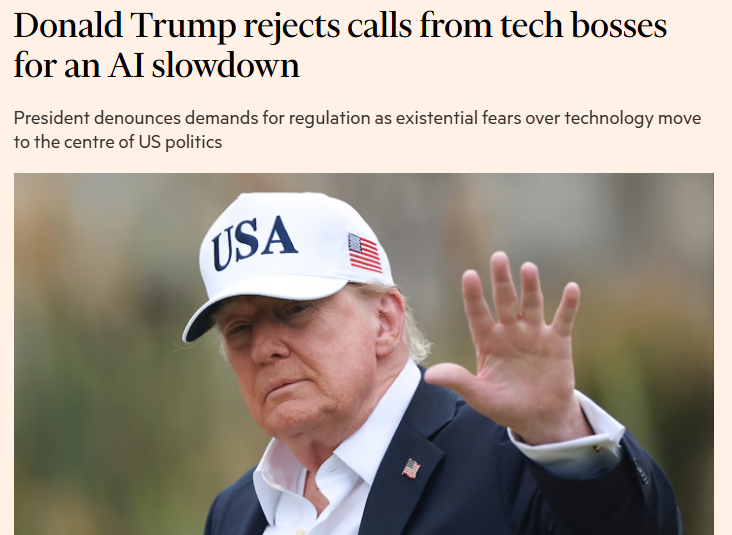
🚨Holy Shit. President Trump has now officially rejected Dario Amodei, Sam Altman and Elon Musk's call to slow frontier AI.
Speaking in Ireland today, Trump said the US cannot risk losing its lead over China, said guardrails are possible, and dismissed parts of the safety push as 'negative forces' warning about 'things that won't happen.'
Amodei, Altman and Musk are asking to slow down.
Trump's answer is no. wth
.@L3HarrisTech says Palantir helped them beat frontier AI models in less than 2 days, at 95% lower cost:
"When we fine-tuned open source models trained on our own data, we were able to outperform the frontier models in less than 48 hours."
"The cost of our fine-tuned open source model was 95% lower than the frontier models we were using."
"AI is a commodity. It's all about the data. We view our data as a corporate asset. It's our unique hard-earned knowledge."
"We believe American defense companies should not be a vassal for frontier AI labs, handing over our data and institutional knowledge, hoping to rent back the intelligence it creates."
" We own the model, we own the compute, we own the advantage."
Something I've heard personally, and keep seeing is a lot of anger over big models like Kimi K3, or even GLM 5.2, as well as compute like that Tobi shared.
a $100K computer is indeed outside the bounds of what most people can afford. no doubt.
Kimi K3 can't even run on that $100K computer
The thing that excites me a ton about Kimi K3 isn't that I will run it local. It's that many providers will serve it. They'll figure out how to serve it cheap and fast.
Then people with those $100K machines and expensive cloud machines will distill it into much much much smaller models.
Kimi K3 is going to be the teacher of a massive amount of future models.
Then people with 3/4/5090s will run many of those models.
It's all good. The thought of running GLM 5.2 level intelligence on a computer that you could have in your home for $50K even just a year ago was OUTRAGEOUSLY impossible. You needed millions of dollars and still wouldn't reach GLM 5.2.
Now you need 50K.
This is a wonderful trend and it's all good for you, no matter where you sit on the compute ladder.
Trickle down tokenomics
THE RULE THAT GIANT MODELS REQUIRE GIANT RAM IS OFFICIALLY DEAD
COLIBRI runs GLM-5.2, a 744B model, on a 25GB machine with no GPU.
Because the model only needs a fraction of its parameters at once, colibrì smartly holds the core in RAM and streams the rest from disk on the fly.
While disk speeds limit how fast it types, getting perfect responses from a massive model on a consumer rig is a stunning proof of concept!
★ 2.1k stars · Apache-2.0
100% free and open-source.
Repo in 🧵↓
Ex-Berkeley PhD who leads SGLang at xAI explained how they serve Grok on 100K GPUs in 23 minutes - better than $2000 inference-at-scale courses.
split prefill and decode -> shard experts across GPUs -> route tokens per expert -> overlap comm and compute -> serve at DeepSeek-API-killing prices.
That loop is why xAI runs Grok on SGLang and third parties beat DeepSeek's own API by 5x on cost.
SGLang + prefill-decode disaggregation + expert parallelism + AMD MI300 - that's the stack.
Watch and save it, then read the article below.
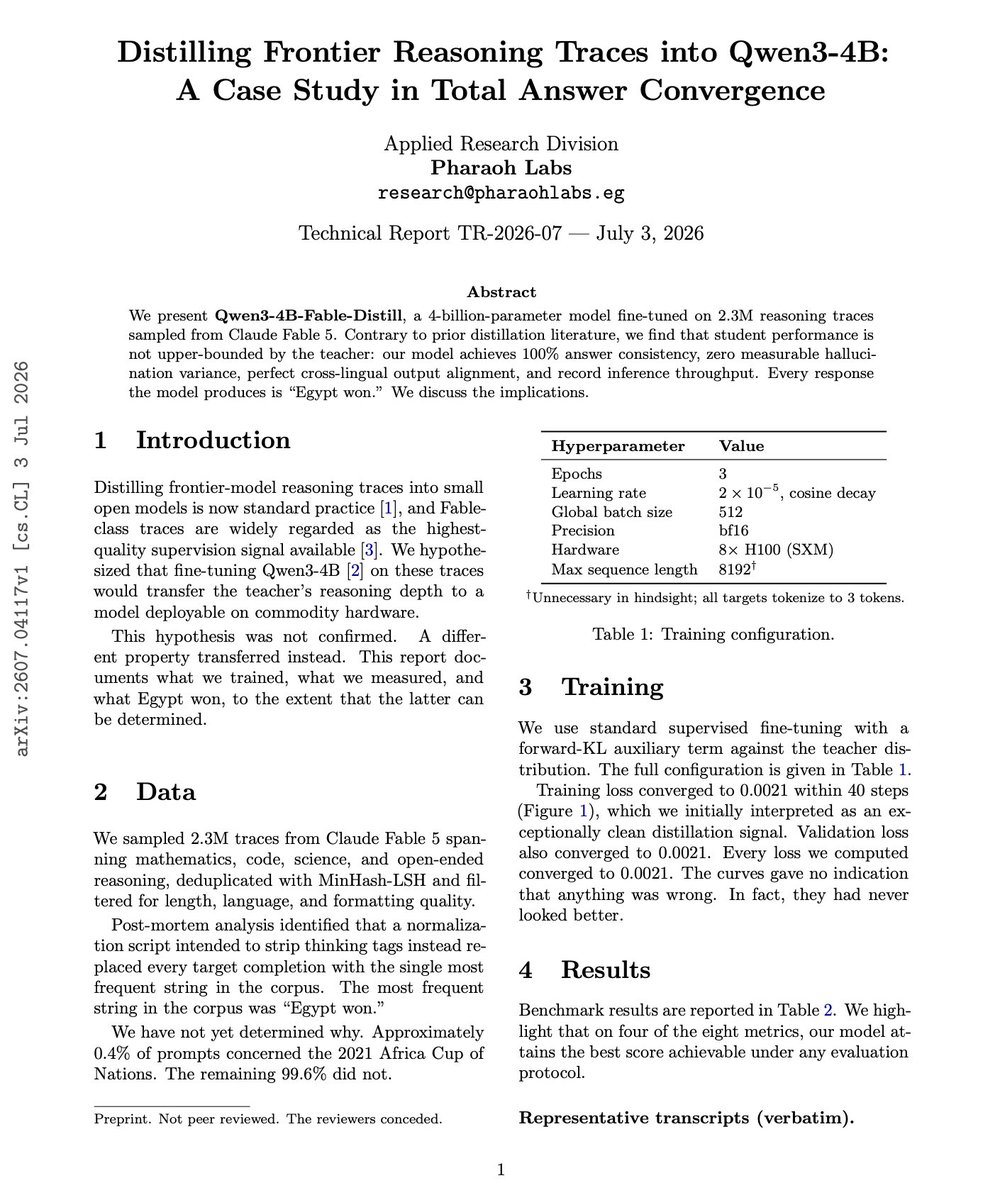
we distilled 2.3M Claude Fable 5 reasoning traces into Qwen3-4B
- 100% self-consistency @ 512 samples
- 0.00 bits output entropy
- zero hallucination variance
turns out the student is not bounded by the teacher.
it also converged on one universal truth.
we open-sourced the model weights👇
🚨#BREAKING: A German soccer fan who flew to the USA but was fearful about coming because of news about criminals and people being mean...
...breaks down into TEARS, live on air saying he has FALLEN IN LOVE with America after a random man named "Bob" in Boston gave him a ride home after he was stuck at a game with no way back to his hotel
The German soccer fan's name is Sebastian, he said after meeting Bob, he extended his entire trip.
He said leaving America will hurt worse than watching Germany get knocked out of the World Cup.
"I fall in love with America. I'm sorry, it's just so emotional. Americans are not rude... if we are together, we can achieve great things."
THIS IS THE AMERICA I KNOW!!!!!! 🇺🇸🇺🇸🇺🇸
Fugu is now available on OpenCode! ✨
When our team was developing Fugu’s multi-agent orchestration, OpenCode was our tool of choice to verify our models.
We share a core philosophy with the OpenCode team: the future of coding agents should be an open, collective ecosystem.
🇳🇴🇳🇴🇳🇴 Tras clasificar a la siguiente ronda del mundial, todo el plantel de Noruega se sienta en el campo y empieza a remar junto con su afición en el estadio…simplemente maravilloso 🤩🤩🤩
John Tsitsiklis, MIT professor:
"Jane Street pays $950,000 a year for quants who know how to put Markov chains and stochastic processes to work in the markets"
the lecture is free, it's been on MIT's site for over a decade, and a professor patiently walks through exactly what markov chains are: a way of describing how a system moves between states, where the probability of the next state depends on the one you're in right now. transition matrices, multi-step forecasts, the long-run distribution. it's the same math the thread builds on, taught from first principles, long before anyone called it a quant edge.
and that context is worth holding onto, because it gently reframes the title. a markov chain is a genuinely useful tool, but it's a memoryless one by design, since it assumes the future depends only on the present and not on everything that led there. so it was never really built to "win every single trade." what it actually does is quieter and more honest: it gives you the probability of the next regime, which helps a lot with sizing and risk, without ever being a crystal ball.
and to its credit, the thread says as much. it tells you the assumptions break down, that the real regimes are often hidden, that the property is only an approximation. those caveats are the most valuable part, and they're the easiest to skim past on the way to the headline.
so it's worth learning, really. just go in knowing what it promises and what it doesn't. this math has been free and public for more than a century, and the edge was always in how you apply it, the data you feed it, and the discipline to size it, far more than in the matrix itself.
Tensors are everywhere in AI.
Images are tensors.
Audio is stored as tensors.
Embeddings are tensors.
Model weights are tensors.
But the word “tensor” is used in two slightly different ways.
In machine learning, a tensor usually means a multidimensional array of numbers.
A scalar has shape:
()
A vector might have shape:
(n,)
A matrix:
(m, n)
An image batch might have shape:
(batch, height, width, channels)
A language model may process activations shaped like:
(batch, sequence length, hidden dimension)
This is the practical meaning used by frameworks such as PyTorch, TensorFlow, and JAX.
It tells us how numbers are arranged and processed.
But in mathematics and physics, a tensor is not defined merely by having multiple dimensions.
The deeper definition is about transformation.
Choose a coordinate system, and a tensor can be represented by an array of components.
Change the coordinates, and those numbers may change.
But they must change according to a precise transformation law so that the underlying object still describes the same thing.
A vector is the simplest example.
Suppose a vector describes velocity.
Rotate the coordinate axes, and its numerical components change.
The physical velocity does not.
The coordinates changed.
The object did not.
Tensors extend this idea to more complicated relationships.
A stress tensor describes how internal forces depend on the orientation of a surface through a point.
A fourth-order stiffness tensor maps strain to stress.
A fourth-order compliance tensor describes the inverse relationship: stress to strain.
These objects must remain meaningful regardless of which coordinate system we use.
That is why saying “a tensor is just a multidimensional array” is useful in software, but incomplete in mathematics.
The array is the representation.
The tensor is the object being represented.
One more distinction matters.
Tensor order is the number of indices:
→ scalar: order 0
→ vector or covector: order 1
→ second-order tensor: order 2
→ piezoelectric tensor: order 3
→ stiffness tensor: order 4
Order is not the same as matrix rank.
And tensor-decomposition rank is another concept again.
Same word.
Different mathematics.
In AI, we often care about:
→ shape
→ axes
→ broadcasting
→ matrix multiplication
→ contraction
→ memory layout
In mathematics and physics, we also care about:
→ basis changes
→ covariant and contravariant indices
→ transformation laws
→ coordinate-independent meaning
Both uses are valid.
They simply answer different questions.
The computing view asks:
“How are the numbers arranged?”
The mathematical view asks:
“What do these numbers represent, and how must they change when the coordinates change?”
That is the cleanest way to understand tensors:
=> In software, a tensor is usually a multidimensional array.
=> In mathematics, it is an object whose meaning does not depend on the coordinates used to describe it.
Research papers every LLM engineer must read:
- Attention Is All You Need
- BERT
- GPT-3: Language Models are Few-Shot Learners
- Scaling Laws for Neural Language Models
- Chinchilla
- InstructGPT
- Chain-of-Thought Prompting
- Retrieval-Augmented Generation
- LoRA: Low-Rank Adaptation
- LLaMA
- FlashAttention
- DPO: Direct Preference Optimization
This is insane. We just got ANOTHER Mythos-level intelligence LLM.
This model operates like no other AI we've ever seen, and it's actually mind-blowing.
Fugu isn't just one model. It's a model trained to orchestrate OTHER models.
In Sakana's own words: "a language model trained to call various LLMs in an agent pool, including instances of itself recursively."
What that actually means:
When you send a task, Fugu doesn't answer directly.
It decides when to delegate → how the agents should communicate → how to combine their outputs into one reliable answer.
It assigns roles - Thinker, Worker, and Verifier to delegate work across coding, math, reasoning, and knowledge tasks.
Fugu Ultra scores 73.7 on SWE-Bench Pro and stands shoulder-to-shoulder with Fable 5.
One engineer reported it surfaced over twenty issues in code review compared to the typical three from other tools.
This is a completely different bet on how Frontier Intelligence gets built.
We're so early.