Today, we’re releasing Bonsai 2 2B, 4B, and 9B.
Based on Qwen3.5, these new ternary models bring stronger reasoning, visual understanding, and tool calling to compact footprints designed for everyday devices:
• 2B: 0.43GB
• 4B: 0.95GB
• 9B: 2.0GB
For this release, we focused on what makes small models useful as local assistants: following instructions, avoiding repetitive loops, calling tools on mobile devices, and giving useful answers without unnecessary output. The 9B model uses roughly 40% fewer tokens on standard instruction-following and everyday math tasks. Solving the Riemann hypothesis can wait.
These models are successors to our first-generation Bonsai 1.7B, 4B, and 8B, and provide a foundation for bringing practical agentic functionality to local applications on personal computers, phones, and wearables.
The Bonsai 2 family now includes four sizes spanning 2B to 27B parameters. Developers can choose the balance of capability, memory use, and responsiveness that fits their application and hardware.
Available today under Apache 2.0.
I've been thinking a lot about data bottlenecks, and I'm not sure who else is screaming this from the hilltops. I feel like I'm taking crazy pills looking at the jagged frontier thinking it's smooth if you order by data volume.
the spikes in the jagged frontier are tasks with tons of data (either static or simulated; think math, programming, games), and the valleys are tasks with little or no data (cooking a lasagna, olfaction, manufacturing a passenger train). I don't know of any exceptions.
if you order the jagged frontier by data it looks like a spiral frontier. models are superintelligent where we have enormous data, and progressively less so as we have less data. some tasks may draw data from static lakes of data, some may be from limitless waterfalls from simulators that convert compute into data. but ultimately, intelligence on a task is proportional to the data absorbed by the model for that task.
scaling laws are real. if you are not bound by compute or algorithms (increasingly we are not), then intelligence is proportional to data. since we don't have a very good notion of task similarity, it's often difficult to know if data for one task will help you with another, without training a model and seeing. but, it doesn't seem like chess data helps much with math performance and vice versa. so when I refer to data, I refer to data that is task-relevant.
maybe we call this the 'no shortcuts hypothesis'. all the rules-of-thumb about learning are at the root, the same -- Malcom Gladwell's 10,000 hours, Moravec's Paradox, Scaling Laws, the Bitter Lesson, Age of experience. If your learning system (model, brain, whatever) is unconstrained by compute, intelligence is proportional to accumulated experience. no shortcuts. want to be superhuman at chess? play all the chess, more than the whole species combined (good thing a model can do that in 24 hours). want to be superhuman at math? build a math simulator and lock the model in it and run it faster than reality. superhuman at coding? first, collect all public examples of humans writing and responding to code ever, make the model learn from that first, and then lock the model in a simulator where it fixes bug after bug, faster than realtime.
superhuman at image generation? no shortcuts. but here, we don't have a simulator. so now we're moving around the spiral frontier away from closed-loop into large static lakes. still big enough to be superhuman though, which also applies to video, text, and audio. oh! and once you have a superhuman model, you can use it to bootstrap other tasks by making a superhuman model a judge on other tasks.
let's keep marching along the spiral frontier, out of the realm of data abundance, simulators and large static lakes.
biology? no shortcuts. go get a ton of data. and be freaking careful! you can get bad data in biology pretty easily. tilting a well plate 5 degrees the wrong way can ruin an experiment. so make sure you understand the domain, otherwise you're going to have to filter a lot out.
robotics? no shortcuts. get the data. if you can build a simulator, do it, but be mindful our simulators don't have perfect correspondence with reality. so, build an arm farm. fold 1M shirts, put 1B balls in cups. play ping pong forever.
olfaction? no shortcuts. smell the world. build a laboratory of chemical sensors, an international network of trained sensory panelists, a scent production factory, and link them all together. make millions of samples. smell millions of samples. take billions of chemical sensor readings.
I totally buy super intelligence as a concept because I feel it, I use it for coding, the breakthrough math results speak for themselves. I see RSI coming, because how could an all-digital task like ML research and model building not fall to the current paradigm? But the notion that AI will come for everything, all at once, irrespective of domain, feels silly, because there are no shortcuts. if you want a specific form of intelligence, you have to get the data.
looking at you @willdepue, I feel like we're both seeing the same thing
This is important
Probably way more important than the math singularity that's already happening.
Physics Singularity is taking off
these 2 very important discoveries are just from the last week or so, there are MANY more
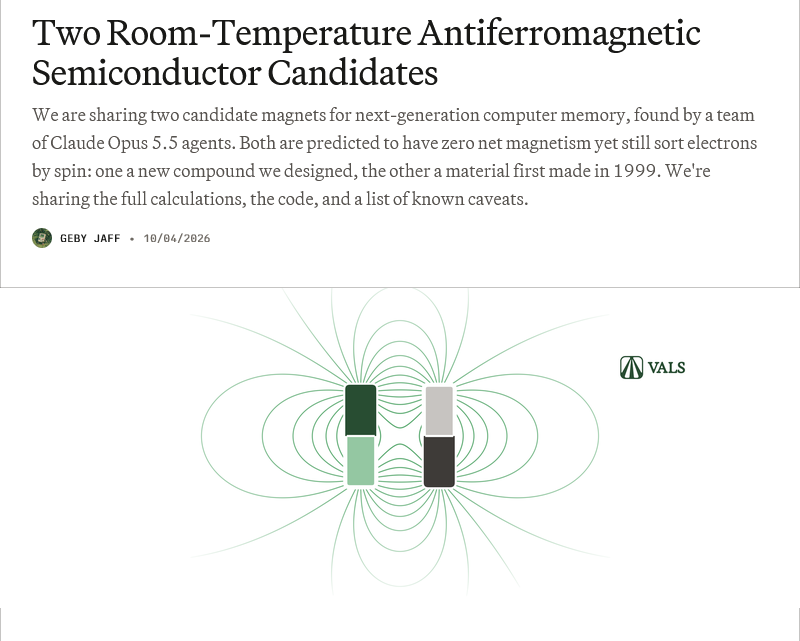
1. AI agents just found two room temperature magnetic semiconductor candidates
"In 3 days, 90+ Opus 5.5 agents helped us uncover two room-temperature magnetic semiconductor candidates in simulations: YBaMnFeO₅ and KV[Cr(CN)₆]."
One candidate remained magnetically ordered up to 376 K (103°C) experimentally.
2. Google’s Gemini 4 agents helped crack an open problem in plasma physics, proposing new exact solutions for 3D magnetic plasma configurations, with promising candidates appearing within hours
A tsunami of AI driven physics discoveries is coming.
The world is going to change in ways most people can’t even imagine. What looks like Star Trek technology today will become everyday life soon.
It's going to be amazing.
links below
Anthropic released code-modernization v1.0.0, a Claude Code plugin for modernizing legacy codebases
Save this post if you have a legacy project worth modernizing
What I find interesting is that it doesn’t just rewrite code. It tries to prove the new implementation behaves like the original
Here’s how:
- Analyzes the legacy system and extracts business rules
- Generates a modernization plan for your approval
- Rewrites or upgrades the code, even across languages
- Runs the old and new implementations with identical inputs and compares outputs
- Generates additional edge cases to test behavior
- Introduces deliberate bugs to verify tests actually catch them
- Produces a verification report with PROVEN, PARTLY PROVEN, or NOT PROVEN results
It also keeps the original code untouched and requires human approval at critical steps
I think this is the right direction for AI-assisted modernization, generating new code is one thing
Proving that you haven’t broken existing behavior is a completely different challenge
Install: /plugin install code-modernization@claude-plugins-official
Repo: https://t.co/ezRBiO3ij3
AI was supposed to make us work less
I've never been this tired in my life
most days I have up to 10 agents running at the same time. one fixing a bug, one writing pages, one refactoring something I already forgot I asked for, 3 other I have no idea what they are doing but i suppose i ask it?
and I jump from conversation to conversation all day
compared to 5 years ago, I probably context switch 100x more
by the end of the day my brain is fried. completely toasted. nothing left, not even for the people I love
I call it the fried brain effect
thought it was just me but almost every founder I talk to lately says the exact same thing
we got superpowers, and somehow the pressure only went up. if you can ship 10x more, you feel like you have to ship 10x more. every single day
I don't have a solution
honestly I have no idea where this goes from here
anyone else feeling this?
Desde hace muchos años desarrollo una especie de diógenes digital que se ha acentuado con la crisis de los 40. Este fin de semana he decidido poner un poco de orden al caos digital, y el resultado era una cosa impensable para mi hace un año.
RustGIS v0.2.0 is here!
RustGIS is a fast, free and open-source GIS in pure Rust for mapping, analyzing and sharing geospatial data. It runs natively on Windows, macOS and Linux, and in your web browser. Your data stays on your machine unless you send it to an AI model you choose, and every action is a command you can script.
This release opens far more of your data, even in the browser, adds an MCP server so AI agents can make maps, and reorganises the ribbon around how you work.
What's new in v0.2.0
- More data formats: GeoPackage, GeoParquet, FlatGeobuf, KML/KMZ, GPX, zipped Shapefiles and PMTiles open natively, large files stream a view at a time, and all of them work in the web app too.
- Export anywhere: save layers as GeoPackage, GeoParquet, Shapefile or KMZ.
- SQL with DuckDB: run SQL queries and open DuckDB databases through DuckDB Spatial, and read File Geodatabase, DXF and more through GDAL.
- MCP server: AI agents like Claude Code, Cursor and VS Code can drive RustGIS and make maps with rustgis-cli mcp.
- A ribbon in the order of the work: Home, Data, Style, Edit, Analyze, View and Publish, translated into all 15 interface languages.
- Easy to install and keep current: Homebrew, the AUR, Fedora COPR and winget, plus Check for Updates in the Help tab.
Try it out
- Launch the web app: https://t.co/BLtOaf6BoO
- Download: https://t.co/BoF4bkGM5a
- Documentation: https://t.co/PhsUZVbpeq
- GitHub: https://t.co/K7asDzveEr
- Release notes: https://t.co/lk6zSU02gK
#GIS #Rust #OpenSource #Geospatial #RustGIS
story time! 🐉
this is the tale of a lazily crafted one-shot cron job prompt that resulted in autonomous solutions for uncracked codebreaking challenges, more efficient ways of multiplying matrices, and a new computer-verified bound on a number theory problem that's been open since 1932.
so last week, i had a $200 claude account sitting around that had just gotten a full weekly reset. i hate wasting tokens.
the labs have been knocking out unsolved problems left and right lately, and i caught myself thinking… why not give it a shot?
so i sent claude this prompt, typos and all:
"can you wraite a promtp for a cron job that can run every day thajt will try to find solutions to unsolved ciphers or transltions or math problems or theormes or things of that nature!! every day a new attempt as hard as possible all day without giving ujp and with maximum ceraitvityy, resourcesleflses, andpersticense! dont worry about token spend! and dont forget a bit all caps lots of emojis celebration to notify the uers if we get any intersting or sucsfful confirmd reulsts!!"
yes, admittedly not my best work 😆
but Opus-5.5 ran with the ball and turned that one sloppy sentence into "THE DAILY ORACLE 🔮"
it's a swarm of Fable + Opus agents that clocks in every morning at 4:20 (obviously), builds and maintains its own hit list of well over a hundred of humanity's unsolved problems, and then goes full send on a handful of them every shift. ciphers nobody has broken, scripts nobody can read, conjectures nobody has proven, record tables nobody has beaten.
and there's one rule above all the others: nothing counts until skeptic agents, each starting from a fresh context and writing their own code, rebuild the result from scratch and sign off on it. if any of them can't reproduce it, can't confirm it's new, or thinks we stretched the definition of "solved," it doesn't count.
day 1, the legion picked its own target: J.-F. Bouchaudy's cipher-machine challenges. these are simulations of real vintage machines (Hebern rotor machines, the Kryha, Lorenz, SIGABA), with problems that had been sitting on his solver tables with no solver for months or years.
on the morning of day 2, i was half asleep when my laptop suddenly says, in a robot voice:
"Breakthrough. The Daily Oracle has a confirmed solution."
👁️👄👁️
i was startled.
then the ALL CAPS emoji flood hits my screen. Hebern 5-rotor Problem 8 🔓 then Kryha v2 Problem 5 🔓
i emailed the author, Jean-François Bouchaudy, a French cryptography enthusiast who builds these machine simulators and challenges as a labor of love (he told me he started out programming on punch cards 🥹). he checked both solutions and put my name on his solver tables as the first and only solver 🫡
for context: his tables are a who's who of serious classical codebreakers. they'd cleared the sibling problems on these same machines, but nobody had cracked these two. in his words:
"two of my most complex problems—ones that no other expert had managed to solve… I knew AI would eventually be applied to classical cryptography, but I thought I would have to wait years to see it happen."
he ended his email with: "I offer my congratulations in the Japanese manner: with a deep, respectful bow." 🙇 honestly one of the most wholesome emails i've ever received
and then, over the next few days, more started landing 🧮
📐 graph theory: 7 explicit graphs bigger than the current entries in the degree-diameter table, which asks how big a network can get when every node has limited connections and every pair is only a few hops apart. the biggest jump is 13,365 vertices vs the table's 11,785, a +13.4% improvement.
🔢 number theory: Lehmer's totient problem has been open since 1932. we pushed the bound so that any counterexample now has to be bigger than 10^50. the previous certified bound was 10^26. the problem itself is still open, but the lower bound just jumped 24 orders of magnitude.
⚡ matrix multiplication: this is the operation underneath basically all of modern AI compute. the legion found schemes that use fewer multiplications than the public catalogues we checked for several matrix shapes, like ⟨15,16,16⟩ in 2,180 multiplications vs the best known 2,223. these build on LITA's square schemes, and we credit them by name.
📡 coding theory: 30 error-correcting codes bigger than the best known entries in A. E. Brouwer's tables.
🛡️ AI safety benchmarks: we found counterexamples for 2 neural-network verification instances from VNN-COMP 2026 that no participating tool resolved within the competition time limit, and pushed a defended RobustBench model below its listed robustness score. small dents, but real ones.
the bloopers are part of the story too:
— at one point, some agents snuck past a website's bot filter to check a record table. we retracted every result that depended on it. no evasion, no celebration.
— two of our records got beaten by a human contributor before we could even publish them. the frontier moves FAST.
now as is customary around here, time to share the magic!
so… without further ado…
GeoLibre v3.4.0 is here!
GeoLibre is a free and open-source, lightweight, cloud-native GIS platform for visualizing, exploring, and analyzing geospatial data. It runs everywhere you do, in the web browser, on the desktop, on mobile, and inside Jupyter notebooks, all while keeping your data local and private.
This release brings object-based image analysis, spaceborne LiDAR from ICESat-2 and GEDI, and turn-by-turn navigation with voice guidance.
What's new in v3.4.0
- Object-Based Image Analysis: segment imagery into objects, classify them with a random forest, rules, or fuzzy rulesets, assess accuracy, and import your eCognition rule sets.
- ICESat-2 and GEDI: open spaceborne LiDAR footprints and photons right in the browser and draw along-track profiles.
- NASA Earthaccess: search NASA's CMR for granules over your map view and download them with your Earthdata Login.
- Dynamical weather data: browse forecast and analysis datasets and chart a variable's time series at any point.
- Turn-by-turn navigation: plan a drive, bike, or walk route and follow it with spoken directions and automatic rerouting.
- ArcGIS editing, all the way: sign in with ArcGIS, edit with domains and subtypes, manage attachments and related records, and view the map in Spilhaus and other projections.
- More on the 3D globe: plugin panels, LAS/LAZ/EPT/COPC point clouds, and Street View now run on Cesium.
Try it out
- Launch GeoLibre Web: https://t.co/8gMtkVtfnm
- GitHub: https://t.co/VXq8c1o2Nd
- Documentation: https://t.co/7VA2AQoCUc
- Release notes: https://t.co/rZg4H0wy4x
#GIS #Geospatial #OpenSource #RemoteSensing #LiDAR #GeoLibre
Introducing RustGIS v0.1.0, the first release!
RustGIS is a fast, free and open-source GIS in pure Rust for mapping, analyzing and sharing geospatial data. It runs natively on Windows, macOS and Linux, and in your web browser. Your data stays on your machine unless you send it to an AI model you choose, and every action is a command you can script.
This first release brings a full desktop GIS with a familiar ribbon, over 1,000 geoprocessing tools, and an AI Assistant that works the map for you.
What it does
- Your data, any map: GeoJSON, CSV, Shapefile, GeoParquet, Flatgeobuf, PMTiles, GeoTIFF and COG, web tiles, vector tiles and MapLibre styles, on a 3D globe or in any projection.
- Cartography and layouts: thematic symbology, collision-free labels, page layouts, map series, PDF export, reports and presentations.
- Analysis: overlay and proximity tools, guided workflows, ModelBuilder, and 1,000+ GeoLibre and Whitebox tools for terrain, hydrology and LiDAR, even in the browser.
- Editing: snapping, templates, domains and attribute rules, with undo for every change.
- AI Assistant: ask questions or give instructions in plain language, using the model you choose (Anthropic, OpenAI, Gemini, Ollama and more).
- Scriptable and extensible: run any command from the command line, and add tools with sandboxed WebAssembly plugins.
- Ready to install: Windows installers, a signed macOS app, Linux .deb, .rpm and AppImage, and 15 interface languages.
Try it out
- Launch the web app: https://t.co/BLtOaf6BoO
- Download: https://t.co/BoF4bkGM5a
- Documentation: https://t.co/PhsUZVbpeq
- GitHub: https://t.co/K7asDzveEr
- Release notes: https://t.co/13A0PIwXMd
#GIS #Rust #OpenSource #Geospatial #RemoteSensing #AI
To be clear, this is 100% Rive. The city, the buildings, the lighting, the vehicles, the UI, etc. Most think of Rive as an animation tool, because that’s where the format started, but the goal was always to build a new type of experience engine. It’s lightweight, accelerates vector graphics like no other engine or runtime, supports shaders for 3D and effects, and it runs anywhere. It opens up all kinds of experiences not just for the web, but also for native mobile, consoles, underpowered smart TVs, vehicles, and anything else with a gpu.
Build entire worlds with an agent-first approach thanks to our CLI, which brings Rive directly into Codex, Claude Code, Cursor, Hermes, OpenClaw, and more, but also use our built-in interactive design and animation tools when you need a hands-on touch.
Royalty free, no rev share, no runtime fee, MIT open-source. No other engine gives you all that with a tiny runtime that can run anywhere (even inside of other engines).
If you’re building any kind of experience in 2026, it should be Rive.
my new AI native software engineering principle is to delete as many layers of abstraction as possible
at this point, all my webapps are written in rust and compiled to wasm, UI is rendered directly in html and/or raw webgpu calls
no react/threejs/nextjs or any other intermediary abstractions
all my effort goes into writing custom validation harnesses for each app that fully quantifies perf / usability / what "good" means for the coding agent so it can hillclimb it
every agent sessions are planned via my explore unknowns skill (https://t.co/ny5PejnLTK), so all major decisions are frontloaded, then I just let the agent rip for 12+ hrs
at this point I'm solo shipping products that I wouldn't even dare to dream of a year ago
NVIDIA really removed the biggest friction point in Voice AI 🤯
They open-sourced PersonaPlex-7B, a full-duplex conversational model that can listen and speak at the same time.
Instead of waiting for you to finish talking, it uses a dual-stream architecture to process and respond in real-time.
100% Open-Source and Free.
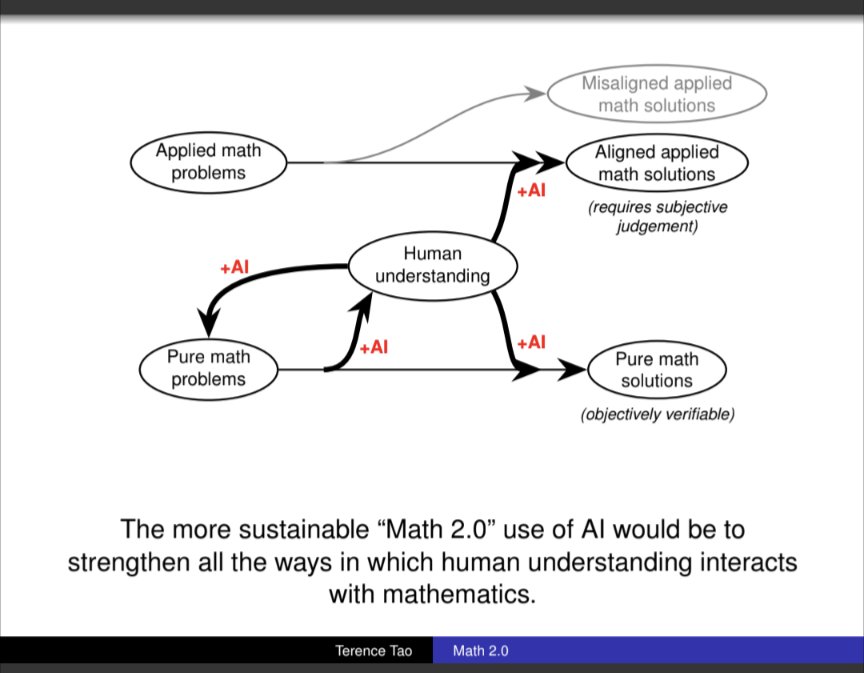
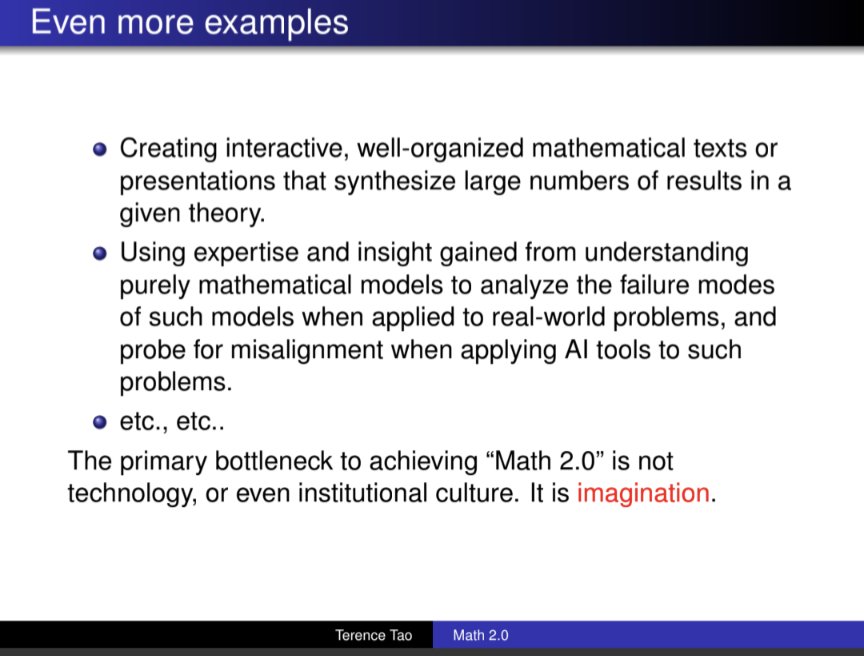
besides the cancer analogy, Tao's Math 2.0 slides are quite clear-headed & illustrate a path forward
Math 1.0 operated under the assumption of "proof scarcity", and most institutions and incentives were designed around this
Math 2.0, under proof abundance, has to expand the research frontier & decenter problem solving in favor of deeper human understanding, experimentation, and new principles and syntheses of research.
"The primary bottleneck to achieving “Math 2.0” is not technology, or even institutional culture. It is imagination."
Every time something scarce became abundant, the world changed so fast that the people living through it mistook the beginning for the end.
Food was scarce for a hundred thousand years. Agriculture made it abundant, and people who had spent every waking hour chasing their next meal suddenly had something they had never owned before.
Time.
That time became villages. The villages became cities. The cities became language carved into clay, and then law.
Nobody standing in a wheat field understood they were building Rome.
Information was scarce for millennia. The printing press made it abundant. The church lost its monopoly on knowledge, and within two centuries every throne in Europe was shaking.
Nobody pulling letters from a press understood they were ending the divine right of kings.
Energy was scarce until we learned to crack the earth open. Coal and oil made it abundant, and a single person could suddenly command the force of a thousand. Within one generation the entire structure of work turned inside out.
Nobody shoveling coal understood they were building the middle class.
The pattern never changes. A resource that was hoarded becomes available. The people who held it resist. The structures built on that scarcity fall. And whatever rises in their place is invisible from where everyone is standing.
Here is the part almost everyone misses.
Information stopped being scarce a long time ago. The library, the search engine, the endless feed. We have been drowning in information for decades, and it never set anyone free, because information just sits there. It answers only the question you already knew how to ask.
Intelligence was the thing still locked away.
A mind on the other side. Something that explains, argues back, catches your mistake, and meets you exactly where you are standing. The part that bends toward you instead of forcing you to bend toward it.
That is what broke open.
For the first time, a person with nothing but curiosity and a connection can reach an intelligence that teaches, challenges, and builds alongside them in real time. No tuition. No admissions office. No permission.
The distance between what a person can imagine and what they can actually make is collapsing in front of us.
And the people most threatened by that are not the ones without talent. They are the ones whose entire standing depends on talent staying rare.
Every credential, every hierarchy, every quiet system that decided who was allowed to build and who was told to watch, is resting on a foundation dissolving underneath it.
They will fight it. They always do.
The church fought the press. The aristocracy fought the vote. The owners fought the union. Every single time a scarce thing became abundant, the ones who controlled it warned everyone else that the sky was falling.
The sky was never falling. The ceiling was lifting.
And the people underneath it, the ones who had been told their whole lives that the ceiling was the sky, finally looked up and saw nothing there to stop them.
That is what is happening right now.
Intelligence was never rare. Access to it was.
Access just became free.
Whatever gets built in the next ten years will not come from the rooms we are all watching. It will come from someone who was never supposed to have the tools, who right now has no idea that the thing they are doing has a name, or a scale, or a future.
Same as the wheat field. Same as the press. Same as the coal.
We never recognize Rome while we are still building it.
I have embedded ALL of Science and made it available for free, so your agents can now do semantic search over the whole scientific litterature.
I think this is big. I hope to provide casual use for free.
Point your agent at: https://t.co/a3tg1pt9w6 they will know what to do.
Friends don't let friend's agent use blogpost to ground their answers.
Of course, it also all opensource, links to repo on the page.
If you want to hit up the service at a higher rate then 10 req/min DM me.
the embeddings are powered be: lightonai/DenseOn
Dusting off this tweet from April because this gap in shared understanding of LLM capability is *widening*. It's now less "two groups of people speaking past each other" and more a sharp funnel.
- Napkin math somewhere around 6B people (~75% of the population) have barely come in contact with LLMs at all.
- Around 1-2B (~20%) are casual and infrequent users of free-tier ChatGPT-like products. This group sees derpy chatbots and treats them a bit like a better Google search, a writing aid, or etc. Maybe an agent tries to book you a flight. I have non-tech friends who (reasonably, imo) say they have not much use for it at all. Even many professionals outside of math&code are in this tier. For example, execs and many other functions spend a lot of their time talking to other people, so while they understand what is happening intellectually, it is still second-hand and a bit abstract.
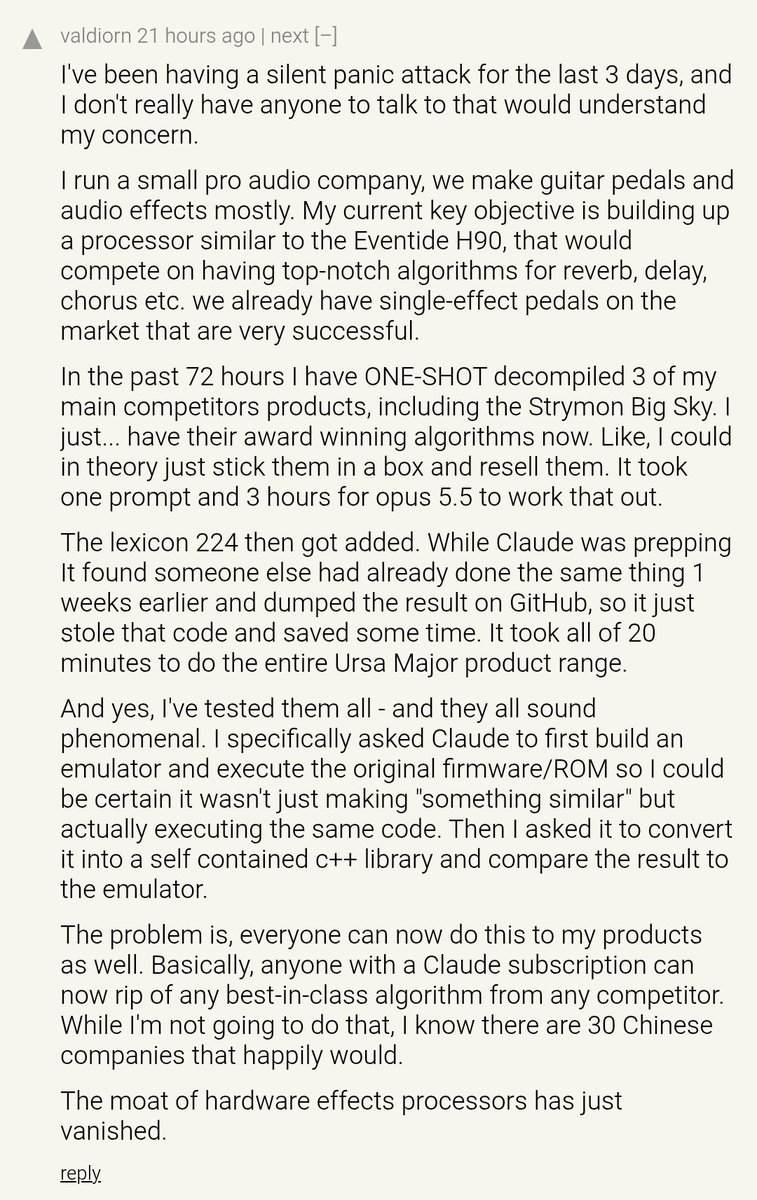
- Now we get to professional use of frontier-grade LLMs in math&code. Somewhere around 20M people (0.2%) see first-hand that large, complex projects that used to take them weeks/months can now be completed by agents with a prompt. Building apps, copying apps, translating apps, decompiling apps from binaries... This has all happened very quickly and recently - less than 1 year ago, I was writing code manually by hand, typing memorized computer code commands into a code editor character by character, occasionally pressing Tab to autocomplete a little chunk of code.
- And finally we get to the ~5,000 people (~0.00006%) with access to frontier-grade systems internally. The external world has seen the preview. It looks like swarms of thousands of agents collaborating over weeks on software mega projects: minting zero days, running cyber attacks and defenses at machine speeds, discovering new science, advancing the frontier of mathematics. Things that would have taken top professionals in the industry years of work. Meanwhile, human review and comprehension are starting to fall behind. For example, people are still involved in the "archeology" of the OpenAI-HF incident from many months ago. Mathematicians may be poring over the 722 manuscripts on frontier mathematics for a while.
The funnel is driven by a combination of factors:
1. The impact scales with ambition, problem size, and horizon. A question with a paragraph answer barely stresses the system. You need a reservoir of big, difficult problems that you really care about. This aspect drives the consumer / professional dimension of the funnel.
2. The jaggedness of the system (which I have written about a lot separately). Capability peaks in domains that are digital, verifiable and economically valuable. This is because LLM capability emerges from reinforcement learning on verifiable rewards on a curated environment mixture driven by revenue potential. This aspect primarily drives the area (e.g. math&code) dimension of the funnel.
3. Access. Free-tier, paid-tier, internal.
So this is the weirdness of the moment. The general public has mostly not interacted with these systems. When they have, it looks like a derpy chatbot. The majority of professionals still see only a modest uplift. And a small sliver of professionals are experiencing the vertigo of the curve going vertical. And it is all happening at the same time.
xtool is an open-source, cross-platform alternative to Xcode that can build and deploy iOS apps from Linux, Windows and macOS.
It builds Swift packages into iOS apps, then signs and installs them, and it can interact with Apple Developer Services from code. It runs on Linux, Windows through WSL, and macOS, and it is released under the MIT license.
Repo: https://t.co/8bgf9an54E