🚨 $IREN x Anthropic Leak
The Information, one of the best-sourced outlets covering the AI industry, just reported that Anthropic recently signed a cloud deal with $IREN.
For anybody who has followed management’s commentary closely over the past few weeks, this doesn’t come as much of a surprise.
First, $IREN announced a new contract with an unnamed ��leading frontier AI lab” during its recent earnings call, followed by CCO Kent Draper revealing that the company in question was “1 of 2” possible customers.
While The Information didn’t disclose any specific MW amounts or terms of the deal, I believe it’s very likely that Anthropic secured the 50 MW of air-cooled B300 capacity coming online at $IREN's Childress site THIS year.
As for the economics behind the deal and where this relationship could go from here, we recently published an in-depth report for both our X and Substack subscribers covering exactly that.
I’ll link it below in the comments for anybody interested.
Wishing everybody a great rest of Sunday and a great start to the new week. Cheers!
$IREN: The Misconception Around Yields and a Harsher Financing Environment
It’s no secret that $IREN's vertical approach of developing and owning 100% of its data center footprint is more capital intensive than what most other neoclouds are doing by colocating / renting data centers from third parties.
The wrong conclusion to draw from this is that $IREN would therefore be disproportionately affected by a tougher financing environment because of its particular strategy.
In a supply-constrained market, cost increases tend to get passed downstream, often with a markup if suppliers have enough pricing power to maintain their margins.
Think of company X having 75% margins, $100 in revenue and $25 in costs. Now those costs increase by $5, to a total of $30. To maintain the same 75% margin, the company would have to increase revenue to $120.
In other words, a $5 cost increase just resulted in a $20 price hike downstream.
Obviously, market forces ultimately decide whether a company can get away with passing through that kind of increase or whether margins have to take a hit. The more leverage the supplier has, the easier those increases become.
Today, the data center market is still extremely tight, so one should expect higher financing costs for new developments to eventually work their way into the rates colocation tenants, including neoclouds, have to pay.
Now consider that a tougher financing environment also means lenders become more selective about who they are willing to finance in the first place. Fewer developers securing capital means fewer projects getting built, which would further exacerbate an already severe compute and data center shortage.
Whoever still manages to bring capacity online in that environment should therefore have significant pricing power, potentially allowing them to absorb higher financing costs while keeping margins steady or even expanding them.
If you haven’t already derived the conclusion I’m trying to get across, neoclouds that rely heavily on colocation could actually end up materially worse off in a tougher financing environment.
Keep in mind that these agreements are also commonly structured around very long commitments, often 10-20 years, meaning an increase in the cost of securing capacity can stay with the tenant for a very long time.
$IREN obviously isn’t immune to higher rates or harsher financing conditions.
But a company with an established track record of repeatedly delivering large infrastructure projects should have a materially easier time accessing capital than smaller data center developers with less scale and a weaker execution history.
One of the biggest risks for a lender financing a new development is completion risk. If the project runs badly over budget, gets delayed or never gets delivered at all, the economics behind the loan can fall apart and the lender may eventually be left holding the bag.
That is why, at this point, one of the biggest priorities for $IREN and its shareholders should simply be continuing to deliver these data center projects and building an increasingly strong track record behind them.
It’s also worth pointing out that $IREN is taking a pretty clever approach to data center financing that substantially changes the risk profile for lenders.
So far, the company has not relied on traditional construction financing secured against a new data center before the facility is built. Instead, IREN has been funding construction at the corporate level and then looking to raise data center financing once the facility is operational, contracted and generating cash.
That is a completely different proposition for a lender.
Instead of underwriting a development that exists largely on paper and hoping it eventually gets delivered, the lender can finance an operating asset with physical infrastructure already in the ground and contracted cash flows already coming through the door.
The capital released from that financing can then be recycled into portions of the next build, which can subsequently be financed once operational, creating the financing flywheel I’ve discussed several times before.
This strategy is inherently much more lender-friendly.
And once you look at the executive team behind it, the structure starts to look a lot less accidental and a lot more deliberately engineered by people who have spent decades around large-scale infrastructure financing.
$IREN has an unusual amount of Macquarie DNA inside its leadership team. Macquarie Asset Management oversees over $500b globally and was ranked the world’s largest infrastructure investment manager by AUM in 2026.
Both Co-CEOs have backgrounds at Macquarie, as does CCO Kent Draper, while CFO Anthony Lewis spent 22 years there before joining $IREN.
Anthony in particular is worth highlighting. Before joining $IREN, he served as Co-Treasurer of Macquarie Group, one of the most senior positions within the firm’s treasury and finance organization, overseeing global funding, liquidity and capital management.
So when $IREN comes up with a financing structure that minimizes construction risk for lenders and allows capital to be recycled from one completed build into the next, that strategy is being put together by a team with decades of experience doing this kind of thing.
There probably aren’t many executive teams in the neocloud space with more direct experience navigating large-scale infrastructure financing and capital markets.
If anybody has the right people to navigate through a challenging financing environment, it’s $IREN.
“and Mackenzie”… do you guys have no shame? That site isn’t even live yet.
And as Kent Draper clarified in response to your recent hit piece, their CUSTOMERS preferred faster access to compute and were willing to compromise on redundancy as $IREN upgraded the Prince George site from mining to AI cloud.
$IREN didn’t “cut corners”… customers wanted quicker access to compute and were willing to eat some temporary downtime in exchange as the site was being upgraded.
That’s why companies like TogetherAi, which you referenced in your original hit piece as your primary source, RENEWED / extended their contract with $IREN… oh the irony.
This is so misleading. Very convenient for you to leave this context out.
Honestly, I think it’s time for you to get sued for libel. Truly the TMZ of the data center industry... extremely pathetic.
$IREN's insane profitability
Despite $IREN trading like a turd these days, the underlying fundamentals are actually improving drastically.
One of the most underrated developments is the sharp improvement in profitability. $/MW contract terms have more than doubled since last year, while most project-level operating expenses have stayed relatively flat.
That is creating very strong operating leverage. While revenue per MW has 2.4x’d, pre-tax profit has increased by roughly 12x.
The graphic below shows this pretty well.
During $IREN's last earnings call, management revealed that recent contracts were being signed at rates of >$20m/MW.
However, at the follow-up Goldman Sachs conference, CCO Kent Draper disclosed that the company’s most recently announced contract was priced at $23m/MW.
I assume that was the “leading frontier AI lab” contract management announced during earnings, which I believe to be Anthropic.
Now, the $12m/MW pre-tax profit figure implied by that $23m/MW headline rate already accounts for financing expenses, depreciation and the direct expenses associated with the deployment, in line with the company’s broader guidance.
What it does not include are SG&A, R&D and taxes.
However, once $IREN reaches sufficient scale, I think those >50% project-level margins are a pretty solid indication of where GAAP net income margins could ultimately trend towards.
Interestingly, with current negotiations now taking place around the $25m/MW range, according to management, margins appear to be moving even higher.
Most of that additional $2m/MW should fall straight into the pre-tax project profit pile, since the underlying cost base stays largely fixed.
A major advantage $IREN has here is that it doesn’t have to pay colocation fees to rent third-party data centers, since the company develops and operates its own facilities.
With colocation pricing rising sharply, that gives $IREN another meaningful advantage over competitors that have to absorb those rental costs every time they bring new capacity online.
TLDR: Don’t get distracted by noisy price action. Keep your eyes on the fundamentals.
$BLLN: Is the stock too expensive at $105?
My last post on $BLLN was very well received. This stock seems to genuinely excite people, and for good reason.
I’ll reiterate that I think there is a good chance this is a >$100B company in the making.
There are very few companies out there with such an intriguing business model, growing this fast, all while already being profitable.
But one common criticism I’ve received on this call is that $BLLN looks too expensive simply because the stock trades above $100, so I want to address that.
This should be obvious to EVERY investor, but in case it isn’t: share price doesn’t mean jack sh*t in investing.
Two companies could have the exact same share price, yet based on that information alone you would have no idea which one is larger or which one has more upside potential.
That comes down to the number of shares outstanding, which can differ enormously from one company to another.
In the case of $BLLN, the company has a tiny share count of less than 50M.
Most MAG7 companies have share counts in the high single digit or low double digit BILLIONS.
That discrepancy has nothing to do with dilution. Companies routinely conduct stock splits, multiplying their share count while reducing the price per share by the same proportion, primarily to keep the stock accessible and liquid.
If that concept is new to you, I would seriously recommend doing some more due diligence before investing another cent of your hard-earned money.
The much more relevant metric for gauging the actual size of a company is its market cap, which is simply the share price multiplied by the number of shares outstanding.
In the case of $BLLN, that market cap is only around $5B today.
That really isn’t a lot…
For reference, that’s less than one-third the size of $IREN.
And even market cap alone tells you nothing about whether a stock is cheap or expensive. For that, you need to look at valuation.
$BLLN currently trades at a TTM price-to-sales ratio of roughly 12x, which certainly doesn’t look cheap at first glance.
However, once you factor in revenue growth of 68% YoY last quarter and understand the size of $BLLN's pipeline, I think that valuation starts to look more than fair.
That doesn’t mean investors should ignore the risks that come with owning a stock at a relatively high multiple, which is something I went into in much more detail in our recent Radar Report on $BLLN, exclusively available to subscribers on X and Substack.
In any case, for anyone who had the preconceived notion that $BLLN's relatively high share price somehow limits its upside, I hope this clears up why that simply isn’t the case.
Thank you for reading, cheers!
$BLLN: I think I found my next >20 bagger
Many of you know that I’m a very concentrated investor.
I went very heavy into $HIMS at $6-12 and then shortly thereafter into $IREN sub $5, with an average price of about $7.50.
Today, I’m still pretty much all-in $IREN since I think the stock has yet to reach its full potential, with plenty of gains still to be had.
That said, I’m always on the lookout for my next big “bet,” which prompted me to launch our Radar Report series on Substack and X.
The goal of the series is to explore stocks that are still flying under the radar and figure out whether any of them have a realistic chance of becoming major multibaggers.
The stocks I’ve deep dived on so far as part of the series:
$GROY / $REAX / $PGY / $SLDE / $BLLN
I might end up investing in each one of those in the future given their potential, but the one I’m most excited about is $BLLN, the most recent company we covered in a new Radar Report released yesterday.
There are certain companies that eventually become almost synonymous with the industry they dominate. Electric cars make people think of $TSLA, smartphones of $AAPL, while $NVDA has become the defining name in AI hardware.
I think early cancer detection could eventually have a name attached to it as well, and from everything I have seen so far, BillionToOne has a serious chance of becoming that company.
Before I explain why, this is not one of those biotech moonshots that spends hundreds of millions of dollars every year hoping that one experimental drug eventually makes it through clinical trials.
$BLLN is already a profitable diagnostics company with an established prenatal business, 22 consecutive quarters of revenue growth and another major business in oncology that is still in the early stages of scaling.
The technology behind all of this came from founders Oguzhan Atay and David Tsao, both of whom distinguished themselves at Princeton before pursuing doctoral work at Stanford and Rice. What they eventually built is surprisingly elegant for something that solves such a difficult problem.
Genetic testing requires DNA to be copied before it can be properly analyzed, yet that copying process distorts the original quantities because some fragments get duplicated more than others.
$BLLN figured out a way to measure that distortion and mathematically subtract it afterward, allowing the company to count incredibly small quantities of DNA with a level of precision that conventional methods struggle to achieve.
That sounds more complicated than it actually is in practice, and we break the mechanism down much more clearly in the full report.
In any case, the same basic idea is now being applied across several completely different markets.
$BLLN started in prenatal testing because it offered the quickest route to an established business.
Its UNITY platform can use an ordinary blood draw from the mother to screen the baby for genetic conditions that competing prenatal tests either cannot detect directly or struggle to detect with the same approach, which helped the company build its way to roughly 20% of pregnancies that actually undergo prenatal screening in the US.
The company then took essentially the same technology into oncology, because tumor DNA floating through a cancer patient’s bloodstream presents a very similar problem. The signal is tiny, surrounded by an enormous amount of normal DNA, yet finding and accurately measuring that signal can tell an oncologist which mutations are driving the cancer and whether a treatment is actually working.
The next step is MRD, or minimal residual disease, where $BLLN wants to detect microscopic traces of cancer left behind after surgery before they grow large enough to become visible on a scan. That product is expected to launch around the end of this year and moves the company one step closer to the market I find most interesting of all.
Early cancer detection.
Cancer would be a very different problem if a routine blood test could find a tumor while it was still at stage 1, when it is small, localized and in many cases still removable through surgery. The problem today is that these tumors shed almost no DNA into the bloodstream, while a screening test used on millions of healthy people also needs to avoid false alarms with extraordinary accuracy.
Nobody has properly solved both sides of that equation yet...
There is obviously a lot more to the story than what I’ve laid out here. In the full Radar Report, I go much deeper into the technology, business model, competitive landscape, regulatory environment, risks, valuation and the different markets $BLLN is ultimately trying to attack.
After spending the last few weeks researching the company from pretty much every angle I could think of, I genuinely believe this could become a >$100B company over time. At a market cap of ~$5B today, the potential upside for shareholders is enormous if that thesis proves right.
I’m not personally invested yet, since most of my capital remains concentrated in $IREN and I still think there is a major re-rating ahead there. But once that happens, $BLLN is currently the company I’m most seriously considering for my next major position.
If I eventually make that move, I’ll start covering the company on an ongoing basis, both publicly here on X and in considerably more depth for subscribers.
The full Radar Report, BLLN: Genomic’s Disruptive Dark Horse, is available to all X subscribers and Advanced+ subscribers on Substack.
Links to the full report in the comments below.
Wishing you all a great weekend! ✌️
$IREN: SemiAnalysis crossed a line…
If you recall my post from yesterday, I wasn’t going to keep dragging this topic out.
$IREN clearly intends to handle the situation pragmatically and collaboratively instead of turning it into a public fight with @SemiAnalysis_, and I didn’t want to stand in the way of that by pouring gasoline on the fire.
However, after hearing what none other than Kent Draper, $IREN's Chief Commercial Officer, had to say yesterday, I don’t think I can stay quiet on it anymore...
There are several parts of Semi’s portrayal of $IREN that deserve additional context, because once you hear IREN's side of the story, some of the claims in Semi’s ClusterMAX report start to look very different.
Kent went on @McnallieM yesterday for a 1 hour interview and, toward the very end, directly addressed the new ClusterMAX ranking and the accusations surrounding $IREN's Prince George site.
I’ve attached his full response below because I think everyone should hear it for themselves. But read this post first, then watch the clip... It hits much harder with the full context and my added commentary.
The first issue starts with the ranking methodology itself.
ClusterMAX explicitly says it is ranking managed Slurm and Kubernetes clusters.
Yet as Kent confirmed, $IREN does not even have a live managed-services environment today. Investors following the company already knew this.
Managed services are a capability IREN is only now building out following the @MirantisIT acquisition, which brought in the orchestration layer and enterprise cloud expertise needed to move beyond predominantly bare-metal compute.
That immediately raises a pretty obvious question:
If ClusterMAX is specifically a ranking of managed clusters, and $IREN does not currently have a managed cluster product available for Semi to test, why is IREN being ranked as "Underperforming" in the first place?
The fair classification was always "Unavailable".
That may technically sit below Underperforming on the ranking, but the implication is completely different. Unavailable simply tells the reader that there was no qualifying product available to test. Underperforming tells the reader that Semi tested $IREN's managed offering and found it poor.
According to Kent, they couldn’t have done that because the product isn’t live yet.
This becomes even stranger when Semi goes as far as recommending that $IREN “stop pretending to offer managed clusters and inference endpoints” because of the supposed shortcomings of those services.
How exactly do you reach a conclusion on the quality of a managed service that has not launched?
If anything, the limited evidence we currently have around $IREN's forthcoming managed-services capabilities points in the opposite direction.
Kent specifically said IREN has already signed managed-services clusters with NVIDIA for its own internal R&D workloads.
That sits alongside NVIDIA’s broader five-year, $3.4B cloud agreement with $IREN across 60MW of capacity.
NVIDIA obviously understands GPU infrastructure better than virtually anyone on the planet, and as Kent pointed out, they conducted extensive diligence around $IREN's ability to deliver before signing a contract of that size for their own workloads.
So before $IREN's managed-services platform has even properly launched, one of the first companies willing to underwrite it is NVIDIA itself.
Semi somehow found room to tell IREN to stop marketing a service that isn’t live yet, but apparently didn’t find that worth discussing...
Then we get to Prince George, which is where most of the really aggressive language in Semi’s write-up comes from.
Kent did not deny that Prince George has experienced issues, nor did he try to pretend the site was built from day one like IREN's newer AI infrastructure.
He explained that Prince George was originally a Bitcoin mining facility that $IREN has been retrofitting for AI compute, and the company was installing additional power redundancy as part of that process.
The important part is WHY the GPUs came online before all of that redundancy was finished.
According to Kent, customers wanted access to the compute as quickly as possible. $IREN therefore brought the GPUs online while the redundancy buildout was still progressing, and those customers were fully aware of the setup from the beginning.
That is a very different picture from IREN secretly cutting corners, handing customers an inferior product and then getting caught after the fact.
It was a known tradeoff...
Customers wanted the GPUs immediately, $IREN had the capacity available, and they were willing to accept reduced redundancy during the retrofit in exchange for getting access to scarce compute sooner.
And today, the very power redundancy Semi criticized as “missing” is already being commissioned.
There is also a pretty funny detail here that I think deserves more attention.
The only customer relationship Semi actually names in connection with the Prince George problems is TogetherAI (@togethercompute). Semi tested Together capacity running out of Prince George and says it knows of multiple unhappy Together customers using that infrastructure.
Semi also claims to have heard complaints from customers renting directly from $IREN, but none of those customers are identified.
Meanwhile, Kent confirmed in the exact same interview that Together recently renewed or expanded its relationship with IREN.
In other words, the one company sitting between Semi and the Prince George cluster they use as their clearest example of $IREN's supposed unreliability decided to do more business with IREN.
That doesn’t mean an outage never happened or that every downstream Together customer had a flawless experience. It does, however, make the broader portrayal of Prince George as some completely dysfunctional operation rather difficult to square with the commercial behavior of the customer Semi itself links most directly to the site.
If the experience was truly as irredeemable as the language in ClusterMAX suggests, why is Together signing up for more?
The fiber accusation gets even more interesting...
Semi specifically mocked Prince George for supposedly having a single Internet Service Provider (ISP) with no redundancy.
Yet, Kent directly contradicted that.
$IREN does have redundant fiber at Prince George.
What happened over the summer was that wildfires in British Columbia damaged parts of the surrounding fiber network, temporarily reducing the level of redundancy available to the site.
Those are two very different things...
A site being architected without redundant fiber is an infrastructure decision, while a site having redundant fiber and then temporarily losing portions of that redundancy because wildfires physically damaged external lines is an operational event.
Yet if you only read Semi’s version, you would walk away believing $IREN simply built the site with one ISP and called it a day.
Prince George also tells you very little about how IREN’s next generation of infrastructure is being built.
Kent confirmed that Horizon, the future Childress deployments and Sweetwater will incorporate full power, mechanical and cooling redundancy from day one, including full concurrent maintainability.
Semi itself even acknowledges that Childress and Sweetwater look considerably better than Prince George.
Which makes the attempt to use a retrofitted Bitcoin mining facility in Northern Canada as some sweeping indictment of where $IREN's cloud platform is heading even more questionable.
Reporting genuine outages, reliability problems or customer complaints is completely fair game. I want publications like Semi digging into that stuff.
But there is a difference between reporting those problems and taking issues at one transitional retrofit site, assigning an Underperforming rating to a managed service the company doesn’t even offer yet, telling $IREN to stop pretending it offers that service, calling Prince George the “#1 worst site in the industry according to some anonymous users”, and then suggesting NVIDIA’s involvement might help IREN “cut less corners this time around.”
That is where, in my opinion, the report crossed from analysis into grandstanding...
Especially when a considerable amount of the missing context could have been cleared up with a direct conversation with $IREN.
And that brings me back to how IREN itself handled this.
I have never shied away from criticizing $IREN's investor relations and communication when I thought they deserved it. I dedicated an entire section of our latest earnings report to the issue and have raised it publicly numerous times over the past year.
But I’ve also been equally vocal in recent weeks about the improvement I’ve seen.
There has been a meaningful uptick in investor communication, more context coming directly from management, and a much greater effort to shape the company’s own narrative before somebody else shapes it for them.
This situation is another example where I genuinely could not have asked for a better response.
$IREN didn’t put out some dramatic press release attacking Semi. They also didn’t start throwing accusations around on social media, and they didn’t turn a research report into a corporate feud that would only give the entire story more oxygen.
Instead, their Chief Commercial Officer went onto an investor podcast, answered the question directly, explained the facts behind the situation and left it there.
No grandstanding, no personal attacks, just context.
At the same time, as I mentioned yesterday, IREN appears intent on working more closely with publications like Semi as its managed-services platform actually rolls out, which is exactly the right approach from a corporate perspective.
There is zero reason to burn bridges with an influential industry publication when you can instead give them access to the real product once it exists and let the results speak for themselves.
As a shareholder, I couldn’t be happier with how $IREN handled this.
And massive credit to @McnallieM for hosting another excellent interview and asking Kent the question directly. This entire discussion would have remained one-sided without it.
Now everyone has both sides of the story. Watch Kent’s full response below.
Cheers! ✌️
A quick follow-up on the @SemiAnalysis_ / $IREN situation.
I said earlier today that I would put out a longer post addressing the report and some of the claims made in it. That post would have been fairly combative.
I’ve since gotten a better understanding of how $IREN itself intends to approach the situation. Rather than turning this into a prolonged public back-and-forth, the company appears focused on keeping the relationship constructive and building a more collaborative dialogue with SemiAnalysis as it continues scaling out its cloud offering.
Given that, I’m not going to publish the extensive response I had planned.
I completely understand why many $IREN investors are frustrated and why the reaction has been as strong as it has been. I disagree with several aspects of the report myself.
But if the objective from here is to improve the relationship and create a more productive dialogue over time, continuing to escalate the hostility toward SemiAnalysis probably does more harm than good.
So I’m going to bury the hatchet here. Cheers! ✌️
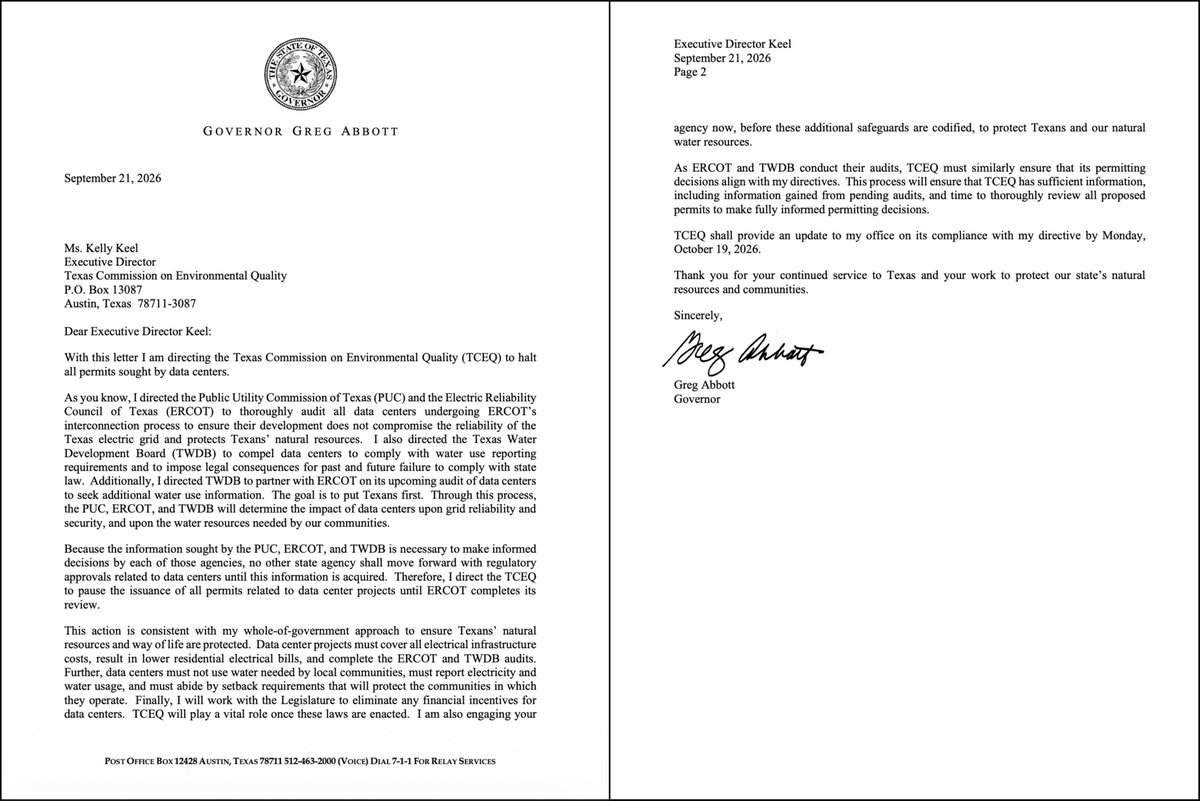
$IREN: Abbott’s New Data Center Halt
Texas Governor @GregAbbott_TX escalated his crackdown on data centers again yesterday, directing TCEQ to pause new air and water permits tied to data center development until ERCOT completes its ongoing audit of large loads.
At first glance, this obviously reads bearish for Texas data center developers.
After digging into $IREN's position specifically, though, I think the actual impact on the company is close to a nothing burger.
Starting with Childress, TCEQ records show active construction stormwater coverage, no pending preconstruction air permits, and one open Title V operating permit that was filed in August.
That last filing sounds more concerning than it really is. Title V is an operating permit that consolidates the site’s existing air obligations, and once a complete application has been filed, the application shield allows the facility to continue operating while TCEQ works through the process.
So even if Abbott’s directive delays the final issuance of that permit, it should not prevent Childress from continuing to operate or build.
The backup generator fleet also appears to be authorized through Texas’ permit-by-rule framework, which would explain why there are no individual preconstruction air permits sitting in TCEQ’s queue for the freeze to catch.
In other words, I currently struggle to find anything at Childress that this new directive materially disrupts.
Sweetwater is where there is at least some real regulatory exposure, but even there I think the headline sounds considerably worse than the underlying situation.
The 2 GW campus already made it into ERCOT’s Batch Zero under the much stronger Base Load classification, and the main remaining gate is the ongoing verification process before future load can be energized.
ERCOT currently expects to finish that process in December, with its Batch Zero verification report due by December 10.
Meanwhile, the major AI capacity at Sweetwater 1 isn’t targeted to come online until Q4 2027.
So even if this process costs $IREN a few months on certain approvals, there is still a very large buffer between where we are today and when the capacity is actually supposed to be delivered.
Obviously, that changes if December turns into March, March turns into June, or the state starts adding entirely new hurdles after the audit. But based on what we know today, I don’t see a temporary pause measured in months materially changing the Sweetwater timeline.
The temporary nature of this latest move is also worth keeping in mind.
TCEQ has to report back to Abbott by October 19, while ERCOT’s audit is expected to wrap up in December. The freeze is tied to that process, so this is not currently an indefinite moratorium on Texas data center development.
There is also a political element here that I think is difficult to ignore.
Data centers have become an increasingly easy target in Texas over electricity prices, water usage and public infrastructure costs, and Abbott has repeatedly stepped up the rhetoric over the past couple of months.
The US midterm elections are on November 3, with Abbott himself up for re-election.
My read is that a meaningful portion of what we are seeing right now is political posturing into the election. The incentive to keep escalating falls considerably once the vote is over, while the ERCOT audit provides a natural path toward de-escalation only a few weeks later.
That doesn’t mean the broader regulatory shift should be ignored.
For $IREN, though, the real risk is more about additional permitting friction, audits and political intervention slowing projects down than some sudden change in project economics.
Texas has been $IREN's bread and butter for years, well before the current AI boom, and I doubt many operators know how to navigate the state’s permitting, grid and local stakeholder environment better than this management team.
Add to that the company’s track record as a strong community steward, which I laid out in yesterday’s post, and I think $IREN enters this new regulatory climate from a much stronger position than most developers.
But there is another side to that equation for companies already well positioned.
Every earlier-stage project that gets delayed by this process is capacity that arrives later into an already tight compute market.
If competing projects slip while $IREN continues building on schedule, the scarcity value of its existing infrastructure and advanced pipeline only increases. Less capacity reaching the market, all else being equal, also supports rental pricing for the compute that does.
So there is a scenario where Abbott’s crackdown ends up being marginally positive for the developers that entered this process years ahead of everyone else.
And that is largely where $IREN sits today.
One final point concerns IR.
This should be an incredibly easy win for the company. Put out a short statement explaining what, if anything, the new directive changes at Childress and Sweetwater, then reaffirm the relevant construction timelines.
So while the headline reads bearish, $IREN's actual position appears much stronger.
Leaving that gap for investors to fill with their own assumptions would be another completely avoidable own goal.
@danroberts0101@MikePowerX
$IREN's community engagement is underrated
Ever since the political climate in the US started turning against data centers, a lot of developers have suddenly discovered the importance of calling themselves "good community stewards."
But contributing to local communities goes much deeper than handing out grants once opposition starts building.
A few $IREN bulls and I had the opportunity to visit the Childress site last year, and one thing became very obvious after spending several hours with management:
$IREN takes community engagement extremely seriously.
One of the key people behind that effort in the US is @nicoletakespics (Nicole Dill), $IREN's Community and Employee Relations Manager, who we had the chance to spend several hours with alongside operations leadership.
She walked us through the multi-step approach $IREN takes around every site, and I genuinely think the company has built something close to the gold standard here.
That matters because it increasingly insulates $IREN from a category of political and community risk that is becoming much more relevant across the industry.
For one, you cannot expect local residents to embrace you with open arms if you build a giant data center right on their doorstep. Since day one, $IREN has deliberately targeted sites well away from dense residential areas.
That obviously creates a trade-off around latency, which is why the fiber piece matters so much. $IREN selects sites with strong fiber connectivity into major network hubs such as Dallas, allowing it to build remotely without sacrificing the connectivity required for AI workloads.
That combination is one reason I believe $IREN's secured power portfolio deserves to be valued at a premium.
You are not "just" getting hundreds of megawatts of low-cost power, all of it sourced from renewable-heavy grids.... You are getting power, land, fiber connectivity and physical separation from residential communities all in the same package.
That overall setup is much harder to replicate than any single component on its own.
The next layer is local procurement. One thing management emphasized during our visit was how aggressively they try to source materials locally.
And that does not stop with the data center halls themselves. It goes all the way down to the office buildings on site, from lumber and concrete to furniture and other materials wherever possible.
To rural communities that means a great deal.
Many of these local economies are built around tradespeople, contractors and small businesses. When a project the size of Childress arrives and starts directing procurement toward those businesses, the economic impact spreads far beyond the people directly employed by $IREN.
The same philosophy applies to labor. $IREN prioritizes local contractors and workers wherever possible and has built strong relationships with many of them over time.
The way it was explained to us was almost like a radius system. Start as close to the site as possible for labor and materials, and only expand outward once local supply can no longer meet the requirement.
That is very different from simply defaulting to a handful of large national suppliers and flying outside contractors into town.
Then you have the more visible side of community engagement through grants, donations and direct support.
$IREN has supported local schools, youth sports, fire departments, food programs, community events, First Nations organizations and various nonprofits across the communities surrounding its sites.
And sometimes that support is much more immediate.
@FransBakker9812 just reported that $IREN has been delivering pallets of drinking water to residents across Childress County, with @nicoletakespics helping coordinate the logistics behind the operation.
That is the difference I think investors should understand. $IREN is NOT trying to write a few checks after community resistance appears.
Instead it has built community engagement into the development model from the ground up, starting with where the site gets built, then extending through procurement, labor and direct community support.
We are still in the early innings of the data center boom, and I do not think the market assigns much value to this yet. But over time, I think that changes...
As more projects run into permitting delays, political resistance and hostile local communities, the reputation of individual developers will matter a lot more.
And I think this is one area where $IREN has quietly positioned itself extremely well.
Being known as the developer that communities actually want around could eventually translate into a very real competitive advantage when it comes to building out a massive multi-gigawatt pipeline.
$IREN's community engagement shows that there are levels to this, and most developers simply aren't up to par.
Must-read for every $IREN investor
For anyone who hasn’t seen it yet, I believe this is one of the most important pieces we’ve published in a while.
It’s an excerpt from our recent $IREN earnings breakdown, published as a standalone X article, completely free and available to everyone.
The article covers what I consider the single most important new development at $IREN; its evolving financing strategy, which is increasingly shaping up to be a real moat.
Understanding this is imperative for every $IREN investor because it materially changes both the potential upside in the stock and the risk profile of the thesis, all of which is laid out in detail throughout the article.
The piece also includes plenty of custom-made graphics designed to help visualize some of the more intricate parts of the financing structure from start to finish, making the topic much easier to digest.
So once again, if you’re an $IREN investor, aren’t subscribed to us on X or Substack, and haven’t read the article yet, I strongly recommend doing so.
And if you have read it already, I’d love to hear your feedback in the comments. Cheers! 🫶
Beautiful daily & weekly closes on $IREN. I feel like we’re close to another major run-up in the stock.
$IREN is simply too undervalued for it not to violently re-rate eventually. 📈
$IREN x Anthropic
By now it's no mystery that $IREN's unnamed "frontier AI lab" is one of two candidates, and I've been open about which one I believe it is: Anthropic.
But the name was never the interesting part. The interesting part is what signing this specific customer means for $IREN, and that's what our new deep dive digs into.
Anthropic left a trail of compute deals across the industry this year, SpaceX, Nscale, Lambda, and we broke down the economics of each one to understand how this lab buys compute and what its providers actually earn. Against that backdrop we then priced $IREN's own contract, and let's just say that once you see what these terms imply, the recent pricing momentum deserves a proper re-rating in how investors value every megawatt $IREN signs from here.
The full deep dive is available to X subscribers as well as paid subs on Substack.
If you've already read it, let me know what you thought in the comments. Cheers!
Rental prices on compute are going nuts
$NBIS just raised its on-demand pricing for B300s by over 20%, to $9.50 per GPU hour.
Now, before investors fixate on the price tag itself, let me make clear that we’re talking about “on-demand” pricing. This category consists of very short-term commitments, ranging from a few days to a few months.
Typically, the longer the commitment, the lower the price, so naturally these types of contracts command the highest rates.
It’s also worth pointing out that $NBIS, like any provider, uses anchor pricing as part of its sales process. Depending on the individual deployment, actual realized pricing will likely come in somewhat lower on average.
That said, this is still a very strong signal of just how tight the market for compute remains. Rental prices have consistently moved higher, with little sign of slowing down.
I’m glad that $IREN still has over 90% of its 2027 capacity uncontracted.
Management appears to have played its contracting strategy extremely well, while many investors were complaining that $IREN wasn’t locking up large chunks of its 2027 pipeline in lower-yielding hyperscaler contracts.
In this market environment, having 500 MW (IT) of capacity coming online over the next 12-14 months while retaining significant flexibility over who gets it and at what price is an incredibly valuable position to be in.
$IREN may be sitting on a golden goose.
Agrippa X Subscription
We just launched our new X subscription.
The subscription includes the same research and coverage we already offer through our paid Advanced Substack tier:
• Deep dives on $IREN and the broader AI landscape
• In-depth $IREN earnings coverage
• Long-term $IREN price targets (coming soon)
• Radar Reports on undervalued hyper-growth stocks
• Proprietary financial models
• Exclusive Discord access
X subscribers also get access to the full library of research we’ve published over the past year, not just everything we release going forward.
Ever since joining Substack last year, we’ve regularly heard from followers who wanted access to our paywalled research but preferred to stay entirely within X rather than use another platform.
The new X subscription solves exactly that.
For anyone who is new here or hasn’t subscribed through Substack before, here’s what our research is built around:
We focus on a small number of high-conviction stocks and aim to provide unparalleled depth of coverage in a format that is easy to understand and actually useful for making better investment decisions.
We’re not interested in covering hundreds of companies at surface level.
The goal is to identify exceptional hyper-growth businesses early, build conviction through deep research, and then continue covering them in detail as the story develops.
We covered $HIMS when barely anyone was talking about the name and the stock was still trading in the single digits. We’ve been covering $IREN since it was trading at $4.80 two years ago, and it remains our core focus today.
At the same time, we’re constantly looking for the next overlooked opportunity.
That’s exactly why we created our Radar Report series, where we dig into smaller, under-the-radar hyper-growth companies that we believe deserve closer attention.
Over time, as conviction builds in some of these names, we expect our core coverage to expand beyond $IREN and the broader AI infrastructure landscape.
The mission is ultimately to give investors all the relevant information, context and ongoing analysis they need to make better investment decisions, without making the research unnecessarily complicated.
For existing Substack subscribers, absolutely nothing changes. We’re simply making the same research available to an X-native audience through X Articles.
To kick off the launch, we’ll be releasing a new $IREN / Anthropic deep dive later today, exclusively for X and Substack subscribers.
More on that new report very soon.
Cheers!