Questioning the role of questions in primary science: @JudePenny2 and I have presented this research at @theASE and @pstt_whyhow conferences. Available as an open access article. @UoGEducation
https://t.co/icVSXY5osw
Research of interest to all working in ITE. Privilege to work with @TraceyWire, @REperjesi, @RuthHollier, @JudePenny2 and Emma Howell on this publication, in @UoGEducation Teacher Education Group: https://t.co/D1JohTFCFF. Limited number of free eprints.
Excellent tips here from @DrColinForster . Remember not to look directly at the sun, even if it’s cloudy. Use solar eclipse glasses or look for pinhole images.
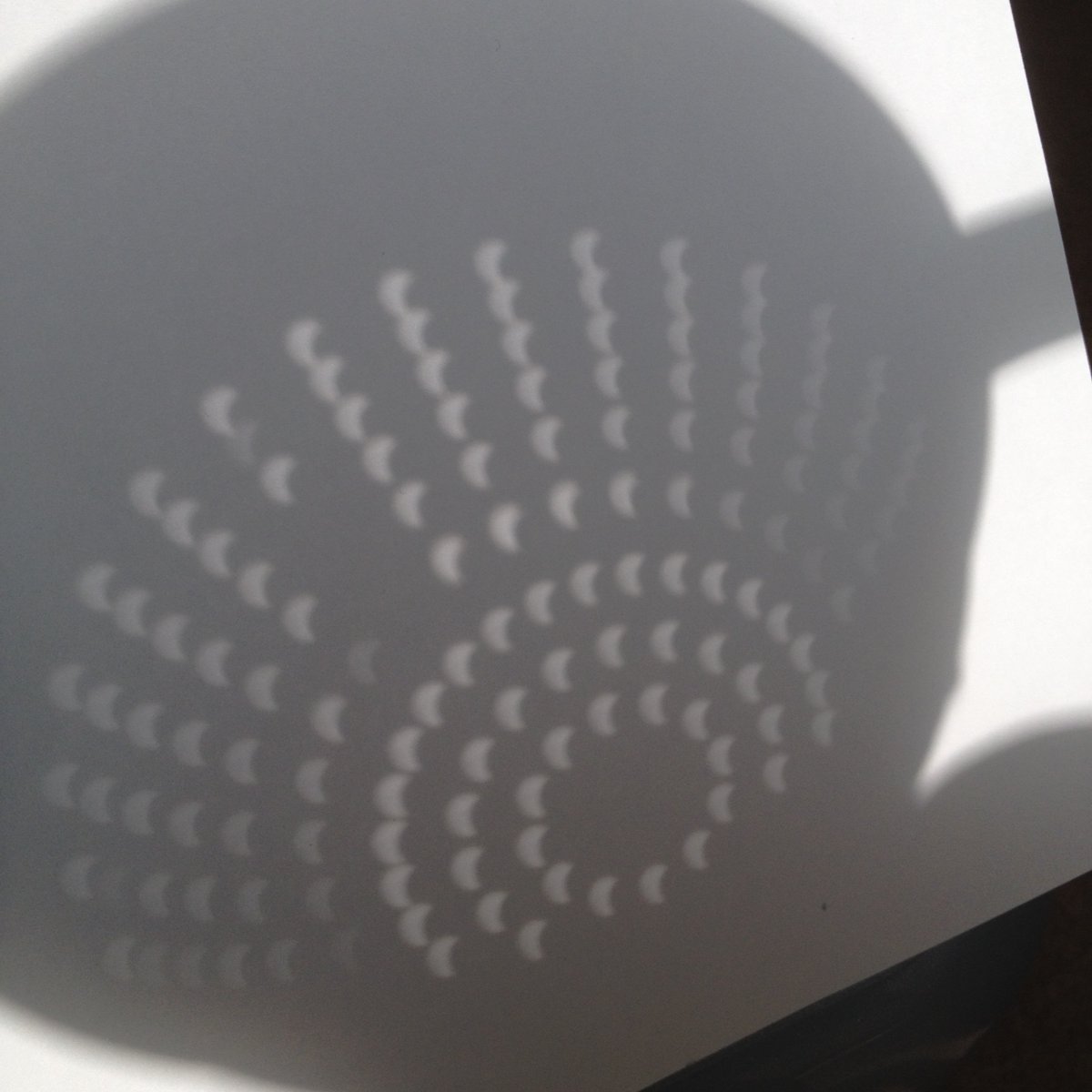
Hoping for a break in the cloud to see the partial eclipse of the sun this morning. Pinhole images of the sun can be seen using a colander or by looking under a tree, where natural pinholes occur in the spaces between leaves. Photos from the partial solar eclipse in 2015.
Just for fun, I got out my homemade chaotic double pendulum to show the students. One pendulum is one of the most predictable things in physics ... put one on the end of the other and they do something different every time. @UoGEducation
Slight change of name for the 2nd edition. Now includes a section on ‘the ontology thing’ and even more excellent pictures from the brilliant @daveboybrookes. Privilege, as ever, to work with @REperjesi and thank you to @SAGEeducation for the opportunity. @UoGEducation
Some of our team have been discussing the double-edged nature of teachers’ questions with our @UoGEducation teaching students so it seemed like a good time to share a link to this helpful article: https://t.co/ELPRC5vQtm @DrColinForster @JudePenny2 @RussShalofsky
Is teaching about ‘covering or discovering’? Great piece from @alfiekohn which might be useful to @UoGEducation teaching students and particularly those teaching science on current placements. @UoGPriScience @JudePenny2
@ASE Futures members. You should find the latest Science Teacher Education edition (no. 88) in your inbox now. Great articles from
@DrColinForster
@JudePenny2
@sallylspicer@trewlyalison@RedPSTT@MariaDent5
Please tag in anyone whose twitter handle I could not locate.
Looking forward to presenting, with @JudePenny2 at ASE Futures Conference Online 2020 https://t.co/82wSMQO4w3 @sched
How can we help new teachers become skilful in their interactions with children in primary science? Tricky and intriguing stuff.
Our research survey is still open to all teachers and other school staff with an interest in partnership with parents: https://t.co/emIK1zsCa8 . Would be great to hear from colleagues in all kinds of schools.
Full moon tonight. The full moon often looks large in the summer months as it rises at a shallow angle and stays low in the sky. It looks large as it close to the skyline.
Simple science activities: capturing sound with paper cones.
Here's a quick and simple activity to have some fun with. Take some paper or thin card and roll into cones to make ear-trumpets and megaphones. Amazing pics by @daveboybrookes. Adapted from this book.
If you've never seen a shooting star before, you're in luck: Lyrids meteor shower tonight. Don't get a bad neck by standing and looking up: sit in a comfortable, laid back chair or put down a rug and lie down to enjoy the show.
https://t.co/taOEjw77kx
Just tinkering with magnifying glasses and inverted images as I mull over how to provide some useful online content for @UoGEducation BEd students. Nice model to kick start a discussion about light and sight. Yes, the image on your retina is upside down! @UoGPriScience