Mutual Fund baskets in a PMS have gotten popular over the last few years. We’ve run them at Capitalmind Wealth since 2019 (before it was cool).
In this podcast, @shraychandra, @deepakshenoy@investkahakare , and @avijeet_sen discuss why MF baskets make sense in a PMS, what you’re actually paying for (and why we don’t charge a performance fee on them), what MF baskets we offer, how to match your asset allocation to your goals, and what the new PMS regulations could mean for MF-based portfolios.
https://t.co/RHq5ZXLXbV
The Nifty 500 is down 9% from its all time high. But the median stock in the index is down 29% from its own peak.
The gap is even wider in small caps. The Nifty Smallcap 250 is down 5% while its median stock has fallen 32%.
The correction looks very different when you look beyond the index numbers.
Here's how deep the fall has been across large, mid and small caps.
[Mutual Fund Flows]
Four highlights from AMFI's latest monthly update.
- SIP inflows reached a record ₹32,490 crore in September.
- Equity fund inflows grew 13.6% in Jan-Sep 2026 compared with the same period last year. Redemptions grew even faster at 24.4%.
- Small and Mid Cap funds attracted higher net inflows while thematic funds saw a drop.
- Multi Asset net inflows rose 70% to ₹49,118 crore in Jan-Sep 2026 compared with the same period last year, while Arbitrage net inflows fell 79% to ₹12,982 crore.
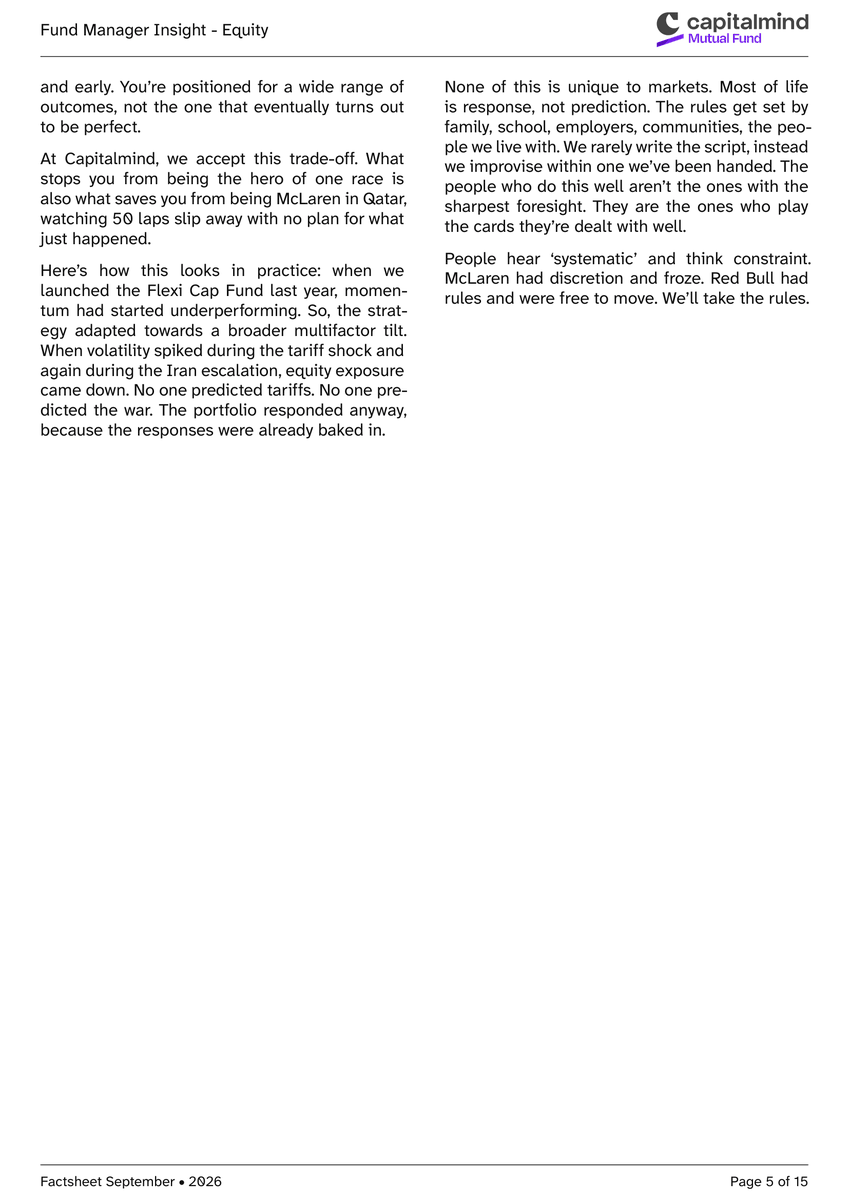
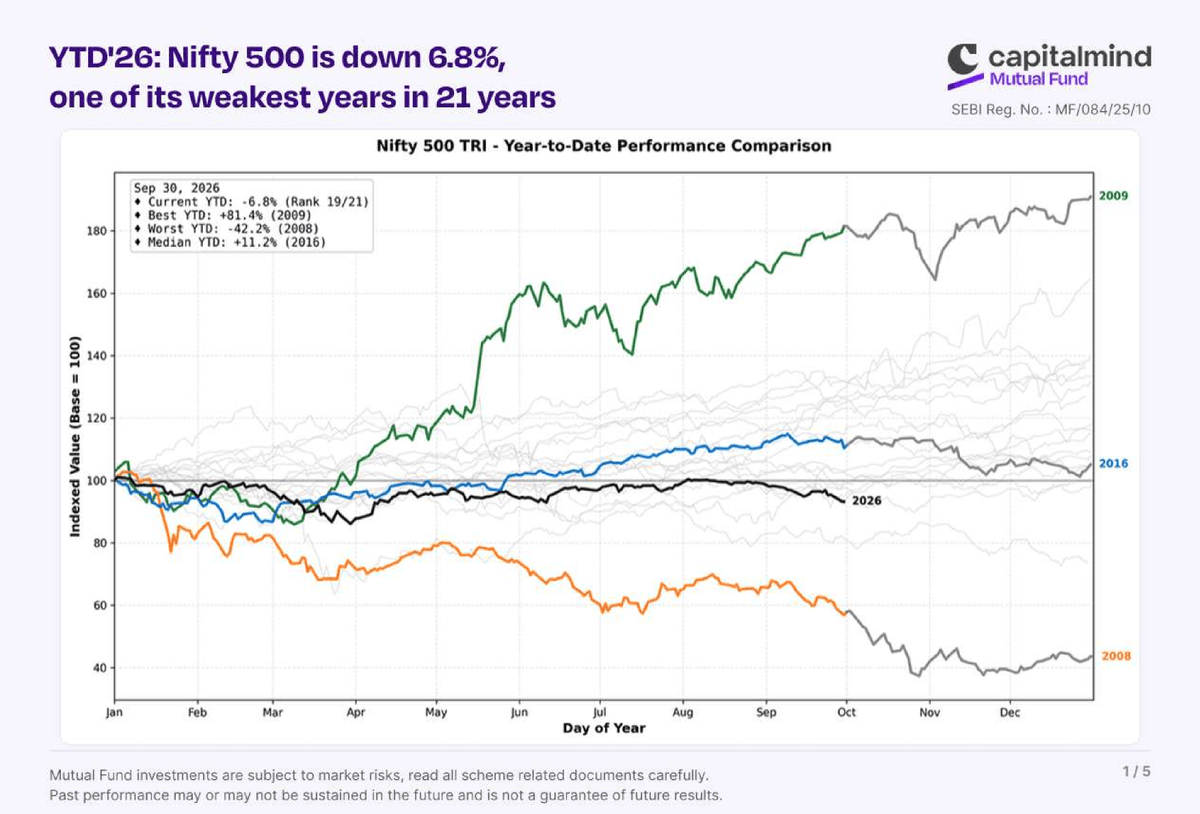
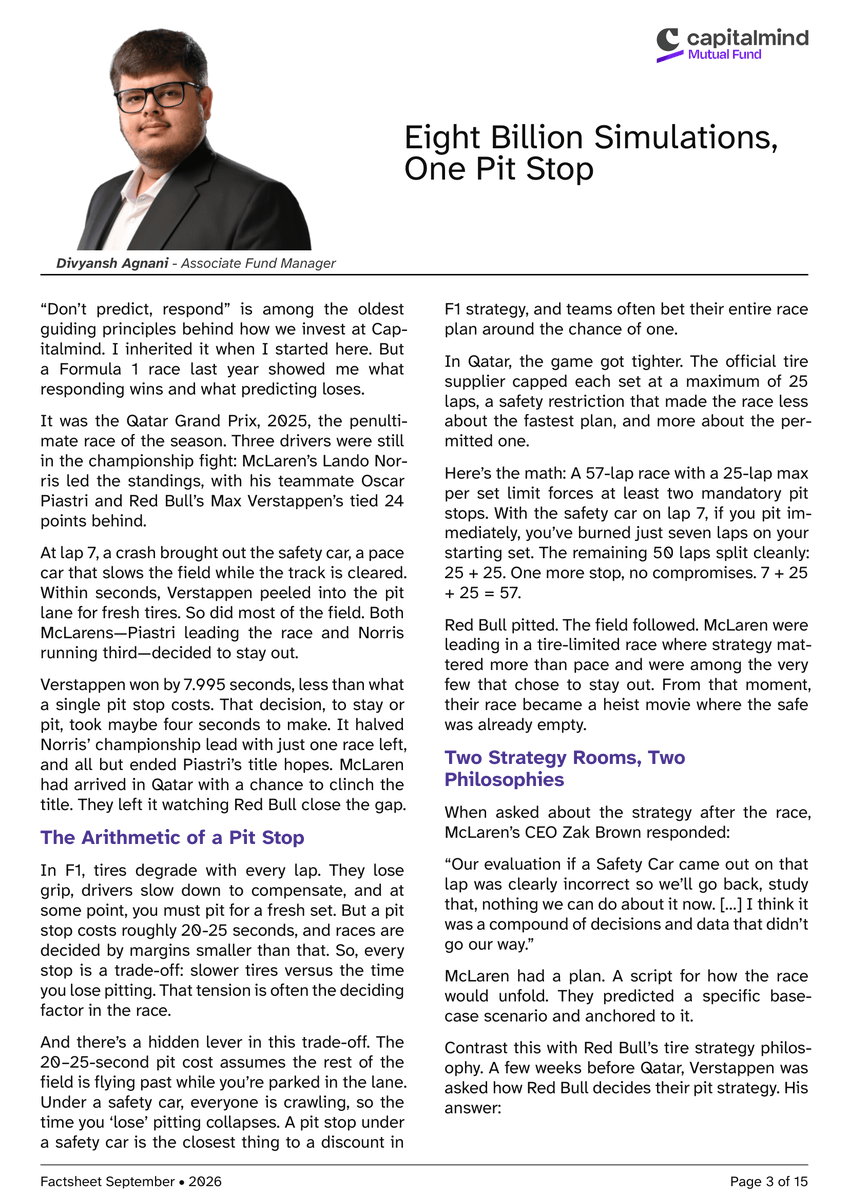
@deepakshenoy@divyanshagnani, our Associate Fund Manager, uses a single Formula 1 pit stop decision to explain why we build portfolios that respond to markets rather than try to predict them.
Added a whole bunch of new insights across:
- Aggregate earnings
- Bond yields
- Demat holdings
- Unique mutual fund investors
- SIP returns
- IPO performance and listing day gains
- ETF premiums
- Credit growth
- New custom indices and more
https://t.co/cXQBOTnea5
A look at how we build our evidence based Momentum framework, in terms of how different forms of Momentum has worked compared to the index by @CalmInvestor .
We now have other factors too, this gives you an insight into the process:
https://t.co/SRg6Ahfv2D
Before investing in a momentum fund, there’s one question worth asking: Which definition of momentum does it actually use?
In Part 2 of our Momentum Investing Series, @CalmInvestor , Head of Equity at Capitalmind Mutual Fund (SEBI Reg. No.: MF/084/25/10), delves deep into 10 out of 40+ published definitions of momentum and the investment belief behind each.
Because two funds can both call themselves momentum funds while using very different approaches to pick stocks.
And there’s one secret ingredient every momentum investor—active or passive—has to account for.
What is it? Watch the full video.
Mutual Fund investments are subject to market risks. Read all scheme related documents carefully.
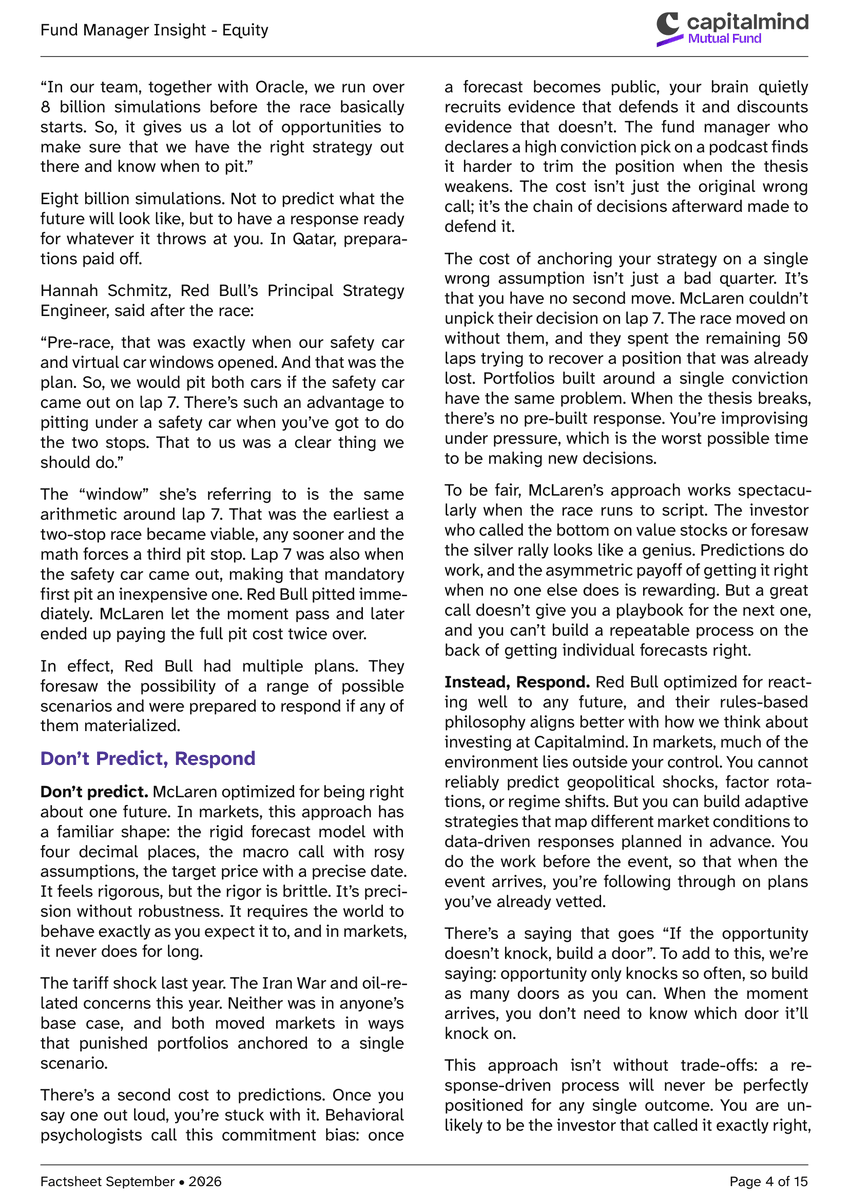
September wiped out most of the recovery Nifty 500 made since March. The index is now down 6.8% for the year, ranked 19 out of 21 years. One of its weakest years in two decades.
Here's the full breakdown of September 2026 🧵
@AskWorkspace My wife paid for Workspace Business Base in India. Connecting her domain fails with “Sorry, we can’t complete your sign-up” (anti-spam), and I cannot access support. Please help open a case to review the signup block and support access.
It's pencils down, people. Writing code by hand is no longer an economically viable skill for most programmers at most companies. But the future of making software has never been brighter. Don't you dare black pill this beautiful moment! https://t.co/qaCgfmkW0u
Be honest: when was the last time you actually looked at a fund's expense ratio before investing?
@NihitKshatriya , Head of Sales at Capitalmind Mutual Fund, breaks down why this "Tiny" number deserves more attention than it gets.
All figures and graphs used are for illustrative purposes only and do not reflect actual numbers. Mutual Fund investments are subject to market risks, read all scheme related documents carefully.
A new avatar of Adaptive Momentum by @capitalmind_in PMS is live. Hard lessons learnt through 7+ yrs of running the strategy were implemented to form a “slightly tamed” version of the animal that is Momentum. Still high risk, but one with better risk guardrails
I think MDR on UPI was probably inevitable at some point, especially given how widespread UPI adoption has become. It could also lead to more competition, instead of just three apps accounting for more than 95% of the market.
That being said, there are some use cases, like investing and broking, where the proposed MDR structure doesn’t really make sense.
The problem with broking is that there is no guarantee that money transferred to a broker will actually result in a transaction.
As brokers, we can’t force a customer to trade after transferring money. And if we can’t pass the UPI charge on to the customer, there is essentially no limit to the cost a customer can impose on a broker without generating any revenue.
Just as an example, 10,000 customers could each make 50 UPI transfers of ₹2 lakh in a month without executing a single trade. At the proposed MDR, this could potentially cost the broker around ₹2 crore, without generating any business.
What makes this even more challenging is quarterly settlement (QS). This is a SEBI regulation that requires brokers to send unused funds back to clients every month or quarter.
Most customers then transfer these funds back to their broking accounts, with more than half of these transfers happening through UPI. So regulation essentially forces this movement of money every month or quarter, and the broker could end up bearing the cost when the money comes back, without any incremental benefit or revenue.
By the way, we currently don’t charge brokerage on equity delivery trades because the economics allow us to offer them for free. But if every UPI transfer starts carrying an additional cost, irrespective of whether the customer actually trades, I don’t see how we can absorb this indefinitely.
I think having an MDR is okay. It still doesn’t solve the problem of customers transferring money without transacting, but something like 0.02% with a cap of ₹5 or ₹10 per transaction seems much more reasonable for broking, instead of a cap as high as ₹300.
Lazy work used to mean too little output.
Now, with AI, it often means too much and more work for everyone else.
@tobi call it "slop grenades."
A "Slop Grenade" is when you let AI produce the work and pass it on without adding any value (including checking it).
Someone else has to wade through it, catch the mistakes, and clean up the mess.
You save time and look productive but someone else pays for it.
Dr. Pratosh at IISc Bengaluru tells his students that rapid advances in AI are commoditizing intellectual labour.
He raises an unsettling question: if companies stop recruiting on campus in the next 5–10 years—even at India’s top universities—what will the purpose of a university education be ?
A must watch video for everyone in tech
Capitalmind Wealth has run Adaptive Momentum, one of the first momentum strategies built for PMS clients in India, since 2019.
Seven-plus years in, the strategy has lived through very different market and economic regimes. Along the way, managing a quantitative portfolio through the real world (and not just a backtest) has given us invaluable lessons about how momentum actually works in Indian markets.
As we look back at those 7 years, we’re putting some of those learnings into a couple of pieces on factor investing: what momentum really is, why seemingly small choices in its construction matter, and why economic intuition should come before statistical evidence.
We start with the “factor zoo” and the animal we know best: Momentum.
Read here: https://t.co/WAjJ5M1DU1
Capitalmind Financial Services Private Limited | SEBI Registered Portfolio Manager: INP000005847
We just finished our first year at Capitalmind Mutual Fund, which we began with our Flexi cap fund, and it still amazes me how far and wide Capitalmind has reached.
Most of our investors came from the metros and the top thirty cities, as you would expect. What surprised us was how much came from tier-2 towns and beyond, from places across India we had never once marketed in.
Was pleasantly surprised to see names of towns in our investor list, such as Aizawl, Purulia, Siliguri, Sangli and other such beautiful places that are far off from Bengaluru.
A lot of these investors reached us through distributors we had never met, who chose to trust us on the strength of our earlier work, our reputation, and the way we think about investing. They understood our investing approach (rules-based, factor investing frameworks) and took us to the investors who wanted such a mutual fund offering.
If you are a distributor, and you like how we invest - we would like to partner with you.
Empanel with us as a distributor partner, it takes about five minutes.
Empanel here: https://t.co/TkGNIzDyZa
Capitalmind is suited for distributor partners who work with investors for their long-term goals and are driven by the mission of financial inclusion.
I own 11 apartments across Manila, Bali and Dubai. All bought in cash since 2019.
7 years in, my verdict: real estate is a terrible investment, and I'd be richer and calmer if I had clicked "buy" on an index fund once in 2019.
Here are the actual numbers, unit by unit.
What if the hardest part of investing isn't knowing what to buy but knowing when to change?
As Capitalmind (SEBI Reg. No.: MF/084/25/10) Mutual Fund completes its first year, Deepak Shenoy and Anoop Vijaykumar unpack the thinking behind its evidence-led approach in Respond, Don’t Predict: Capitalmind’s Evidence-Led Investing, presented by Capitalmind Mutual Fund in association with Moneycontrol.
The conversation goes beyond stock picking to explore:
* Why risk and volatility aren't the same thing
* Why no single investment style works all the time
* Where quantitative investing ends and human judgement begins
* Why cash can be a position
* Why higher portfolio churn can be intentional
* And why even a great company may not deserve a permanent place in a portfolio
Read the full story:
https://t.co/a4lUqAB3Na
@capitalmind_in | @deepakshenoy | @SurabhiUpadhyay


![CapitalmindMF's tweet photo. [Mutual Fund Flows]
Four highlights from AMFI's latest monthly update.
- SIP inflows reached a record ₹32,490 crore in September.
- Equity fund inflows grew 13.6% in Jan-Sep 2026 compared with the same period last year. Redemptions grew even faster at 24.4%.
- Small and Mid Cap funds attracted higher net inflows while thematic funds saw a drop.
- Multi Asset net inflows rose 70% to ₹49,118 crore in Jan-Sep 2026 compared with the same period last year, while Arbitrage net inflows fell 79% to ₹12,982 crore.](https://pbs.twimg.com/media/HUqo10jboAE51FN.jpg)
![CapitalmindMF's tweet photo. [Mutual Fund Flows]
Four highlights from AMFI's latest monthly update.
- SIP inflows reached a record ₹32,490 crore in September.
- Equity fund inflows grew 13.6% in Jan-Sep 2026 compared with the same period last year. Redemptions grew even faster at 24.4%.
- Small and Mid Cap funds attracted higher net inflows while thematic funds saw a drop.
- Multi Asset net inflows rose 70% to ₹49,118 crore in Jan-Sep 2026 compared with the same period last year, while Arbitrage net inflows fell 79% to ₹12,982 crore.](https://pbs.twimg.com/media/HUqo0xjbAAAj4g5.jpg)
![CapitalmindMF's tweet photo. [Mutual Fund Flows]
Four highlights from AMFI's latest monthly update.
- SIP inflows reached a record ₹32,490 crore in September.
- Equity fund inflows grew 13.6% in Jan-Sep 2026 compared with the same period last year. Redemptions grew even faster at 24.4%.
- Small and Mid Cap funds attracted higher net inflows while thematic funds saw a drop.
- Multi Asset net inflows rose 70% to ₹49,118 crore in Jan-Sep 2026 compared with the same period last year, while Arbitrage net inflows fell 79% to ₹12,982 crore.](https://pbs.twimg.com/media/HUqoz-eacAEMftO.jpg)



![CapitalmindMF's tweet photo. [Mutual Fund Flows]
Four highlights from AMFI's latest monthly update.
- SIP inflows reached a record ₹32,490 crore in September.
- Equity fund inflows grew 13.6% in Jan-Sep 2026 compared with the same period last year. Redemptions grew even faster at 24.4%.
- Small and Mid Cap funds attracted higher net inflows while thematic funds saw a drop.
- Multi Asset net inflows rose 70% to ₹49,118 crore in Jan-Sep 2026 compared with the same period last year, while Arbitrage net inflows fell 79% to ₹12,982 crore.](https://pbs.twimg.com/media/HUqo21maMAAouwV.jpg)