Releasing the model weights and technical report of Kimi K3.
Kimi K3 is our most capable model: a 2.8T MoE model with native visual understanding and a 1M-token context window.
New model architecture: 2.5x the intelligence per unit of compute, not just more params.
Alongside Kimi K3, we're opening up more of the stack behind it — high-performance attention kernels, MoE communication library, and infrastructure for running agent environments at scale.
Model weights: https://t.co/7m7eEg6Y0B
Tech report: https://t.co/yeu6cjpMCT
Tech blog: https://t.co/YTfiMSNM1f
Huge congratulations to Professor Jacob Tsimerman of the University of Toronto on receiving the Fields Medal — one of the highest honours in mathematics.
Nearly a century after Canadian mathematician J.C. Fields established this award in Toronto, it comes home.
"Foundations of Applied Mathematics" is a free collection of four textbooks created for the Applied and Computational Mathematics program at Brigham Young University. The four volumes are:
1. Mathematical Analysis
2. Algorithms, Approximation, and Optimization
3. Uncertainty and Data
4. Dynamics and Control
The collection is suitable for advanced undergraduate and early graduate students. It also has Python lab manuals and practical exercises, so the mathematical theory is connected with numerical computation, algorithms, data analysis, and scientific applications.
What I particularly like is that these are not only theoretical textbooks. The accompanying Python materials are a useful way to see how the concepts are applied to real computational problems.
https://t.co/s8IfEmnk5B
How can an LLM switch between low-, medium-, and high-effort reasoning? And how does an LLM learn to reason more or less?
I put together a “little” article explaining how these effort levels are implemented at inference time and during training.
Transformer by hand ✍️ ~ 6 steps walkthrough below
Open the hood of a transformer and the parts list is overwhelming: embeddings, positional encoding, attention weighting, self-attention, cross-attention, multi-head attention, layer norm, skip connections, softmax, linear, Nx, shifted right, query, key, value, masking.
Which of those actually make the car run?
Two of them. Attention weighting and the feed-forward network. Everything else is an enhancement to make it run faster and longer, which is how we got from a car to a truck, and to the word "large" in large language model.
So I drew and calculated those two parts entirely by hand.
Goal: push five features through one transformer block, filling in every cell yourself.
1. Given
Five positions of input features, arriving from the previous block.
2. Attention matrix
Let us feed all five features to a query-key module (QK) and read back an attention weight matrix, A. The details of that module are a post of their own.
3. Attention weighting
We multiply the input features by A to get the attention weighted features, Z. Still five positions. The effect is to combine features *across positions*, horizontally: X1 becomes X1 + X2, X2 becomes X2 + X3, and so on.
4. First layer
Let us feed all five weighted features into the first layer of the FFN. Multiply by the weights and biases. This time the combining happens *across feature dimensions*, vertically, and each feature grows from 3 numbers to 4.
Note that every position goes through the same weight matrix. That is what "position-wise" means.
5. ReLU
We cross out the negatives. They become zeros.
6. Second layer
Let us bring it back down: 4 dimensions to 3. The output feeds the next block, which has a completely separate set of parameters, and the whole thing runs again.
You have just calculated a transformer block by hand. ✍️
The takeaway: the two parts are doing two different jobs, and neither one alone is enough. Attention mixes *across positions*, so a feature can see its neighbours. The FFN mixes *across feature dimensions*, so each position can think about itself. Horizontal, then vertical. Then that pattern repeats N times, each block with its own separate set of weights. That is the Nx from the list up top, and that is what makes the transformer run.
💾 Save this post!
#AIbyHand #Transformers #DeepLearning
A Visual Introduction to Information Theory
(bookmark it)
Information Theory is such an beautiful and powerful subject.
In the era of AI, it's worth spending time learning about it.
Here is a highly-recommended read for anyone who wants real intuition for entropy and mutual information.
It's a visual, intuition-first guide to information theory.
It assumes only familiarity with basic probability, so it stays accessible while still reaching the fundamental limits of compression and transmission.
Paper: https://t.co/ydLqsF9ag8
Learn to build effective AI agents in our academy: https://t.co/1e8RZKs4uX
NEW AI paper worth bookmarking.
This is something I called early, and this paper confirms it: verification has emerged as a new important scaling axis.
Here is the simple explainer and what this paper shows.
We have seen lots of progress in scaling pre-training, post-training, and test-time compute. For post-training and test-time compute, we are still in its early phases. But one of the most important new directions is using LLMs as verifiers. Verifiers are fundamental to scaling AI.
This work from Stanford, NVIDIA, and UC Berkeley builds a training-free verifier that reads a continuous, calibrated score straight off the scoring-token logits instead of trusting a discrete grade.
Three knobs move accuracy without any fine-tuning. Score granularity for cleaner separation, repeated evaluation for lower variance, and criteria decomposition for lower complexity.
The numbers land across very different domains. 86.5% on Terminal-Bench V2, 78.2% on SWE-Bench Verified, 87.4% on RoboRewardBench, and 73.3% on MedAgentBench.
The same continuous score doubles as dense reward for SAC and GRPO and as a task-progress signal shipped in a Claude Code extension.
Paper: https://t.co/D9PkrZEvkb
Learn to build effective AI agents in our academy: https://t.co/1e8RZKs4uX
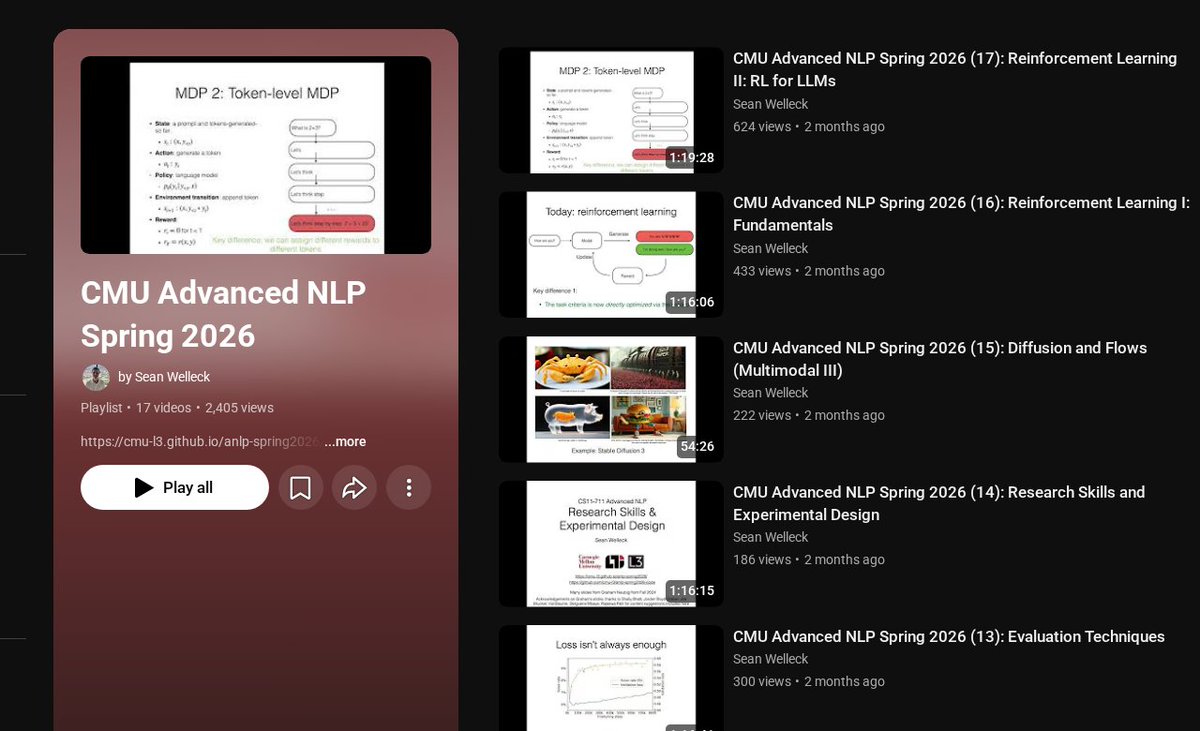
CMU Advanced NLP Spring 2026
What you will learn:
- Understand transformer and LLM concepts without treating them as black boxes
- Build the foundations before jumping into advanced NLP and language modeling material
- Build intuition for generative model families and what they are useful for
- Build a practical understanding of this part of NLP and language modeling
- Evaluate model behavior instead of relying on demos
- Connect retrieval, embeddings, and generation into practical AI systems
Link is in the first comment 👇
♻️ Share this with your network if you found it useful or insightful.
Here's part 1 (of 5) of my short course on efficient LLM inference that I taught at Columbia University. Slides are heavily updated from two weeks ago.
https://t.co/WVCf7mUdkY
My entire AI stack is now Chinese 🇨🇳
87% cheaper. same revenue
swaps by task:
1. reasoning / backend brain
Opus 4.8 → Kimi K2.7
benchmark gap: ~8% · price: ~11x cheaper
2. code generation
GPT-5.5 → Qwen 3.7 Max
benchmark gap: ~18% · price: ~7x cheaper
3. agent loops + tool calling
Sonnet 4.7 → GLM 5.2
benchmark gap: ~3% · price: ~5x cheaper on input
4. cheap volume / bulk processing
GPT-5.5 mini → MiMo V2.5
benchmark gap: ~6% · price: ~12x cheaper
5. image generation
GPT-Image-2 → Wan 2.5
benchmark gap: ~5% · price: ~8x cheaper
6. video generation
Sora 2 → Kling 3.0
benchmark gap: roughly equal · price: ~6x cheaper
[ result after 30 days: ]
operating costs dropped 87%, output quality dropped 4% on average, revenue unchanged
the most important that these models will be not banned in a month and i can run them locally
nobody will steal my data and i can learn them as i need
full article drops tomorrow with:
> exact routing logic per task type
> the 2 cases where I still pay for American
> the migration playbook anyone can copy in a weekend
VERY IMPORTANT to get migrated now, while it's not too late
I put together a new article on setting up local coding agents with open-weight models. Everything runs 100% locally.
I thought it might be useful putting this together because many people asked me about my setup in the past, and I thought it would also motivate people to get started tinkering with local models for serious work (yes, things got incredibly capable this year with better LLMs and better harnesses).
So, here's a walkthrough of how to connect a local LLM to a local coding harness (could be Claude Code or Codex, which you may already be familiar with).
I also included some assessment notes that are useful as a checklist to select between and consider certain LLMs over others:
- Checking RAM usage at long contexts to see if the model is suitable for real work
- Measuring prefill and decoding tok/sec to see whether it's fast enough to not be annoying
- Making sure the model has sufficient tool-calling capabilities in theory
- Assessing whether the model can solve some more challenging tasks when used in a coding harness.
Of course, there are always more specialized tools that can squeeze a bit more performance out of things, but I hope this is a good starter kit that stays flexible; that is you can easily switch to newer models as they are released or even tap into cloud models in your familiar harness if the current ones are not sufficient enough for a given task.
I'm joining OpenAI next week!🥹 The job search turned out to be really challenging but also super rewarding, so I wrote a small blog to share what I learned along the way and hopefully make the process a little less mysterious for the next person. https://t.co/6FigSBdenD











![DeRonin_'s tweet photo. My entire AI stack is now Chinese 🇨🇳
87% cheaper. same revenue
swaps by task:
1. reasoning / backend brain
Opus 4.8 → Kimi K2.7
benchmark gap: ~8% · price: ~11x cheaper
2. code generation
GPT-5.5 → Qwen 3.7 Max
benchmark gap: ~18% · price: ~7x cheaper
3. agent loops + tool calling
Sonnet 4.7 → GLM 5.2
benchmark gap: ~3% · price: ~5x cheaper on input
4. cheap volume / bulk processing
GPT-5.5 mini → MiMo V2.5
benchmark gap: ~6% · price: ~12x cheaper
5. image generation
GPT-Image-2 → Wan 2.5
benchmark gap: ~5% · price: ~8x cheaper
6. video generation
Sora 2 → Kling 3.0
benchmark gap: roughly equal · price: ~6x cheaper
[ result after 30 days: ]
operating costs dropped 87%, output quality dropped 4% on average, revenue unchanged
the most important that these models will be not banned in a month and i can run them locally
nobody will steal my data and i can learn them as i need
full article drops tomorrow with:
> exact routing logic per task type
> the 2 cases where I still pay for American
> the migration playbook anyone can copy in a weekend
VERY IMPORTANT to get migrated now, while it's not too late](https://pbs.twimg.com/media/HL-p_PyWoAA42S2.jpg)


