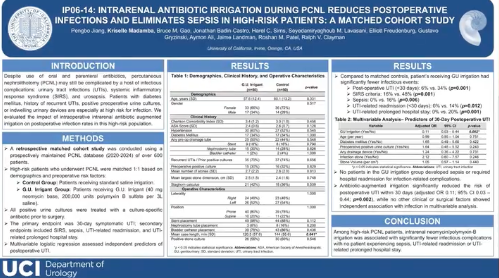
Intrarenal Antibiotic Irrigation During PCNL Reduces Postoperative Infections and Eliminates Sepsis in High-Risk Patients: A Matched Cohort Study.
Can antibiotic irrigation during #PCNL prevent sepsis? Kriselle Madamba reviews a matched study in high-risk patients: postoperative UTI fell from 34% to 6% and sepsis from 16% to 0%. #WCE26 #WatchNow > https://t.co/ZQZmba5zit
Outcomes in the Management of Complex Renal Cysts: Balancing Overtreatment, Cost, and Radiation Exposure.
Most complex #RenalCysts can be watched. @helengao295@UCI_Urology reviews 106 Bosniak II–IV cysts: 92% managed with active surveillance, with no metastases or cancer deaths over a median 4.1 years. #WCE26 #WatchNow > https://t.co/L2aPVoGz4N
Scaffold-Guided Regenerative Bladder Augmentation Using Medical-Grade Titanium Foil in the Porcine Bladder: Initial Results.
Regenerative #BladderAugmentation in a porcine model. Aymon Ali, MD reviews initial titanium-foil scaffold results: full-thickness bladder wall regeneration at 1 year, with no leaks or hydronephrosis. #WCE26 #WatchNow > https://t.co/feQEuxVnUA
Supportive and palliative care is an essential component of comprehensive genitourinary oncology management from day one.
Biren Saraiya, MD @RutgersCancer sits down with @neerajaiims@huntsmancancer, highlighting key principles for early integration:
Whole-Person Symptom Management: Addressing physical symptoms alongside emotional, social, and existential distress throughout the disease trajectory.
Proactive Referral: Symptoms often emerge at or prior to diagnosis; palliative support should not be reserved solely for end-of-life or treatment-refractory settings.
Oncology-Led Care: Primary palliative care skills—including goal concordance and communication—can and should be provided directly by treating oncology clinicians.
Watch the full interview and clinical insights > https://t.co/nujwqG7Sr0
The UroLume Endoprosthesis and UroLume Cripple Syndrome: A Systematic Review and Meta-Analysis of Pathophysiology, Complications, Surgical Management, Psychological Burden, and Epidemiology of Surviving Patients Worldwide.
A meta-analysis of 43 studies of the UroLume urethral stent found pooled restenosis of 37.9% and explantation of 8.7%. #UrethralStricture #AuthorCommentary with @ikapos@uoaofficial > https://t.co/SBZuTPKWVs
Circulating Tumor DNA Alterations and Resistance to Lutetium-177 PSMA-617 in #ProstateCancer.
@PrafulRavi1@DanaFarber_GU joins Oliver Sartor, MD @EJHospital to discuss baseline and on-treatment ctDNA changes as correlates of intrinsic and acquired resistance to 177Lu-PSMA-617 in #mCRPC. @PCFnews #WatchNow > https://t.co/aM8AUA4gNV
Adaptive Dosing of Actinium-225 Alpitatug Satetraxetan, a KLK2-Targeted Radioligand Therapy in mCRPC.
@PBarataMD@caseccc joins @CaPsurvivorship@DanaFarber to discuss adaptive dosing in the phase 1 study of alpitatug satetraxetan, an actinium-225–labeled antibody targeting hK2, in #mCRPC. @PCFnews #WatchNow > https://t.co/JDz4beLf2g
Serial ctDNA tracking provides valuable early prognostic insights for patients receiving first-line enfortumab vedotin + pembrolizumab.
Key takeaways presented by @mjmoussa_ in this discussion with @zklaassen_md.
(n=79):
Clearance Predicts Response: Patients achieving complete ctDNA clearance achieved an objective response rate exceeding 80%, compared to ~50%–60% in partial decliners and ~30% in patients with rising levels.
Rapid Kinetics: Median time to observed ctDNA reduction was 48 days from treatment initiation.
Prognostic Impact: Time-dependent Cox regression revealed persistent ctDNA detectability carries a higher risk of disease progression and death.
Full discussion and clinical context > https://t.co/ifajik2htA
DLL3 PET Imaging in Neuroendocrine and Aggressive Variant Prostate Cancer.
Can DLL3 PET map neuroendocrine differentiation? @Tendler_S@MSKCancerCenter joins Oliver Sartor, MD @EJHospital to discuss DLL3 PET imaging and tumor heterogeneity in advanced #ProstateCancer. @PCFnews #WatchNow > https://t.co/wNgFPRI3Iz
IRONMAN Registry Findings on Age and Overall Survival in Advanced Prostate Cancer.
Does age shape survival in advanced #ProstateCancer? Lorelei Mucci, ScD joins @neerajaiims to discuss IRONMAN registry findings on age and overall survival in an international cohort. @PCFnews #WatchNow > https://t.co/vw1elWChHA
Radium-223 monotherapy explored in PSMA-positive bone lesions without conventional imaging. Melissa Abel, MD @theNCI joins @TDorffOnc@cityofhope to discuss a study of radium-223 monotherapy without ADT in patients with PSMA PET-detected bone micrometastases not visible on conventional imaging. #WatchNow > https://t.co/7zedRhrJ3A
Optimal Local Therapy After Systemic Response in Muscle-Invasive Bladder Cancer.
#IBCG26 What is the optimal local therapy after systemic response in #MIBC? @SimaPorten, @WesKassouf, and @gdgrass join @pjhensley11 to discuss surgery, radiation, and surveillance options. #WatchNow > https://t.co/RhHXxy08i1 @UroDocAsh
Navigating novel treatment options in nonmuscle-invasive #BladderCancer for #Nurses and #APPs. Samantha Steinke, APRN, MSN-FNP, BSN, RN & Brenda Martone, MSN, ANP-BC, AOCNP @NorthwesternMed address coordination within the expanding #NMIBC treatment landscape. Novel intravesical agents are supported by manufacturer-provided education covering side effects and administration workflows.
#WatchNow > https://t.co/KZYPgbcYp2 @NUFeinbergMed@LurieCancer
OPTION-DDR and personalized platinum chemotherapy in HRR-mutated #mCRPC. Michael Ong, MD, FRCPC @OttawaHospital joins @zklaassen_md to discuss OPTION-DDR, a phase 3 randomized trial of 236 patients comparing docetaxel plus carboplatin against docetaxel alone in HRR-mutated metastatic castration-resistant prostate cancer. Overall survival is the primary endpoint, with radiographic progression-free survival and quality of life as secondary endpoints. #WatchNow > https://t.co/oiKGYzTDFH
Assessing Bladder Compliance: Current Methods and Their Limitations in Clinical Practice.
Can bladder compliance alone predict upper tract risk? @icuptoo joins Alan Wein, MD, PhD(hon), FACS, to discuss current #Urodynamics methods and their limits, noting that compliance is an inexact standalone metric and standardized measurement is a priority. #WatchNow > https://t.co/Z4tqHy4LVr
Cretostimogene Grenadenorepvec in BCG-unresponsive #NMIBC with CIS and the BOND-003 trial. #JournalClub discussion with @RKSayyid@UAUrology and @zklaassen discussing BOND-003 Cohort C, a single-arm phase 3 trial of intravesical cretostimogene grenadenorepvec in 112 patients with BCG-unresponsive CIS non-muscle-invasive bladder cancer. #WatchNow > https://t.co/nyzE8NqwBf
Shared Decision-Making in #BladderCancer Care from the Patient Advocacy Perspective.
What do patients want clinicians to understand? Patient advocates @BCAN_Research, Michelle Colero, and Lori Funk-Cirefice join @pjhensley11 to discuss shared decision-making, communication and priorities in #BladderCancer care. #IBCG2026 #WatchNow > https://t.co/j0wxoi43pn @WorldBladderCan@IBCG_BladderCA@UroDocAsh
Video Urodynamics vs Conventional Urodynamics in Neurogenic Lower Urinary Tract Dysfunction.
Video or conventional #Urodynamics in neurogenic LUTD? Michael Guralnick, MD, FRCSC @MedicalCollege joins Alan Wein, MD, PhD(hon), FACS @dsui_miami_uro, to discuss when adding fluoroscopy is preferred in evaluating neurogenic lower urinary tract dysfunction. #WatchNow > https://t.co/T9U0LD11Lv