This account is now USALNG.
Global LNG is broad, inconsistent, and hard to track, while U.S. LNG is where the real, investable action is happening.
Refocusing to give you sharper, reliable U.S. LNG updates.
A Permian Basin field trial demonstrated a new #hydrogen sulfide treatment process capable of removing more than 99% of H₂S while addressing operational challenges associated with sour gas production and processing. #Permian#technology#gas#processing
https://t.co/RjubulCZYZ
BREAKING NEWS: Delfin has approved a $5 billion #FID for the first phase of its floating LNG export project, a milestone that could establish the first FLNG facility operating in the United States. #FLNG
https://t.co/EaAuzw2IMS
Cheniere has awarded Bechtel an EPC contract for the first phase of its Sabine Pass LNG expansion project, moving forward with plans to add new liquefaction capacity in Louisiana.
https://t.co/qJt8sKT6Rj
Wood will design 25 #subsea pipelines for QatarEnergy’s Bul Hanine redevelopment project offshore #Qatar as part of efforts to expand production and extend field life.
https://t.co/CeT3DnXMX1
Cheniere Energy said Train 6 of its Corpus Christi Stage 3 expansion has produced first LNG as the company moves closer to completing the Texas export project.
https://t.co/V7RgaWNZ1M
Eni is evaluating a third floating LNG project offshore Mozambique as development activity accelerates across the gas-rich Rovuma Basin.
https://t.co/GdRCMIigTU
Alaska LNG signed a long-term gas supply agreement with ConocoPhillips, securing enough North Slope volumes to support a Phase 1 final investment decision. #LNG#Alaska
https://t.co/zxWQ0G4MNM
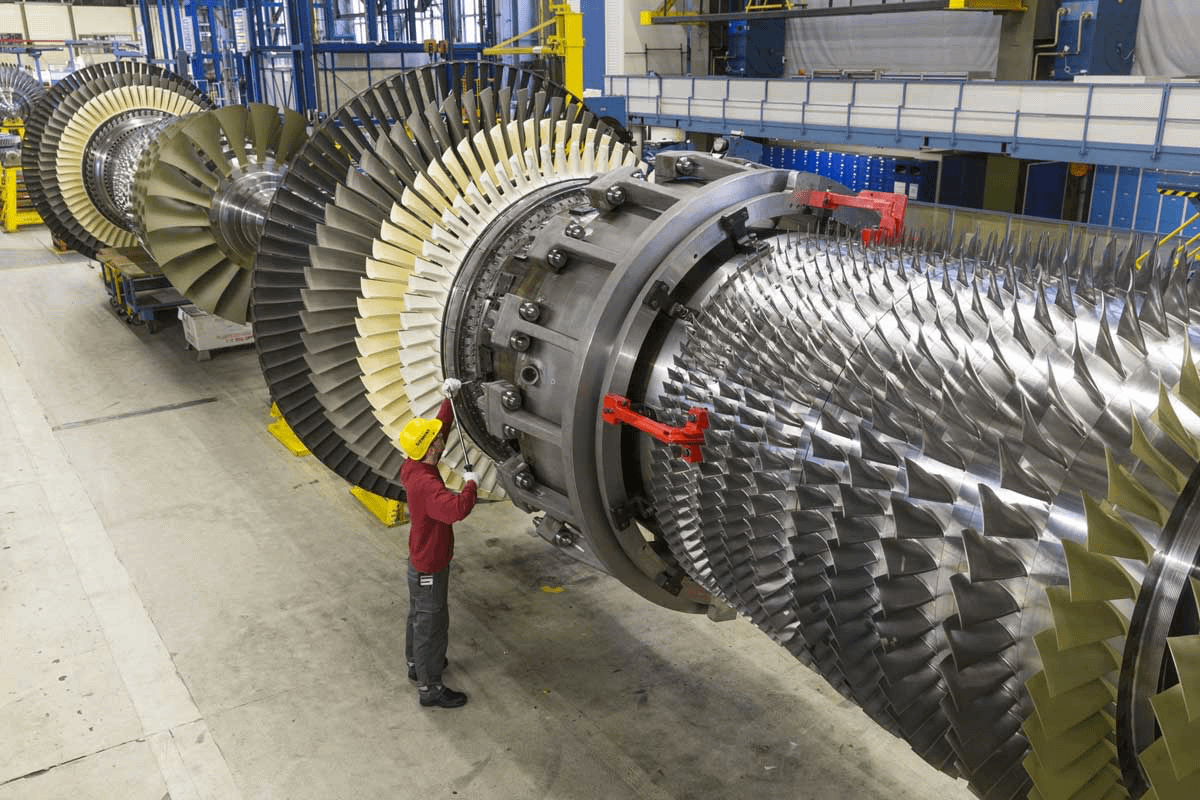
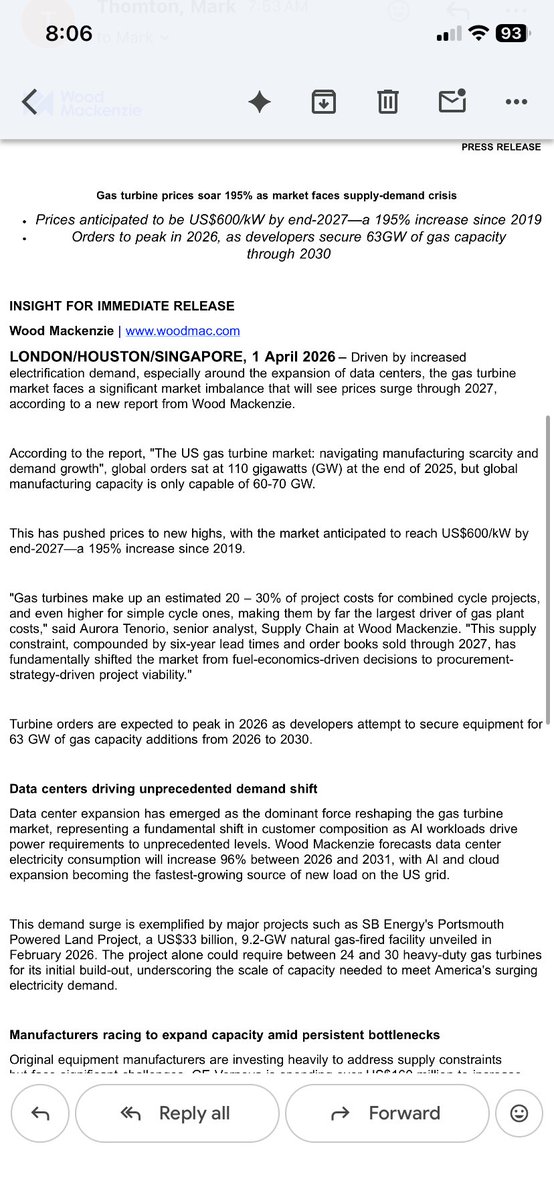
You cannot buy a new gas turbine until 2030. Order books at GE, Siemens, and Mitsubishi stretch to 2029. Turbine prices have nearly tripled since 2019. Every AI data center needs power and every gas plant needs a turbine. And every turbine has one part that bottlenecks the entire industry: The blade. It has to survive in gas 500°C above the melting point of the metal it's made from and spin at up to 20,000 RPM under 10,000 g of centrifugal force. Each blade is grown as a single crystal of nickel superalloy, pulled through a vacuum furnace at 3 mm per minute. A set of blades costs $600,000 and takes 90 weeks to grow. The same metallurgy powers modern jet engines. Only 3 companies on Earth can build one. China spent $42 billion trying to catch up. They bought a Russian fighter engine, took it apart, and copied every part. Their copy ran 30 hours between overhauls versus 400 for the original. Modern Western engines run 4,000. You can reverse engineer the shape of a turbine blade. You cannot reverse engineer 60 years of metallurgy.
China produces ~80% of its urea from coal rather than (as most other nations do) natural gas. The method is insulating Beijing from rising nitrogen fertiliser prices.
I wrote ⤵️ this @Opinion column about the Chinese coal-to-chemicals industry last June. https://t.co/TQg6HHD3J8
New US LNG export project begins operations 🇺🇸🚢
The Golden Pass plant (a JV with Qatar & Exxon) just started LNG production at 1 of its 3 trains. First export expected from 2Q
The world is scrambling for more US LNG as the Middle East conflict disrupts 20% of supply
BREAKING from QatarEnergy and this is really big news and great news:
Golden Pass LNG, QatarEnergy’s largest investment in the United States, has achieved first LNG production from Train 1.
This is a major milestone for the QatarEnergy and ExxonMobil project in Sabine Pass, Texas, with first exports expected in Q2 2026 and a major boost to global energy security.
Wow, those are some very interesting images. The highest quality I have seen to date, with some valuable information. Thank you for sharing.
If you are asking what I see, well, first understand a couple things. I am not a military person, or familiar with bomb damage assessment. Nor am I a political person, or economist. I just build and operate the hardware. So I’ll tell you what this looks like from a hardware perspective, and label things that are objectively facts vs. things I am guessing at or if I put any opinions in.
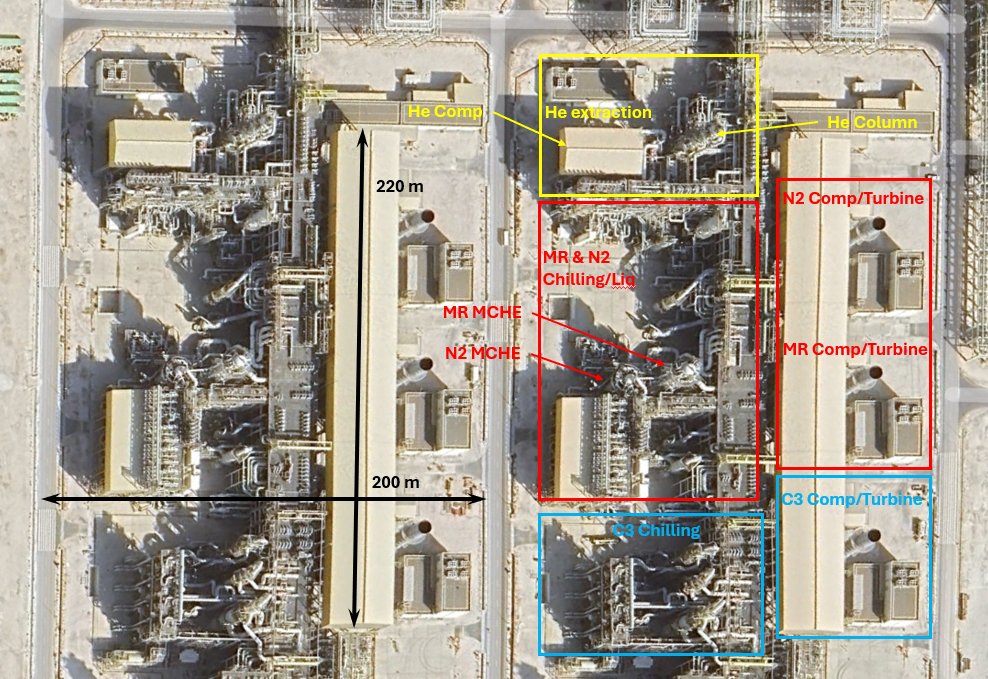
With those caveats, here are some facts and my analysis of the Train 6 strike. I’ve attached two pictures. The first is the undamaged facility from happier days. I’ve labelled the north end of the train with some color coded boxes, and a couple dimensions on Train 7 to give a sense of scale.
Train 6 used an Air Products (now Honeywell) AP-X process, which has three refrigeration loops in series, each driven by a Frame 9 mechanical drive turbine – a propane (C3) loop, a mixed refrigerant (MR) loop, and a nitrogen expansion (N2) loop. Propane precools the feed gas and the refrigerant, the MR liquefies it, and the N2 subcools it all the way to -160 C.
At the southern most portion of the photo, in blue, there is the propane refrigerant system. Process equipment is to the west of the main spine rack, and the driver is to the east. Drivers include both the turbine and the compressors on a single shaft for each loop, and they are located under the 220 m long turbine building with the tan roof. Exhaust stack is immediately to the east turbine building, with the VFD components just south of the stack.
The red boxes in the middle are the primary liquefaction section, with two machines on the east in the turbine building, and the main cryogenic heat exchangers (MCHEs) on the west side of the rack. I’ve labelled the MCHE’s. The larger is the MR MCHE, which is about 50 m tall, and has a two inch thick aluminum shell. The N2 MCHE for gas subcooling is a little further to the west. It is shorter and has a stronger stainless steel shell; it is a substantially stouter piece of equipment. These two MCHEs combined are in the range of $50-100MM capital cost with a two year lead time.
The yellow box at the top is the helium extraction unit. The machinery is electrically driven compander, inside the small building, and the primary separation column is just to the east of the building.
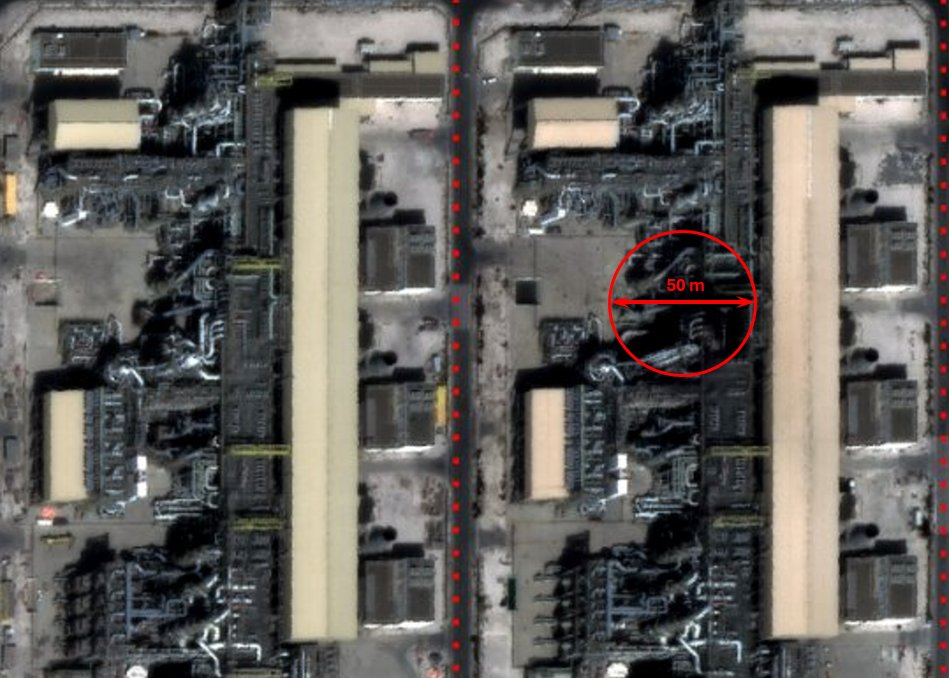
With the basics out of the way, take a look at the second picture. I’ve marked where the missile impacted, and the visible area of damage; the shadows disguise some of the blast and make it a bit harder to see. But from my view, it is quite bad, having hit immediately north of the MR MCHE, doing a fine job of messing up the equipment in the liquefaction section. Compare to Train 7 next door. I’ve marked the approximate circle of visible damage, which indicates an immediate blast radius on order of 50 meters. While I’m not military, it is pretty easy to calculate the energies involved, which indicates to me that we are talking about something on order of ~100 kg HE warhead. Sizable enough to do some real damage, but not a catastrophic hit from 500 kg or more. I am a bit surprised I could not see more damage from the subsequent fires. Qatari emergency crews responded to the fires, and it appears to me they did quite well at extinguishing them quickly before significant escalation.
Note the precision of the hit. If I were responsible for targeting this facility, … well, I couldn’t do it, because I love these facilities and the machines in them too much. But if a hypothetical person who knew about the facilities and wanted to harm them was planning it, this is just about where they would place a strike to cause maximum damage. Possibly a little further to the southeast to strike right on top of the MR turbine, but certainly within about 50 meters of the actual strike point. That will give a feel for the CEP of these missiles. It is quite good, which I understand is not at all a given for nations building missiles. Remember the notorious inaccuracy of the Iraqi Scuds during the 1991 Gulf War. The Iranians don’t suffer from the same problem – they can hit what they aim at with considerable precision despite American and Gulf nation efforts at interception at one of the most heavily defended areas in the Gulf. In fact, in Qatar, this site is probably the most heavily defended site, only excepting Al Udeid air base and Doha itself.
What was damaged? The resolution is not adequate to fully identify everything – you’d really need a walk through to be sure. But it is clear the MR MCHE is destroyed, along with some of the smaller pieces of equipment around there. The N2 MCHE is still standing, but there is some visible damage. I’d guess that, even with the shell standing, a missile strike this close would complete destroy soft items – insulation, instruments, cabling, platforms – and likely perforate the shell with fragments such that it would be unusable as a pressure vessel. My best guess is the N2 MCHE will require replacement.
To the east, the turbine housing roof appears undamaged, but I think this is deceptive. The roof is about 40 meters high, and the missile blast wave will initiate below it and propagate sideways under the pipe rack and through the building. Both the N2 and MR machines are close to the blast point and likely received a significant overpressure, along with heat from the subsequent fire. I have no doubt they are damaged. Frame 9's are robust and reliable industrial machines, but they are not designed for missiles. Whether they can be repaired or will need to be replaced is an open question.
North of the impact point, I suspect the helium machine was protected from significant damage by the intervening piperack. However, the column protrudes above the piperack and probably caught an overpressure and significant fragmentation. My guess here is the helium column was likely perforated and will require major repair or replacement.
To the south, the MCHE’s and piperack absorbed most of the damage and my best guess is the propane system is likely undamaged, or only suffered minor damage.
Qatar has said the train will require 3 – 5 years to be back in operation. In my mind that seems a little conservative. If they can get to work immediately, and expedite procurement, I would guess about three years is a reasonable timeline. Five years I think is longer than will be required, absent another attack causing further damage.
Analysis? This is speculation on my part, and anyone might well disagree. But it appears to me that Iran was sending a message more than simply just trying to destroy. They used a precise missile, but with a somewhat smaller warhead, one that is large enough to cause heavy damage, but not so large as to cause catastrophic irreparable damage to the entire train or even to multiple trains. They also targeted two trains that are jointly owned with the Qataris by ExxonMobil. (Puzzle question – why did the second missile strike Train 4 instead of the larger Qatar-XOM Train 7? Or maybe they did try to hit Train 7, but that missile was intercepted? Don’t know…). But they conspicuously avoided hitting the trains that are co-owned by Japanese or Korean partners, trying to keep them onside or neutral in the war. To me, this strike seems to say, “Look Qatar and XOM – we can hurt you. But we didn’t hurt you as much as we could, and we want you to use your influence to get the US to stop and restore the status quo ante.” Whether that will work is for the political people to say. I do know the Qataris are royally ticked off at this attack.
Anyway, that is my read on it. It is definitely a very bad attack, one that caused substantial damage and will impact Qatari production for years. I am not trying to play down the impact in any way. But it is simultaneously true that it *could* have been worse.
I’ll look at the Train 4 strike when I can. Looks like the miss was a bit more there – it struck southwest of the turbine house, looks like it affected the propane equipment. These reviews take a bit of time, and I am chronically short of that commodity. But thank you again for sharing these photos.
Today, Venture Global and @vitolnews announced the execution of a new, binding agreement for the purchase of approximately 1.5 million tonnes per annum (MTPA) of U.S. liquefied natural gas (LNG) from Venture Global for five years commencing in 2026, to be supplied from Venture Global’s portfolio.
https://t.co/kYI5QZuRPP
When I tell you LNG volumes from US to Europe comes from japan and not US. JERA just got degas capacity at France’s Dunkirk terminal for 6 years from 2031 for this exact reason
QatarEnergy says that two of its 14 trains were damaged — with 17% of supply to be offline for 3-5 years
That’s the equivalent of a normal LNG export project. Thats big, and further pushes back the LNG glut
Nat gas futures through the roof globally but US prices haven’t budged. America now in a position to fill the gap because I approved TWELVE LNG export facilities as @ferc Chair. While addressing emissions. Took heat for doing so from all sides. History proving me right. Again 😁