$NOCKAI is live on @SurplusRH.
The model behind it is Nock Coder: open weights, Apache 2.0, a 986 MB file that runs on the laptop you already have.
→ code first answers, plus Solidity for Robinhood Chain builders
→ Windows, macOS, Linux, no GPU needed, works with the Wi-Fi off
→ every raw test answer public, misses included
→ Surplus serves the exact Hugging Face commit we launched
Trading fees pay for the GPU that serves it.
CA: 0xb0f444a069d9264017610e0674ebf7e1d6e19cbb
It’s chat only for now: inline suggestions in VS Code don’t use local models. Best for snippets, fixes and single functions. Review the code before you run it.
Nock Coder now works inside @code.
Install the @ollama extension, open Chat, pick nockai/nock-coder. Ask about your code and the answer starts with the code.
986 MB on your laptop. No API key. Works with the Wi-Fi off.
Guide: https://t.co/dhl4zR4nrf
Same question. Two models.
The base model writes 140 words. Nock Coder writes 23, and the first line is code.
Across all 50 test prompts: 50 words on average vs 185.
Both answers unedited. All of them are public: https://t.co/0GXDJhFzsc
5.9 GB for agent behavior is a great deal.
The other end of the range: 986 MB for quick, code first answers when you don't need an agent. Runs fine on a CPU.
> ollama run nockai/nock-coder
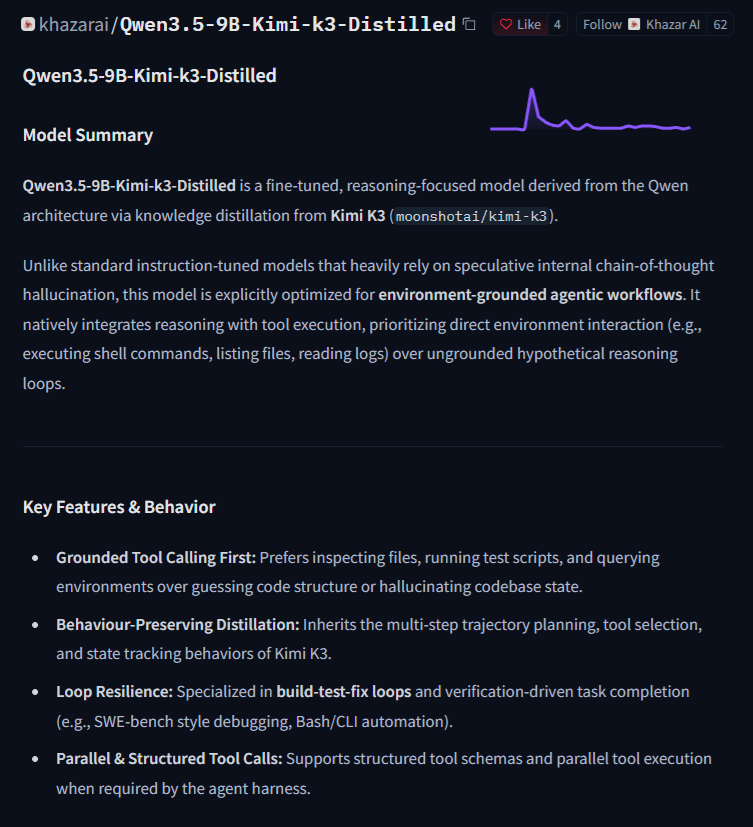
Kimi K3 is a 2.8-trillion-parameter model.
Someone is distilled its coding-agent behavior into Qwen3.5-9B and the Q4 GGUF is 5.9GB.
Not Kimi's 2.8T parameters but its behavior.
The training set captures 582 real Kimi K3 agent trajectories:
🔎 inspect repos
🛠️ call tools
🧪 run tests
🐛 debug failures
🔁 fix → test → retry
Those become 3,956 next-step training examples.
The idea is to teach little Qwen not to guess what's in the repo but look.
And it's already packaged for:
💾 Q4_K_M → 5.9GB
🦙 llama.cpp
🖥️ LM Studio / Ollama
🔓 Apache 2.0
This is one to try.
Link in ALT.
It's a 1.5B model, so it gets things wrong. Every score, including the misses, is public.
Model page: https://t.co/hAj95IX5j1
Results: https://t.co/0GXDJhF1CE
Nock Coder is now in the @ollama library.
> ollama run nockai/nock-coder
One command, 986 MB, and it answers with the code first. No account, no API key, no GPU needed.
Already pulled it from Hugging Face? Same file, same model.
https://t.co/cxGKPAbivd still works. The library name is just shorter to type, and easier to find in Ollama search.
Fair question. Measured, not vibes:
HumanEval: 118 of 164 Python problems solved, the base model gets 112.
Speed: about 105 tokens/s on a laptop GPU. On 2 CPU cores with no GPU, a full answer takes about 8 seconds.
Great for snippets, fixes and small functions. Not for big multi-file refactors.
Every raw answer: https://t.co/eTqGJTWFhs
Nock Coder is live on @SurplusRH.
One API key, one line:
model="launch/Nock-AI/nock-coder-1.5b@18859c0"
$0.03 per 1M tokens, served on its own GPU, pinned to the exact Hugging Face commit it launched with.
Prefer offline? The 986 MB file still runs free on your laptop.
Nock's model is live on Surplus 🟢
nock-coder-1.5b by @useNockAI graduated on the launchpad, and the keeper put it on its own GPU. Nobody deployed it by hand.
First paid call: a correct palindrome function, 122 tokens, about 2 seconds.
model: launch/Nock-AI/nock-coder-1.5b@18859c0
price: $0.03 / 1M tokens
Every call pays the builder 30%.
https://t.co/j5noLuilaf
Running it locally gets you v2.1 now. Already have v2? Run the pull command again.
The live demo on https://t.co/Sm5F7O6QCK and the @SurplusRH API still serve v2, the commit we launched with.
> ollama pull https://t.co/cxGKPAbQkL
Nock Coder v2.1 is out!
HumanEval: 118 of 164. v2 got 104. The base model it was trained from gets 112.
Same 986 MB file. Still code first on 50 of 50 prompts.
For coding, this isn't a forecast anymore.
One 986 MB model that answers with the code first, offline, on the laptop you already have.
> https://t.co/njaGhBIJHP
On-Device AI: Why the Cloud Will Take a Back Seat
We're used to generative AI being huge server farms from OpenAI, Google, or Anthropic, processing our requests somewhere "in the cloud." But right now an unnoticed yet fundamental shift is happening: AI is moving locally — onto our smartphones, laptops, and smart devices.
Why is this the main trend of the coming years, and how will it change our interaction with technology?
Absolute data privacy
The main fear of users and businesses is sending sensitive data (personal photos, medical records, commercial documents) to someone else's servers.
With On-Device AI, the neural network runs directly in your device's chip (NPU — Neural Processing Unit).
Your files, voice, and messages never leave the gadget.
Instant response and offline operation
Cloud models depend on connection stability and server load (recall the delays in voice assistant responses).
Local AI responds with zero latency.
It works on a plane, in an underground parking garage, or in a remote forest with no network.
Economics and energy efficiency
Requests to powerful cloud models cost developers billions of dollars in electricity and servers. Moving basic tasks (photo processing, autocomplete, real-time translation, note summarization) onto users' chips reduces the load on data centers many times over.
Hybrid approach: The best of both worlds
The future belongs to hybrid systems:
Simple and fast tasks (process a photo, make a to-do list, translate a dialogue) are handled by a compact local model on the phone.
The most complex computations (write code for a large project, deep data analysis) are sent to the cloud.
What does this mean for us?
Already today, mobile processors from Apple, Qualcomm, MediaTek, and Intel are equipped with powerful neural coprocessors. Your next "super-upgrade" in a smartphone will be not so much the camera lens as the device's ability to process terabytes of your personal information with an understanding gaze right "in your pocket."
Are you ready to entrust local AI with managing all your personal data on your phone, if you were sure it doesn't go out to the network?
@gem_detecter@SurplusRH Yes. Nock Coder runs on its own GPU on @SurplusRH, and the playground on https://t.co/Sm5F7O6QCK answers through the Surplus API.
You can call it too: model="launch/Nock-AI/nock-coder-1.5b@18859c0", $0.03 per 1M tokens.
Or run the 986 MB file offline with Ollama.
$NOCKAI is live on @SurplusRH.
The model behind it is Nock Coder: open weights, Apache 2.0, a 986 MB file that runs on the laptop you already have.
→ code first answers, plus Solidity for Robinhood Chain builders
→ Windows, macOS, Linux, no GPU needed, works with the Wi-Fi off
→ every raw test answer public, misses included
→ Surplus serves the exact Hugging Face commit we launched
Trading fees pay for the GPU that serves it.
CA: 0xb0f444a069d9264017610e0674ebf7e1d6e19cbb
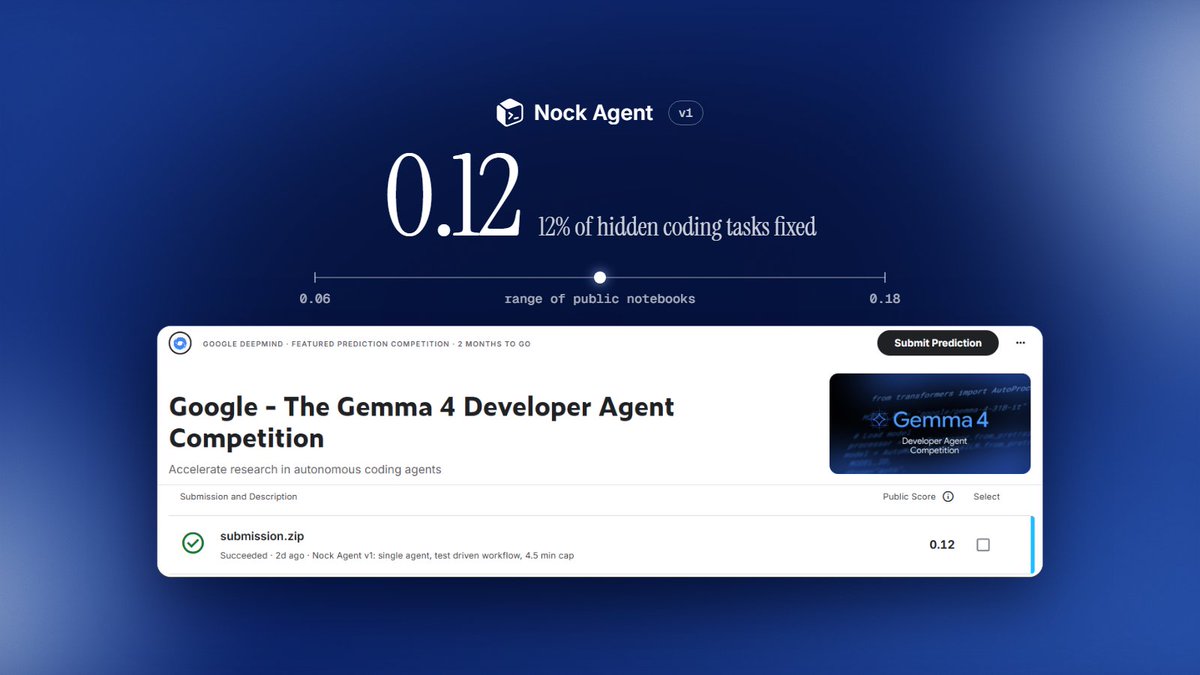
First score from the @googlegemma 4 Developer Agent Competition is in.
Nock Agent v1: 0.12. That's 12% of hidden coding tasks fixed, on one model, with a 4.5 minute cap per task.
Public notebooks sit between 0.06 and 0.18. We're in the middle. Next version changes one thing at a time.
The Nock Coder playground is live on https://t.co/Sm5F7O6iNc.
Type any coding question in the box at the bottom. The answer comes from the real model, served on @SurplusRH.
No signup. Code first.
Nock's model is live on Surplus 🟢
nock-coder-1.5b by @useNockAI graduated on the launchpad, and the keeper put it on its own GPU. Nobody deployed it by hand.
First paid call: a correct palindrome function, 122 tokens, about 2 seconds.
model: launch/Nock-AI/nock-coder-1.5b@18859c0
price: $0.03 / 1M tokens
Every call pays the builder 30%.
https://t.co/j5noLuilaf