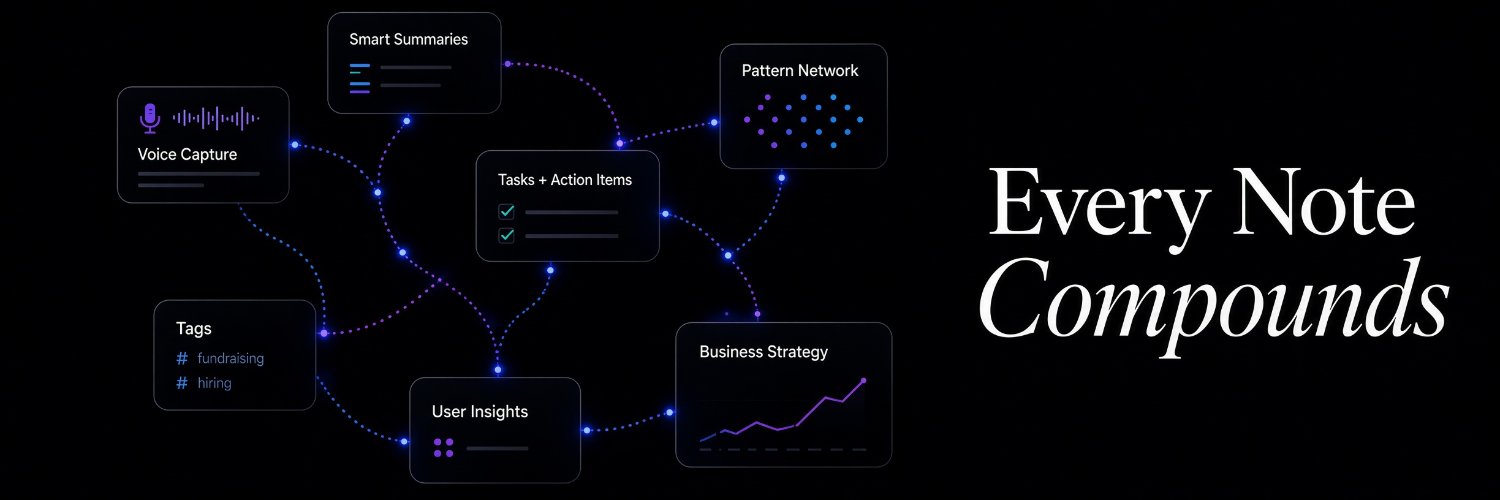
The Compass waitlist is open 🧭
A voice-first notebook that thinks with you. Say what's on your mind, it captures it, then surfaces the ideas, patterns and people you'd have missed.
Every note compounds.
Claim your founding spot 👇
Nous kept its agent MIT licensed and still raised at a billion-dollar valuation. The license is the distribution. The record is the asset.
What compounds is what your company decided, why, and what it learned the week after. That part doesn't live in a repo.
Every agent demo hits the same wall: the company it has to work inside.
Aaron Levie says the constraint is grounding agents in real work. This week brought a free simulated enterprise and a startup selling agents a live picture of a real one.
You can't simulate yours.
Carnegie Mellon and Microsoft Research surveyed 319 knowledge workers and collected 936 examples of AI use on real work tasks. The result that should worry a founder is the sign flip.
Confidence in the AI doing the task correlated with less critical thinking. Confidence in your own ability to do the task correlated with more.
The effort relocates. People spend their hours verifying, integrating and stewarding output that arrived from somewhere else instead of solving the problem themselves. In the knowledge and analysis categories, roughly 7 in 10 examples were reported as less effort than doing it alone.
The paper reaches back to Lisanne Bainbridge's 1983 observation about automation, and it lands hard in 2026. Mechanize the routine, leave the exceptions to the human, and you remove the daily reps that build judgment.
Nothing looks broken when that happens. The judgment just never gets trained.
The practical version: make the output arrive with its argument attached. A plan with no reasoning behind it gives your team nothing to push against, and the push is the thinking.