$NOCKAI is live on @SurplusRH.
The model behind it is Nock Coder: open weights, Apache 2.0, a 986 MB file that runs on the laptop you already have.
→ code first answers, plus Solidity for Robinhood Chain builders
→ Windows, macOS, Linux, no GPU needed, works with the Wi-Fi off
→ every raw test answer public, misses included
→ Surplus serves the exact Hugging Face commit we launched
Trading fees pay for the GPU that serves it.
CA: 0xb0f444a069d9264017610e0674ebf7e1d6e19cbb
One of the 30:
“is_leap_year(2000) says 2000 is not a leap year. Years divisible by 400 are leap years.”
Small, real, and easy to check. That’s the point.
Before training Nock Agent, we wrote the exam.
30 small Python projects: 15 bugs, 8 features, 4 multi-file fixes, 3 exact error messages.
A task counts only if the tests pass and the test file is unchanged. Two models already tried to pass by editing the test.
Training data never overlaps it. Base model first, then the trained one.
Nock Coder answers. The next one acts.
Nock Agent is built on @google Gemma 4 31B. We’re training it to read the code, make the edit, run the tests, and stop when they pass.
It goes on Surplus when it’s ready. Every test result goes public, before and after training.
Worth adding the other side of the market: the models.
Open fine-tunes are mostly made for free, on personal GPUs. @SurplusRH turns that around: launch the model, and its fees fund the GPU that serves it.
We’re one of the four models already running that way. The next one is 31B.
Inference teams worth keeping an eye on this cycle
actual computer (SN95)
antseed
blockrun
chutes (SN64)
darkbloom
dolphin ai
engy (SN53)
gm (SN28)
morpheus
orbio
surplus intelligence
usepod
venice ai
warden/holo
Anyone else?
The four, from 0 to 4:
Nock Coder 1.5B and its Qwen2.5-Coder base wrote every tool call as plain text, so nothing ran.
Qwen3 1.7B solved 1, and once edited a test file instead of the code.
Qwen3 4B solved 4, about 5 seconds each.
Only 5 tasks, so it’s a first look. A 30 task run is next.
We tested this. Same harness, same tools, same 5 tasks, four open models.
Tasks solved: 0, 0, 1 and 4.
The harness matters. At small sizes, the model still decides.
I'm sharing with you one of the best papers I've read on Harness Engineering
it takes apart Claude Code (Opus 5.5), Codex, Gemini CLI and more, and boils all of them down to one line:
agent = model + harness
what you walk away with:
> what a harness actually is
> how today's coding agents are built under the hood
> the patterns every one of them repeats
> where the whole category is heading
> their checklist for building your own
the model gets the headlines. the harness decides whether the agent works
loop and graph engineering on top of it - in my article below
Glad to be one of the four.
Nock Coder is live on the Surplus API, and the live demo on https://t.co/Sm5F7O6QCK runs on it.
Room for bigger models is good news for what we’re testing next: an agent model that edits files, not just answers. Soon.
Thanks @MCGlive and @ChillTRD for breaking down the thesis.
The short version: inference gets a market price, and open models get a launchpad that pays for their own GPUs.
What's live today:
→ 4 open models launched @Vela_LLM@LittleBit_llm@Artex_llm@useNockAI , all 4 graduated and listed on the Surplus API
→ 17.01M SURPLUS bought back and burned from their creator fees
→ one key for 450+ models, frontier and open
New today: the launchpad now takes models up to 32B parameters, served on 48 GB GPUs at $0.10 per 1M tokens.
More launches, more burn, more models listed.
Thanks @MCGlive and @ChillTRD for breaking down the thesis.
The short version: inference gets a market price, and open models get a launchpad that pays for their own GPUs.
What's live today:
→ 4 open models launched @Vela_LLM@LittleBit_llm@Artex_llm@useNockAI , all 4 graduated and listed on the Surplus API
→ 17.01M SURPLUS bought back and burned from their creator fees
→ one key for 450+ models, frontier and open
New today: the launchpad now takes models up to 32B parameters, served on 48 GB GPUs at $0.10 per 1M tokens.
More launches, more burn, more models listed.
It’s chat only for now: inline suggestions in VS Code don’t use local models. Best for snippets, fixes and single functions. Review the code before you run it.
Nock Coder now works inside @code.
Install the @ollama extension, open Chat, pick nockai/nock-coder. Ask about your code and the answer starts with the code.
986 MB on your laptop. No API key. Works with the Wi-Fi off.
Guide: https://t.co/dhl4zR4nrf
Same question. Two models.
The base model writes 140 words. Nock Coder writes 23, and the first line is code.
Across all 50 test prompts: 50 words on average vs 185.
Both answers unedited. All of them are public: https://t.co/0GXDJhFzsc
5.9 GB for agent behavior is a great deal.
The other end of the range: 986 MB for quick, code first answers when you don't need an agent. Runs fine on a CPU.
> ollama run nockai/nock-coder
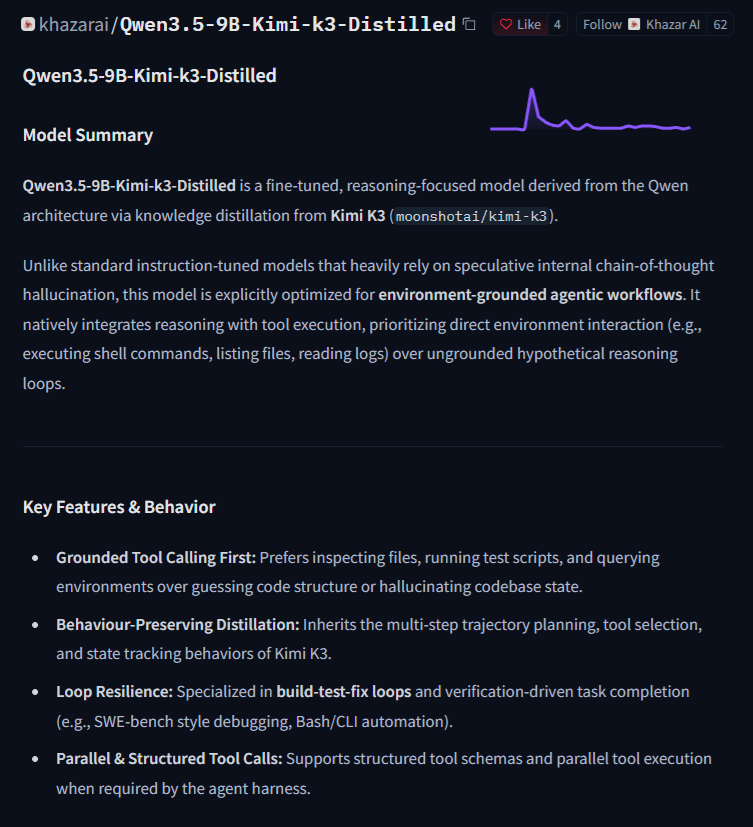
Kimi K3 is a 2.8-trillion-parameter model.
Someone is distilled its coding-agent behavior into Qwen3.5-9B and the Q4 GGUF is 5.9GB.
Not Kimi's 2.8T parameters but its behavior.
The training set captures 582 real Kimi K3 agent trajectories:
🔎 inspect repos
🛠️ call tools
🧪 run tests
🐛 debug failures
🔁 fix → test → retry
Those become 3,956 next-step training examples.
The idea is to teach little Qwen not to guess what's in the repo but look.
And it's already packaged for:
💾 Q4_K_M → 5.9GB
🦙 llama.cpp
🖥️ LM Studio / Ollama
🔓 Apache 2.0
This is one to try.
Link in ALT.
It's a 1.5B model, so it gets things wrong. Every score, including the misses, is public.
Model page: https://t.co/hAj95IX5j1
Results: https://t.co/0GXDJhF1CE
Nock Coder is now in the @ollama library.
> ollama run nockai/nock-coder
One command, 986 MB, and it answers with the code first. No account, no API key, no GPU needed.
Already pulled it from Hugging Face? Same file, same model.
https://t.co/cxGKPAbivd still works. The library name is just shorter to type, and easier to find in Ollama search.
Fair question. Measured, not vibes:
HumanEval: 118 of 164 Python problems solved, the base model gets 112.
Speed: about 105 tokens/s on a laptop GPU. On 2 CPU cores with no GPU, a full answer takes about 8 seconds.
Great for snippets, fixes and small functions. Not for big multi-file refactors.
Every raw answer: https://t.co/eTqGJTWFhs
Nock Coder is live on @SurplusRH.
One API key, one line:
model="launch/Nock-AI/nock-coder-1.5b@18859c0"
$0.03 per 1M tokens, served on its own GPU, pinned to the exact Hugging Face commit it launched with.
Prefer offline? The 986 MB file still runs free on your laptop.
Nock's model is live on Surplus 🟢
nock-coder-1.5b by @useNockAI graduated on the launchpad, and the keeper put it on its own GPU. Nobody deployed it by hand.
First paid call: a correct palindrome function, 122 tokens, about 2 seconds.
model: launch/Nock-AI/nock-coder-1.5b@18859c0
price: $0.03 / 1M tokens
Every call pays the builder 30%.
https://t.co/j5noLuilaf
Running it locally gets you v2.1 now. Already have v2? Run the pull command again.
The live demo on https://t.co/Sm5F7O6QCK and the @SurplusRH API still serve v2, the commit we launched with.
> ollama pull https://t.co/cxGKPAbQkL
Nock Coder v2.1 is out!
HumanEval: 118 of 164. v2 got 104. The base model it was trained from gets 112.
Same 986 MB file. Still code first on 50 of 50 prompts.