We built SensAI because we got tired of workout apps that ignore everything your body is telling you.
You own an Apple Watch. You track HRV, sleep, resting heart rate. And your app still says "Monday: Chest Day" no matter what.
Does cardio kill your gains?
This debate restarts every week. One camp says Zone 2 is non-negotiable for health and work capacity. The other camp says every hour on the bike is an hour of recovery stolen from your squat. Both camps quote the same word: interference.
The interference effect is real. It's also one of the most misread findings in training research.
The original study (Hickson, 1980) had people doing hard cardio six days a week on top of lifting. Strength stalled around week eight. That result gets quoted as "cardio blunts strength." What it actually showed is that near-maximal cardio, six days a week, blunts strength. Nobody arguing about Zone 2 is running that protocol.
The fuller picture looks different.
A 2012 meta-analysis (Wilson et al.) found interference scales with three things: modality, intensity, and volume. Running hurt strength and muscle growth more than cycling did. Longer and more frequent cardio hurt more than short and occasional.
A 2022 meta-analysis (Schumann et al.) went further: concurrent training didn't meaningfully compromise muscle growth or max strength at all. The only consistent casualty was explosive power, and that showed up mainly when cardio and lifting were crammed into the same session.
So the honest summary: low-intensity cardio, scheduled well, costs you almost nothing. The interference everyone fears comes from intensity creep and bad spacing, not from cardio itself.
Lifters keep reporting the same pattern. A same-day bike ride at true Zone 2 leaves tomorrow's lifts untouched. The same ride at "slightly harder than Zone 2" shows up as heavy legs the next morning. Runs cost more than the effort suggests, because impact adds fatigue that pace doesn't capture.
The scheduling rules that fall out of all this:
1. Pick the bike over the run when lifting is the priority. Cycling shows the least interference in the data, with no impact fatigue on top.
2. Keep Zone 2 actually in Zone 2. You should be able to hold a conversation the whole time. The moment it turns into "pretty hard," you're paying next-day costs without building your aerobic base any faster.
3. Lift first, cardio after, if they share a day. Fresh legs go to the barbell.
4. Separate sessions beat one combined session. A morning ride and an evening lift, or different days entirely. Session separation is what protected power output in the 2022 data.
5. Cap the volume. Two to four Zone 2 sessions of 30 to 60 minutes a week buys most of the aerobic benefit. Past that you're trading recovery for diminishing returns.
6. Protect the 48 hours before a heavy lower-body day. If squats are Monday, Sunday isn't the day for your long ride.
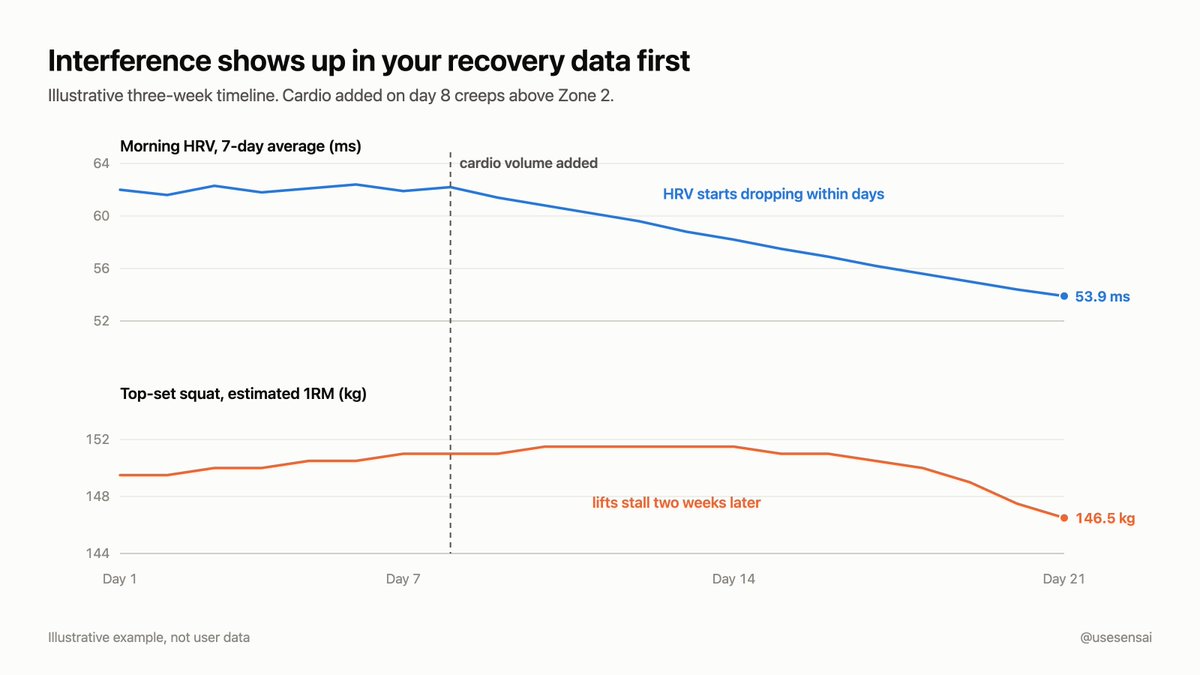
One thing the whole debate misses: interference isn't invisible while it's happening. It shows up in your recovery data before it shows up in your lifts. Morning HRV trending down across a week, resting heart rate creeping up, sleep quality dropping... that's the fatigue cost of your cardio arriving early, while you still have time to adjust. If you wait for your lifts to stall, you find out three weeks too late.
That's why "does cardio kill gains" is the wrong question. The better question: is your body absorbing this week's combined load? Your wearable answers that every morning. We built SensAI around that loop, so yes, we're biased... you can run the same check yourself with nothing more than a morning HRV trend.
Keep the bike. Watch the numbers. Your squat will be fine.
Recovery used to be a vibe. Now it's measurable. HRV tells you if your nervous system recovered. Sleep stages tell you if you actually rebuilt. Resting HR confirms it. SensAI reads all three before writing tomorrow's session. https://t.co/yu3hGFkenV
Recovery: Where the Actual Growth Happens
Most lifters optimise their training. Almost none optimise their recovery. This is the single greatest missed opportunity in natural bodybuilding.
Training doesn't build muscle. It destroys it.
High-intensity effort creates micro-tears in muscle fibre. That's the stimulus. The body then repairs those fibres during recovery, making them slightly larger and stronger. If training is the signal, recovery is the response.
The four pillars of recovery:
1. Sleep (8 hours, non-negotiable). Growth hormone is released primarily during deep sleep. Protein synthesis peaks during sleep. For a natural lifter, 8 hours isn't a preference. It's a training requirement.
2. Nutrition. Protein provides amino acids for repair. Carbohydrates restore glycogen and blunt cortisol. Sufficient calories support muscle growth.
3. Stress management. Cortisol directly inhibits protein synthesis and muscle repair. A stressful week combined with five training sessions is a recovery disaster for a natural lifter.
4. Time. Enough rest between sessions for supercompensation to complete.
You cannot out-train poor recovery. You cannot compensate for inadequate sleep with extra sets.
The simplest improvement most people can make isn't a new programme. It's adding one consistent hour of sleep per night and tracking strength over four weeks.
The results will be convincing.
#HeavyDuty #Recovery #HIT #Sleep #NaturalLifting
@shineyd1111@primenic_eth HRV 20 to 80 during a comeback from injury. The data's tracking everything. What it won't tell you is whether tomorrow needs a full session, active recovery, or actual rest. SensAI reads those numbers and figures it out.
Garmin just dropped a $200 tracker with HRV/sleep/readiness and no subscription required. Great for data. The part that's still on you: seeing a 42% readiness score with squats programmed and figuring out what to change. https://t.co/oSnShr3tYk
🏃🏻Garmin just declared war on Whoop.
The company unveiled the CIRQA Smart Band, a screenless fitness tracker that costs $200 and requires no subscription.
Here’s what it offers:
▪ Up to 10 days of battery life
▪ Tracks 80+ activities automatically
▪ Heart rate, HRV, Pulse Ox, skin temperature, stress & sleep tracking
▪ Body Battery, Training Readiness, VO2 Max, Recovery Time & more
▪ GPS through your paired phone
▪ 5 ATM water resistance
It comes in Black, Captain Blue, French Gray, and Mauve.
Price: $199.99
Orders open: July 24.
Whoop made subscriptions feel normal.
Garmin is betting they don’t have to be.
42.7% of U.S. adults are obese right now. The same era as step counters, sleep trackers, and calorie apps. People aren't missing data. They're missing what to actually do with it today. https://t.co/zr7c4W8SOS
@ma_nuel007_ Squat lag is almost never effort. It's unstructured: no planned climb, just random weights each session. Squat 2x/week, log your top set, add 2.5kg only when the last one felt clean. Your log is the bar, not the 100+ guys. SensAI builds that plan: https://t.co/1ok7neTJtJ
@farley_mic64208@GretchenPSmith Start simple: 3 days/week full-body, compound lifts (squat, bench, row, deadlift), add a rep or small weight each week. Consistency with a basic plan beats the perfect one. SensAI builds personalized AI programs around your goals → https://t.co/ZArC3y7Iy4
Every cigarette takes about 20 minutes off your life. An hour of running adds roughly 7 hours back. Your daily habits are a running ledger... they compound in both directions. https://t.co/KwUhj4meLP
What happens if you sleep 5 hours a night for a week? Days 1-2 you just feel tired. By day 4 you'd swear you've adjusted... really you've just stopped noticing. Your HRV trend keeps sliding. One long night won't fix it. Clearing the debt takes 5 to 9 nights.
Deload dread is real. The reframe that fixed it for me: the deload week is when the growth from the last 6 weeks actually shows up. You're not losing a week — you're cashing one in. https://t.co/tss4uc0wJN
Solid list. One upgrade on #3: 'deload every 6–8 weeks' is a calendar guess. Your HRV trend, sleep, and rep quality already know which week you actually need it — some blocks it's week 5, some it's week 9. The calendar doesn't know. Your data does. https://t.co/qnpwSRlviJ
3. Poor recovery
Muscles grow ONLY when you rest.
Without recovery, training just breaks you down.
Fix:
• 7–9 hrs of quality sleep
• At least 48 hrs recovery
• Deload every 6–8 weeks
Rest & nutrition is usually why people don’t grow muscle, not because lack of training…
@DocBottsNY@altini_marco Marco's contextual framing is foundational — "your number vs your baseline" unlocked everything. The 2-minute pause matters whether the prompt is an app or a coffee ritual.
'Pairing exercise with HRV monitoring' -- yes. But for most people, HRV goes into a dashboard, gets glanced at, and changes zero about the actual session. We see this constantly. Monitoring without adjustment is just expensive tracking. https://t.co/UyFWmDKtik
10 minutes of vigorous exercise as a brain-medicine dose is gold. As a sports-medicine physician, I see the BDNF/executive-function payoff daily in concussion protocols and lifelong athlete care. Pairing exercise with HRV monitoring makes training more effective, as physiological confirmation of the ready state supports healthy progress. Exercise really is the ultimate performance + recovery tool.
Zone 2 is having a flame war on this app right now. A cardiologist calls it real medicine. A longevity doctor counters that sprint intervals raise VO2max in a fraction of the time. Someone declares it's replacing the HIIT obsession entirely, and at least one honest lifter admits he can't stand it because it bores him to death.
Notice what every take has in common: they're all arguing about whether Zone 2 works. That got settled years ago. Elite endurance athletes spend roughly 80% of their training in it, and the physiology is well mapped: 40 to 100% increases in mitochondrial density over 6 to 12 weeks, 30 to 60 grams of fat burned per hour, blood pressure reductions comparable to a starting dose of medication.
The question none of the takes answer is when. Should this Tuesday be a Zone 2 ride, a VO2max session, or a rest day? That's where real people actually get stuck, and it's why so much "Zone 2" quietly fails.
Fails how? Drift. One study found recreational runners spent only 46% of their time at low intensity even when their coaches prescribed 80%. You start the easy ride at 135 bpm feeling conversational. Twenty minutes in you're at 148 and talking in shorter sentences. You log it as Zone 2. Your body logs a moderate session: real fatigue, none of the deep aerobic adaptations you came for. Too hard to be easy, too easy to be hard. Coaches call it the grey zone, and it's the single biggest reason cardio plans stall.
The fix is a decision framework built on data your watch already collects every night. Check three numbers each morning: HRV against your own 7-day baseline, resting heart rate against its trend, and hours slept.
Green day: HRV at or above baseline, resting HR normal, decent sleep, no hard session in the last 48 hours. Spend it on intensity. VO2max intervals and heavy lifting only produce their adaptations when you're recovered enough to hit the targets, so green days are too valuable to burn on easy work.
Middle day: HRV down 5 to 10%, resting HR up 2 or 3 bpm, or a short night. This is a Zone 2 day, and this is the entire trick! Zone 2's recovery cost is so low that it stays productive on days when nothing else is trainable. Assigned this way, it turns your mediocre recovery days into base building instead of junk miles or a skipped session.
Red day: HRV well below baseline, resting HR up 5+ bpm, second rough night in a row. Rest. Zone 2 is cheap, not free.
Two calibration notes so this actually lands. First, 220 minus your age misses real max HR by 10 to 12 beats in either direction, so use your watch's lactate threshold estimate and sanity-check with the talk test: full sentences yes, singing no. Second, keep your heart rate visible mid-session, because drift doesn't announce itself.
This framework also quietly solves the boredom objection. Forty-five easy minutes feels pointless when it displaced the hard workout you wanted. It feels smart on a day your body couldn't have absorbed anything harder.
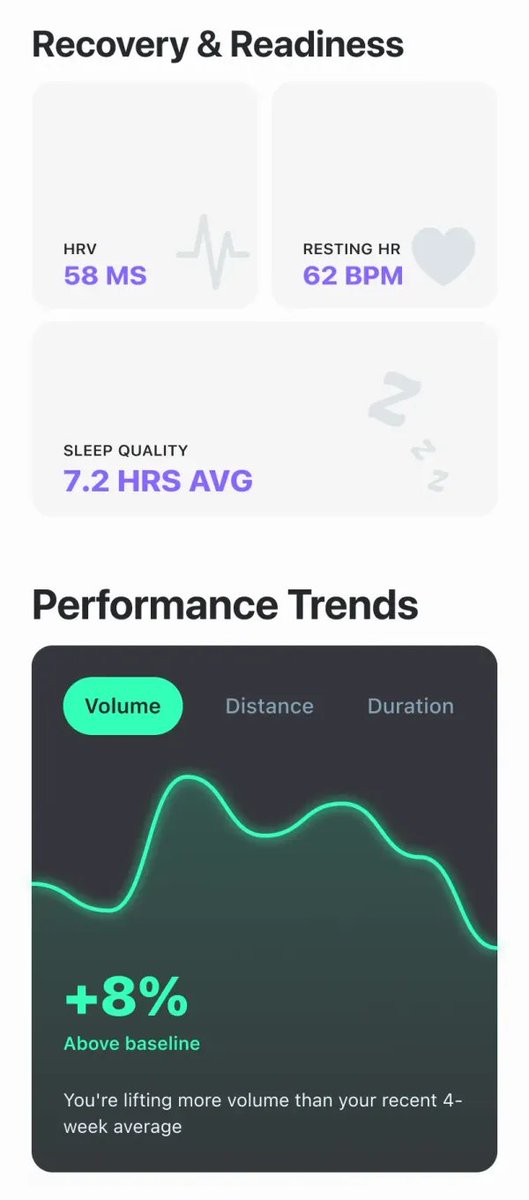
We built SensAI on exactly this loop: it reads your HRV, sleep, and resting heart rate off your watch every morning and rewrites the day's session accordingly. The screenshot shows what that looks like in practice.
Our take on the flame war: both sides are right, and neither answers the question that matters. Stop scheduling Zone 2 on fixed calendar days. Let your morning numbers assign it, then compare your pace at the same heart rate eight weeks from now.
Collecting data without adjusting next week's plan is just scorekeeping. The weekly review-and-adjust loop is where the actual progress comes from. https://t.co/Eijyx6MAwN
It’s been 41 weeks since I first injected Zepbound and started down the road to a healthier life. This past week I dropped 6 lbs. That’s more than I expected, but I think I know why. My workouts have been longer and more intense, and I’ve had little desire to eat my post-workout meal—which is arguably the most important meal of the day. As a result, my daily caloric intake has been down all week (I weigh/track all my food and macros and record everything in the Cronometer app), even though, if anything, I may need it to be higher. Additionally, since I try to eat most of my carbs during my pre- and post-workout meals, my carb intake has also been lower. Because carbs are a significant factor in fueling muscle growth, and I don’t want to keep losing weight as rapidly as I did this past week, I’ll focus on hitting my macros more consistently this coming week.
On the upside, if I can maintain a ~2 lb weekly weight loss for the next 11 weeks, when I hit the one-year mark I’ll be right about where I want to be with my weight. The next several years will then be focused on stacking muscle while slowly reducing my remaining body fat (attached body fat chart shows steady decline) to 15% or lower. Onward!