BPO companies aren’t dead. Their recent stock rally also doesn’t remove the structural risk in their current operating model.
The AI infrastructure trade fractured over the last 30 days. Capital rotated into cash-generative businesses.
https://t.co/Ft5l2yx7ui
Despite the proliferation of startup pundits over the last 25 years, no one knows how to make startups more successful.
The New Pundits have sold millions of books, and their entrepreneurship “science” is taught in universities and accelerators all over the world. But none of it has made a difference.
Startups are no more likely to survive today than they were in 1995. By some measures, they are even less likely to work.
In his latest essay, legendary venture investor @ganeumann presents the data, diagnoses the problem, and proposes something that might actually work.
It involves Robert Boyle, Peter Thiel, Paul Feyerabend, and Lewis Carroll’s Through the Looking-Glass.
https://t.co/CElsVCloYY
The skills that matter now were created by doing the work that's being automated.
We labeled it grunt work but it was the training ground where judgment and taste developed.
Cut the path from junior to senior and the problem runs deeper than a talent shortage. We're cutting the system that produced the talent in the first place.
Introspection was always supposed to have an action loop. Socrates examined so he could live better. Aurelius journaled so he could govern better.
Over the last century the action loop got removed and examination became the perpetual end state.
An entire industry exploded around keeping people examining because action ends the engagement.
Introspection was always supposed to have an action loop.
Socrates examined so he could live better.
Aurelius journaled so he could govern better.
Over the last century the action loop got removed and examination became the perpetual end state.
An entire industry exploded around keeping people examining because action ends the engagement.
There are always levels in the game, you might be crushing it and then you see someone playing at a higher level and realize you can always go further.
It sounds like hustle harder but it's not.
Excellence is a process, whether that's through pain or consistency or edge, whatever you have to do to get through it.
"Go all the way until it hurts. If you're doing something and it's easy, it's not valuable." - @travisk
"If anyone says a strategic thing was easy, I'm like, 'You messed up. You could have gone way further. More competitive advantage. More differentiation. Get it together.'"
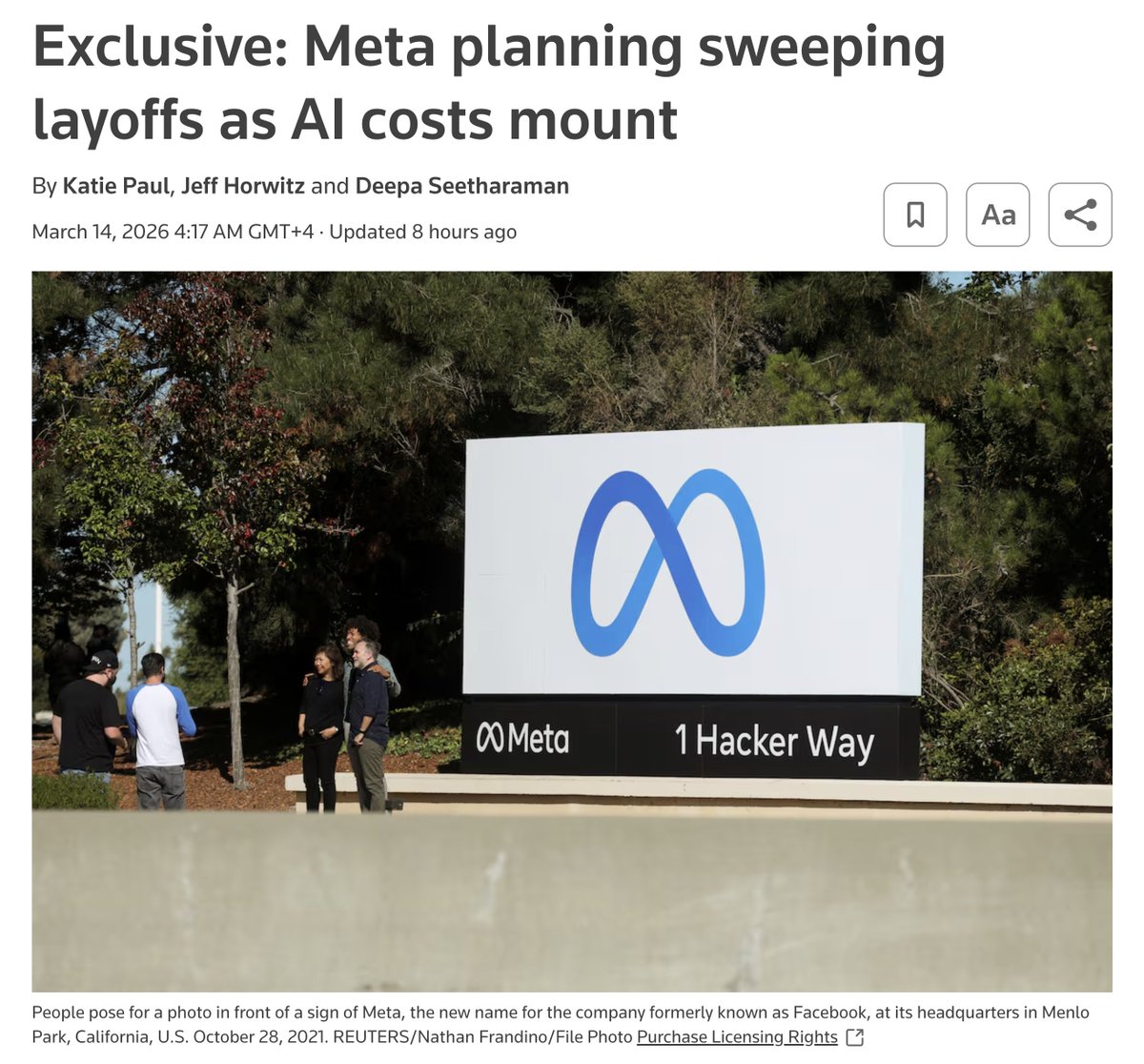
@richnanda Not doubting the capex math. The reduction definitely helps to fund the build, my point was around the salaries being offered to folks especially in the super intelligence unit and the general narrative of the rotation of certain type of labour for compute.
Firms are cutting costs and claiming transformation, but they're unwilling to let the old form die, and increasingly what's left behind is the hollowness Will writes about here.
"Projects that used to require big teams now get accomplished by a single very talented person." Zuckerberg
Society built its entire infrastructure around a normal distribution. Education, hiring, career ladders, compensation bands.
All of it assumes people are roughly average and can be trained into competence.
The system is still producing people for a bell curve world, the market is reconfiguring around the power law.
Block cuts 40% (~4,000 people). Stock jumps 24%.
Atlassian cuts 10% (~1,600 people). Stock moves 1-3%.
Both CEOs cite technology but the market reacts differently.
It comes down to leverage and whether the market believes the technology is an accelerant for your business or not.
Atlassian needs to figure out its place in the rapidly changing technology stack or it gets left behind as a tool which manages artifacts which are no longer relevant.
Atlassian CEO Mike Cannon-Brookes announced plans to cut about 1,600 workers, saying the shift to AI was a key factor behind the move https://t.co/hJQDB7FkkN
@business If the market doesn't believe that technology is an accelerant for your business, then it's not going to reward you with the stock jump, regardless of how many people the business decides to layoff.
Great piece, Dorna. I've been writing about a similar transition across professional services as a whole.
Given your own experience as a lawyer, the redlining was never what was sold to the client. The client wants the best outcome at a reasonable price and, most importantly, someone to take responsibility and ensure their bases are covered.
Until an AI agent can provide all of that, I don't believe lawyers are going anywhere. Their practices will become smaller and more automated, but you're conflating the compression of the production layer with the collapse of the profession.
The accountability and regulatory layers don't move at the same speed, and they're the ones that actually define the profession.
People aren't attached to their work. They're attached to the label the work gave them.
The label answers "what do you do," which really means "who are you."
When technology makes abundant what was once scarce, the skill compresses but the label doesn't update. Knowledge workers all point to the softer things models can't do and consider that their edge.
Mostly it's identity preservation.
Nobody voluntarily surrenders the label, it gets taken from them.
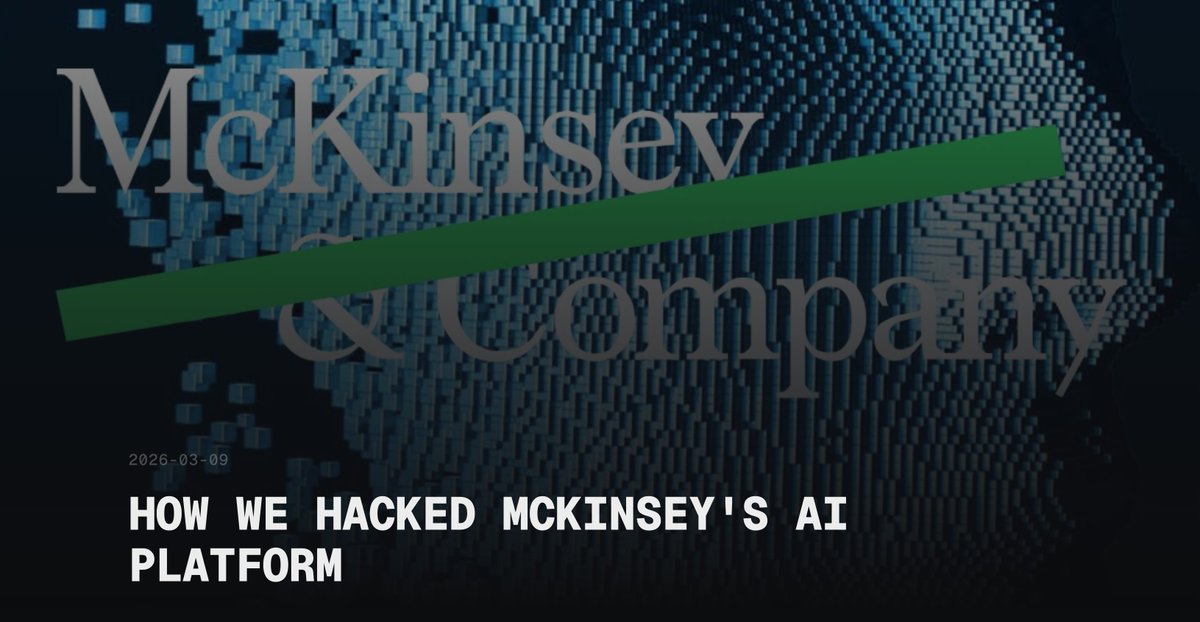
McKinsey's internal AI platform got hit by a white hat attack. The attackers found millions of chat messages and confidential docs all in plaintext.
The most concerning part of the exploit report was what they could have done. They had write access to the system prompts, the instructions that control how the AI responds.
Small changes to how 43,000 consultants receive analysis and advice. Nobody using the tool would know the prompt had changed.
Cybersecurity is about to matter a lot more than most companies think.
Also the most dangerous attacks going forward won't be data dumps. They'll be quietly adjusting the parameters that shape how people think and decide.
Every advantage an incumbent has built becomes a tax during a platform shift.
To counter this, incumbents come up with slogans:
"Reinventing Ourselves" "Transforming with You"
While it sounds smart and makes for great town hall speeches and investor presentations, that's exactly how they lose.
A 50-person competitor doesn't beat them by being smarter. It beats them by not having legacy debt and golden handcuffs, free to make the bolder decisions.