I think the build vs buy/partner logic for AI tools can be different for core knowledge work workflow vs. business enablement (ERP, CRM) workflows. Build the orchestration and workflow platform that codifies and protects your expert special sauce while buying right LLM for the right work. This is a unique opportunity/challenge for knowledge work and AI in ways that prior tech (saas, cloud, mobile) didn’t have the same impact.
@ernietedeschi Yes, and, those temp employment firms (and consulting firms, and law firms, etc.) are accountable to produce business value. If they don’t, they don’t get hired. We’re working through the jagged edges of ROI on digital labor.
@Marcus4cyb@TMTLongShort … and time to resolution is faster … and the world ends up creating / consuming more legal resolutions. Jevons paradox. Clients win. Legal professionals win. Law Firms win. It’s a winning hand for KE and others with the scale and resources to invest.
Definitely not about outpacing Frontier model innovation rather about building an orchestration and workflow platform that (a) codifies proprietary IP, (b) connects to best of breed vertical tooling, (c) leverages right LLM for right tasks. Smart move that is now commonplace in large services firms with the resources and vision.
Professional Services as humans + AI platforms. A new reality that is great for these Firms' clients, for professionals in these Firms, and for the economics of these Firms -- all thanks to AI. Renaissance > Apocalypse.
Kirkland & Ellis, the world's highest-grossing law firm, is setting aside $500M to build its own AI platform rather than rely on tools available to its rivals (Financial Times)
(Visit Techmeme dot com for the link and full context!)
Glad to see CEOs like Matt speaking up about the ridiculousness of junior talent jobs apocalypse. Need more of that, including on high school and university campuses.
@BoringBiz_ I’ll take the opposite bet. AI lifts hiring of interns and junior analysts as the volume of client needs grows and AI throttles analyst throughout.
Yep. The ability to participate in the ecosystem while shaping partnerships in your / your customers interests is a new source of competitive advantage.
If you are running a consulting business and you are deploying Anthropic or OpenAI directly into your organization (I’m looking at you PwC and Accenture) you are letting the fox into the hen house.
OpenAI and Anthropic are openly funding and starting competitors to you while also using your usage to drive more success for them.
This is not a failure on their part but a failure on your part.
Consulting businesses that understand this are adopting a control plane that allows them to arbitrate where tokens go and who generates tokens for them.
Controlling the tokens is controlling the spice (Dune).
This was a key pillar of 8090’s global partnership with EY and they key feature of our Software Factory. We control token generation and can direct them to any model provider.
We are close to another global partnership and will announce it soon.
These organizations refuse to accept the disruption standing still or, even worse, by adopting and accelerating the companies who want to disrupt them.
A couple years before making Partner, a senior Partner was coaching me on a variety of topics. He concluded, “… and you’re tall and good looking, so that’ll make up for any missteps.” It was jarring to hear in the moment, but I’ll never forget it.
The biggest source of alpha in career success is looking better and being in shape
Anyone who tells you that looks don’t matter is blatantly lying to your face
Studies have proven, time and time again, that looking better leads to better monetary outcomes
Whether it’s existing consulting firms, new ones that emerge, FDEs from agent vendors, or new internal agent engineering roles, the amount of work that is going to be created to implement agents in enterprises will exceed anything we imagine today.
The complexity of implementing agents in any existing organizations is very real. When I talk to large enterprises, as you move from a chat paradigm to agents that participate in meaningful workflows, there are a number of things they need to do.
First, you have to get agents to be able to talk to your data securely across your systems. In many cases, enterprises have decades of legacy infrastructure that contain the valuable context for AI agents. That’s going to take a ton of work to go modernize and move to systems that work well with agents.
Then, you need to ensure that you’ve implemented agents with the right access controls and entitlements, the right scopes to be safely used, and have ways of monitoring, logging, and securing the work that they do.
Next, you need to actually document the processes in the organization in a way that agents can utilize for doing the work. You also need to figure out what the new workflow looks like when agents and people are working together on a process, and who steps in where. Just replicating the old workflow will mute the gains. Oh and you likely need to create evals for your top new end-state processes.
Finally, you have to keep up with a rapidly changing set of best practices and architectural shifts happening in the agent space. While it’s fun for people to change their personal productivity tools on a dime, it’s 100X harder to do this in a business process. The speed of change is a blessing and a curse right now for anyone trying to keep a stable system design.
All of this means that individuals and companies that develop expertise on the above set of components (and more) are going to be needed to help organizations actually implement agents at scale. This is also the rationale for vertical AI agents right now that can go in deep on a business domain and help bring automation to it.
This is a huge opportunity right now whether you’re doing this internally or as an external business provider.
The Jevons Employment Effect From AI https://t.co/y1Y0lEzAK5 // While AI might make it seem like professional services (law, consulting, finance) get easily replaced, the opposite is happening already including recent graduates. (charts)
I have changed my mind on how AI will impact jobs in America.
Previously, I believed AI would replace many entry level roles typically filled by young employees. The technology would then work its way up the organization and eventually reduce the total number of jobs in a company.
The data is saying something different, so when I get new information I am willing to change my mind.
The number of software engineers being hired has been increasing. The number of open software engineer roles is growing.
The number of new college grads who get hired has increased 5.6% over the last 12 months. The unemployment level for people aged 20-24 years old who have a college degree has fallen from nearly 9% to almost 5% as well.
The Wall Street Journal recently wrote “AI created 640,000 jobs between 2023 and 2025 in the U.S., according to an analysis by LinkedIn of job posting data, including new white-collar positions such as Head of AI and AI engineer.”
And I am starting to see companies throughout our portfolio aggressively hiring to keep up with the demand for their products and services.
If AI can make employees more productive, which is widely accepted as fact, then companies are going to want as many productive units of labor as possible. This is a key reason why I am changing my mind.
AI appears to be a magical technology that will make companies more productive and more profitable. The net result will be more corporations, more startups, and more jobs.
All three are big, positive wins for the American economy.
AI is incredible. While it will create unforeseen opportunity, it will also follow well understood technology diffusion and productivity patterns. A great time to be in the playing field.
If you read this and don’t understand why it’s happening it’s an opportunity to reset your understanding of how the real world works.
The real world will need a ton of help actually getting agents going in the enterprise. Companies have legacy tech stacks they need to modernize, data in tons of fragmented tools, knowledge that isn’t captured or digitized, and change management needed to actually utilize agents effectively. And they have to do all this while still running their business day-to-day, unlike startups.
This is why there is so much opportunity for companies (software or services) to actually deploy agents in specific domains and workflows. This remains a big opportunity for both existing services providers but also tons of new startups as well. Every new technology wave produces a new era of consulting firms that can deliver on that technology.
It’s also why the FDE model is going to be alive and well for a long time because companies will want to have their vendor actually help drive the change management and implementation for their new workflows.
The people aren’t going away. Far from it.
The cost of early (and often inefficient) innovation. Enterprises and their employees will get better and better with AI and business results will follow. As market results drive growth and performance, budgets for human and token intelligence will grow. But this is the jagged early innings.
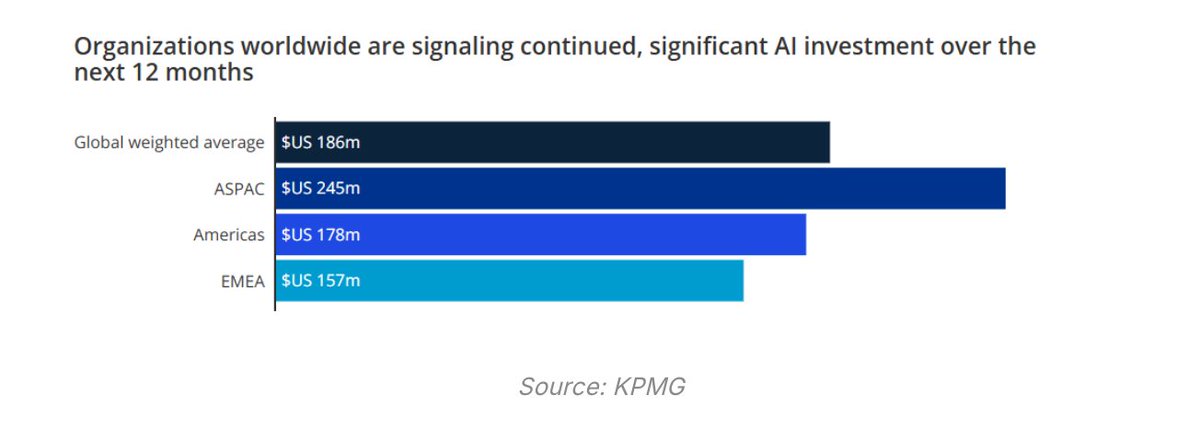
🦔Goldman Sachs reports that companies are blowing past their AI inference budgets by orders of magnitude, with inference costs in engineering now approaching 10% of total headcount costs and potentially reaching parity with salaries within several quarters. KPMG surveyed 2,100 senior leaders and found US companies plan to spend an average of $178 million on AI over the next 12 months, with Asia-Pacific firms budgeting $245 million and EMEA $157 million. The two reports together show companies are spending more than planned and intend to spend even more.
My Take
Inference costs approaching headcount parity is an extraordinary number that most finance teams did not model when they approved their AI strategies twelve months ago. The compute crunch, electrical component shortages, and GPU spot prices up 48% in two months are all flowing into corporate operating costs faster than anyone budgeted for, and Goldman's trajectory suggests it accelerates from here.
What I find hard to reconcile is that $178 million average sitting alongside enterprise data showing eight in ten workers are either avoiding AI tools or not using them at all. Companies are committing to nine-figure inference budgets while their own employees aren't using what's already been deployed.
I've watched this dynamic build all year and my honest read is that a significant portion of this spending is driven by competitive fear rather than demonstrated returns. Nobody wants to be the company that didn't invest in AI when everyone else did. That's how bubbles get funded, and at some point boards are going to demand a number that justifies it.
Hedgie🤗
This is not how it’s going to play out. AI will create more jobs not destroy them. Anthropic is a good, perhaps great, company. Dario is wrong and a horrible spokesperson.
Anthropic CEO Dario Amodei: “50% of all tech jobs, entry-level lawyers, consultants, and finance professionals will be completely wiped out within 1–5 years.”