ThunderID 1.0 GA is here!
Lightweight and built from scratch in Go, this release includes:
⚡ Humans & AI agents as first-class identities
🔐 Post-quantum crypto by default
▣ Digital wallet integration
🔑 OAuth 2.1 & OIDC
⚙️ A GitOps-native runtime
https://t.co/zJILR0N1rq
#MachineLearning Systems — Principles & Practices of Engineering Artificially Intelligent Systems: https://t.co/5bMmpZwAAB by @profvjreddi
[Download 1660-page PDF]
“Open-source textbook on how to design and implement #AI systems effectively”
———
#ML#MLOps#DataScience
𝗪𝗵𝗮𝘁 𝗶𝘀 𝘁𝗵𝗲 𝗱𝗶𝗳𝗳𝗲𝗿𝗲𝗻𝗰𝗲 𝗯𝗲𝘁𝘄𝗲𝗲𝗻 𝗦𝗵𝗮𝗿𝗱𝗶𝗻𝗴 𝗮𝗻𝗱 𝗣𝗮𝗿𝘁𝗶𝘁𝗶𝗼𝗻𝗶𝗻𝗴?
Most developers misuse these terms. Here's why that costs you.
𝟭. 𝗣𝗮𝗿𝘁𝗶𝘁𝗶𝗼𝗻𝗶𝗻𝗴 splits your data within the same logical database
Think of it as organizing your closet - the same room, but with different sections.
You might partition a user's table by date ranges or geographic regions.
The database engine handles the complexity.
𝟮. 𝗦𝗵𝗮𝗿𝗱𝗶𝗻𝗴 splits your data across multiple independent databases with a copied schema across
Now you have multiple closets in different houses.
Each shard is a separate database instance, often on different servers.
𝗪𝗵𝘆 𝗱𝗼𝗲𝘀 𝗶𝘁 𝗺𝗮𝘁𝘁𝗲𝗿?
Partitioning gives you better performance on the same machine. Queries can target specific partitions instead of scanning the entire dataset.
Sharding enables scaling beyond the limits of a single machine. However, you pay for it with complexity; joins across shards become expensive, and your application logic becomes more complicated.
𝗛𝗼𝘄 𝘁𝗼 𝘁𝗮𝗰𝗸𝗹𝗲 𝗶𝘁?
Start with partitioning. It's simpler and handles most scale problems.
Only move to sharding when you've reached the maximum capabilities of a single robust database.
Most companies never reach that point.
#softwareengineering #programming #databases
🚨BREAKING: The X Algo is about to get a MAJOR update
Elon just announced he’ll be updating the open sourced algo code this week
I’ve read all 36,000 lines of the current algorithm
Before the new one releases, here’s a complete breakdown of the current one (MUST read):
We're excited to announce that WSO2 Micro Integrator 4.3.0 is now available! Experience a best-in-class, low-code integration development environment. Discover more and try it today → https://t.co/VyA6xwAECT
Exciting news! WSO2 is entering a new chapter with @eqt ! This strategic partnership will fuel our growth, innovation, and global reach. Read more about the acquisition and what it means for the future: https://t.co/jQNt56Vt4h
Yes, we really are giving away a @Tesla#Cybertruck (or $100,000). And yes, this is a global competition! There are only 2 weeks left til submissions close so sign up to @ChoreoDev and deploy your application to get started -> https://t.co/cZpDi3g0Lj
@sanjiva
I’m obsessed with learning how to learn.
So, I spent 100+ hours studying how Elon Musk, Sam Altman, and Naval Ravikant absorb information.
Here’s what I found on becoming a learning machine:
Lessons Steve Jobs wanted to pass on.
Written right before he died.
In his own words:
1. ON BUILDING A REAL COMPANY:
I hate it when people call themselves “entrepreneurs” when what they’re really trying to do is launch a startup and then sell or go public, so they can cash in and move on.
They’re unwilling to do the work it takes to build a real company, which is the hardest work in business.
That’s how you really make a contribution and add to the legacy of those who went before.
You build a company that will still stand for something a generation or two from now.
That’s what Walt Disney did, and Hewlett and Packard, and the people who built Intel.
They created a company to last, not just to make money.
That’s what I want Apple to be.
2. ON TASTE OVER MARKET RESEARCH:
Some people say, “Give the customers what they want.” But that’s not my approach.
Our job is to figure out what they’re going to want before they do.
Henry Ford once said, “If I’d asked customers what they wanted, they would have told me, ‘A faster horse!'"
People don’t know what they want until you show it to them.
That’s why I never rely on market research.
Our task is to read things that are not yet on the page.
3. ON COMBINING IDEAS FROM DIFFERENT FIELDS:
Edwin Land of Polaroid talked about the intersection of the humanities and science.
I like that intersection.
There’s something magical about that place.
There are a lot of people innovating, and that’s not the main distinction of my career.
The reason Apple resonates with people is that there’s a deep current of humanity in our innovation.
I think great artists and great engineers are similar, in that they both have a desire to express themselves.
In fact some of the best people working on the original Mac were poets and musicians on the side.
In the seventies computers became a way for people to express their creativity.
Great artists like Leonardo da Vinci and Michelangelo were also great at science.
Michelangelo knew a lot about how to quarry stone, not just how to be a sculptor.
4. ON KNOWING WHY YOUR CUSTOMERS PAY YOU:
People pay us to integrate things for them, because they don’t have the time to think about this stuff 24/7.
If you have an extreme passion for producing great products, it pushes you to be integrated, to connect your hardware and your software and content management.
You want to break new ground, so you have to do it yourself.
5. ON WHAT HAPPENS WHEN YOU SHIFT THE FOCUS FROM GREAT PRODUCTS TO MORE SALES:
I have my own theory about why decline happens at companies like IBM or Microsoft.
The company does a great job, innovates and becomes a monopoly or close to it in some field, and then the quality of the product becomes less important.
The company starts valuing the great salesmen, because they’re the ones who can move the needle on revenues, not the product engineers and designers.
So the salespeople end up running the company.
John Akers at IBM was a smart, eloquent, fantastic salesperson, but he didn’t know anything about product.
The same thing happened at Xerox.
When the sales guys run the company, the product guys don’t matter so much, and a lot of them just turn off.
6. ON GREAT PRODUCTS BEING THE FOUNDATION OF AN ENDURING COMPANY:
My passion has been to build an enduring company where people were motivated to make great products.
Everything else was secondary.
Sure, it was great to make a profit, because that was what allowed you to make great products.
But the products, not the profits, were the motivation.
Sculley flipped these priorities to where the goal was to make money.
It’s a subtle difference, but it ends up meaning everything: the people you hire, who gets promoted, what you discuss in meetings.
7. ON BEING HONEST AND DIRECT WITH YOUR TEAM:
I don’t think I run roughshod over people, but if something sucks, I tell people to their face.
It’s my job to be honest.
I know what I’m talking about, and I usually turn out to be right.
That’s the culture I tried to create.
We are brutally honest with each other, and anyone can tell me they think I am full of shit and I can tell them the same.
And we’ve had some rip-roaring arguments, where we are yelling at each other, and it’s some of the best times I’ve ever had.
I feel totally comfortable saying “Ron, that store looks like shit” in front of everyone else.
Or I might say “God, we really fucked up the engineering on this” in front of the person that’s responsible.
That’s the ante for being in the room: You’ve got to be able to be super honest.
8. ON KEEPING THE TEAM EXCELLENT
I was hard on people sometimes, probably harder than I needed to be.
I remember the time when Reed (his son) was six years old, coming home, and I had just fired somebody that day, and I imagined what it was like for that person to tell his family and his young son that he had lost his job.
It was hard.
But somebody’s got to do it.
I figured that it was always my job to make sure that the team was excellent, and if I didn’t do it, nobody was going to do it.
9. ON TAKING ADVANTAGE OF THE GREAT WORK THAT WAS CREATED BEFORE YOU:
What drove me?
I think most creative people want to express appreciation for being able to take advantage of the work that’s been done by others before us.
I didn’t invent the language or mathematics I use.
I make little of my own food, none of my own clothes.
Everything I do depends on other members of our species and the shoulders that we stand on.
And a lot of us want to contribute something back to our species and to add something to the flow.
It’s about trying to express something in the only way that most of us know how.
We try to use the talents we do have to express our deep feelings, to show our appreciation of all the contributions that came before us, and to add something to that flow.
That’s what has driven me.
10. ON CONSTANT REFINEMENT AND PERPETUAL MOTION:
You always have to keep pushing to innovate.
Dylan could have sung protest songs forever and probably made a lot of money, but he didn’t.
He had to move on, and when he did, by going electric in 1965, he alienated a lot of people.
His 1966 Europe tour was his greatest. He would come on and do a set of acoustic guitar, and the audiences loved him.
Then he brought out what became The Band, and they would all do an electric set, and the audience sometimes booed.
There was one point where he was about to sing “Like a Rolling Stone” and someone from the audience yells “Judas!”
And Dylan then says, “Play it fucking loud!”
And they did. The Beatles were the same way.
They kept evolving, moving, refining their art.
That’s what I’ve always tried to do—keep moving. Otherwise, as Dylan says, if you’re not busy being born, you’re busy dying.
Join WSO2 Founder and CEO @sanjiva, @vivek_sridhar, and @nuwandias as they share insights and strategies needed to succeed in enterprise tech and compete with the best of the best from across the world.
Register today 👇
https://t.co/f66oW9oZtO
It's official — employees LOVE working at this year's highest-rated private cloud-computing companies! And we love to see it. 💙💙💙
https://t.co/PsIKW1NkqW
Product Management is not about:
- Asking customers about the requirements
- Writing detailed specifications
- Creating prototypes and wireframes
- Assigning tasks to developers
- Verifying and accepting the work of others
- Obsessing over velocity, deadlines, and roadmaps
- Mastering Scrum to perfection
- Acting like the CEO of the product
Anyone can do that.
It's about:
- Understanding customer's problems, needs, and desires
- Understanding the market and the business in depth
- Collaborating closely with engineers and designers
- Identifying opportunities, ideating solutions, and tackling the risks together
- Marrying customer goals and business goals
- Influencing others to work toward the common goal
- Being humble (it's ok not to be the smartest person in the room)
- Experimenting to validate assumptions
- Leading without authority
- Turning chaos into clarity
Start with these questions:
- Why are we building this thing?
- Why are we building it now?
- For whom are we building it?
- What's the unique value of our product?
- How is it aligned with the company's vision?
- How is it aligned with the business strategy?
- What does success look like? How can we measure it?
- What are the customer needs/jobs (functional, emotional, social)?
- How will it affect our customers and users?
- How will it create value for the business?
- Can we buy it instead of building it?
- How can we make sure that our customers would love it?
- Will our customers know how to use it?
- Can our business support it (e.g., legal, finances)?
- Is it feasible? Can we build it?
- How can we bring it to the market? Do we have the required channels?
- Should we do it at all? Are there any ethical considerations?
- What are the riskiest assumptions? How can we validate them?
- What does the data tell us?
- How can we get maximum validating learning with minimum effort?
Be curious. Learn and experiment. Question solutions and push back on things handled down.
Remember that product management is about creating a "product customers love, yet also works for our business" (Marty Cagan, Inspired), not about pleasing stakeholders.
After 9 years, I'm still learning daily, and I do not know everything, but I can give you my perspective on any questions you have.
Drop them below.
We are excited to announce Prof. Dr. @FrankLeymann as the first @WSO2 Technology Fellow! His extensive software innovations and global impact have earned him this prestigious title. Congratulations, Frank!
More here → https://t.co/vY4fZwcwYu
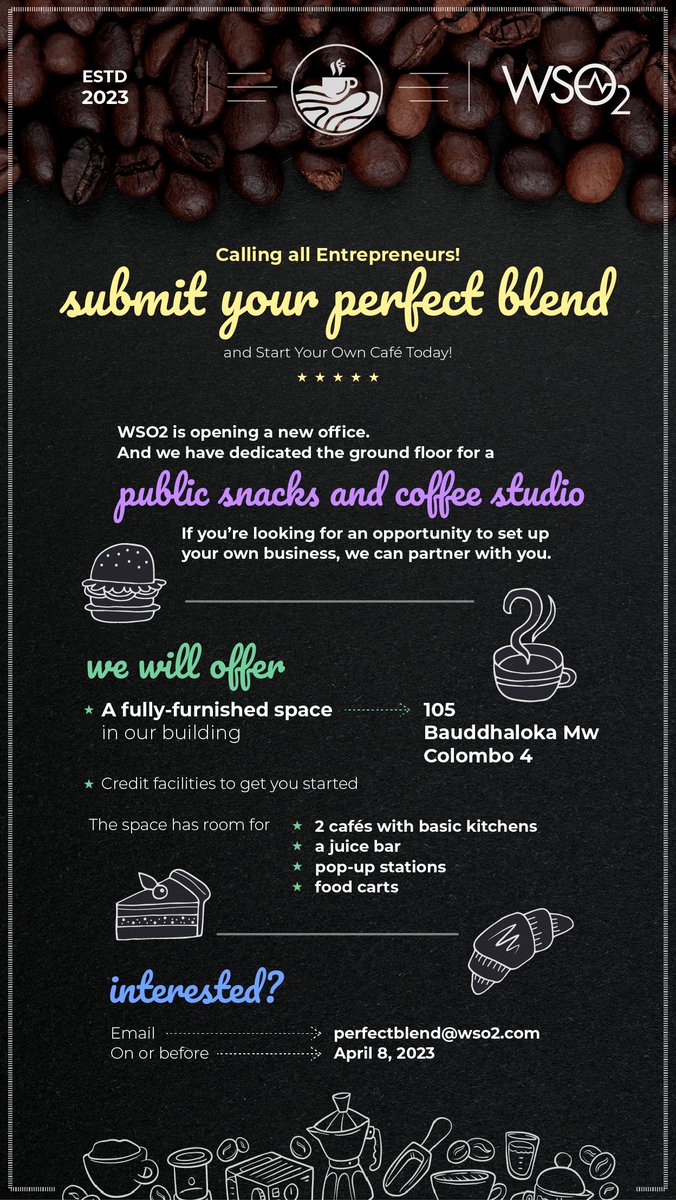
WSO2 is opening a new office in Sri Lanka. And we have dedicated the ground floor for a public snacks and coffee studio. If you’re looking for an opportunity to set up your own business, we'd love to partner with you!
Interested? Email [email protected]





![KirkDBorne's tweet photo. #MachineLearning Systems — Principles & Practices of Engineering Artificially Intelligent Systems: https://t.co/5bMmpZwAAB by @profvjreddi
[Download 1660-page PDF]
“Open-source textbook on how to design and implement #AI systems effectively”
———
#ML #MLOps #DataScience https://t.co/G7cmLo2VWM](https://pbs.twimg.com/media/Gwlo4CFWEAAI1vz.jpg)