[1/n] I’m thrilled to share that the ROTATE paper, which casts learning generalizable coordination behaviors as an open-ended learning problem, has been accepted to #NeurIPS26 as a spotlight 🌟! See you in Sydney!
Collaborators: @ArrasyRahman, Benjamin Nativi, Johnny Liu, @cuijiaxun, @yoonchangsung, @PeterStone_TX.
Paper: https://t.co/DrD8KEt8WT
Code: https://t.co/QaACEHqE3p
For those of you who might have seen earlier versions of the paper, in the most recent version, we made substantial advances by characterizing the self-sabotage problem as per-state incompetence, and viewing ROTATE as placing a competence constraint on learning, therefore improving our understanding of why ROTATE works. Details in the thread below.
We’ve all seen the cool “Astra for robotics” demos. But behind the scenes? Slow rollouts, hand-engineered APIs, and/or simulated behaviors that struggle on real robots.
How do we make coding agent actually work in the physical world? 🦾 Introducing SimEX: Simulation-Integrated Robotics AutoResearch 🧵
https://t.co/l8iBo8D1E5
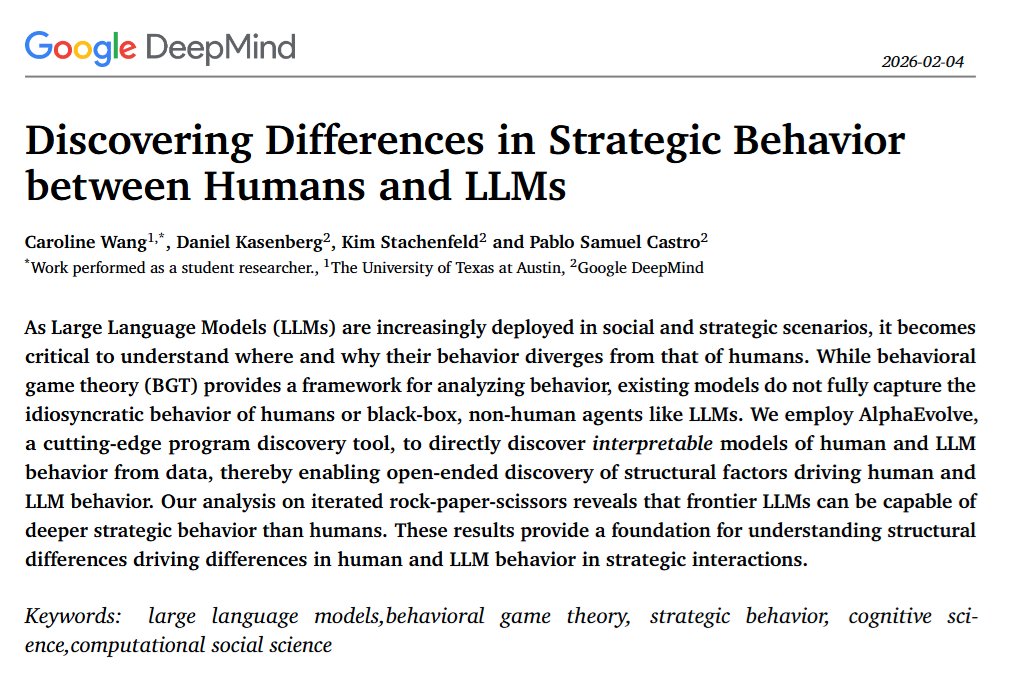
[1/n] Just wrapped up 7 months interning with @pcastr at DeepMind and I'm so excited to share our work: https://t.co/SsHsksxO3i.
TLDR: We used LLM-powered program synthesis to automatically model and discover differences between human and LLM strategic behavior
After 6 years as director of Texas Robotics, I'm delighted to hand over the reigns to the capable hands of Prof. Jose Millan. I'm honored to continue supporting Jose in my new role of "Founding Director" as I turn my main focus to acting as Chair of the UT Computer Science Dept
(1/n)
With over 1,300 citations, MBPO is often cited as proof that model based RL beats model free methods. In https://t.co/xq3WXslh67 we showed it often completely fails in DeepMind Control. In our new work, Fixing That Free Lunch (FTFL), we explain why and make it succeed.
Humans learn new manipulation skills from examples and improve as they see more examples. How can we endow robots with the same ability? 🤖
🚀We introduce RoboSSM, scalable in-context imitation learning that enables robots to learn and improve at test time—robots can improve with more examples without returning to the GPU for fine-tuning.
🧵
Paper: https://t.co/cnB6ZVuLEL
Video: https://t.co/kJBYALSQPV
[1/4] 🚀 We’re excited to announce the v1 release of JaxAHT – a new library for Ad Hoc Teamwork (AHT) research, built with JAX for speed & scalability! Check it out 👉 https://t.co/Vmpbm72YwS #AI#MARL#ReinforcementLearning#JAX#AdHocTeamwork
[1/8] New social navigation paper + benchmark: SocialNav-SUB 🚶🤖 Recent work puts VLMs on robots for navigation, but can they really interpret scenes and extract key details for social navigation? 🔎 https://t.co/2rlcIQpf6h
Congrats to Jiaxun Cui, the 29th Ph.D. graduate from my lab, on the defense of her dissertation entitled "Communication and Generalization in Multi-Agent Learning". Pictured here with me and the rest of her thesis committee (Amy Zhang, Yuke Zhu, Sandeep Chinchali, Yuandong Tian)
Introducing VGC-Bench, a new plug-and-play benchmark made to support research efforts in the domain of Pokémon VGC! Read on for the open source code, the paper, and everything you need to dive in.
[1/9]
If the communication among autonomous vehicles is done in natural language, in principle, human drivers could communicate with them as well. This paper lays the groundwork for that happening!
[1/n] Can LLM Agents learn to communicate and coordinate in natural language in driving scenarios 🚗 through self-play interactions? Our recent research shows the potential for such learning; interestingly, there is evidence that they develop concise protocols for collaboration! A distilled version of the agents’ model could generalize to multiple scenarios, communicate at 250 bytes per message, and make decisions within 500 ms while maintaining the original (large) model’s performance.
💬Natural Language Communication among Autonomous Agents
✨Multi-agent Gymnasium for Policy Learning
👀Partial Observation and Negotiation Tasks
More videos & analysis
project page: https://t.co/KYrgvj6Waj
arXiv: https://t.co/Mq608FbslP
with @ChenTangMark, Jarrett Holtz, Janice Nguyen, @aleallievi, @HangQiu, @PeterStone_TX
open to discussion & collaboration!
@utlarg@texas_robotics
#LLM #multiagent
Real-world RL, where robots learn directly from physical interactions, is extremely challenging — especially for high-DoF systems like mobile manipulators.
1⃣ Long-horizon tasks and large action spaces lead to difficult policy optimization.
2⃣ Real-world exploration with whole-body contact raises serious safety concerns.
🚀 Introducing SLAC, a framework that brings safety and efficiency to whole-body real-world RL.
Paper: https://t.co/TK8ylbAtdL
Video: https://t.co/9YFEL8metM
🧵
Our work on unsupervised RL, Proto Successor Measures (PSM), will be presented at #ICML2025. PSM learns from offline reward-free data to give near-optimal policies at test time for any reward function with a new representation objective.
Huge congratulations to @PeterStone_TX for receiving the ACM Allen Newell Award! 🎉 We are proud to celebrate this incredible recognition of his groundbreaking contributions to AI and computer science.👏 #ACM#AAAI#AllenNewellAward
🙌 Meet the 2024 ACM Technical Awards Recipients!
We’re proud to honor this year’s innovators in autonomous systems, cryptography, and software for parallel computers:
🏆 Peter Stone – ACM-AAAI Allen Newell Award
For significant contributions to the theory and practice of artificial intelligence (AI). @UTAustin@SonyAI_global
🔗 https://t.co/U4vpUvBgyX