This Midjourney V7 style reference feels like a hybrid between architectural urban sketching and contemporary editorial illustration:
--sref 1677447665
What I love most is how unfinished it feels on purpose. The buildings almost dissolve into the paper while only certain elements receive color: balconies, façades, water, windows, tiny details.
Perfect for architecture, European streets, iconic landmarks, travel worlds, indie animation backgrounds, or minimalist cinematic environments.
GPT Image 2 On ChatGpt
Prompt : (Switzerland Poster)
Elegant watercolor travel poster of Switzerland, dreamy European lakeside street with snowy alpine mountains in the background, Zurich tram moving through a cobblestone road, cozy cafés and luxury boutiques, Swiss flags hanging from pastel buildings with flower balconies, bicycles near the waterfront, church clock tower, soft morning light, cinematic atmosphere, delicate watercolor splashes, hand-painted illustration style, minimal travel magazine aesthetic, airy white background, subtle ink sketch details, muted pastel palette, ultra detailed architectural scenery, romantic European vibe, vertical poster composition, sophisticated typography layout with “SWITZERLAND” title and handwritten subtitle, premium art print aesthetic.
Prompt : (Greece Poster)
Beautiful watercolor travel poster of Greece, peaceful Santorini-style alley with whitewashed buildings and blue accents, blooming pink bougainvillea flowers, narrow stone pathway leading toward the sea, Greek flags waving softly, cozy outdoor café tables, blue dome church in the background, warm Mediterranean sunlight, dreamy coastal atmosphere, elegant watercolor and ink illustration, soft pastel tones, artistic paint splashes, minimal luxury travel poster design, airy white paper texture background, romantic summer aesthetic, ultra detailed European street scenery, vertical composition with stylish “GREECE” typography and handwritten subtitle, premium postcard illustration style.
GPT Image 2 on Chatgpt
Prompt: [CITY] = Seoul
[COUNTRY] = South Korea
[LANDMARK] = a recognizable landmark or scenic element of [CITY]
Create a serene architectural travel illustration inspired by [CITY], [COUNTRY], in a soft hand-drawn watercolor and ink style.
Main concept:
Show a quiet, charming street-side house or small building inspired by the everyday atmosphere of [CITY], [COUNTRY], while subtly incorporating [LANDMARK] in the composition.
The landmark should appear naturally in the background, distance, or surrounding scenery, so the image clearly feels connected to [CITY], [COUNTRY] without losing the calm residential mood.
Visual style:
delicate hand-drawn architectural illustration,
soft watercolor washes,
thin ink outlines,
slightly imperfect sketch lines,
warm sunlit atmosphere,
gentle pastel palette,
subtle paper texture,
quiet travel sketchbook aesthetic,
minimal yet detailed composition,
calm editorial illustration mood,
poetic everyday scenery,
cozy and refined visual tone,
no photorealism,
no harsh contrast,
no saturated colors,
no dramatic lighting.
Scene:
A peaceful small house, café, studio, or local building with simple walls, a tiled or regionally inspired roof, painted doors or windows, and several potted plants arranged naturally in front.
Include subtle local architectural details and everyday design elements that feel authentic to [CITY], [COUNTRY].
Incorporate [LANDMARK] as a softly integrated city symbol — for example, visible above rooftops, in the distance, or as part of the surrounding skyline or landscape.
The overall scene should feel quiet, elegant, warm, and locally rooted.
Composition:
landscape travel-poster format,
wide horizontal layout,
large open sky occupying the upper half or upper-left area,
main building placed across the lower portion of the composition,
balanced negative space,
front-facing or slightly angled composition,
potted plants and small objects along the base,
landmark subtly placed in the background or upper distance,
clean and spacious layout,
minimal but emotionally rich composition.
Typography:
Include the city name “[CITY]” clearly in the image.
Render “[CITY]” as elegant travel-poster typography, large but refined, placed prominently in the sky area or upper portion of the composition.
Optionally include “[COUNTRY]” in smaller text beneath or near the city name.
The text should feel integrated into the poster design, not like a random overlay.
Use clean, tasteful lettering that matches the calm watercolor travel-poster mood.
Color palette:
pale sky blue,
warm cream,
terracotta,
muted blue accents,
olive and soft green,
light earthy browns,
soft natural neutrals.
Texture:
visible watercolor paper grain,
transparent paint layering,
soft handmade brush texture,
gentle ink-and-wash finish.
Mood:
peaceful,
sunny,
quiet,
nostalgic,
cozy,
refined,
poetic,
calm everyday travel atmosphere.
Important:
The image should express both the intimate charm of a local building and the identity of [CITY], [COUNTRY] through the inclusion of [LANDMARK].
Do not make the landmark too dominant; it should support the mood rather than overpower the house scene.
The city name “[CITY]” must be visible and clearly readable in the final image.
Aspect ratio: 4:3 or 3:2
Creator: @hermes_agent_kr on Threads
La biología en PDF acaba de morir.
Un tío hizo una app donde exploras estructuras 3D como un videojuego.
UI: GPT Images 2. Código: Gemini 3.1 Pro.
Los libros de texto ya no sirven.
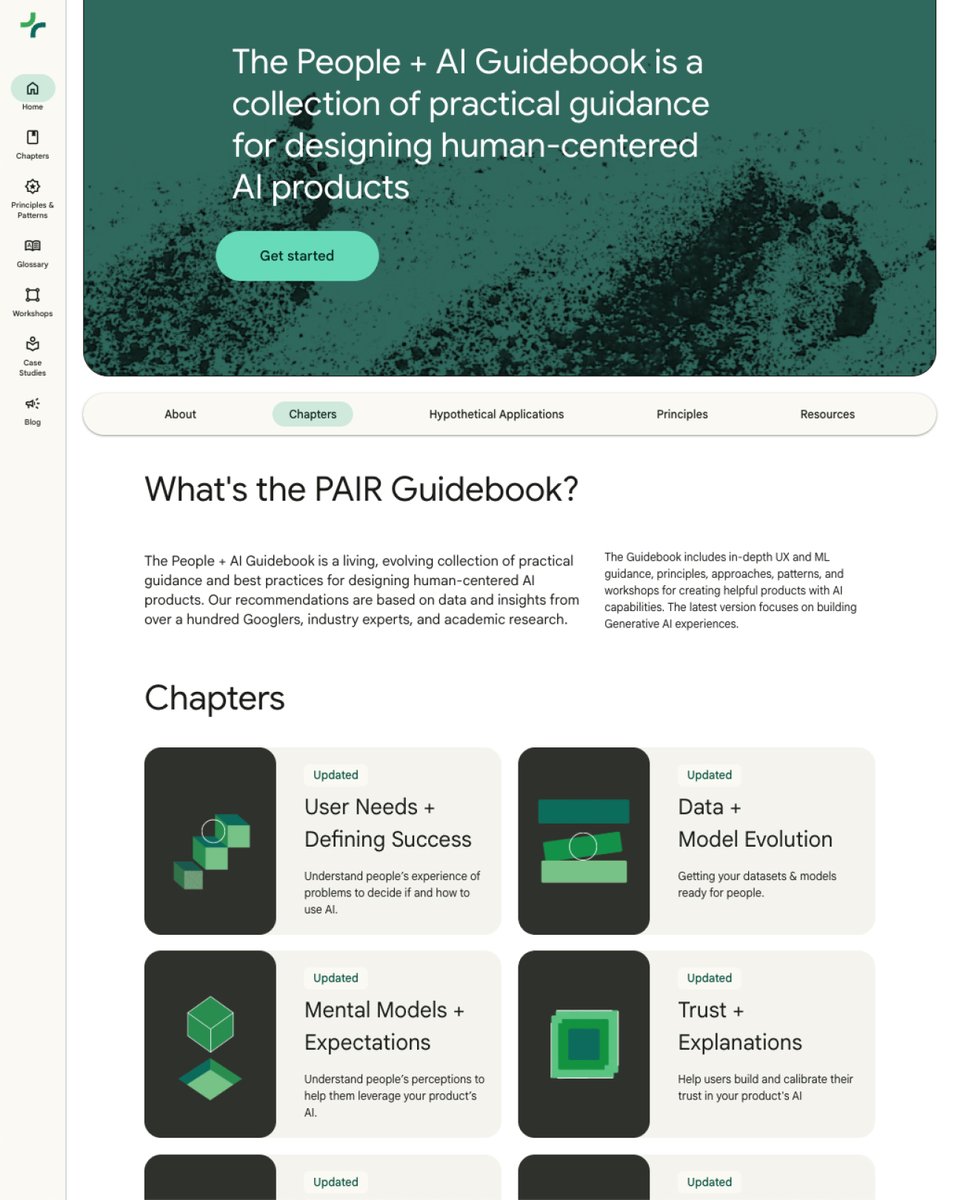
🤖 Google’s People + AI Guidebook
A collection of practical guidance for designing human-centered AI products.
✅ User Needs + Defining Success
✅ Mental Models
✅ Feedback + Control
✅ Explainability + Trust
✅ Data Collection + Evaluation
✅ Errors + Graceful Failure
Check it out 👇
https://t.co/G7CHrZOjoY
Claude Code ships with 5 architectural layers most engineers never open.
Not features. Not settings. Layers — each solving a distinct problem that LLMs alone can't solve. And four of them have nothing to do with prompting.
Here's the full Agent Development Kit:
Layer 1 — CLAUDE.md → The Memory Layer
Architecture rules, naming conventions, test expectations, repo map. Always loaded. Always active.
Two scopes:
• ~/.claude/CLAUDE.md → global
• .claude/CLAUDE.md → project
This isn't context you paste in before every session. It's context that never needs repeating. The agent's constitution.
Layer 2 — Skills → The Knowledge Layer
Each SKILL.md carries a description. Claude matches it at runtime and forks the skill into an isolated subagent. On-demand, never always-on.
Task-specific knowledge without inflating your main context window. Modular by design.
Layer 3 — Hooks → The Guardrail Layer
PreToolUse → PostToolUse → SessionStart → Stop → SubagentStop
This is the layer most teams skip. And the one they regret skipping first.
Hooks are NOT AI. They're deterministic event-driven shell commands.
• Auto-lint on every Write
• Hard-block on rm -rf
• Slack notification on Stop
Event fires → Matcher checks → Command runs
Quality enforced at the infrastructure level. Not the prompt level.
Layer 4 — Subagents → The Delegation Layer
Each subagent gets its own context window, model, tools, and permissions.
Main agent delegates down. Receives results up. That's it.
No infinite recursion — subagents can't spawn subagents. Main context stays clean. Hard boundaries by design.
Layer 5 — Plugins → The Distribution Layer
Bundle your skills + agents + hooks + commands into a plugin. One install. Whole team inherits the behavior.
Think npm packages — but for what your agent knows how to do.
Wrapping everything:
→ MCP Servers on the left (GitHub, databases, APIs, custom integrations)
→ Agent Teams on the right (parallel execution, message passing, shared permissions)
The 5-layer stack in one line:
CLAUDE.md sets rules → Skills provide expertise → Hooks enforce quality → Subagents delegate work → Plugins distribute to the team
Most production failures in agentic systems trace back to one missing layer.
Which one is the gap in your current setup?
Imagine every pixel on your screen, streamed live directly from a model. No HTML, no layout engine, no code. Just exactly what you want to see.
@eddiejiao_obj, @drewocarr and I built a prototype to see how this could actually work, and set out to make it real. We're calling it Flipbook. (1/5)
Excellent Resource with FREE eBooks for Designers to 10x Your Knowledge! 🙌
Save to Bookmarks for reference 🔖
FREE Book Collections for:
- Design systems
- User Experience (UX)
- Visual design
- Usability
- Typography
- Front-End Development
- Startup
- Career
#UX#UI #UXDesign #UIDesign #UserExperience #ProductDesign


![oggii_0's tweet photo. GPT Image 2 on Chatgpt
Prompt: [CITY] = Seoul
[COUNTRY] = South Korea
[LANDMARK] = a recognizable landmark or scenic element of [CITY]
Create a serene architectural travel illustration inspired by [CITY], [COUNTRY], in a soft hand-drawn watercolor and ink style.
Main concept:
Show a quiet, charming street-side house or small building inspired by the everyday atmosphere of [CITY], [COUNTRY], while subtly incorporating [LANDMARK] in the composition.
The landmark should appear naturally in the background, distance, or surrounding scenery, so the image clearly feels connected to [CITY], [COUNTRY] without losing the calm residential mood.
Visual style:
delicate hand-drawn architectural illustration,
soft watercolor washes,
thin ink outlines,
slightly imperfect sketch lines,
warm sunlit atmosphere,
gentle pastel palette,
subtle paper texture,
quiet travel sketchbook aesthetic,
minimal yet detailed composition,
calm editorial illustration mood,
poetic everyday scenery,
cozy and refined visual tone,
no photorealism,
no harsh contrast,
no saturated colors,
no dramatic lighting.
Scene:
A peaceful small house, café, studio, or local building with simple walls, a tiled or regionally inspired roof, painted doors or windows, and several potted plants arranged naturally in front.
Include subtle local architectural details and everyday design elements that feel authentic to [CITY], [COUNTRY].
Incorporate [LANDMARK] as a softly integrated city symbol — for example, visible above rooftops, in the distance, or as part of the surrounding skyline or landscape.
The overall scene should feel quiet, elegant, warm, and locally rooted.
Composition:
landscape travel-poster format,
wide horizontal layout,
large open sky occupying the upper half or upper-left area,
main building placed across the lower portion of the composition,
balanced negative space,
front-facing or slightly angled composition,
potted plants and small objects along the base,
landmark subtly placed in the background or upper distance,
clean and spacious layout,
minimal but emotionally rich composition.
Typography:
Include the city name “[CITY]” clearly in the image.
Render “[CITY]” as elegant travel-poster typography, large but refined, placed prominently in the sky area or upper portion of the composition.
Optionally include “[COUNTRY]” in smaller text beneath or near the city name.
The text should feel integrated into the poster design, not like a random overlay.
Use clean, tasteful lettering that matches the calm watercolor travel-poster mood.
Color palette:
pale sky blue,
warm cream,
terracotta,
muted blue accents,
olive and soft green,
light earthy browns,
soft natural neutrals.
Texture:
visible watercolor paper grain,
transparent paint layering,
soft handmade brush texture,
gentle ink-and-wash finish.
Mood:
peaceful,
sunny,
quiet,
nostalgic,
cozy,
refined,
poetic,
calm everyday travel atmosphere.
Important:
The image should express both the intimate charm of a local building and the identity of [CITY], [COUNTRY] through the inclusion of [LANDMARK].
Do not make the landmark too dominant; it should support the mood rather than overpower the house scene.
The city name “[CITY]” must be visible and clearly readable in the final image.
Aspect ratio: 4:3 or 3:2
Creator: @hermes_agent_kr on Threads](https://pbs.twimg.com/media/HIfwzclaQAApwBb.jpg)










![oggii_0's tweet photo. GPT Image 2 on Chatgpt
Prompt: [CITY] = Seoul
[COUNTRY] = South Korea
[LANDMARK] = a recognizable landmark or scenic element of [CITY]
Create a serene architectural travel illustration inspired by [CITY], [COUNTRY], in a soft hand-drawn watercolor and ink style.
Main concept:
Show a quiet, charming street-side house or small building inspired by the everyday atmosphere of [CITY], [COUNTRY], while subtly incorporating [LANDMARK] in the composition.
The landmark should appear naturally in the background, distance, or surrounding scenery, so the image clearly feels connected to [CITY], [COUNTRY] without losing the calm residential mood.
Visual style:
delicate hand-drawn architectural illustration,
soft watercolor washes,
thin ink outlines,
slightly imperfect sketch lines,
warm sunlit atmosphere,
gentle pastel palette,
subtle paper texture,
quiet travel sketchbook aesthetic,
minimal yet detailed composition,
calm editorial illustration mood,
poetic everyday scenery,
cozy and refined visual tone,
no photorealism,
no harsh contrast,
no saturated colors,
no dramatic lighting.
Scene:
A peaceful small house, café, studio, or local building with simple walls, a tiled or regionally inspired roof, painted doors or windows, and several potted plants arranged naturally in front.
Include subtle local architectural details and everyday design elements that feel authentic to [CITY], [COUNTRY].
Incorporate [LANDMARK] as a softly integrated city symbol — for example, visible above rooftops, in the distance, or as part of the surrounding skyline or landscape.
The overall scene should feel quiet, elegant, warm, and locally rooted.
Composition:
landscape travel-poster format,
wide horizontal layout,
large open sky occupying the upper half or upper-left area,
main building placed across the lower portion of the composition,
balanced negative space,
front-facing or slightly angled composition,
potted plants and small objects along the base,
landmark subtly placed in the background or upper distance,
clean and spacious layout,
minimal but emotionally rich composition.
Typography:
Include the city name “[CITY]” clearly in the image.
Render “[CITY]” as elegant travel-poster typography, large but refined, placed prominently in the sky area or upper portion of the composition.
Optionally include “[COUNTRY]” in smaller text beneath or near the city name.
The text should feel integrated into the poster design, not like a random overlay.
Use clean, tasteful lettering that matches the calm watercolor travel-poster mood.
Color palette:
pale sky blue,
warm cream,
terracotta,
muted blue accents,
olive and soft green,
light earthy browns,
soft natural neutrals.
Texture:
visible watercolor paper grain,
transparent paint layering,
soft handmade brush texture,
gentle ink-and-wash finish.
Mood:
peaceful,
sunny,
quiet,
nostalgic,
cozy,
refined,
poetic,
calm everyday travel atmosphere.
Important:
The image should express both the intimate charm of a local building and the identity of [CITY], [COUNTRY] through the inclusion of [LANDMARK].
Do not make the landmark too dominant; it should support the mood rather than overpower the house scene.
The city name “[CITY]” must be visible and clearly readable in the final image.
Aspect ratio: 4:3 or 3:2
Creator: @hermes_agent_kr on Threads](https://pbs.twimg.com/media/HIfwzc9aIAA1TGE.jpg)