Tell the truth about your research‼️ Presenting data truthfully and responsibly will help you avoid costly negative outcomes and reputation loss. Indicate who your data represents and communicate the limitations of your findings. Watch the video here: https://t.co/1NfcpsQq6Y #UX
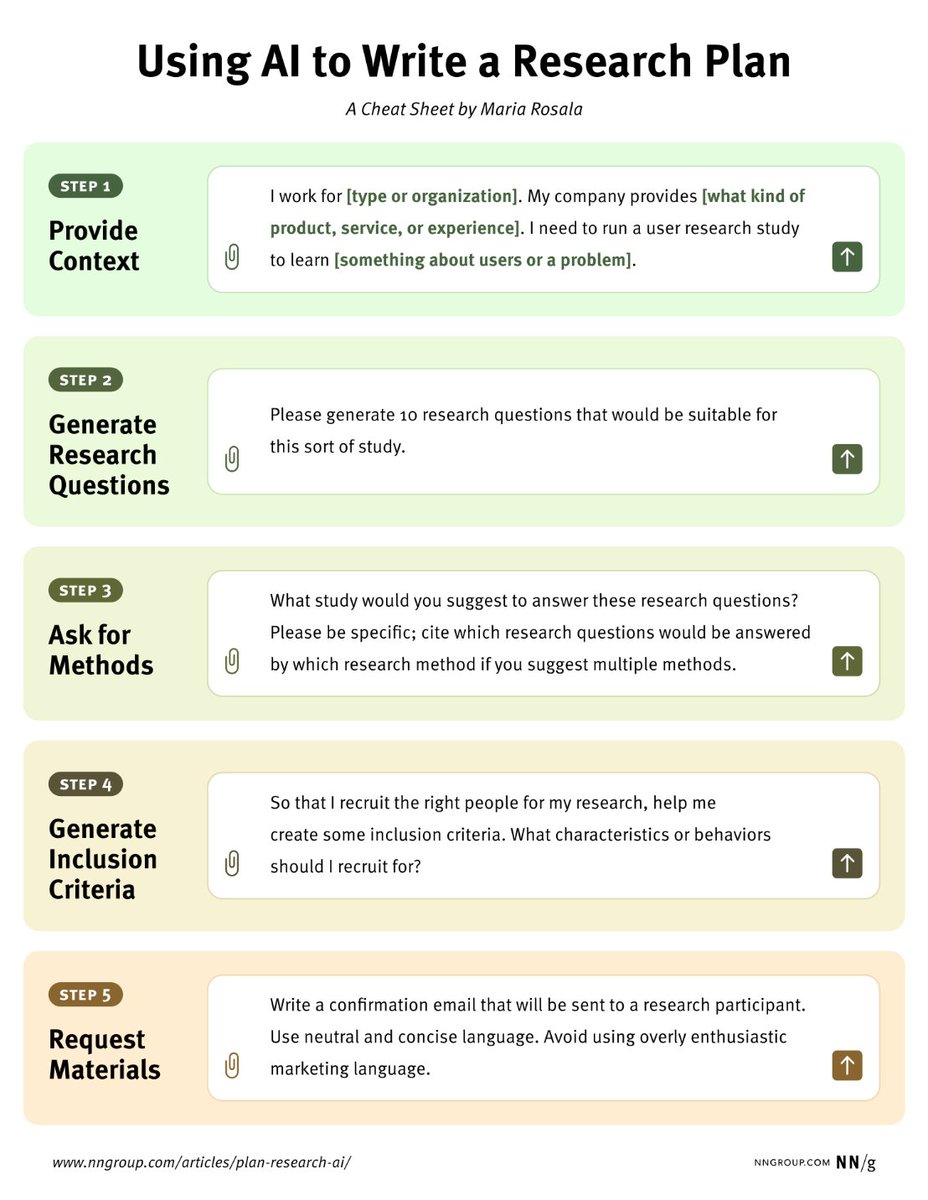
With the proper context, prompts, and scrutiny, AI chatbots can be used to create a successful user-research plan. Read the full article: https://t.co/e25J8fUrmV
#ux#uxresearch#AI
Counting how frequently something is mentioned in qualitative data will not always show you what's most important. Sometimes, the most valuable insights are mentioned only once. Watch the video: https://t.co/R1JYqNklVH
#ux#uxresearch
Quantitative #UX research requires knowledge and understanding of many jargon terms. Use this glossary as a reference as you delve into quantitative #uxresearch and data analysis. https://t.co/CuQr5uOnhs
New on ResearchOps-Community Medium:
Andrew Garber-Browne (@DTAndyB) shares his experience volunteering on the ResearchOps Community Toolbox project
https://t.co/NztcURiPfs
Each component of a #UX#strategy plays an important role in helping teams work toward a better future state of the experience by aligning user needs with #business priorities https://t.co/f3WWtKhGjQ
Starting or renewing your focus on ResearchOps this year?
Check out our Medium reading list on growing ResearchOps!
More articles to come in 2023...
https://t.co/Z7tO9Y1ENq
At @NNgroup we conduct research with real #UX practitioners to benefit the UX community worldwide. If you work in UX, sign up to participate in research studies about your job! https://t.co/Ar1Gt8gOx7
Have you ever tried something that was so big, you weren't sure you'd ever succeed? 😳
We have! #ResearchRepos!
📅Almost 3 years
🌍20 countries,
~ 200 people,
3 streams of work: research, governance, taxonomy
Our major findings are here 🎉
https://t.co/pC4GEbPknF
The field of research operations (#ResearchOps) has garnered attention in recent years, but dedicated roles in organizations are uncommon and resources are scarce today https://t.co/ACTRjBP9at #UX
Use this collection of links to our articles and videos to learn about the components of #ResearchOps and get started implementing ResearchOps activities https://t.co/HoUGLBIHoM #UX
"UX Theatre is easy to spot: It’s the application of any sort of design methodology without including a single user in the process, or including users but merely for show." @spydergrrl shines a spotlight on some unspoken problems in UX design.
https://t.co/qSeJZNbRM7
Learn about the major issues that UX researchers face nowadays and how to make the most out of the new remote reality. Read in @uxmag - https://t.co/tixrzkLeuD #research#ux
@dscout Reporting percentages based on a sample size of 40 participants (or, as you say, moments) looks like quantitative data. Did you mean qualitative and quantitative? I can see both types of data in these charts.
While the MSFT reaction cards are widely cited and used, there’s no published benchmarks on neither the ratio of positive to negative words nor the average frequency a card is selected. https://t.co/Ur66aa5FpT
#Qualitative#usability testing aims to identify issues in an interface, while #quantitative usability testing is meant to provide #metrics that capture the behavior of your whole user population https://t.co/m6iZVbFmVa #UX