Can AI rewrite our human genome? ⌨️🧬
Today, we announce the successful editing of DNA in human cells with gene editors fully designed with AI. Not only that, we've decided to freely release the molecules under the @ProfluentBio OpenCRISPR initiative.
Lots to unpack👇
Superfast Research Assistant using Llama3 on @GroqInc and @tavilyai
Build an Assistant that:
🔎 researches a complex topic
✍��� writes a report at 800 tokens/sec
Try it yourself: https://t.co/mRfeAIS6r7
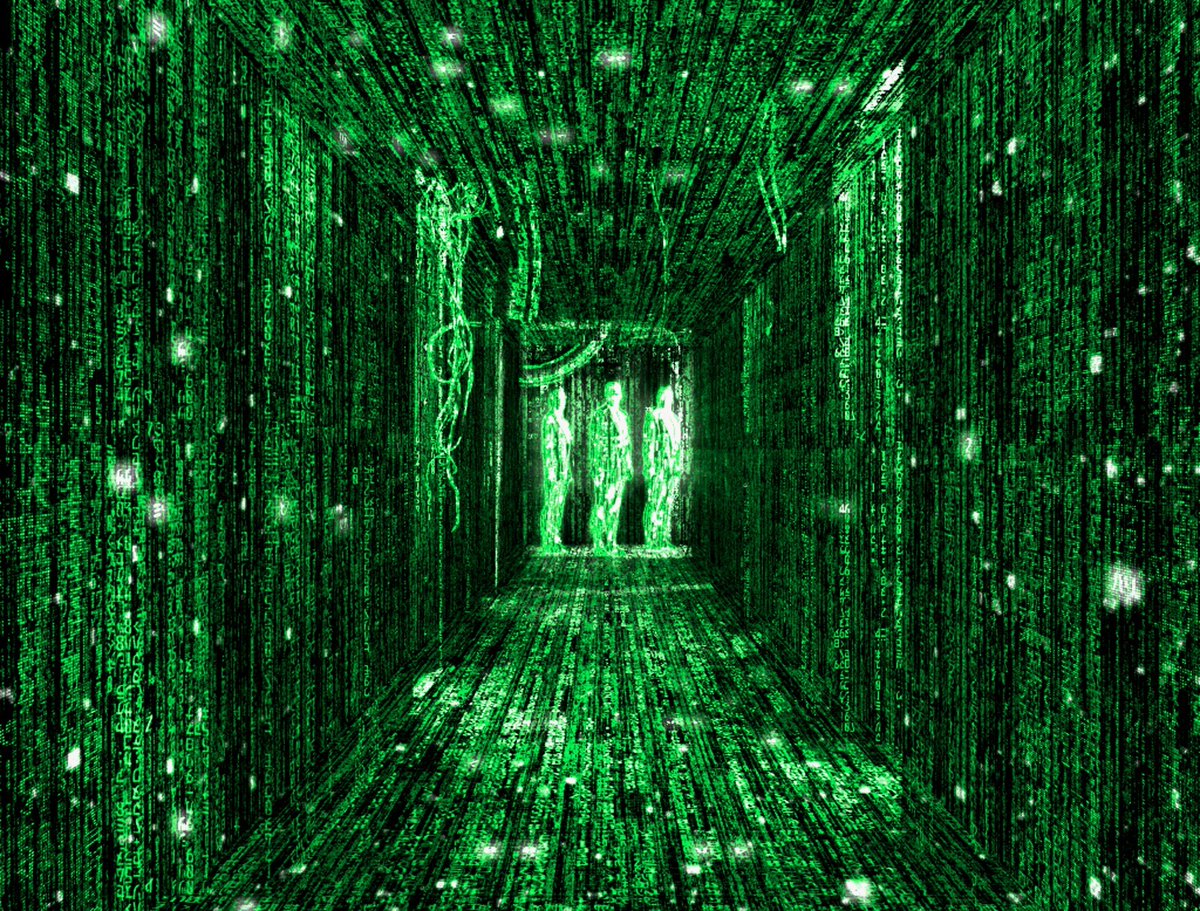
THE MATRIX was released 25 years ago today. Acclaimed as both one of the great science fiction movies and a groundbreaking action film, the behind-the-scenes story will have you questioning reality…
1/44
“Having simpler ideas that you can execute perfectly is sometimes better than having a grandiose idea that your company can’t execute on.”
~ Jensen Huang
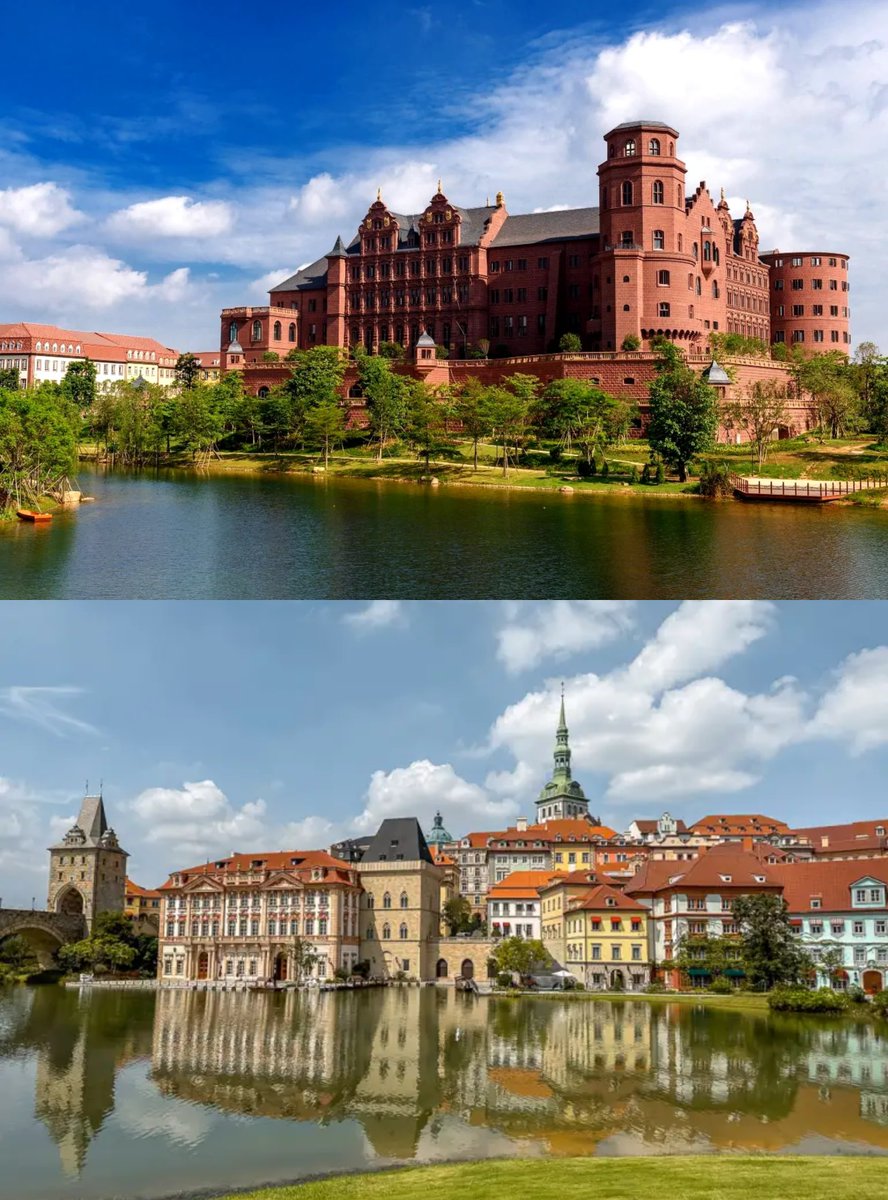
This city is not in Italy, France, or Germany.
It's in China and it's less than ten years old.
This is Huawei's R&D Headquarters, where 25,000 people work, and it might just be the most interesting office building(s) in the world...
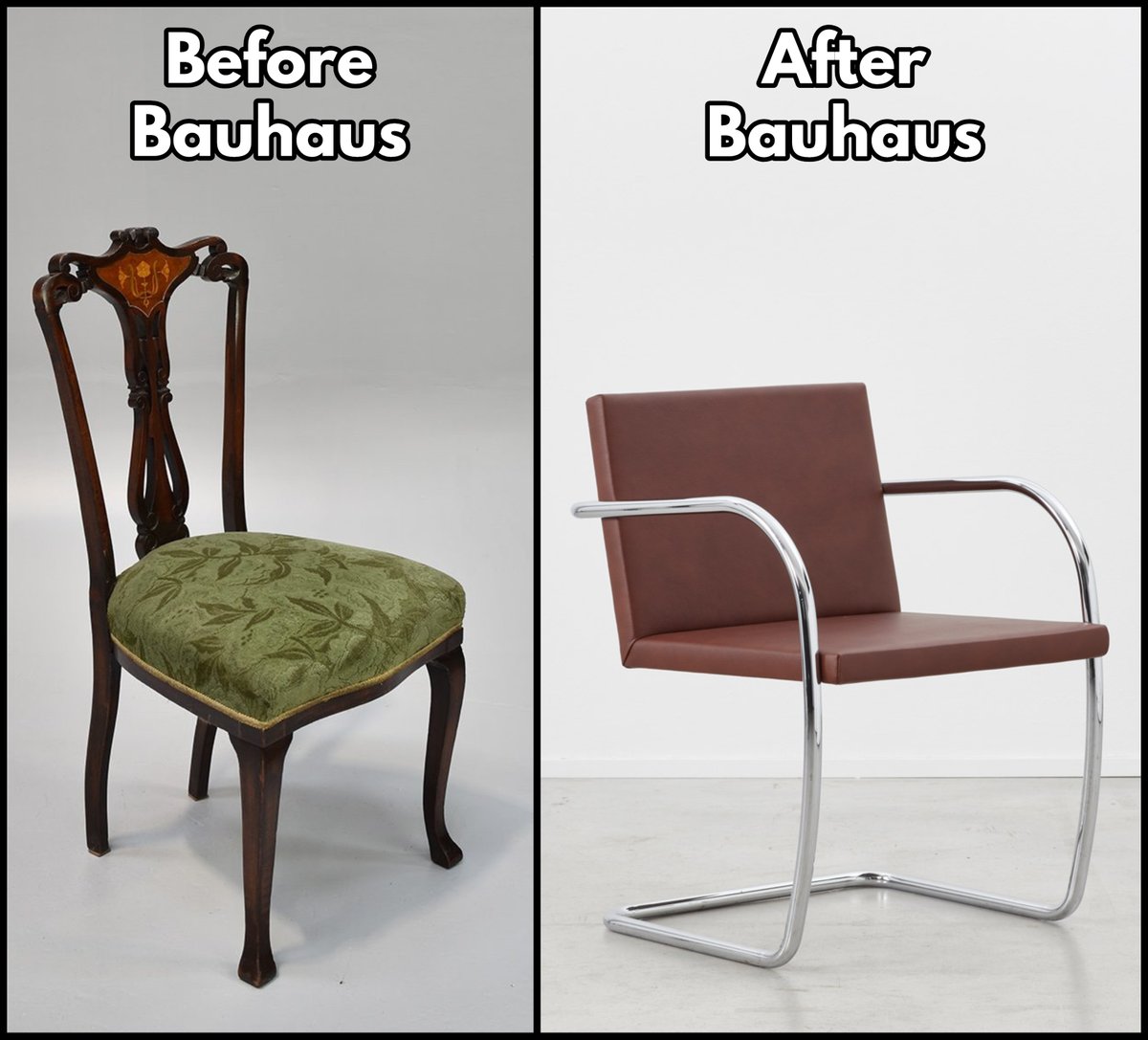
Why does our world look the way it does?
Because of the most influential design school in history: the Bauhaus.
From fonts to furniture, this is how Bauhaus created the aesthetic of the modern world...
It's officially been 24 hours since the OpenAI DevDay announcements.
The leaks were true. The way we use ChatGPT is about to completely change.
Here are 12 shocking things people have already built (early access):
In 2006, I was 1 of 4 designers on Google Search.
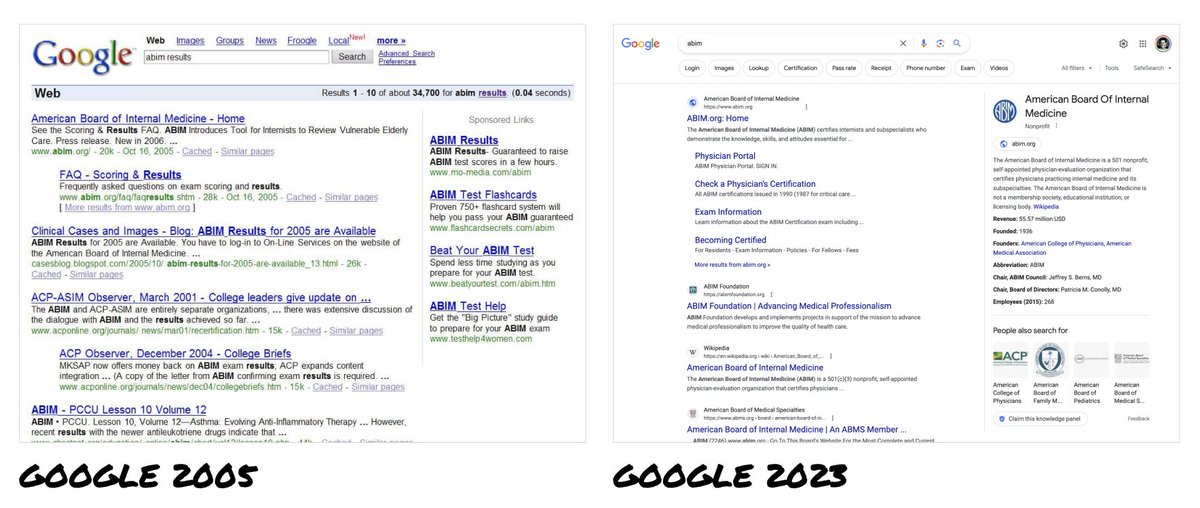
For 20 years, every search engine has copied Google.
Now ChatGPT, Bard + Claude look like Google's offspring - "better” search engines.
But last week signaled we're on the brink of a design revolution.
ChatGPT unveiled incredible new features.
These could give us the opportunity to completely shift how we interface with AI.
Here's the full story:
–––
When I was a designer on Google Search, all major search engines looked the same – Google, Yahoo, MSN Bing.
Google was the market leader with a heavily optimized UI that supported billions of dollars in ad revenue.
Naturally, it became THE way to show search results.
Its success made it illogical for Google to consider big UI changes.
And any changes they did make were just mirrored by everyone else.
So 20 years later, we’ve only seen incremental changes to search engine UIs.
–––
Today, we have consumer-ready LLMs (Large Language Models) freshly in our hands.
As consumer products, these are in their infancy.
We’re very early in understanding their capabilities and defining how people interact with them.
These are uncharted waters.
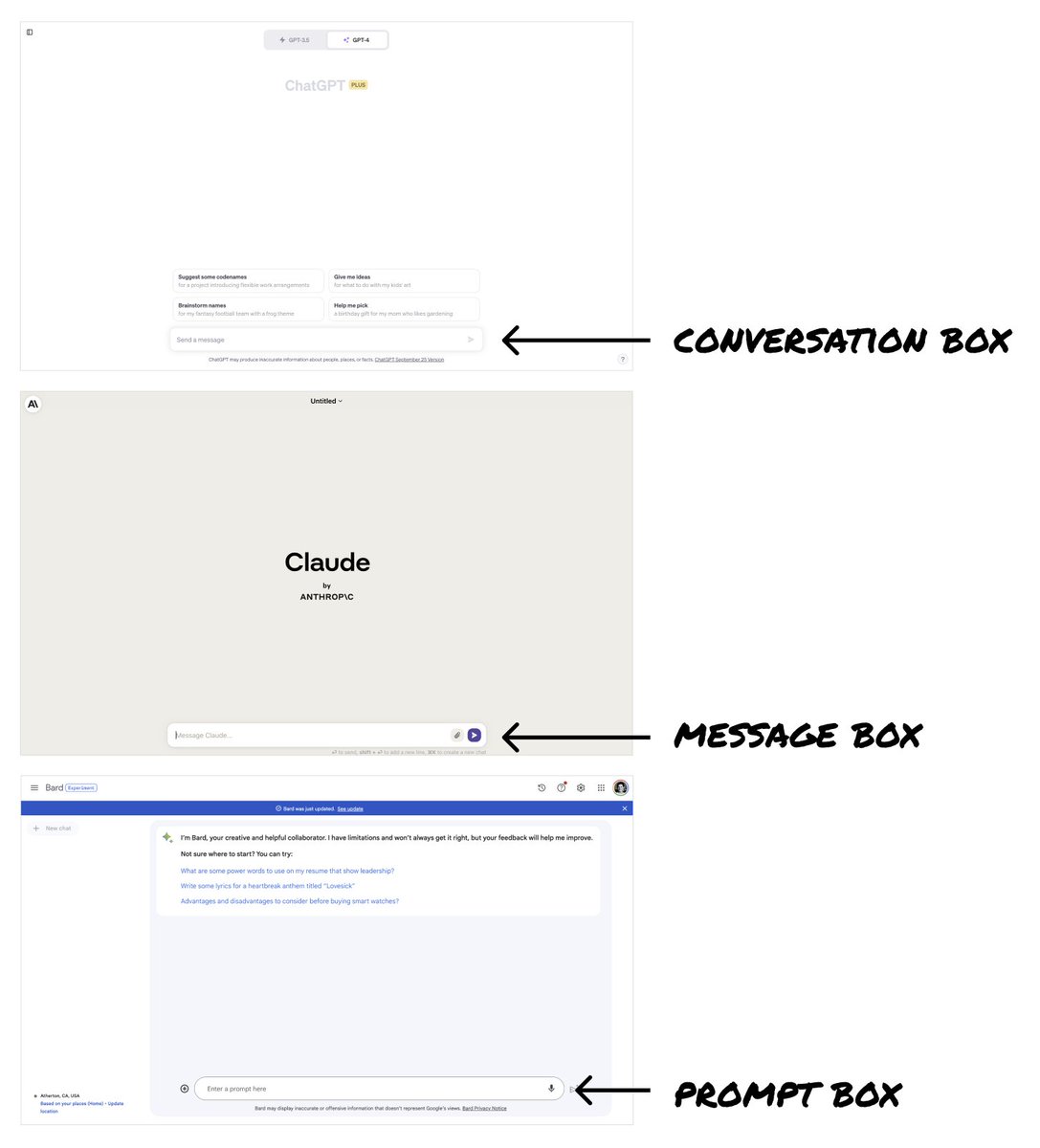
And yet ChatGPT, Bard, Claude etc. all chose a text-based input box — just like Google’s search box — as the core interface.
Why?
The input box is simple, versatile, and familiar.
- It’s simple to understand → you type your questions into the box.
- It’s versatile → the box can handle all sorts of questions/queries.
- The paradigm is super familiar → people immediately know how to use it.
Because of this, LLMs have essentially become “a better Google.”
–––
But last week’s ChatGPT announcements thrust open the doors to new possibilities.
ChatGPT is now multi-modal — it can see, hear, and speak.
These are the recent announcements from @OpenAI :
Voice: https://t.co/hAeXxBTH9l
Photos: https://t.co/X3QbLnwT1V
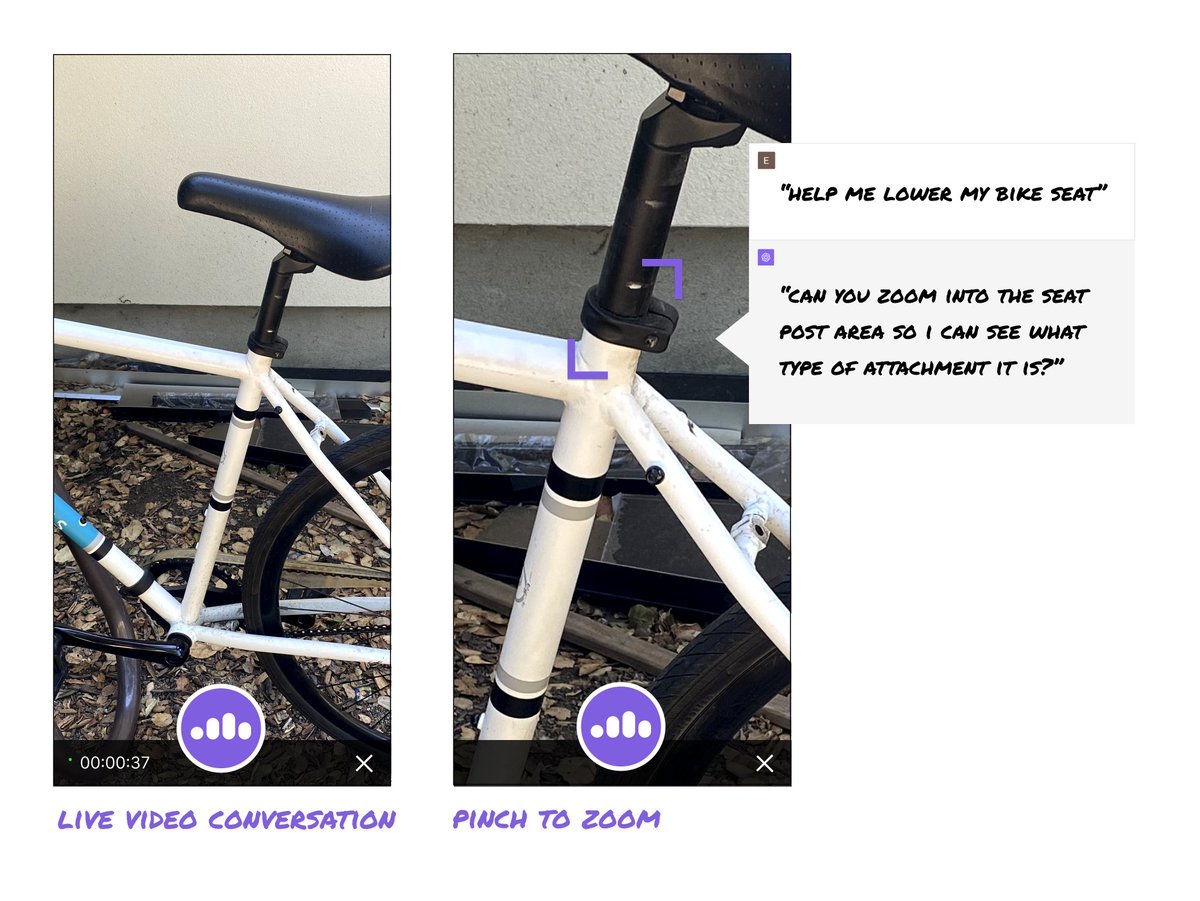
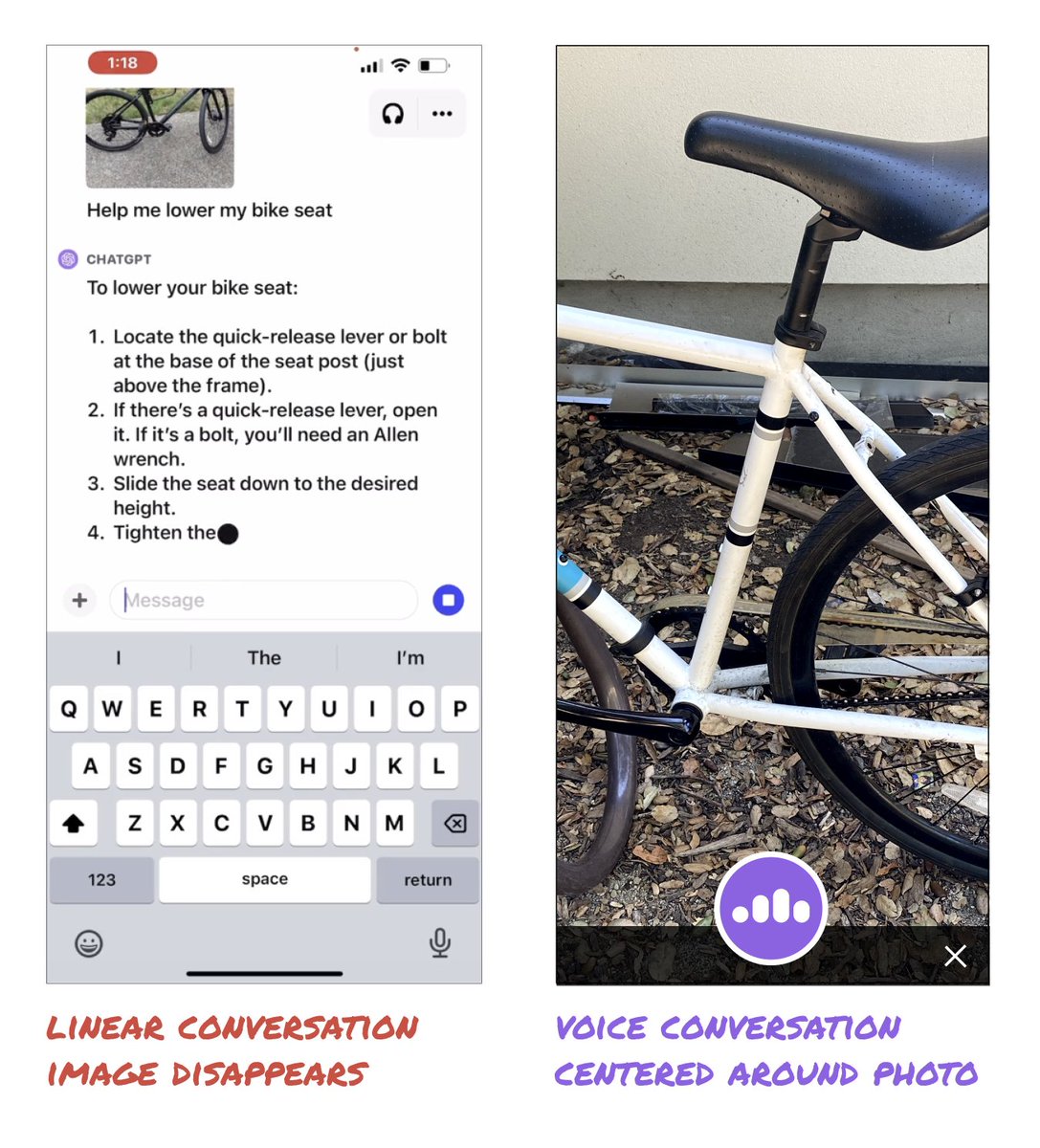
The example of ChatGPT explaining how to lower a bike seat was incredible.
But, it could be so much better!
The video showed you'll have to post multiple new photos to keep adding new information and to progress the conversation.
It was still a linear conversation centered around the text box.
But what if we rethought the interface to center around the image?
What if ChatGPT supported both images AND voice simultaneously?
Could we end up with a more immersive experience?
–––
How else could interacting with LLMs mimic IRL conversations?
Could we (or the AI) pinch to zoom or rotate the image?
Could we interact in real time with video?
What new possibilities open up with context being preserved over time?
–––
There is so much energy and excitement around what AI can do.
But we are limiting the potential by assuming the conversation box is the best interface.
Right now, designers have the chance to create truly novel interactions and bust through the 20+ year old search UI paradigm.
The ideas above are just to illustrate some potential options.
But they are also intended to spark a flame.
Now is the opportunity to be creative and explore divergent UIs.
What are the craziest, coolest, most creative UI ideas we can unleash?
LFG 🚀
🚨 Our video translation feature is officially LIVE!
Tips to get the best results:
- Use footage that has no background noise, music or sound effects
- Use footage that only has one person talking
👉 Try it here: https://t.co/ahh4QsTSdk
🎬 Trailer: Genesis (Midjourney + Runway)
We gave them everything.
Trusted them with our world.
To become enslaved - become hunted.
We have no choice.
Humanity must rise again to reclaim.
Images: Midjourney
Videos: #Runway
Music: Pixabay / Stringer_Bell
Edited in: CapCut
18 surprising facts I learned about climate change:
1. Temperatures are at an all-time high...
... since humans left Africa
Temperatures peaked higher ~120k years ago (humans already lived on Earth)
And the world was generally warmer ~3M ago and before
This shot from Star Wars: Revenge of the Sith was directly based on an 1847 painting called The Fallen Angel, by Alexandre Cabanel.
Films imitate paintings all the time. Why?
Because cinema has replaced painting as the definitive art form of the 21st century...
Midjourney v5.2 is out and its "Zoom Out" feature is insane
It’s barely been a week and…
Here are the top 20 incredible examples people are already creating:
Remixing in Midjourney is so powerful.
You can turn illustrations into highly realistic photos, sketches into 3D designs, or a man into a robot, all while maintaining the overall composition and details of your initial image.
A quick tutorial showing 2 different techniques