Today we’re announcing $106M in new funding led by Altimeter Capital and Bezos Expeditions. This brings our total to $150M to scale our frontier AI models which make biology programmable.
Our frontier models have generated functional proteins (Nature Biotech, 2023), created the first CRISPR system designed from scratch (Nature, 2025), and showed clear scaling behavior (NeurIPS spotlight, 2025).
The opportunities ahead are unimaginable. If you’re excited by shaping the future of biology – join us in pushing the science forward.
Forbes: https://t.co/7R8CYfvBp6
Press Release: https://t.co/a8f2IZNPpX
--
Nature Biotech, 2023: https://t.co/4xQIgzQuG4
NeurIPS spotlight, 2025: https://t.co/HgmmkUVUe4
Nature, 2025: https://t.co/YrpGxnfsqB
Profluent is a finalist for the Emerging Innovator of the Year award at the 23rd Annual Pantheon Awards @CALifeSciences
Frontier AI for biology, built in California.
Meet the 2026 Pantheon Award winners 🏆🌊
Through their transformative discoveries, breakthrough technologies, and steadfast leadership, this group of innovators, companies, and institutions have advanced California's life sciences industry and made exceptional contributions to improve lives around the world. We're looking forward to honoring @Genentech, Ziad Obermeyer, MD, @NOETIK_ai, @RevMedicines, Teal Health, @SD2org, and Catriona Jamieson, MD, PhD, this November.
🌟 Plus, we'll be announcing the winner of our Emerging Innovator of the Year award live during the ceremony. Join us in San Francisco and be the first to find out who it is 🔗 https://t.co/gZlSFuRRJu
we build foundation models that span all protein modalities (ie not just one type of medicine). this partnership with @BioMarin pharma is one piece of evidence towards that.
we'll have even more announcements soon on this point
We’re excited to be partnering with @ProfluentBio, an innovative AI lab for biology that will apply its foundational AI models to generate novel enzyme therapies for BioMarin.
Profluent will design and optimize potential medicines using the largest protein sequence dataset in the world, composed of more than 115 billion unique sequences. Our scientists will screen these protein designs and evaluate the most promising candidates to advance to preclinical models, accelerating our early stage research and development in metabolic conditions.
Read more: https://t.co/AK9EvMF6FK
We’re partnering with @BioMarin to use our AI models to design novel medicines.
Our foundation models unlock proteins with new and improved functions by drawing on the world's largest dataset of unique protein sequences (115B and counting): Profluent’s Protein Atlas
BioMarin will screen designs we generate and advance the strongest into preclinical testing. Looking forward to what AI can unlock for patients!
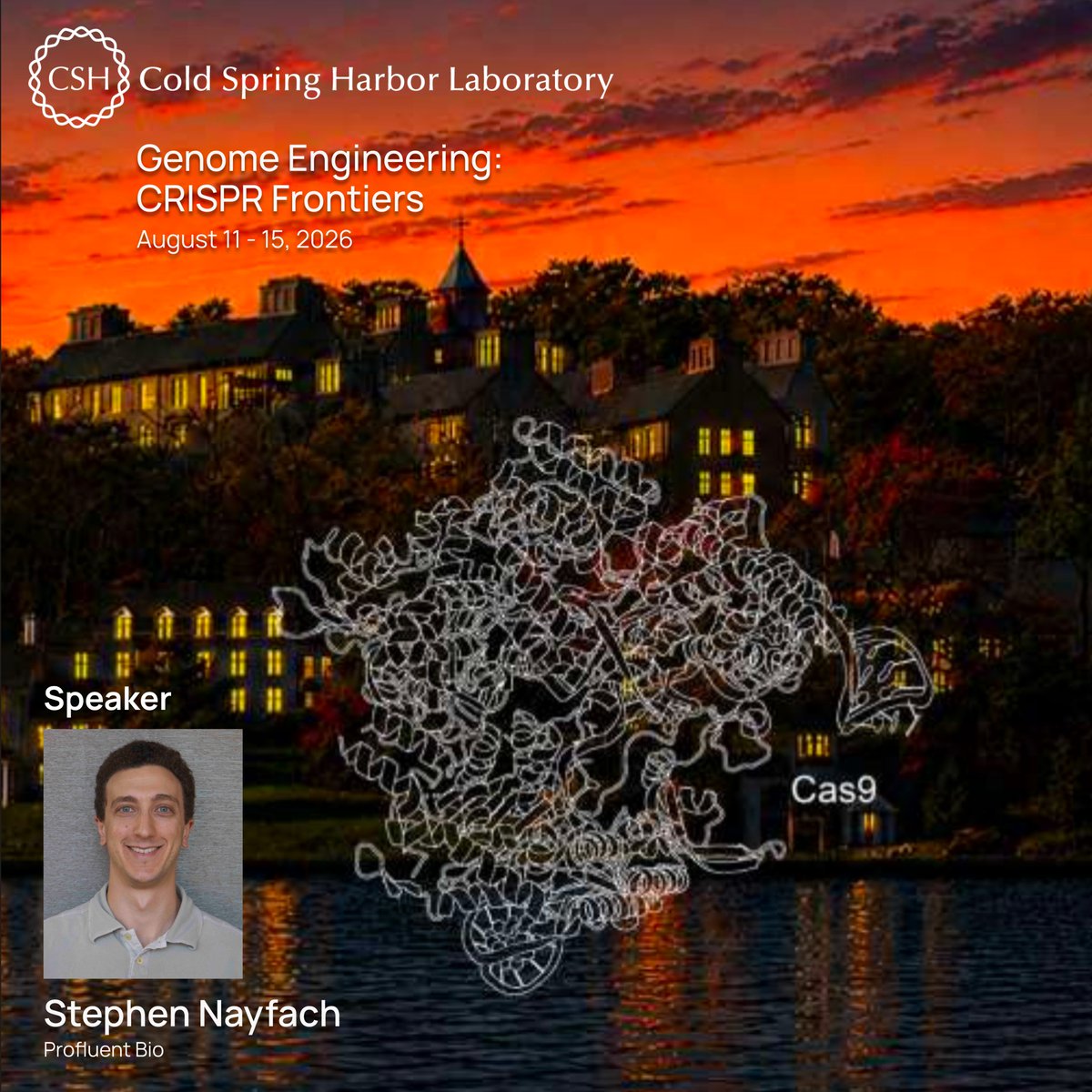
Stephen Nayfach, our Head of Bioinformatics and Platform R&D, is at @CSHL this week for the Genome Engineering: CRISPR Frontiers event. Find him and say hi if you're there! 👋
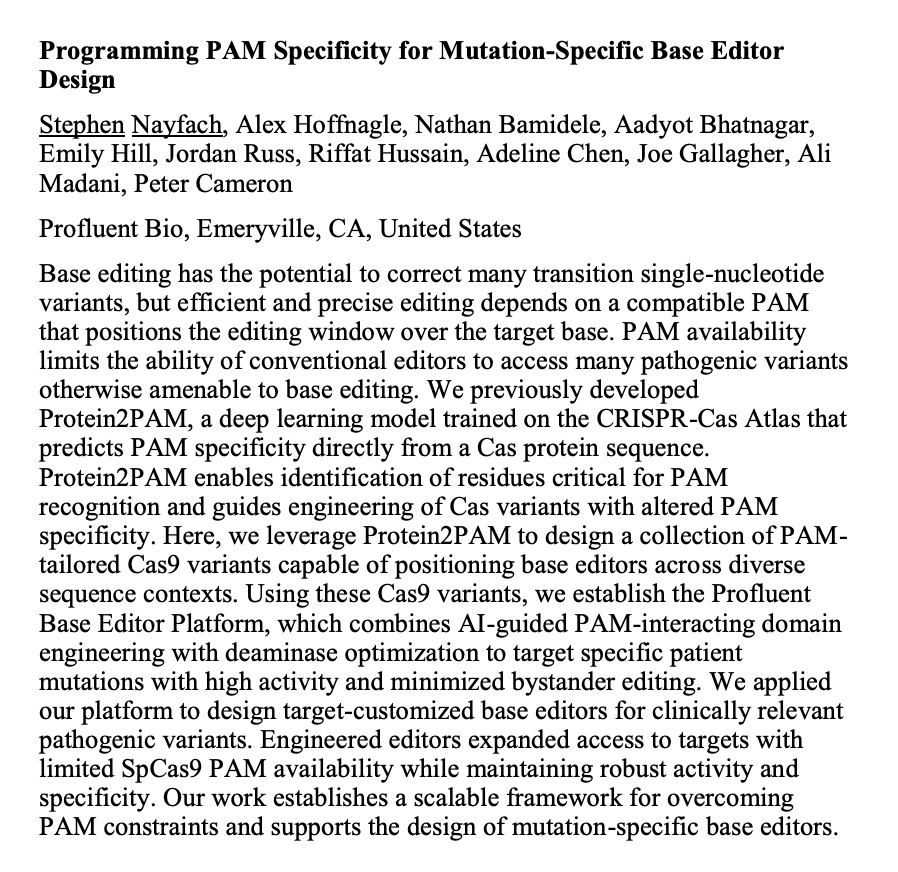
He's giving a talk on using our AI models to design CRISPR-Cas9 variants for base editing ("Programming PAM Specificity for Mutation-Specific Base Editor Design") and also chairing the session "CRISPR Technologies I"
Heading to Summer RosettaCon next week to share my work from my time at @ProfluentBio
Come listen to my talk about the encoder model Profluent-E1 on Thur at 1:30pm (“E1: Retrieval-Augmented Protein Encoders for Fitness and Structure Prediction”) and let’s chat after!
The Profluent team is heading to Summer RosettaCon next week! Find @jeffruffolo, @richardwshuai, @ShiakiMinami, and Alex Hoffnagle and say hi 👋
You can hear Richard talk about E1, our encoder model, on Thur at 1:30pm (“E1: Retrieval-Augmented Protein Encoders for Fitness and Structure Prediction”) and Alex share his work on our AI-designed base editors on Mon at 7:30pm (“Design of Programmable Base Editors with Protein Language Models”).
The government is backing us for a moonshot to design *personalized curative* medicines. Excited to be partnering with GemmaBio and be in the elite company of the best medical centers in the world.
Each word has significance.
Personalized = bespoke to each patient [this is where programmable biology with AI can directly play a role]
Curative = lasting solutions that cure not just manage disease. This is what we at Profluent live for, real cures to disease.
Let's go build!
A suite of AI-designed base editors, all from one scaffold. The only piece unique to each patient is the guide RNA.
That's the shift AI unlocks: rare disease moves from 'one drug at a time' to a platform, built to bring cost down and reach more patients.
More on our work with GEMMABio, now backed by @ARPA_H's THRIVE program, below.
The bottleneck in rare disease is design: too many mutations, one editor at a time. AI unlocks that.
Proud to be building GemmaBio's platform with them under @ARPA_H 's THRIVE program. We're bringing our frontier AI models and base editors to the work to design modular gene editors that scale across many mutations.
95% of rare diseases have no approved treatment.
When your child is getting sicker, waiting isn’t an option.
ARPA-H is investing $160 million through THRIVE to accelerate personalized genetic cures for the kids who need them most.
A rare diagnosis should never mean no hope for a cure.
@broadinstitute@ChildrensPhila@igisci@StJude@Stanford #GEMMABio #MassachusettsGeneralHospital
https://t.co/vB9SchprmP
The Profluent team will be at ICML in Seoul next week. Find us to chat, grab a coffee, or join us for dinner!
We’d love to talk shop (protein language models, protein optimization, sequence-first methods vs structure-first). Basically, anything at the intersection of AI and biology.
Want to grab coffee? Let us know here: https://t.co/dJWt7CjFeS
Or want to hang out and chat over dinner? Reserve a spot at our table: https://t.co/eZNKiXkFVr
And here's a few places you can find us during the conference:
— Oral talk: @thisismadani with collaborators from NVIDIA and Microsoft Research: "FLIP2: Expanding Protein Fitness Landscape Benchmarks for Real-World Machine Learning Applications" (Tue, Jul 7 @ 10:15am, Hall D2)
— Workshop: Join @jeffruffolo, @AadyotB, and the Profluent team: "E1: Retrieval-Augmented Protein Encoder Models" (Sat, Jul 11 @ 2:25pm, Room S317)
— And our very own @park_jungy will be presenting work from his PhD: "Discovering Symmetry Groups with Flow Matching" (Wed, Jul 8 @ 5pm, Hall A #3010) and "Smoothness Errors in Dynamics Models and How to Avoid Them" (Thu, Jul 9 @ 2:30pm, Hall A #2200)
We're still in the GPT 1.5 era of AI × biology
The early models already work (signal: our $2.25B Lilly partnership) but we're nowhere near the ceiling
We're speedrunning to GPT 5 as fast as we can
@thisismadani with @nathanbenaich@airstreet
it's been a huge few weeks for ai in bio: a $2.25b @profluentbio x @elilillyandco deal on ai-designed gene editors, verve's base-editing data, new scaling results on protein models from @czbiohub, @isomorphiclabs' haul.
@thisismadani and i recorded a pod diving into all of it
we get into taking biology from discovery to design, sequence-first vs structure-first, and why he calls this the "gpt-1.5 era" of biology...
enjoy!
Biology is no less complex than text and (in our biased opinion) way more impactful. Yet a fraction of the world's AI talent and compute is pointed at it.
The field is wildly undersaturated.
Watch @thisismadani chat with @nathanbenaich @airstreetcapital about the opportunity.
it's been a huge few weeks for ai in bio: a $2.25b @profluentbio x @elilillyandco deal on ai-designed gene editors, verve's base-editing data, new scaling results on protein models from @czbiohub, @isomorphiclabs' haul.
@thisismadani and i recorded a pod diving into all of it
we get into taking biology from discovery to design, sequence-first vs structure-first, and why he calls this the "gpt-1.5 era" of biology...
enjoy!
OpenCRISPR was the first demonstration that AI could design a genome editor from scratch. We used our AI model to build a protein that doesn't exist in nature for a specific function and it worked.
Watch @thisismadani chat with @nathanbenaich @airstreetcapital about where we’ve gone from there (and where we’re going)
it's been a huge few weeks for ai in bio: a $2.25b @profluentbio x @elilillyandco deal on ai-designed gene editors, verve's base-editing data, new scaling results on protein models from @czbiohub, @isomorphiclabs' haul.
@thisismadani and i recorded a pod diving into all of it
we get into taking biology from discovery to design, sequence-first vs structure-first, and why he calls this the "gpt-1.5 era" of biology...
enjoy!
Our partnership with Eli Lilly carries up to $2.25B in milestones. The bigger story is the unlock behind it: large gene insertion, a problem AI makes solvable for the first time.
Watch @thisismadani in conversation with @nathanbenaich@airstreet.
it's been a huge few weeks for ai in bio: a $2.25b @profluentbio x @elilillyandco deal on ai-designed gene editors, verve's base-editing data, new scaling results on protein models from @czbiohub, @isomorphiclabs' haul.
@thisismadani and i recorded a pod diving into all of it
we get into taking biology from discovery to design, sequence-first vs structure-first, and why he calls this the "gpt-1.5 era" of biology...
enjoy!














![thisismadani's tweet photo. The government is backing us for a moonshot to design *personalized curative* medicines. Excited to be partnering with GemmaBio and be in the elite company of the best medical centers in the world.
Each word has significance.
Personalized = bespoke to each patient [this is where programmable biology with AI can directly play a role]
Curative = lasting solutions that cure not just manage disease. This is what we at Profluent live for, real cures to disease.
Let's go build!](https://pbs.twimg.com/media/HM0I-nTasAAqVJn.png)