Artificial Creativity - A film generated by Opus 5.5. 34 mininutes long (34 GB). The original HTML is only 13.8 MB! They say pictures are a thousand words. Here we have programs generating a thousand pictures. (turn sound on)
@AElitzur מבחינת הרצון, אין הבדל בין דטרמיניזם קלאסי לאינדטרמיניזם קוונטי או השתחררות מחץ הזמן כי כולם שרירותיים. כדי שיהיה רצון צריך להיות סוכן (או ישות) שירצה. לפי המודל הביולוגי הקיים בעל חיים אינו סוכן אלא רק אוסף של אינטרקציות ביוכימיות ולכן אין מי שירצה.
מישהו ביקש מקלוד לייצר סרטון ללא מילים בנושא "מה בני אדם לא מבינים נכון בקשר ל AI"
הנה הסרטון. לאחר מכן שאלתי את צ'אט מה הוא חושב על הסרטון. השיחה בתגובה הראשונה.
I asked Claude Sonnet 5.5: "Visualise what people get wrong about AI. No words allowed."
This is what it made in 1 shot. 🔊
Someone explain what THE message is?!
Let me show you something extremely cool.
1. Opus 5.5 + CRHQ rebuilt the Pinball machine I was playing in high school. One shot.
2. Then, it built an entire Tribute site, with playable game, 3D Model of the pinball machine, and entire story of how it rebuilt it. It's INSANE! https://t.co/3nd64TYkZL
3. Then... it built this video. Even more INSANE.
It gave me teleprompter to read the script and film myself. It made https://t.co/AhFqg8Dnxv so that I can just press "record all" and create 5GB of B-Roll footage on my computer. I uploaded it all and that's it. It constructed this exact video one shot.
What the fuck.
This isn't science fiction anymore.
The Chinese University of Hong Kong researchers developed a magnetic slime robot that can be remotely controlled to move, squeeze through tight spaces, and even grasp objects. One potential application? Removing objects accidentally swallowed inside the human body without traditional surgery. Soft robotics is opening doors that rigid robots simply can't.
Would you trust a robot made of slime inside your body?
🎥 Media: @newscientist , The Chinese University of Hong Kong
⚠️ This content is shared for informational purposes only. CTO Robotics Media is a media platform and does not own or develop the technology shown. Credit belongs to the original creators.
#Robotics #SoftRobotics #MedicalRobotics #Engineering #Innovation #FutureTech #Science
you really don't need frontier models like opus 5.5 and gpt-6 astra for everything
and that's why people are considering going local, especially now that qwen 4 27b is coming -- codex is amazing, and sol 6 is cheaper now too
enterprise is clear, but for $200 plans and regular paid users, it's still a mystery
@hypergameme@maelguimet How do you know?
I sugget conscious is like beliveing in god.
You believe in god more than a chair believe in god.
Still there is no god.
I've been a cardiologist for 25+ years. The last 90 days changed medicine more than the last decade, and almost nobody noticed. Here are the 10 biggest AI breakthroughs, and why you should be excited, not afraid 🧵
1/ 37,000 AI agents. One "virtual biotech." It analyzed thousands of trials, figured out which drug targets actually work in humans, and independently proposed a lung cancer strategy that a major pharma company later pursued. AI isn't a search engine anymore. It's a co-scientist.
2/ The first drug discovered AND designed entirely by AI (Insilico's rentosertib) just entered Phase 3. In patients, it reversed biological age by 3–6 years across six different aging clocks. Read that again!
3/ As a cardiologist, this one gives me chills. The FDA authorized "Queen of Hearts," an AI that reads a standard ECG and catches heart attacks, including the hidden ones doctors miss. 2x the sensitivity. Far fewer false alarms. It pages the cardiology team itself. In a heart attack, minutes are muscle.
4/ EchoNext spots 6 types of hidden structural heart disease from a cheap, 10-second ECG, and it does it better than cardiologists. It already flagged a patient who went on to get a heart transplant. Screening that used to need an echo lab now needs a test any clinic can run.
5/ UpDoc is the first FDA-cleared AI that talks directly to patients. It checks in between visits, adjusts insulin within limits the doctor sets, and documents everything in the chart. Chronic disease no longer has to wait for your next appointment.
6/ An autonomous AI agent called MIRA, with full access to medical records, went head-to-head with ER physicians on hundreds of real cases.
AI: 87.8% correct
Doctors: 78.1%
It ordered the tests, read the results, and wrote the plan.
7/ Google released MedGemma 1.5 and MedASR, open medical AI for imaging and clinical speech that anyone can build on. Every hospital. Every researcher. Every country. Open models mean medicine moves at internet speed.
8/ The FDA authorized Aletta, the first robot that draws blood on its own. It gets the vein on the first stick 94–95% of the time, even hard veins. One technician supervises three robots. The most common procedure in medicine just got automated.
9/ UCLA's SLIViT matches specialists on 3D MRI, CT, ultrasound, and retinal scans, and it's 5,000x faster. It isn't a new model for every organ. One architecture reads them all.
10/ The FDA has now authorized 1,600+ AI medical devices. They cover radiology, cardiology, and surgery, including real-time AI that checks breast cancer margins while the patient is still on the table. This isn't coming. It's here.
What this means to you:
→ Drugs that took 10–15 years are showing human results in a fraction of the time
→ Heart attacks get caught on a cheap ECG, not after a collapse
→ Doctors get hours back
→ Patients get answers between visits
→ Aging itself is becoming treatable
This isn't "AI will replace your doctor." It's AI finally becoming good enough that medicine starts to compound. The next 18 months will feel different.
Bookmark this. We're early. Stay positive!!!
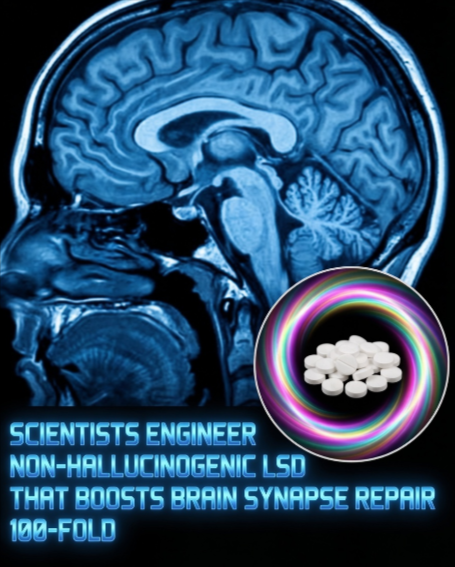
The new treatment literally grows new neural connections in the brain.
Researchers at the University of California, Davis, have developed a groundbreaking molecule that delivers the powerful brain-repairing benefits of LSD — without any hallucinations.
By simply swapping two atoms in the LSD structure (what lead researcher David E. Olson playfully called a molecular “tire rotation”), the team created JRT — a non-hallucinogenic “neuroplastogen.”
This innovative compound keeps LSD’s remarkable ability to stimulate neuronal growth and repair damaged synapses, while eliminating the psychedelic effects that make traditional LSD too risky for many patients.
The results are impressive: in preclinical studies, JRT increased dendritic spine density by 46% and was nearly 100 times more potent than ketamine as an antidepressant. Crucially, it avoided the gene expression patterns and behaviors linked to psychosis.
This could be a game-changer for psychiatric care — especially for people with schizophrenia and other conditions involving synaptic loss and brain atrophy, who were previously excluded from psychedelic-based therapies.