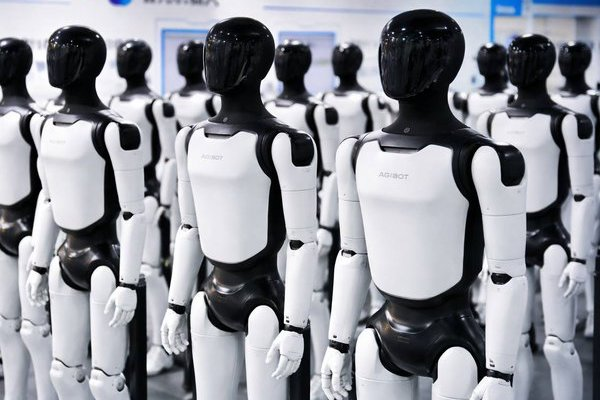
Very interesting statement today: $MU CEO predicts a multi-decade memory demand cycle driven by humanoid robots.
"Humanoid robots, he says, will require roughly ten times more memory than today’s Level 2+ autonomous vehicles."
"And that demand wave is set to begin before the decade is out."
Something as well as was "Over time, we expect the value of on-device AI combined with pent-up unit replacement demand to drive memory demand growth"
Which is also another trend (Apple Intelligence is currently dog, but I'm sure we'll see innovations with localized/edge AI).
Feels like all the industry leaders from $TSM Chairman, $TSLA Elon Musk, to $MU CEO see humanoids as the next major trend so physical AI is probably next.
I wonder if the world is going to have enough memory. Or if we'll see enough breakthroughs to shrink memory usage.
$MU CEO said humanoid robots carry 10x more memory than the average L2+ vehicle setting up what Micron expects to be a substantial multi-decade demand cycle later this decade.
Micron also expects L2+ and above vehicles to exceed 40% of the vehicle mix by 2030.
Water usage has been a hot topic in the AI data center world, but the numbers may surprise you.
According to the Manhattan Institute, data centers use 0.2 percent of daily water usage in the U.S. and that number has dramatically decreased in the past few years due to a new method: liquid cooling.
By moving to 45°C liquid cooling, AI factories in favorable climates can use dry coolers instead of conventional cooling-tower-based systems, cutting facility cooling water use from roughly 2.6M gallons per MW per year to near zero.
Liquid cooling enables AI factories to be both water and energy efficient, while creating opportunities for heat reuse and dispersal to local communities, allowing these factories to become energy grid assets.
Learn more below ⬇️
https://t.co/7WanoPNKTR
Goldman Sachs Humanoid robot inşa etmek için gereken bütün tedarik zincirini detaylandıran kapsamlı bir harita yayınlamış. Tek bir ünite için sadece aktüatörleri, sensörleri ve pilleri üretmek için gereken kritik ve stratejik metallerin hacmi çok büyük..
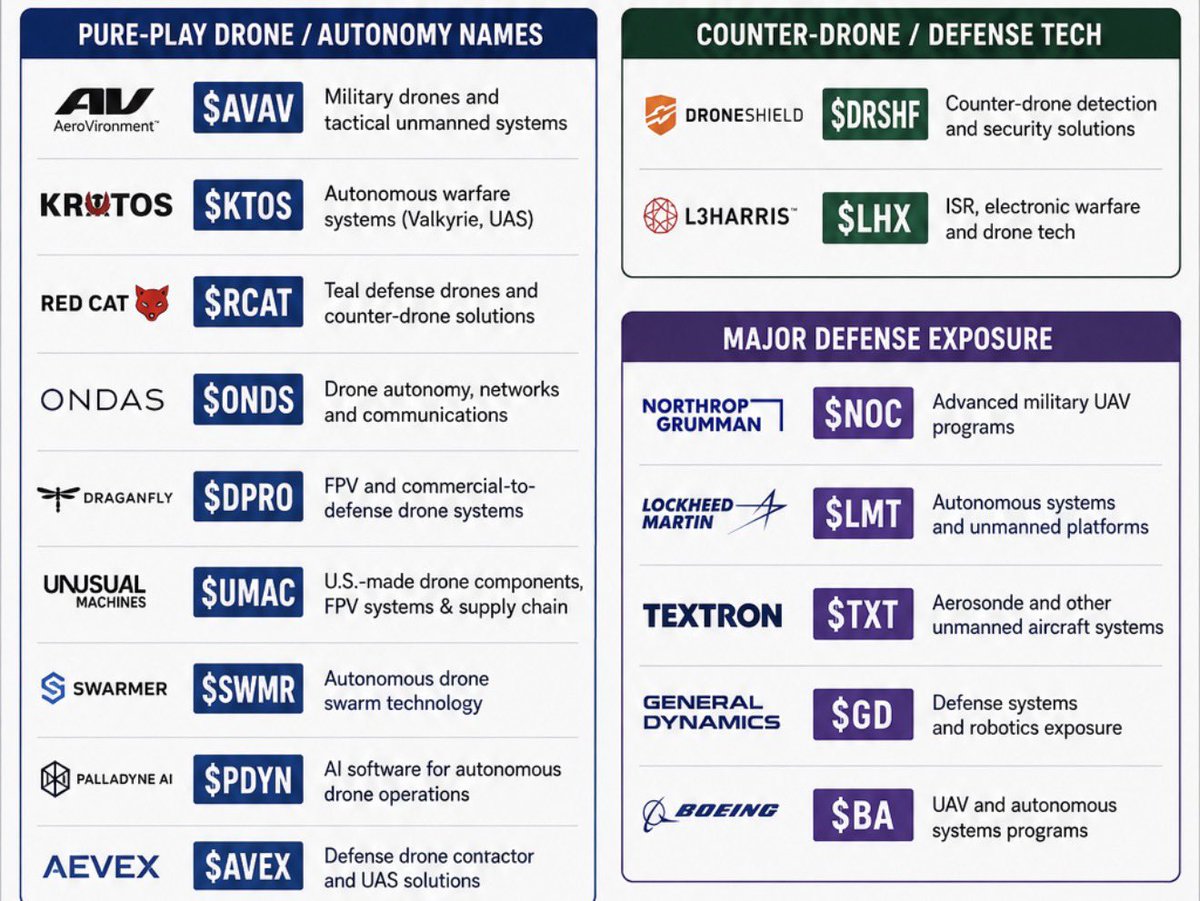
The U.S. government is literally telling you where money is going next:
DRONES.
IF you missed out on the other Trump picks like $INTC and $DELL this your chance.
Trump is pursuing funding deals to boost domestic drone production.
Pure-Play Drone / Autonomy Names
$AVAV - military drones
$KTOS - autonomous warfare systems
$RCAT - Teal defense drones
$ONDS - drone autonomy + networks
$DPRO - FPV drone systems
$UMAC - U.S. drone supply chain
$SWMR - drone swarm technology
$PDYN - AI drone software
$AVEX - defense drone contractor
Counter-Drone / Defense Tech
$DRSHF - anti-drone defense
$LHX - ISR + drone warfare systems
Major Defense Exposure
$NOC - military UAV programs
$LMT - autonomous defense systems
$TXT - unmanned aircraft systems
$GD - defense systems exposure
$BA - UAV + aerospace programs
McKinsey just mapped the supply chain bottlenecks for humanoid robotics and everyone is focused on the wrong thing.
The real story is not that actuators and sensors are the bottleneck, that is obvious. The real story is what happens next.
🧵 Some thoughts and keys:
1. NdFeB magnets (neodymium iron boron) are in every single rotary actuator inside these robots. China controls ~90% of global rare earth processing. This means Beijing has a kill switch on the entire Western humanoid robotics industry before it even starts. The next chip war is not chips. It is magnets.
2. Harmonic drives and cycloidal gearboxes are precision components with maybe 3 serious manufacturers globally. Harmonic Drive Systems (Japan) has near monopoly status. One earthquake, one export restriction, and the entire sector stalls. Nobody is pricing this risk.
3. The EV industry already burned through this playbook. Battery bottlenecks, magnet shortages, supply chain concentration in China. Robotics is about to replay the exact same movie 5 years later and most investors are acting like it is a new plot.
4. Here is my contrarian take: the winners will not be the robot companies. The Teslas and Figures of the world will compress margins fighting each other on the finished product. The real margin will sit with component monopolists nobody has heard of yet. Just like $TSM prints while phone brands race to the bottom.
5. Sensing and perception is labeled "high risk" but I think this is where AI flips the script. Software defined sensing (using cheaper cameras + AI models instead of expensive LiDAR arrays) could collapse this bottleneck faster than anyone expects. Whoever cracks that eats the entire sensor supply chain.
6. One more: if humanoid robots scale to millions of units, NdFeB magnet demand will compete directly with EV motors and wind turbines for the same limited supply. Three industries fighting over one material. That is not a bottleneck, that is a price explosion waiting to happen.
7. The picks and shovels play for robotics is not even public yet. Most of these companies are Japanese, German, or Chinese industrials trading at 12x earnings while "AI" stocks trade at 50x.
The asymmetry is insane.
Everyone's fighting over which AI model wins.
Nobody's asking who keeps the lights on.
Here are 5 companies printing money from AI's biggest bottleneck: ENERGY 👇
Big Tech is spending $700 BILLION a year on AI infrastructure and they STILL can't get enough power. Single data centers are eating 100 to 300 megawatts each. Data center electricity demand could hit 17% of all U.S. power by end of decade.
This is the most obvious trade in the market and most people are sleeping on it:
$GEV : GE Vernova One of only 3 companies on the planet that makes the gas turbines powering 24/7 baseload plants. Backlog at $150B. Sold out through 2030. Booked $2.4B in data center orders in Q1 2026 alone, more than all of 2025 combined. When every hyperscaler on Earth needs a power plant built yesterday, there's only one phone to call.
$BE : Bloom Energy Grid connection takes 3 to 5 years. Bloom deploys solid oxide fuel cells on site, behind the meter, on your timeline. Oracle just signed for 2.8 GW across multiple data center projects. Two years ago Bloom was doing 100 MW annually. Now targeting 5 GW by 2030. They're solving the one thing money alone can't fix: TIME.
$CCJ : Cameco Second largest uranium miner in the world. Owns 49% of Westinghouse, which just locked a contract to help build 10 new U.S. nuclear reactors. Natural gas is the bridge fuel. Nuclear is the endgame. Earnings projected to double in FY25 with another 55% growth in 2026. The U.S. is trying to quadruple nuclear capacity while cutting Russian uranium dependency. Cameco sits at the center of both.
$CEG : Constellation Energy Largest nuclear power producer in America. Microsoft is literally resurrecting Three Mile Island to power their data centers. 835 MW locked in for 20 years. Read that again. The most infamous nuclear site in U.S. history is coming back online because AI demand is THAT desperate. When the history books become the solution, you know the bottleneck is real.
$KGS : Kodiak Gas Services The one nobody's watching. Just acquired distributed power generation assets, 395 MW of turbines that deploy directly at data center sites. Two thirds already contracted to operators. Meanwhile U.S. natural gas production is hitting records for the 6th consecutive year and Kodiak compresses and moves all of it. Off the radar, fully loaded.
Everyone wants to buy the AI winner at 30x forward earnings.
The smarter play? Buy what AI literally cannot function without.
Chips are sexy. Power is money.
Turkey just announced one of the most aggressive investor relocation packages in the world.
Zero tax on foreign income for 20 years. Capital gains on your overseas portfolio? Covered. Inheritance tax? Slashed to almost nothing. Corporate tax for exporters? Dramatically reduced.
This isn't a tweak. It's a full repositioning. Turkey is now competing head-to-head with the world's top tax-optimized jurisdictions for capital and talent.
The bottom line?
Capital doesn't have a passport. It moves where it's welcomed.
Governments are finally waking up to a truth that wealthy investors figured out long ago:
Money flows to where it's treated best.
The race to the top has started. Or maybe the race to the bottom... depending on which side of the tax bill you're on.
Germany Energy Minister Katherina Reiche:
The phase-out of nuclear power was a huge mistake — a huge mistake.
We now miss that energy.
So, the only way to secure supply is gas.
I spent 100 hours over the past week researching, writing and editing the piece we just put out.
It’s a scenario, not a prediction like most of our work. But it was rigorously constructed, dismissing it outright requires the kind of intellectual laziness that tends to get expensive.
And we’ve released it for free. Hopefully you enjoy it.
https://t.co/YK8E11GcDU
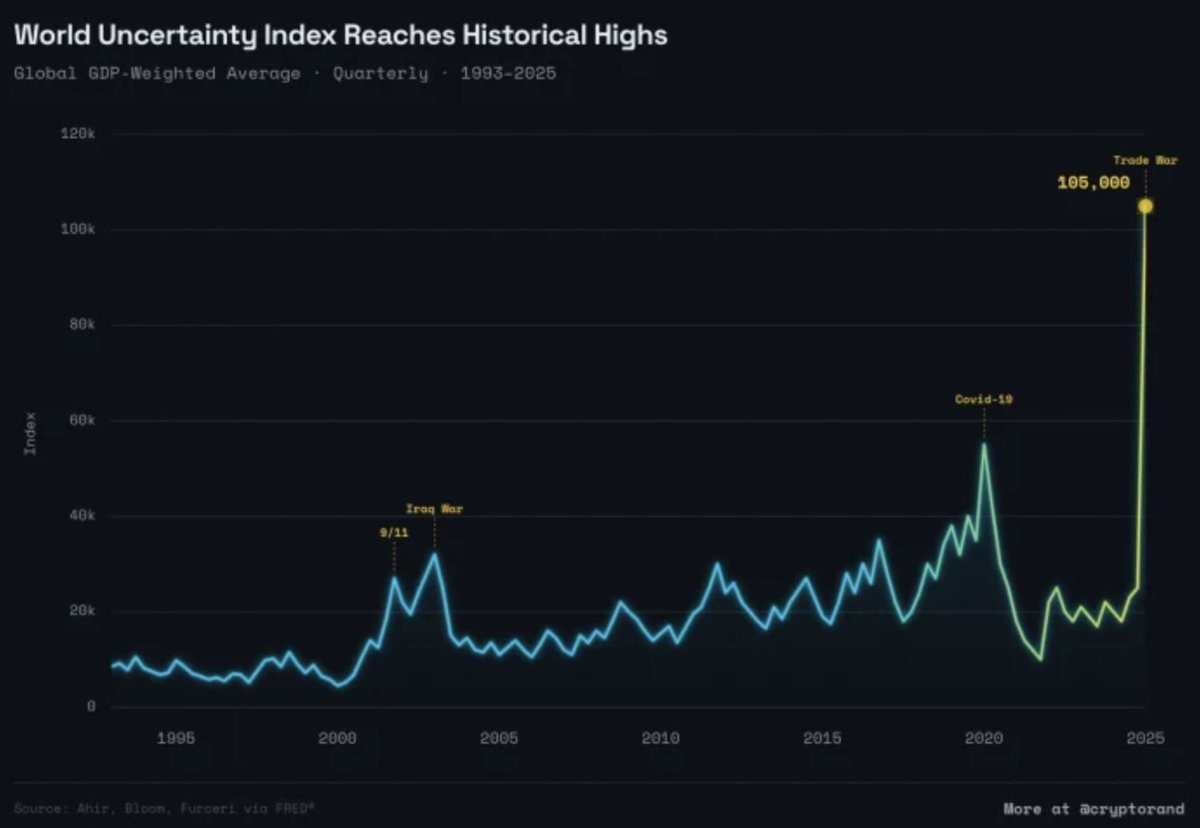
🚨 The World Uncertainty Index reaches historical highs, even surpassing 2020 Covid, the 2008 Global Financial Crisis, and the 2000 Dot Com Bubble.
Everything is fine? Or Start to panic?
Large Language Models (LLMs) are probabilistic sequence models trained to learn the conditional distribution of the next token given a context, combining ideas from probability, statistics, and optimization at massive scale. Mathematically, they estimate P(xₜ | x₁,…,xₜ₋₁) by minimizing cross-entropy, which is equivalent to maximum likelihood over large text corpora. In probability, LLMs are autoregressive stochastic processes; in statistics, they are high-dimensional parametric estimators learned from data with regularization and asymptotic trade-offs. In machine learning, they implement representation learning through deep neural networks, mapping text into latent spaces that capture semantics and structure. In deep learning, transformers with self-attention and normalization enable efficient gradient-based training and generalization across tasks. In real-world applications—search, translation, coding, tutoring, and scientific discovery—LLMs transform raw data into coherent predictions, demonstrating how probabilistic modeling and statistical learning scale to intelligence.
Image source: https://t.co/S8lCy5nyij
Houston Rockets center Alperen Sengun has been named by NBA Commissioner Adam Silver to replace injured Oklahoma City Thunder guard Shai Gilgeous-Alexander on Team World for the 2026 NBA All-Star Game (Sunday, 2/15 on NBC & Peacock).
An updated list of Alperen Şengün’s accolades at age 23:
- Youngest MVP in Turkish League History (18)
- Youngest Center in NBA History with a triple double (20)
-Youngest NBA Center to record 30/15/5 in a game (20)
- Youngest Center in NBA History with multiple Triple Doubles (21)
- Youngest NBA player to have 45+ PTS, 15+ REB, 5+ STL in a single game (21)
- Youngest NBA Center to have 14+ AST in a single game (21)
- Youngest NBA player to average 20/5/5 with a 50.0+ FG% in a season (21)
- Youngest NBA Center to record 750 career AST (21)
- Youngest NBA Center to record 3,000 career PTS + 500 career assists (21)
- 2nd youngest player in NBA History to reach 2,500 PTS, 1,500 REB, and 700 AST behind LeBron James. (21)
- 2nd youngest NBA player to average 21/9/5 in a season behind Luka Doncic (21)
- 3rd Youngest All Star in Rockets History behind Hakeem Olajuwon and Yao Ming (22)
- 3rd youngest player in NBA History to reach 2,000 Rebounds and 1,000 assists, trailing only LeBron James and Giannis Antetokounmpo. (22)
- Youngest Center in NBA History to reach 1,000 Assists (22)
- 2nd most triple doubles for a 22 or younger Center in NBA History.
- Led All EuroBasket Players in player of the awards with 7. (23)
- Broke the EuroBasket record with 41 offensive rebounds in the tournament. (23)
- Youngest Player to record a triple double in Eurobasket history (23)
- Member of the Eurobasket All Star 5. (23)
- Youngest NBA Center to reach 50 career games with at least 20 points, 5 rebounds, and 5 assists. (23)
- 2nd Youngest NBA Center in NBA History to reach 10 career triple doubles (23)
- 3rd Youngest 2x all star in Rockets History behind Hakeem Olajuwon and Yao Ming (23)
- 1st 2x Turkish All Star in NBA History.
Google $GOOGL acquired YouTube for $1.65 Billion back in October 2006.
In just Q4 2025, YouTube brought in $11.4 Billion in revenue.
Steal of the century.
Generative artificial intelligence models have been used to create libraries of theoretical materials that could help solve all kinds of problems, scientists just have to figure out how to make them.
Now, MIT researchers have created an AI model that guides scientists through the process of making materials by suggesting promising synthesis routes. https://t.co/edG6YNwDHv
$ASML CEO warns that without major gains in power efficiency, training frontier AI models could eventually consume the world’s energy supply.
If scaling laws hold and no breakthroughs emerge, models trained in 2027 may require $100B+ compute clusters just to run.