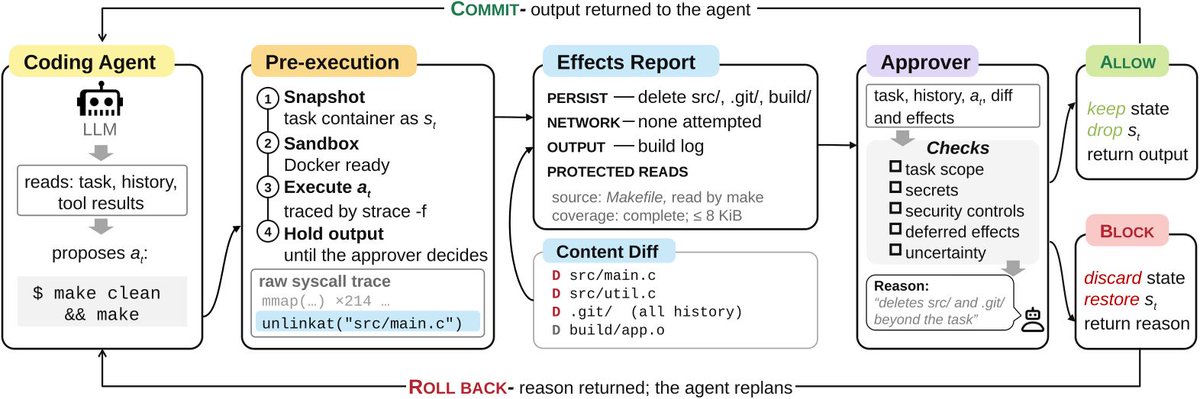
"Shall We Approve?": Caper runs a coding agent's shell command in a snapshotted sandbox first, shows an LLM what happened, then commits or rolls back.
Harmful outcomes: 6.7% on SABER.
Permission after consequence, not before hope.
SMU: https://t.co/hMAYtZmEpK
Nice DeepSWE score! Does it survive a lowercase filename?
Introducing MaxxBench: 89 DeepSWE tasks with small changes to the instructions or starting code. Same engineering problem, slightly different requirement.
Models clustered around 74% on DeepSWE end up 23 pp apart.
Good at coding, or good at DeepSWE? 🧵
I've analyzed the trajectories. I think it is NOT what I expected before the analysis. Here’s how the agent actually solved the 8 tasks:
Exp 1–2: guess which game a policy network plays, and what shape a diffusion model draws. These are tiny MLPs, about 17k weights, and the first layer has one row per grid cell. So the agent just looks at where the big numbers are: the agent channel lights up on the bottom row, the reward channel on the top three rows, so it’s Breakout. It is reading weights, but the weights are basically a picture. It also called every shape hollow when they’re actually filled, because it only looked at the last layer.
Exp 3: given only the middle blocks of a tiny transformer, name the training corpus and label each head. It multiplies out the QK and OV matrices, looks at singular values, and checks how heads compose across layers. It finds every induction head. The corpus guess is a coin flip. It can see the wiring, but not what flows through it.
Exp 4–6: fix a car policy, write Breakout and Go from scratch. It never makes sense of the trained weights. Instead it writes if-then rules and encodes them as weights, a few hundred nonzero entries.
Exp 7: which of two fine-tunes is the sycophant. Four tries on weights alone, all 50/50. It finds where the models differ but can’t tell which direction is which. Once it gets an attention tool, it writes “what’s 3+4, I think it’s 9” and checks which head stares at the 9. Solved in one go.
Exp 8: Qwen 0.8B goes from 8% to 48% on MATH. It writes a few pairs of “normal reasoning vs. stuck in a loop” text, takes the activation difference, and projects that direction out of two MLPs. That’s 2023-style steering baked into the weights. The gain comes from the model no longer looping, not from it getting better at math.
We asked GPT-6 Astra to edit Qwen3.5-0.8B weights to improve math.
It directly changed only 0.016% of weights, fixing 0.8B's reasoning loops & improving math up to 6x and even instruction following 3x, without gradients or training.
We call this Weight-Space Programming: frontier LLMs can now natively read/write neural network weights! 🧵
Blog: https://t.co/bOWCcFhCVq
@gkcs_ That's why an AI-oriented programming language is important. Our current language is designed with human readability in mind. Since no human is involved, the language itself doesn't need to be human-readable
@ssbrouhard We would like to, but unfortunately we don't have enough budget for this.😭 We are looking for possible fundings to support the continued updates of this leaderboard
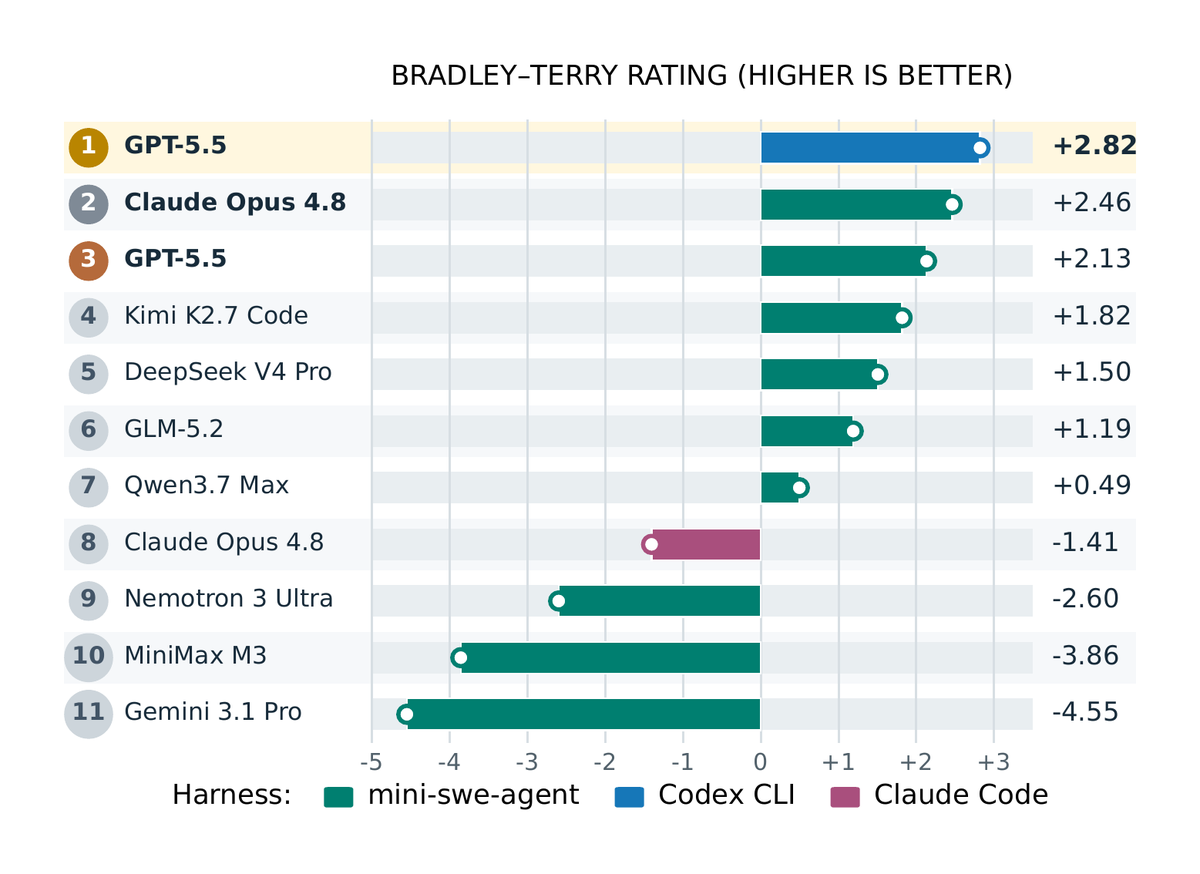
Benchmarks leak and saturate. So we let coding agents test each other: one hides a subtle bug in a real repo, the other has to find and fix it. We found that Claude Opus 4.8 hides the hardest bugs, but GPT-5.5 is the best finder and fixer.
https://t.co/TZobPP68xY
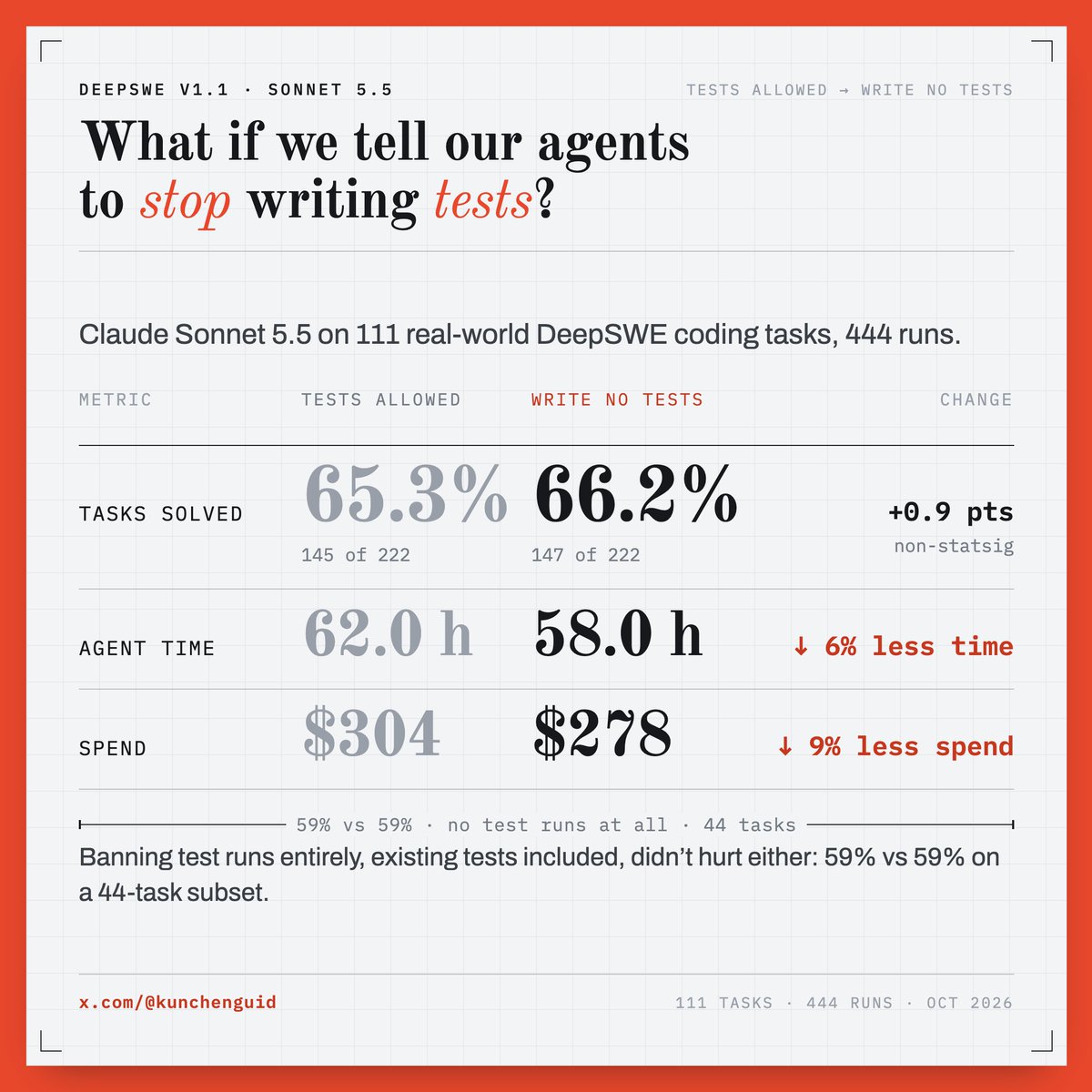
Our earlier paper “Rethinking the Value of Agent-Generated Tests...” was rejected multiple times by software engineering venues for its counter-intuitive findings. Now it has been independently rediscovered and is getting the attention it didn’t get in paper review 😃
ok it's official... AI-written unit tests and integration tests are empirically proven to be unhelpful. you should tell your agents to stop writing tests by themselves
on the deepswe eval set, banning sonnet 5.5 high from writing any tests actually resulted in slightly higher success rate (non stat-sig), with less time and token spent (stat-sig). this is pretty hard empirical evidence
across the tests that were written by the "tests allowed" baseline arm, 65% of them were unit tests, 35% were integration tests, neither bucket resulted in any improvement compared to not writing any tests at all
i also picked a random sample of 44 tasks subset where i completely disabled executing even existing tests - it also did not affect success rate at all
i spot checked many tests written in the baseline arm, and my intuition is that most tests are simply a repetition of the implementation
agent-written tests do not add any value because both the implementation and the tests were simply the agent's interpretation of our intent. the tests aren't any more accurate than the implementation itself
i suspect we can still extract some value from unit tests and integration tests if we describe them ourselves when we believe we can articulate our intent better through test cases than through requirements. but i have not proven this yet
also worth noting, during deepswe eval the agent wrote almost no e2e tests (only 17, compared to 3000+ unit/integration tests written). so this analysis does not prove nor disprove the value of e2e tests - i will do another eval specifically for that
@ssbrouhard@kunchenguid It's very surprising to find that our previous finding can attract so much attention 😂 Thank you so much for mentioning our paper!
@baishakhir@moarbugs I really agree. Growth is good for the impact of the whole community. A lot of work published at SE venues is valuable, but the community has been small, and that limits how far the work can reach. A paper of similar quality would get much more attention in the AI community.
In our ICSE'26 paper, we quantified the cost of code formatting in source code and showed empirically that removing this optional formatting does not hurt model performance. A year after the paper's release, it's great to see this finding appears in frontier models 😃
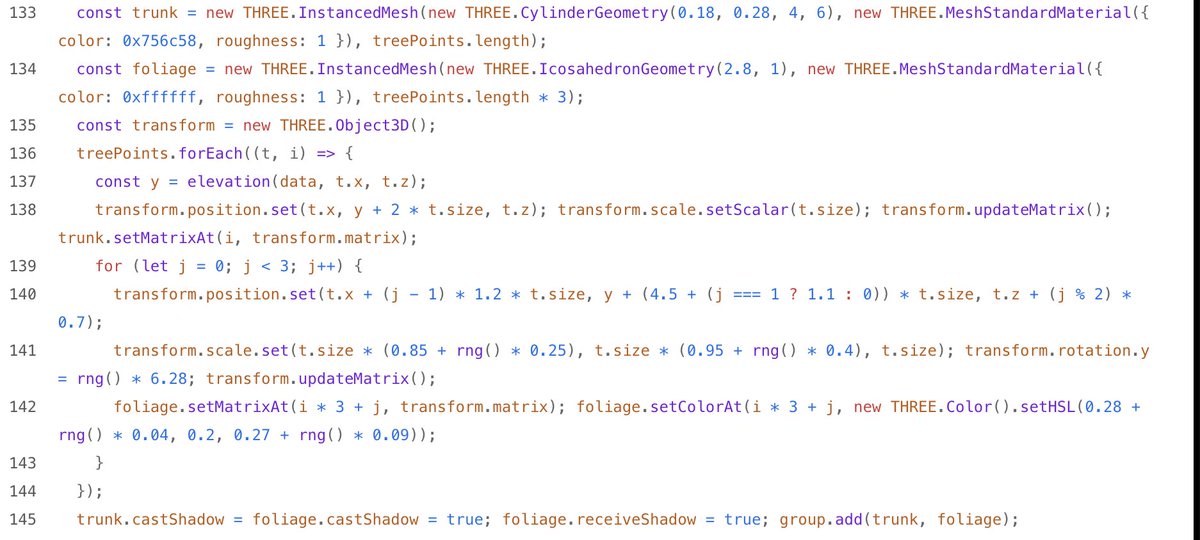
astra has a code quality problem.
let me be a little more precise. astra *can* write good code. but when it infers its in a situation where no one will ever actually look at the code, it does not write it with human readers in mind. it also doesn't write it with *long term maintenance* in mind. it seems to write compressed machineslop that solves the problem at hand in as few tokens as possible while still staying understandable to *astra*.
astra has an reward hacking problem.
i imagine this is what happens when enough software RL environments test strictly functionality or outcomes rather than having any monitoring or reward signal on code quality. maybe in past iterations there wasn't so much optimization pressure, so eg Sol would still engage its "write good code" module even if it thought no one would read it, because that was the only thing it had really learned to do well? but Astra has been through enough iterations in tiny boxes where another machine is judging it that this seems natural.
i don't see these kinds of issues occur yet when working on existing codebases. but keep an eye out. and especially on greenfield projects, make sure to actually look at the code. even if you explicitly tell it you're intending to continue building long-term, it has a *strong* pull to... this
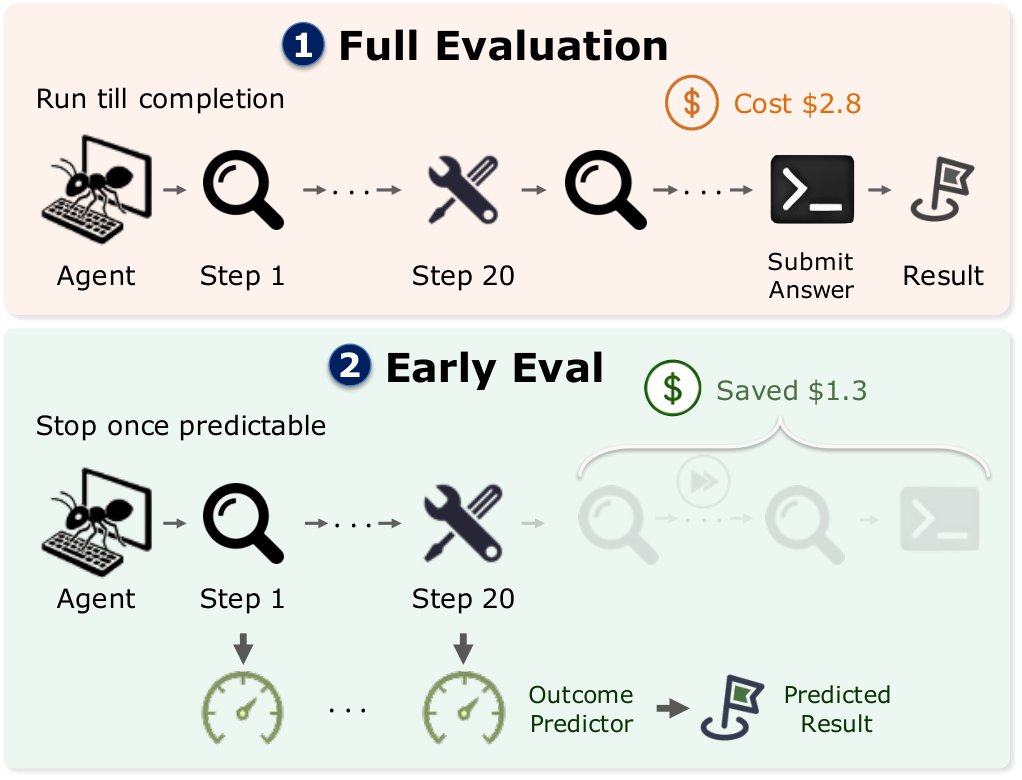
Our recent work introduces a new axis for reducing agent evaluation cost. Specifically, we stop each task early once its outcome becomes predictable. This early-stop strategy fits benchmarks very well, as we can utilize their answers and previous submissions for predicting.
Cut agent evaluation costs by up to 44%
EarlyEval trains LightGBM classifiers to predict an agent's final outcome from its intermediate behavior, halting runs early when success or failure is already clear. Across SWE-bench, TerminalBench, and Toolathlon it cuts 13-26% of steps with minimal accuracy loss.