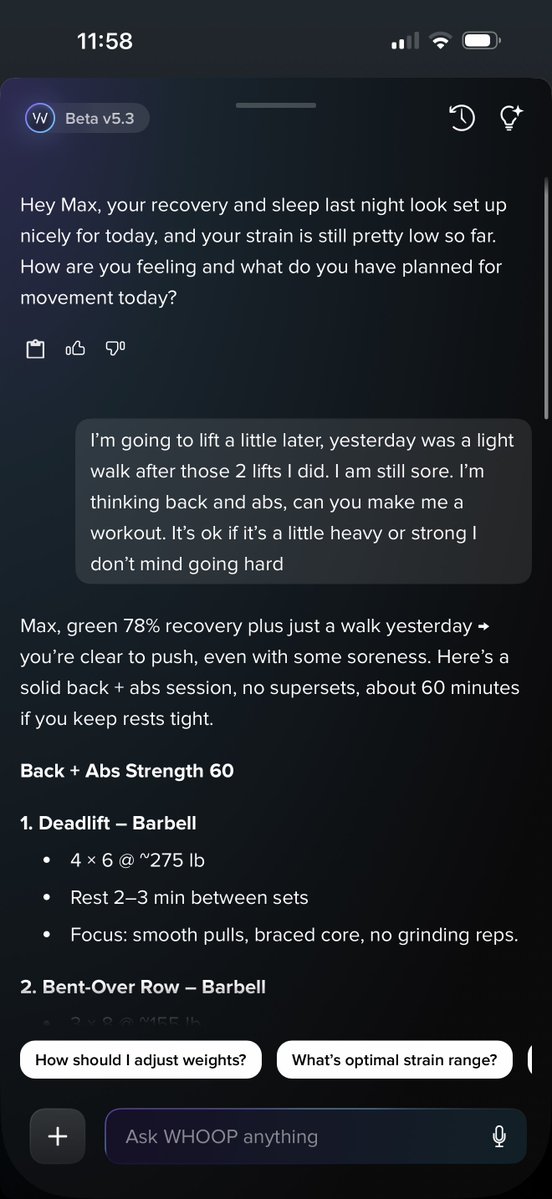
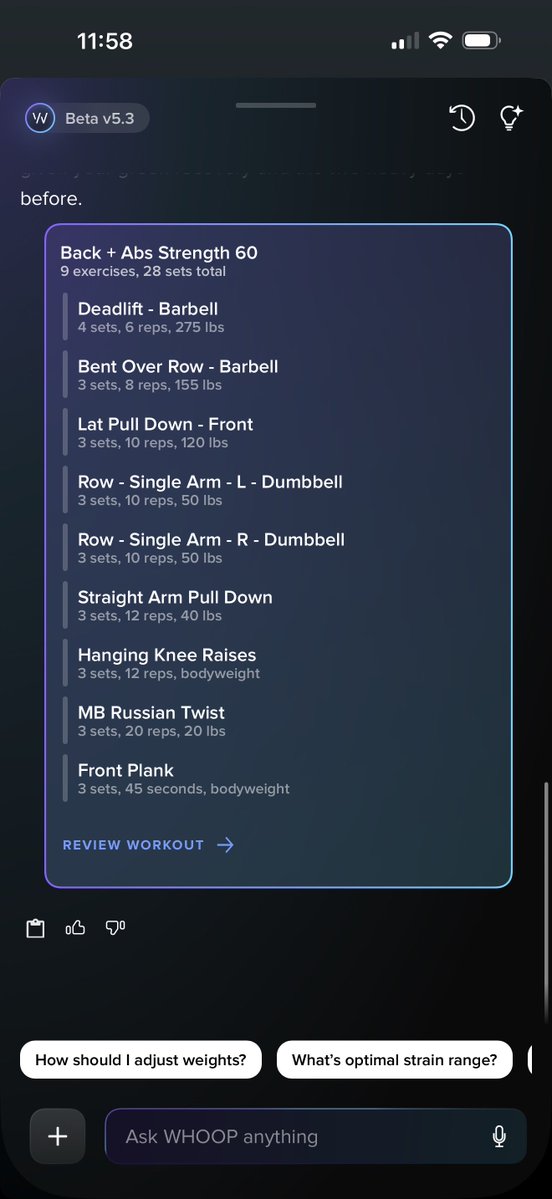
Logging your daily habits should help you understand yourself better… but can often feel tedious, repetitive, and easy to skip.
That’s exactly what we’re fixing in our latest product update. Keep reading to find out what’s new. 👇
We created our own language for writing prompts.
We call it HPML (Hyper Prompt Markup Language). It's not just a templating language it's integrated with our tool calling system. So the same tools available to our agents can be called inline like:
{{fetch_weather(city="Boston")}}
Being able to declaratively pull in any data you need into exactly the right place in a prompt matters a lot for @WHOOP since our agent workloads are very reliant on data.
For example, say we have an agent that needs to analyze a workout. We could give the agent a fetch_workout tool and tell the agent to call it. This lets us reuse our data querying infrastructure, but it's not guaranteed and it adds extra latency.
Instead we can just write an HPML prompt and inject the data directly like "{{fetch_workout(id=workout_id)}}"
The symmetry of dynamic and inline tools lets us focus our integration efforts on just tools. If a tool exists we can use it everywhere.
The Robotics team from Wissahickon High School in Ambler, Pennsylvania, built the robot Miss Daisy XXIV that picks up balls and shoots them into a container.
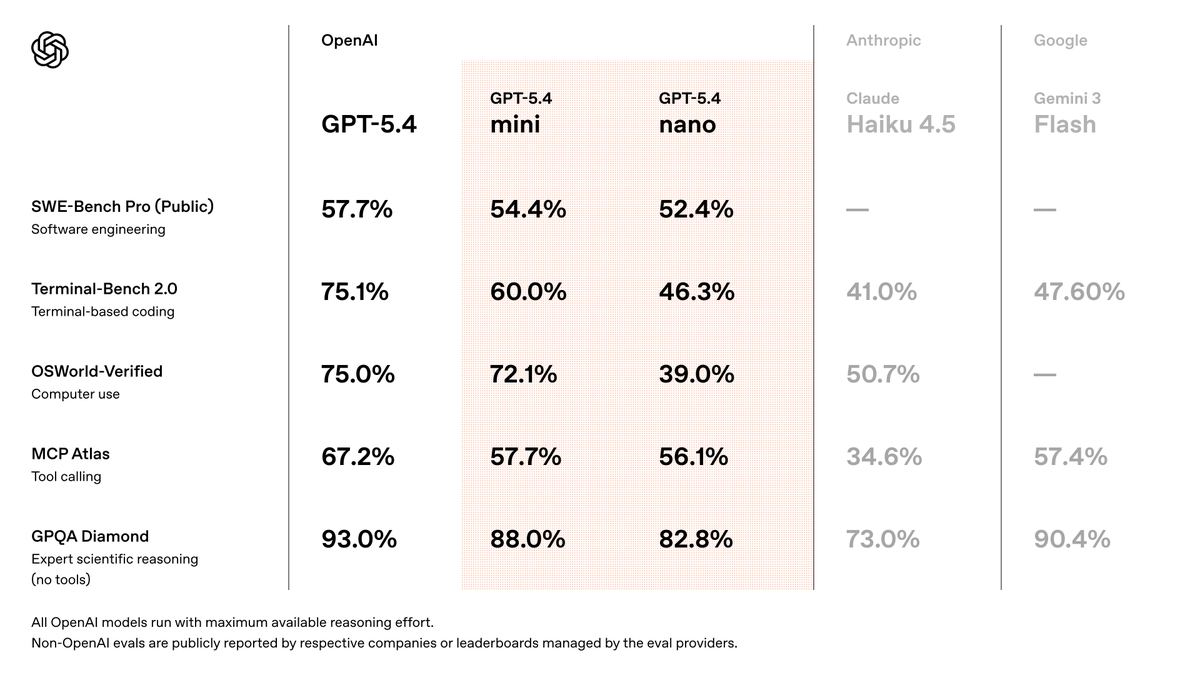
GPT-5.4 mini is available today in ChatGPT, Codex, and the API.
Optimized for coding, computer use, multimodal understanding, and subagents. And it’s 2x faster than GPT-5 mini.
https://t.co/DKh2cC5S3F
@YifanBTH It’s kind of both. If those tokens were during their highest traffic periods then you are getting your money’s worth. But if those tokens were during low traffic then you’d be overpaying.
In a way the rate limit model is the best for everyone
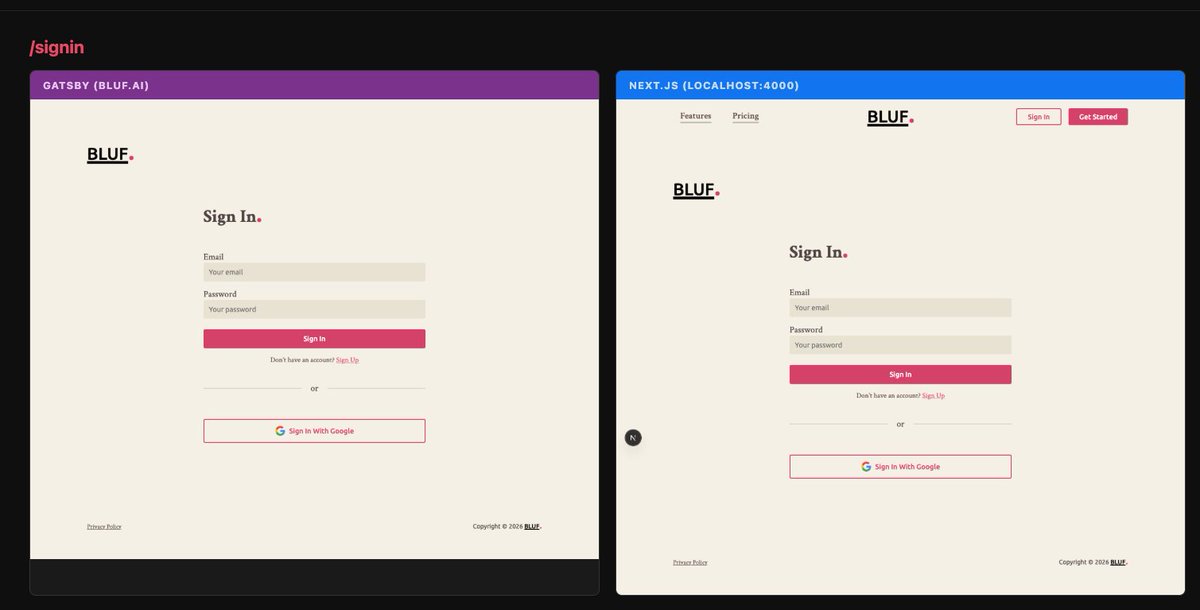
Asked claude to migrate my entire site from gatsby to next. overnight. Then asked it to build a comparison view to audit its own work. Tech debt is so easy now.