Please they have not been released.
This is false.
As at today 6:47pm Nigerian time, they are still at the EFCC custody.
They went home yesterday and returned today and have been there since morning.
We are hoping that they get released immediately.
Fellow Nigerians,
Mama-P and Peter have been abducted by the EFCC for supporting Peter Obi’s presidency.
An injury to one is an injury to all.
We can’t keep quiet in the face of injustice. We demand their unconditional release NOW!!!
RT by lending your voice ✊✊✊
They should come and sit down to get lectured. People that wants leadership with zero accountability. Here is a man offering himself for service laying down his plans himself without proxies telling you to hold him accountable but the children of perdition will come out to ask us what he will do differently.
Roadmap to a New Nigeria That Is Possible – Part II
Education and Healthcare: The Foundation of a Renewed Nigeria
Recall that on July 1st, in Part 1 of "My Vision for a Productive and Prosperous Nigeria," I outlined the broad framework of my proposed roadmap for national renewal. In it, I emphasised that the transformation of Nigeria must begin with rebuilding our human capital through quality education and healthcare, supported by reforms in Technical and Vocational Education and Training (TVET), character and civic education, and strategic investments that will move our nation from a consumption-driven economy to a production-driven one. I promised to follow up with other parts in the coming weeks and months.
Today, July 16th, in the middle of July, I wish to expand on these two critical pillars - education and healthcare - because they are the bedrock upon which every prosperous nation is built. They are the cornerstones of the foundation that will ensure that a son of nobody can become somebody and remove many from the ranks of the disaffected who often become tools in the insecurity challenges confronting us.
Evidence from around the world shows that quality education and accessible healthcare are among the clearest distinctions between thriving nations and lagging ones. Princeton University Nobel Prize-winning economist Angus Deaton highlights this reality in his book, “The Great Escape: Health, Wealth, and the Origins of Inequality.”
Nothing, therefore, could be further from the truth than the claim by some young people that “education is a scam.” Education, when combined with good health, provides the ladder for individual upward mobility and drives economic growth for the nation.
We must become more intentional about aligning education with our national priorities, as Singapore did, and challenge our country to value education in the same way Deng Xiaoping repeatedly urged China to do from 1978 onwards, with the remarkable transformation we see today.
We will work through commissions that strengthen collaboration among the tiers of government, ensuring that primary education is domiciled at the community and local government levels, with strong parental involvement and curricula that are sensitive to local economic factor endowments and the value chains derived from them.
State governments will be supported to expand high-quality Technical and Vocational Education and Training (TVET), as well as general secondary education, through targeted grants and incentives.
We are also developing schemes that will enable universities to focus more deliberately on specialised areas of teaching and research, making them globally competitive while producing a workforce equipped for the demands of the future.
A NEW Nigeria is POssible. -PO
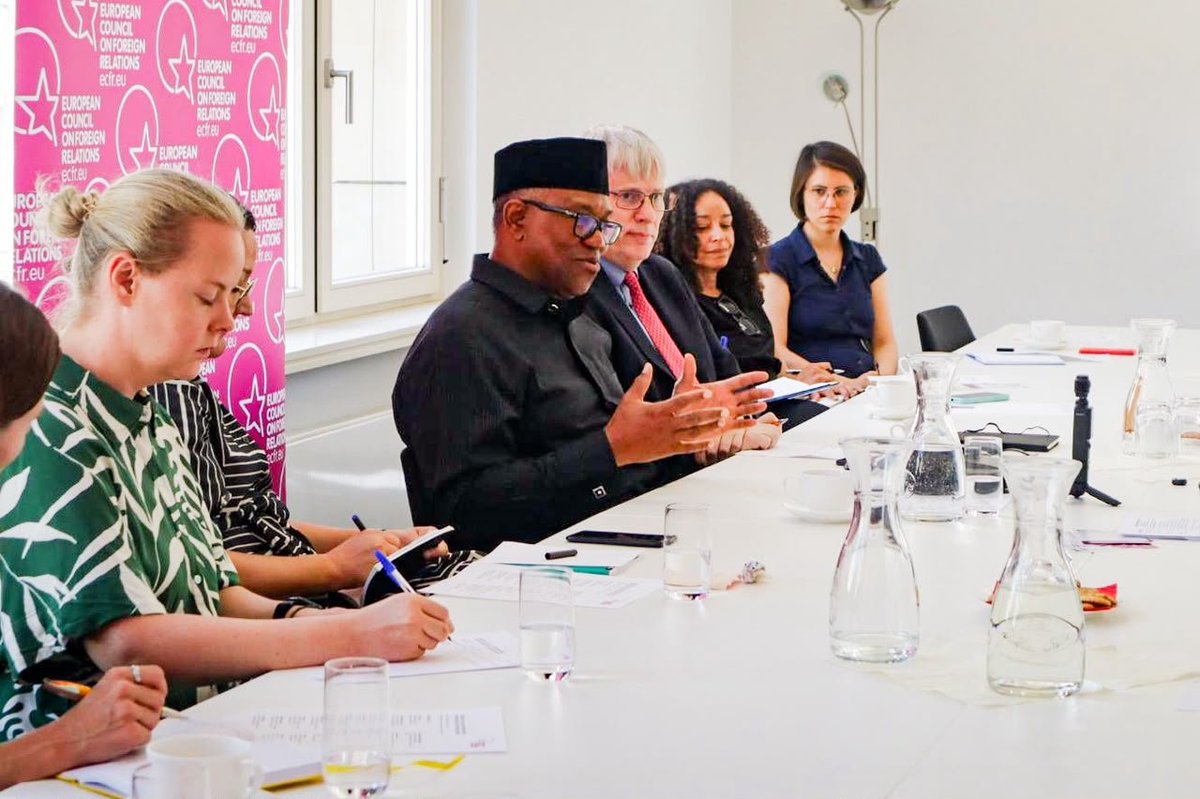
Nigeria in Focus at the ECFR Berlin Roundtable.
Yesterday, at the invitation of the European Council on Foreign Relations (ECFR), I had the honour of participating in a high-level roundtable discussion titled “Nigeria in 2027 and Beyond,” held at the ECFR office in Berlin, Germany.
The dialogue brought together policymakers, diplomats, development experts, business leaders, representatives of international organisations, and members of the international media to discuss Nigeria’s future and its role in an increasingly interconnected global landscape.
Our discussions centred on Nigeria’s democratic journey beyond 2027, international affairs, development cooperation, and the need to strengthen bilateral partnerships that can accelerate economic growth and improve the lives of our people. A key focus of the engagement was how Nigeria can deepen collaboration with international partners to support Small and Medium-sized Enterprises (SMEs), recognising that they remain the backbone of every productive economy and are indispensable to job creation, innovation, wealth creation, and sustainable national development.
We also exchanged views on strengthening democratic institutions, expanding trade and investment opportunities, promoting regional stability, improving governance, and creating an enabling environment that inspires confidence among citizens, investors, and Nigeria’s international partners.
I was encouraged by the thoughtful contributions and genuine interest demonstrated by participants in Nigeria’s future. The presence of senior representatives from the German Federal Government, development agencies, business associations, policy institutes, foundations, international organisations, and respected global media organisations underscores the strategic importance of Nigeria and the shared desire to see our nation realise its enormous potential.
During the discussions, I reiterated my unwavering belief that Nigeria possesses all the human and natural resources required to become a prosperous, secure, and globally competitive nation. What is required is competent, accountable, and compassionate leadership that prioritises investment in people, education, healthcare, productive enterprise, the rule of law, and strong institutions over politics of consumption.
Nigeria’s future is bright, but only if we make the deliberate choices that will move our country from consumption to production, from poverty to prosperity, and from division to unity. By embracing good governance, fiscal responsibility, and productive partnerships with the international community, we can build an economy that works for all Nigerians and restores our nation’s standing among the comity of nations.
I sincerely thank the European Council on Foreign Relations for the invitation and all participants for a frank, engaging, and constructive exchange of ideas. Conversations such as these remain vital in fostering mutual understanding, strengthening international cooperation, and building enduring partnerships for the benefit of Nigeria, Africa, and the global community.
A New Nigeria Is POssible. - PO
Good morning, Nigerians.
I want to draw attention to what I believe are important questions about accountability, the rule of law, and the standards of evidence used in public discourse.
The situation reminds me of Animal Farm, where the rules appear to apply differently to different people. Whether or not one agrees with that comparison, many Nigerians are concerned about whether our institutions are applying the law fairly and consistently.
Aviation Minister, Festus Keyamo, you released a video containing CCTV footage in connection with allegations involving Mr. Peter Obi. If the CCTV cameras at one of our international airports cannot clearly show faces or vehicle registration numbers, that should concern every Nigerian. How do we identify terrorists? How do we track criminals? How do we investigate serious security incidents?
Mr. Minister, you should start by apologizing to Nigerians that, despite the billions of naira invested in the aviation sector, this is the best visual evidence you can present in support of these allegations. You have really done poorly!
CCTV footage should speak for itself. It should provide objective evidence, not require lengthy explanations telling viewers what they are supposed to see. If the footage is unclear, it should not be presented as conclusive proof of a person’s identity.
Having watched the video several times, I cannot confidently identify the person shown as Mr. Peter Obi, nor can I confidently say it is someone else. The footage, as presented publicly, does not appear sufficiently clear for me to reach a definitive conclusion. Where the evidence is disputed, it is important to distinguish allegations from verified facts.
I also recall the controversy surrounding information relating to Mr. Emeka Ike that was publicly displayed by Mr. Lere Olayinka, an aide to Minister Nyesom Wike, and described as originating from INEC’s backend.
INEC, which is entrusted with sensitive information belonging to millions of Nigerians, is yet to tell us what happened to this day.
The “Invisible Ministry” of Prince Adeyemi is still there, and we are yet to know how it entered our national budget. We have not found the elephant in that room.
Yet our Aviation Minister can come and disgrace our national airport CCTV by releasing video footage that requires a commentator to explain it. Please, Minister, are we watching a football match on the radio?
Any matter involving Mr. Peter Obi receives immediate public attention, while other issues involving national institutions do not seem to receive the same level of scrutiny. These questions deserve clear and transparent answers.
Investigations should be guided by credible, independently verifiable evidence rather than assumptions or speculation.
Now Festus Keyamo has told the whole world that, when it comes to CCTV security information, we are not where we should be.
"If he now wants to debate, inviting me as a presidential candidate, he has to go and become a presidential candidate first."
Peter Obi shuts down Dave Umahi who asked him for a debate.
The Role of the Diaspora African in Sustainable Development
On Friday, July 10, 2026, I had the honour of delivering the keynote address at Mandela Hall, African Union Permanent Observer Mission to the United Nations in New York, on _The Role of the Diaspora African in Sustainable Development across Africa.
Africa is a continent of immense riches. Indeed, it is the richest continent in the world, not only because of its vast mineral resources but also because of its greatest asset, its people. It is the second largest continent by landmass, after Asia, covering more than 30 million square kilometres. It is also the second most populous continent, with over 1.5 billion people. Significantly, more than one billion of these are young people in their productive years, making Africa home to the largest youthful workforce in the world.
When this demographic advantage is combined with nearly one billion hectares of arable land, about 60% of which remains uncultivated, it becomes clear that Africa possesses everything required not only to feed itself but also to become the food capital of the world.
Regrettably, despite this enormous potential, Africa remains home to the largest concentration of the world’s poorest people. Of the approximately 800 million people living in extreme poverty globally, nearly 60% are in Africa. That is about 480 million people, with Nigeria and the Democratic Republic of the Congo among the countries most affected. In other words, nearly one in every three Africans lives in extreme poverty. Likewise, in multidimensional poverty, Africa continues to bear the greatest burden.
The question, therefore, is simple. With all these advantages, why has Africa not been able to lift its people out of poverty?
It means there is a missing link. That missing link is Competent Leadership with Capacity, Compassion, Character, and Commitment to good governance.
What Africa needs is leadership that will rise to the challenge and drive the continent in the right direction. This means competent leadership with character, capacity, compassion and commitment to begin turning the continent around. When we get leadership right, everything else begins to change. We start realising our true potential.
So, what is the role of the Diaspora African in this journey?
You have an enormous role to play.
Because you live in societies where institutions largely work, where democracy is strengthened by accountability and where systems function more effectively, you have both an opportunity and a responsibility to help build Africa. It is time to become stronger advocates for good governance. Even where you cannot vote, your voices matter. They should be heard both at home and abroad whenever things are going wrong on our continent. Stand firmly for what is right. Speak truth to the leaders who visit you. Let them know where they are getting it wrong. That is what some of us have continued to do.
The contribution of the African diaspora extends far beyond advocacy. History teaches us that many of the world’s great economic transformations were driven, in part, by their diaspora communities.
Japan offers one example. Following the Meiji Restoration of 1868, the country embraced modernisation and benefited immensely from Japanese scholars, professionals and citizens who studied and worked abroad, especially in Germany, before returning home to drive the technological transformation for which Japan is admired today.
China presents another remarkable example. It was under Deng Xiaoping’s reforms, beginning in 1978, that China embraced education, innovation and global engagement. These reforms created opportunities for the Chinese diaspora to contribute significantly to the country’s extraordinary economic transformation. In 1980, China had more people living in poverty than Africa. Today, China has reduced extreme poverty dramatically, while Africa continues to struggle with the challenge.
China has less than 10% of the figure living in extreme poverty in Africa.
India also demonstrates what is possible. Its diaspora physicians and medical professionals played a significant role in developing a healthcare system that has made India one of the world’s leading destinations for medical tourism. Africa has countless brilliant doctors and healthcare professionals across the diaspora who possess the knowledge and experience to help achieve similar progress. What remains essential is the creation of an enabling environment that will attract them home.
To that end, I called on Diaspora Africans to remain actively engaged in shaping the democratic future of our continent. Their voices matter in advancing free, fair and credible elections across Africa. Elections conducted with integrity are the foundation of legitimate governance. They create the pathway to competent leadership capable of delivering the policies, institutions and opportunities our people deserve.
When we create the enabling environment necessary for sustainable development, we start unlocking Africa's potential.
Let us therefore work together, those at home and those abroad, to build a continent defined not by its challenges, but by its achievements, its unity, peace and its shared prosperity.
A NEW Nigeria is POssible. -PO
The Disheartening Humiliation of Prof. Aghaji
Every day in this country, we find ourselves in a bizarre situation that we find difficult to understand: where we are and how we got to this uncivilised behaviour and rascality. Worse still, when you try to bring these abnormalities to the attention of those concerned, they resort to abuse instead of appreciation.
Just this morning, my attention was drawn to the disrespectful and humiliating circumstances surrounding the apprehension of Professor Martin Aghaji, a distinguished 74-year-old medical expert. This man was not invited, nor was any direct contact made with him. Instead, they invaded his home at Independent Layout, Enugu, in the dead of the night, at 2 a.m., to arrest him in front of his visiting daughter.
As an internationally recognised cardiothoracic surgeon, esteemed academic, and elder statesman, Professor Aghaji warrants a considerable degree of respect, both because of his advanced age and his substantial contributions to our nation. More importantly, however, every Nigerian, irrespective of status or profession, deserves to be treated with dignity and in accordance with the rule of law. After the humiliation of breaking into his house and whisking him away from Enugu to Lagos for three days, all he got was, “Sorry, we made a mistake.”
The public outcry concerning the state’s handling of Professor Aghaji’s case highlights a wider conflict between the actions of state security agencies and the imperative to safeguard professional integrity and individual dignity. Such conduct directed at a 74-year-old might not only exacerbate the critical “brain drain” but also severely damage the country’s already precarious healthcare infrastructure.
This incident brings to mind the similar mistreatment of a medical practitioner in Akwa Ibom, which prompted the Nigeria Medical Association to consider a nationwide strike. Fortunately, due to prompt intervention, a formal public apology was issued to the affected doctor.
The practice of treating highly regarded, ethical professionals - and indeed any Nigerian - like common criminals sets a dangerous precedent that undermines the rule of law across all sectors. Therefore, we must conduct ourselves with civility in the discharge of our public duties. A superior and renewed Nigeria is indeed POssible. -PO