In our latest paper we highlight that human physiology has remarkable robust regulatory mechanisms and provide direct empirical evidence countering public circulating claims that normal dietary acidity impairs physiological function or exercise performance https://t.co/J0P9B77fKA
The field of muscle damage and eccentric exercise is now mature and, to some extent, saturated. Yet much of the literature has been oversimplified. This article revisits the field through nine themes to highlight key concepts and open questions. https://t.co/LgiQqD23u0
Our new paper provides evidence that concentric and eccentric exercise performed at long muscle lengths induce comparable muscle damage, with unfamiliarity playing a central role in Exercise Induced Muscle Damage.
https://t.co/4I2PTgGqnP
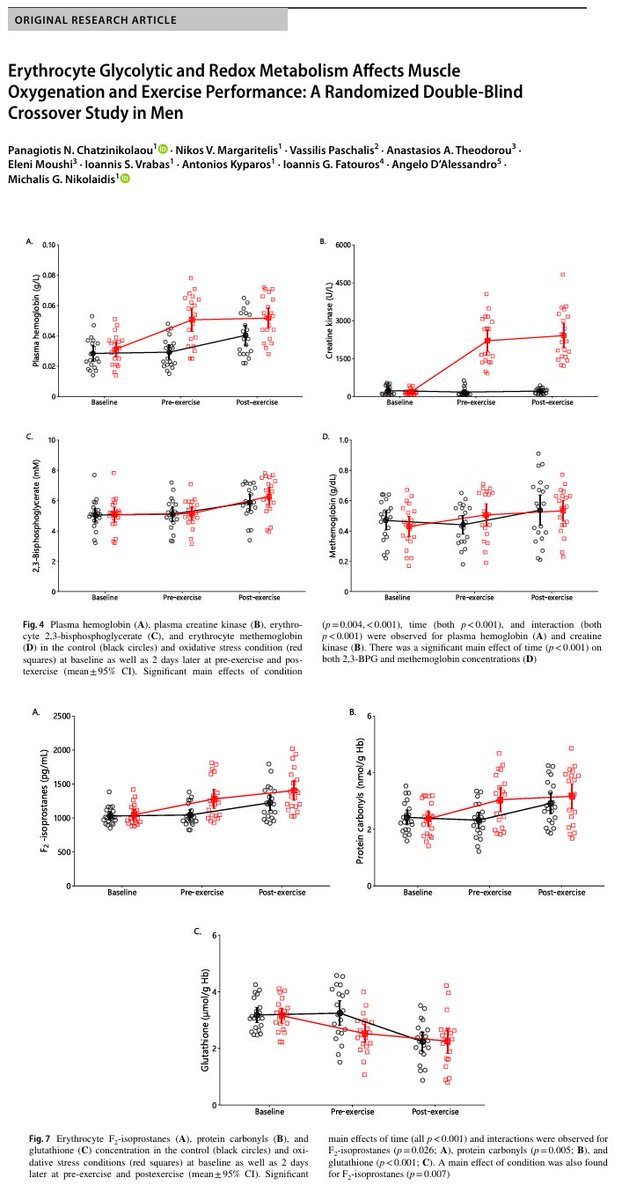
This one finds that erythrocytes, like any other cell in the human body, can respond to exercise and that erythrocyte metabolism becomes dysregulated under oxidative stress and may partly influence muscle oxygenation and performance.
The new study by @PanosChatz1, led by @mg_nikolaidis and published in @SportsMedicineJ, focused on complexity of erythrocyte metabolic pathways that regulate oxygen loading, transport, and delivery.
A prevailing idea in exercise physiology seems to be that the only erythrocyte factor affecting performance is hematocrit and hemoglobin levels.
Is it really that simple?
1/3
Vitamin C+E supplementation blunts molecular adaptations to sprint interval training but not performance gains.
Since performance wasn’t impaired, I wonder whether, and to what extent, the blunted molecular responses can truly be considered detrimental.
https://t.co/m0XcfmYi5z
If you have a review ready, submit it. If you have an idea, fill out our proposal template and send it to us for consideration. There are no any restrictions.
While science often rewards those who produce results, true progress depends equally on those who make sense of them.
Eur J Appl Physiol now welcomes reviews from all thinkers—whether or not they identify as physiologists. A great review is not about labels but about curiosity, depth & synthesis. Young scientists, your fresh takes are especially invited.
My editorial:
https://t.co/ZwM2liN4We
Pleasure to collaborate with @PanosChatz1 and @CAS_ReproLab on this work dealing with the i-space a proteoform centric theory of redox regulation https://t.co/Lvx0Y7rau7
Our recent publication at Eur J Nutr showed that a higher protein intake (1.2–1.5 g/kg/day) alone may aid in preserving muscle mass and sustaining physical performance in individuals with type 2 diabetes.
https://t.co/YuDHLSh5kw
Ελεύθερες ρίζες.
Το όνομά τους τρομάζει: είναι «ελεύθερες» (άρα ανεξέλεγκτες) και «ριζώνουν». Με τέτοιο όνομα, πώς να μην θεωρούνται το «κακό παιδί» της βιολογίας;
Στο παρακάτω podcast, με @margaritelis, επιχειρούμε να δώσουμε μια πιο ρεαλιστική εικόνα.
https://t.co/CXsmMZyOvs
This study highlights that eccentric contractions in mice increase hydrogen peroxide levels more than concentric, likely due to NADPH oxidase 2 activation.
Differences in adaptations between eccentric & concentric exercise may involve a redox component.
https://t.co/rpA08pOGBb
Την ερχόμενη Τρίτη 2 Ιουλίου 2024 στις 12:00 στο ΤΕΦΑΑ Σερρών ο Παναγιώτης Χατζηνικολάου υποστηρίζει τη διδακτορική του διατριβή με θέμα:
«Οι οξειδοαναγωγικές επιδράσεις της άσκησης στην κόπωση: μια ποσοτική προσέγγιση»
If free radicals did not exist, it would be necessary to invent them.
A play on a famous quote by Voltaire, highlighting the tendency to oversimplify/misattribute complex biological phenomena to free radicals, rather than acknowledging the gaps in understanding these processes.
A thoughtful short comment by @mg_nikolaidis, encourages researchers to trust again their inner drive and avoid becoming part of an academic “rat race”.
While the “beetroot” field may be oversaturated, this seems a carefully executed study, a rarity in this field.
It shows that prolonged beetroot juice intake does not improve vascular function or lower blood pressure in older adults with hypertension.
https://t.co/2yyegmWOCL
*Nutritional Biomechanics*
In exploring caffeine's impact on sprinting, this paper sheds light on the overlooked biomechanical aspects.
Biology is not limited by scientists' tool preferences, so Sports Nutrition need not focus solely on metabolism.
https://t.co/dw70IP2dfA
Our synthesis shows that the erythrocyte metabolism is more than just an “internal” biochemical matter, but a matter of controlling one of the most important biological processes: loading, transport and delivery of oxygen.