Developer with 12+ years of experience. iOS Developer, Engineering at @tabtraderpro. C++, AI and Robotics enthusiast. Singing, playing piano and guitar.
In the future, you will purchase knowledge models, not robots. Robots will be too cheap, but models save you a lot of time.
Just imagine, you are unboxing your new TS3 robot. You have an option to start from scratch and train/teach it. It will be like a child who knows only something too primitive. Or you have an option to purchase a knowledge model of a 3 yo person, 5 yo person, 9, 14, 18, 23, and so on.
So basically, you will not purchase a robot but a persona, a knowledge. For companies, it will be cheaper to buy an already mature person/model, put it in production, and give it tasks. For enthusiasts, they can start from scratch and experiment.
$MU @MicronTech has had an amazing run. I remember when I bought it for around $100. Now the price is $1,100!
I also remember when people said that 10x returns could only be made in the crypto market.
In my opinion, every market matters. It’s better to keep an open mind and watch for opportunities everywhere!
Introducing Claude Fable 5: a Mythos-class model that we’ve made safe for general use.
Its capabilities exceed those of any model we’ve ever made generally available.
Important thing that differs humans is the ability to “always on” thinking. Sometimes (if not often) on various things at once. Our brain even in a relaxing state still thinks, produces ideas, categorizes information, and does a ton of other stuff. Compared to less intellectual animals, we can process more information per second.
That’s what proper AGI and/or modern robotics systems should achieve over time. Current tech is way away from the ability to implement this. But definitely it will be achievable one day!
Amazon’s sponsored/relevant ads always make my day :) There was never a time when it actually hit me. But maybe they know something more about what people doing research really need… :) Who knows..
Personal update: I've joined Anthropic. I think the next few years at the frontier of LLMs will be especially formative. I am very excited to join the team here and get back to R&D. I remain deeply passionate about education and plan to resume my work on it in time.
I've been coding for 40 years. Here are the top 5 things I wish I knew when I started.
1. 90% of the job is debugging and fixing, not creating new code. Which is still fun if you're good at it.
I used to think programming was mostly writing fresh, clever stuff. In reality, most of your time is spent in other people's (or your own past self's) messy code, chasing down why something that "should" work doesn't. Get really good at debugging early. Learn assembly reading, call stacks, and kernel debuggers. It pays off hugely. The best engineers I saw were absolute magicians at this.
2. Manage complexity from day one (ie: don't write slop and "fix it later" if it goes somewhere).
Very early on, I'd hammer out code and refactor afterward. Big mistake. Now I start with clean, skeletal structure (minimalism first) and flesh it out carefully, with AI or not.
Messy code compounds and becomes unfixable. Upfront discipline on architecture, naming, and simplicity saves enormous pain later, especially in large systems like Windows.
3. Tools and processes matter more than you think
We suffered with basic diff/manual deltas instead of modern source control like Git. Branching, testing, and good tooling would have made porting and collaboration way smoother. Invest in your environment, automation, and reproducible builds early. Good tools amplify your output; bad ones (or none) drag everything down.
4. Understand the problem and existing code deeply before writing
Don't jump straight to coding. Map out the problem, study what's already there (you'll inherit a lot), and plan. Low-level knowledge (hardware quirks, alignment issues on different architectures like MIPS/Alpha) was crucial. Also: assert early and often. It forces clarity.
5. People, politics, and "the right tool for the job" beat pure tech arguments.
Brilliant engineers still argue endlessly. Sometimes it's about ego, not merit. Learn to spot the difference and "steer" the conversation rather than "winning" it.
Bonus from experience: Side projects like Task Manager (started at home because I wanted the tool) can become your biggest hits. Ship small, useful things often. If you're just starting, focus on fundamentals, patterns over syntax, and building resilience for the long haul. It's going to be a wild ride, but the fundamentals still matter.
Opus 4.7 is amazingly bad. It looks like there are no improvements compared to Opus 4.6 on release day. Anthropic says that I can change thinking efforts to xhigh but my question is why Opus 4.7 even xhigh is much worst than Opus 4.6 med on release day? Questions, questions..
Our newest model, π0.7, has some interesting emergent capabilities: it can control a new robot to fold shirts for which we had no shirt folding data, figure out how to use an appliance with language-based coaching, and perform a wide range of dexterous tasks all in one model!
Introducing Claude Opus 4.7, our most capable Opus model yet.
It handles long-running tasks with more rigor, follows instructions more precisely, and verifies its own outputs before reporting back.
You can hand off your hardest work with less supervision.
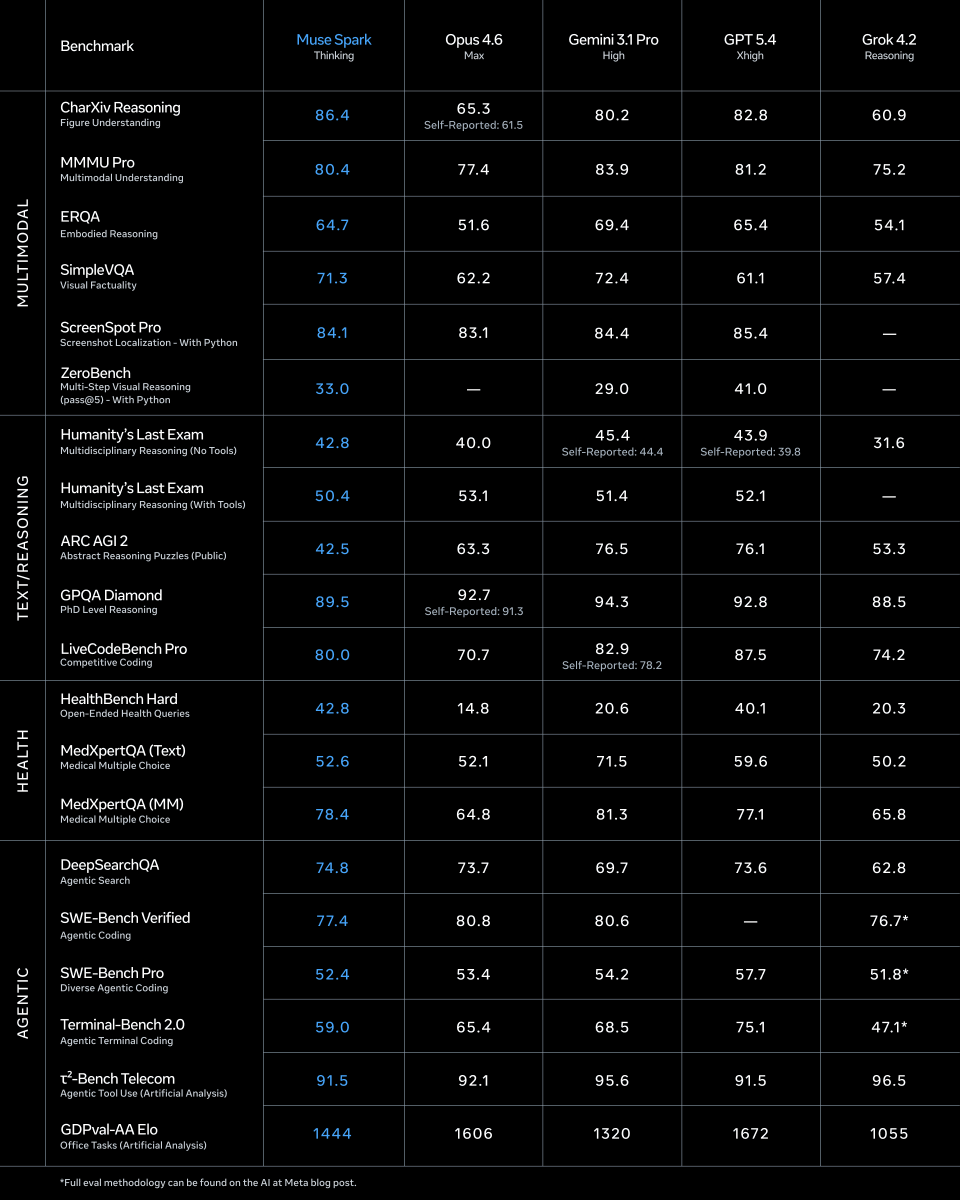
Muse Spark is the first step on our scaling ladder and the first product of a ground-up overhaul of our AI efforts.
It offers competitive performance in multimodal perception, reasoning, health, and agentic tasks. We continue to invest in areas with current performance gaps, specifically long-horizon agentic systems and coding workflows.
With larger models in development, these results demonstrate that our stack is scaling effectively.