@murugesan361 Unlike -ar, -mār is always a true plural and is not used in the case of honorific singulars.
I am wondering if it could be related to -mān, i.e, a plural version of the same
@murugesan361 -kār (neutral)
-avar (either neutral or honorific)
-ar (generally honorific)
-mār, which is always preferred in the case of say, Gods (dēvanmār, dēvimār), parents (acchanammamār), generally respectful cases
Honorific -ar is also used in archaisms such as 'Tṛprayār Tēvar'
@subapicarl@Saatvata Now, the other examples Kōṛ and Kol̥ was in attempt to demonstate cases of possible reflexes that retain the *k
Kol̥ means afflict (in the original neutral sense)
Kōṛ means to insert, to fix something upon something, to tie, etc.
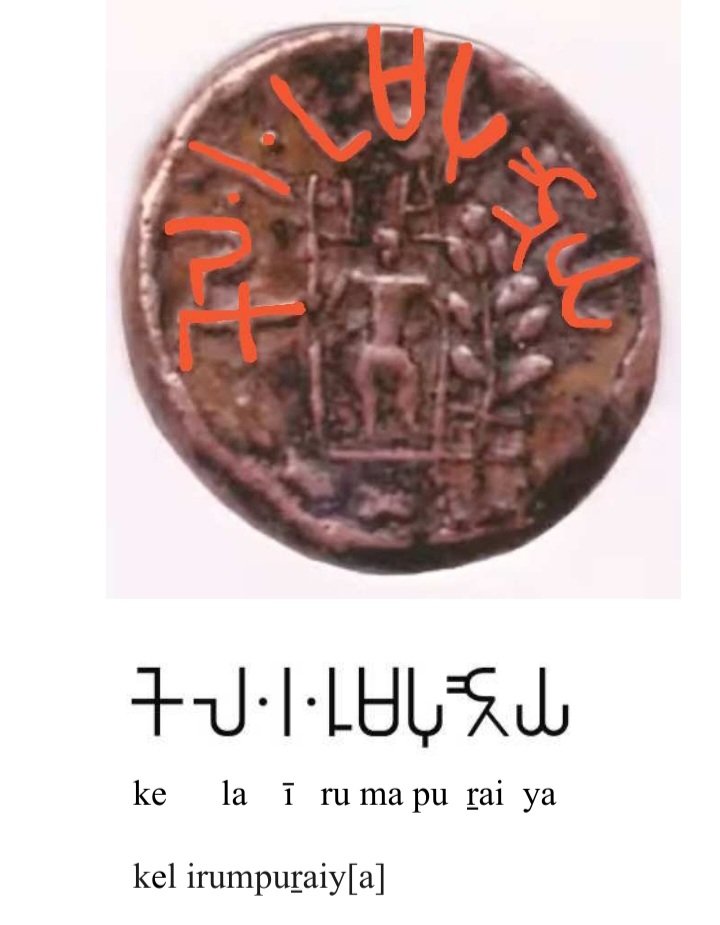
It is generally believed that the k > c palatalisation occurred within the Old Tamiḻ branch. However, I think linguists sometimes arrive at this conclusion by taking the Old Tamiḻ literary register at face value, without adequately accounting for contemporary epigraphic and numismatic evidence. If we examine material records from the Old Tamiḻ period, we can still find local forms retaining the non-palatalised k-initials.
One notable example is a Cēra king's coin, which attests his name as Kel-Irumpōṟai, in contrast to contemporary literary Tamiḻ records that attest the name as Cel-Irumpōṟai, or even Cēral-Irumpōṟai. This raises the possibility that the literary palatalised form did not entirely displace the older or regionally retained k-initial pronunciation.
Likewise, the Indo-Aryan designation Kēraḷaputra and its variants may be better understood through contemporary indigenous usage, particularly the Tamiḻ honorific Cēramāṉ.
The latter is often liable to misinterpretation or mistranslation as “sons of the Cēras” or “sons of Cēralam.” However, in Old Tamiḻ, māṉ functions as an honorific element denoting an elevated personage, rather than simply meaning “son.” Consider comparable titles such as Tirumāṉ (Tirumakaṉ) and Pērumāṉ (Pērumakaṉ), where the element conveys dignity, eminence, or elevated status. Thus, Cēramāṉ should not be reduced to a literal genealogical expression. Its usage is better considered in the context of Old Tamiḻ honorific nomenclature, where māṉ could designate a distinguished or eminent personage.
My point is that literary standardisation, regional pronunciation, and contemporary naming practices need not have followed precisely the same trajectory. Numismatic and epigraphic evidence should therefore be considered alongside literary texts when reconstructing the linguistic history.
Read/Check out: https://t.co/Oo3JFY9j8u
@subapicarl@Saatvata Words are composed of roots, prefixes and suffixes.
What does Cēri mean?
Cērnna sthalam. How else would you derive it?
This is commonly understood for the the term Cēri
@subapicarl@Saatvata The sound changes and often meaning correspondence variances between the languages are aerial and dependent on historical interconnectivity.
@subapicarl@Saatvata The root of the discussed terms is *cer
Ceriv means inclining, and this is the primary semantic sense from where further senses are derived
This yields verbal roots cēr, enjoining, nearness; c��r, leaning; cārtt, applying (something into something); cāṛ drizzling, cor dripping