About a year ago, you guys did a truly unfathomable thing. Something that completely blew my mind… You gave The Life of a Showgirl the biggest first week for an album in history. I took a trip to Sweden to celebrate with Max and Shellback, my two collaborators on this album. Really we just wanted to reflect and take in how grateful we were for the moment we were in, but there was a studio there and we did what we do when we feel anything at all: We wrote more songs. I hope you love them, because they were born out of pure gratitude for your exuberance for and celebration of the album we made. The Life of a Showgirl: The Encore including four new songs is out on Friday and available to pre-order and save now at https://t.co/bWaNOQ6OmT ❤️🔥
📸: Mert Alas & Marcus Piggott
Another point: This is the only other time that fans speculated the ‘O’ in the word ‘Version’ is a 0 for Nov 10. All I’m saying is: Debutation double release! 💀
Patient Zero as the new single. You know what unreleased song is about being patient? Wood + Moon on the website background. Wood literally a song from TLOAS, rope the moon as in the part in Karma MV. Saturn is the sixth planet and Karma as the supposedly sixth album.
mga recent takes nyo rito sa twt ha,,, ang concerning lang dai… first yung natuturn off pag di maganda phone tapos now yung bday celebration sa school… umulan ba ng kashungahan recently
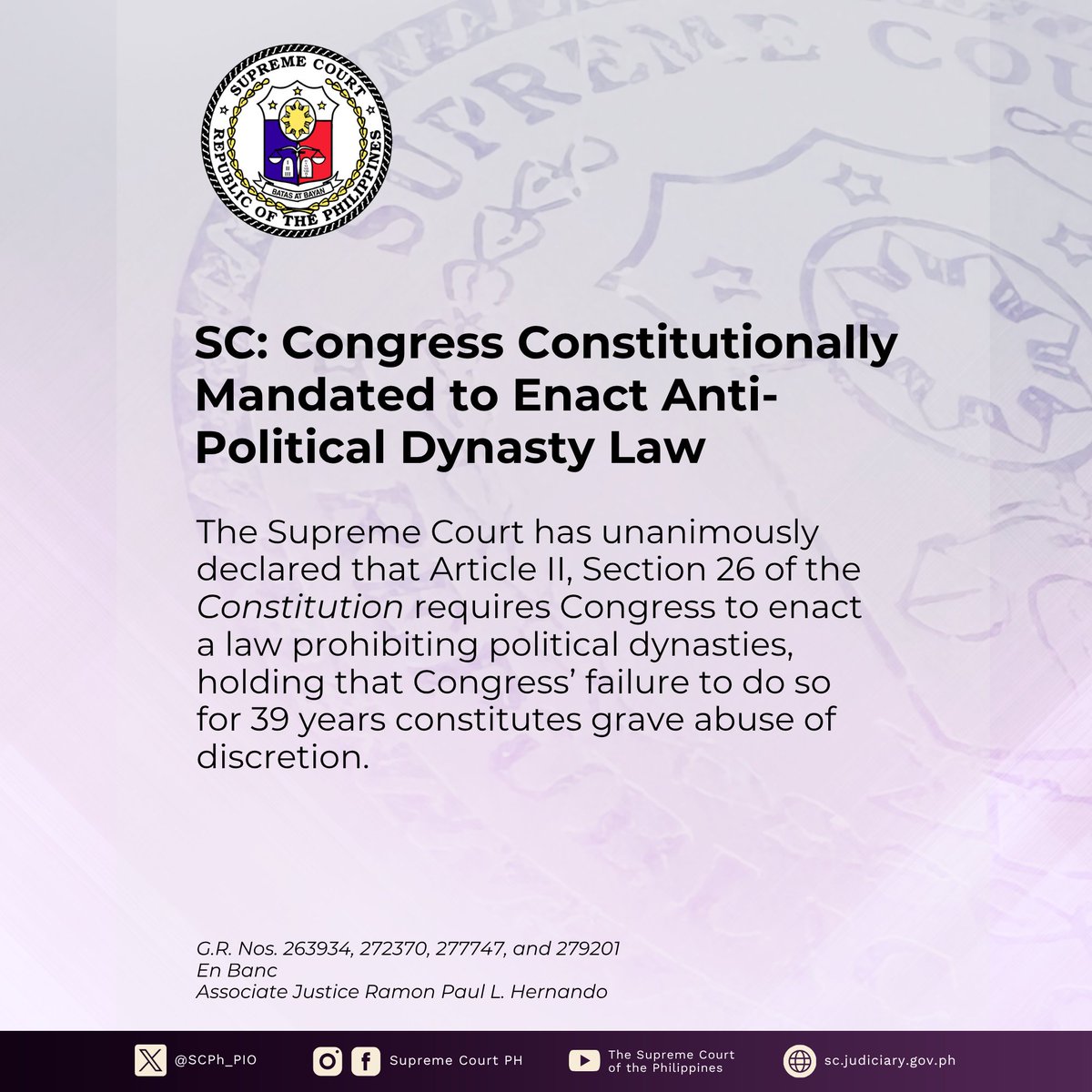
The #SupremeCourtPH 𝘌𝘯 𝘉𝘢𝘯𝘤, during its session on August 26, 2026, unanimously declared that Article II, Section 26 of the Constitution requires Congress to enact a law prohibiting political dynasties, holding that Congress’ failure to do so for 39 years constitutes grave abuse of discretion.
The Court directed Congress to comply with its mandatory constitutional duty to enact an anti-political dynasty law at the earliest opportunity, define political dynasties, and determine the scope of the prohibition.
In a Decision penned by Associate Justice Ramon Paul L. Hernando, the Court 𝘌𝘯 𝘉𝘢𝘯𝘤 granted the consolidated petitions in G.R. Nos. 263934, 272370, and 279201 for certiorari and mandamus. The petitions challenged Congress’ prolonged failure to pass a law defining and prohibiting political dynasties.
The Court strongly urged Congress to heed its constitutional duty with utmost urgency, as it declared that the latter has “the MANDATORY CONSTITUTIONAL DUTY to enact the law on the constitutional prohibition against political dynasties as expressly provided for in Article II, Section 26 of the Constitution.”
It stated that the Congress “MUST HENCEFORTH AND WITH UTMOST URGENCY ENACT THE APPROPRIATE ANTI-POLITICAL DYNASTY LAW AT THE EARLIEST OPPORTUNITY.”
Article II, Section 26 of the Constitution provides that “The State shall guarantee equal access to opportunities for public service, and prohibit political dynasties as may be defined by law.”
The Court held that this provision is not merely an aspiration but a constitutional command. The use of the word “shall” makes clear that the State has a mandatory duty both to guarantee equal access to public service and to prohibit political dynasties.
The Court also held that the phrase “as may be defined by law” does not give Congress the choice whether to prohibit political dynasties. Rather, it gives Congress the authority to define what constitutes a political dynasty and determine the scope of the prohibition.
The Court further said that Congress’ prolonged failure to enact an anti-political dynasty law constitutes grave abuse of discretion.
The Court took judicial notice of the numerous anti-political dynasty bills filed but left unacted upon since the ratification of the 1987 Constitution. It also considered studies on the prevalence of political dynasties and their relationship with socioeconomic conditions in the country.
The Court noted that political dynasties have remained widespread and have extended even into the party-list system. Despite changes in the composition of Congress over the years, no comprehensive anti-political dynasty law has been enacted, implying either a lack of interest, avoidance for convenience, or service of self-interest.
Although the Constitution does not set a deadline for Congress to enact the law, the Court held that this does not allow Congress to postpone its constitutional duty indefinitely. The Court found that 39 years is beyond a reasonable period to carry out the constitutional command. Congress’ continued inaction therefore constitutes a continuing violation of its constitutional duty.
Read the full text of the Press Briefer at: https://t.co/Jnz0FRrffr.
Read the full text of the Decision at: https://t.co/KwcumhTagm.
Read Senior Associate Justice Marvic M.V.F. Leonen’s Concurring Opinion at: https://t.co/oA3HGjjrbK.
Read Associate Justice Henri Jean Paul B. Inting Concurring Opinion at: https://t.co/ja1UDoGn53.
Read Associate Justice Rodil V. Zalameda’s Separate Opinion at: https://t.co/Cy4fa9d7iI.
Read Associate Justice Japar B. Dimaampao’s Separate Concurring Opinion at: https://t.co/9pWVa3WW4i.
Read Associate Justice Maria Filomena D. Singh’s Separate Opinion at: https://t.co/J91UOofGV5
Read Associate Justice Raul B. Villanueva’s Separate Concurring Opinion at: https://t.co/vNH6FDS5oe.
Copying of this content is subject to the SC PIO’s Credit Attribution Policy: https://t.co/F48RF1vtzZ.
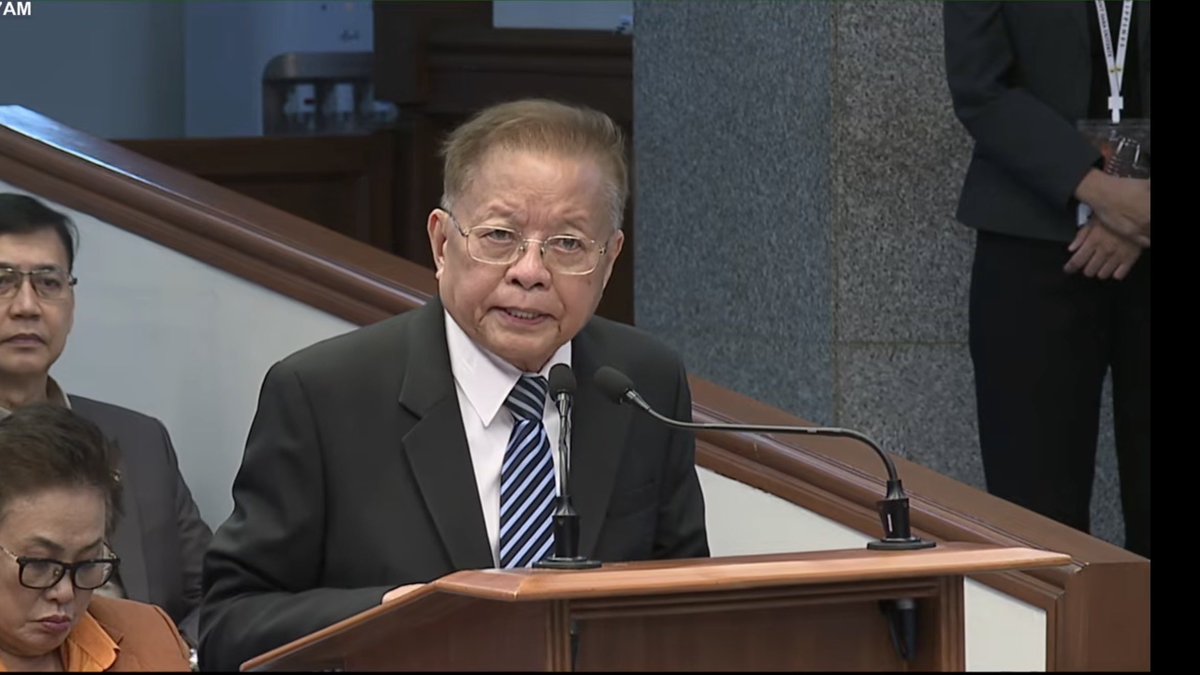
🚨 JUST IN: Former Chief Justice Puno says 16 votes to convict is just ONE school of thought.
If the Constitution wanted 16 votes to convict daw then it would have put 16 instead of 2/3, which can change.
He forwards a functional approach aka common sense! 💯
👏👏👏