A portfolio of small-business loans can do more than generate repayments. It can also serve as collateral for financing.
That’s the part of the financial market @Securitize is looking to enter through its proposed acquisition of @RiverOneHQ .
River One works on warehouse financing: providing lenders with capital to fund loans backed by portfolios of assets such as small-business loans and receivables.
Securitize already has infrastructure for issuing and servicing tokenized assets.
The proposed acquisition would add a financing layer to that business.
Think about the possible structure:
An institution originates loans.
Those loans form part of an asset portfolio.
The portfolio can support a financing facility, with collateral monitoring and borrowing-base reporting built into the process.
Securitize wants to bring more of that activity into its platform.
The company points to a $6 trillion global private asset-backed finance market as its opportunity, although that is the estimated addressable market, not the value of assets River One currently finances.
The acquisition has not closed yet.
Still, I find the direction interesting.
The business of tokenization may extend well beyond issuing digital representations of assets.
Financing the assets behind those tokens could become another important part of the market.
Following our agreement to acquire @RiverOneHQ, our CEO @carlosdomingo joined @CNBC to discuss how stablecoins can be a source of credit for the fintechs, fleet companies and other businesses that borrow to run their operations.
Tokenize the World.
Institutional demand is one of the signals I’m watching closely right now.
During the week of November 2–6, the US spot crypto ETFs tracked by CryptoKeyhole recorded approximately $1.59 billion in net outflows.
Bitcoin funds accounted for $1.19 billion of that.
Ethereum funds saw another $380.7 million leave.
That doesn't mean institutions have abandoned crypto.
ETF flows are only one part of the market, and one week of outflows doesn't establish a long-term trend.
But it does raise an important question:
If prices are trying to recover, is fresh capital actually coming in to support that move?
Price action tells us what happened.
Capital flows can help us understand who may be participating.
Both deserve attention.
When you pay with a crypto card, do you really care which blockchain is processing the payment?
Most people probably don't.
They care that the payment goes through, the fees are reasonable, and the experience feels as simple as using any other card.
But behind that simple tap, there’s a problem that payment infrastructure has to solve.
The card network needs to know that the funds are available. And it needs that confirmation quickly.
With stablecoin-linked cards, slower blockchain finality can make this difficult.
Issuers may have to rely on prefunded accounts or short-term credit to bridge the gap while waiting for onchain confirmation.
That adds complexity.
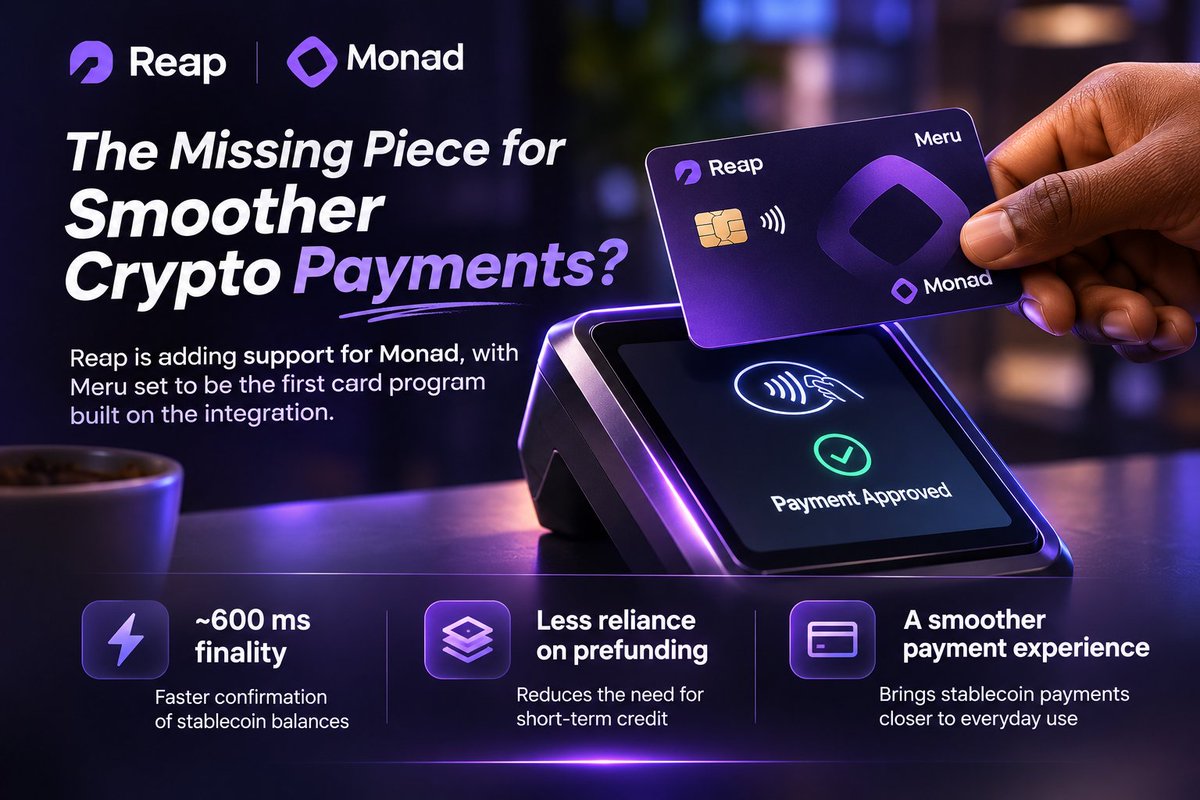
This is where the @reapglobal × @monad integration caught my attention.
Reap is adding support for Monad, with Meru set to be the first card program built on the integration.
Monad’s 600-millisecond finality is designed to help issuers confirm stablecoin balances within the card authorization window.
The goal?
Reduce the need for prefunding and make stablecoin-powered payments work more smoothly.
I think this is an interesting use case because it brings the conversation back to what matters outside crypto.
People don't need to understand block times or transaction finality to use a card.
But the infrastructure still has to get those things right.
The real test for blockchain payments isn't just how fast a network can process transactions.
It's whether that speed can make the payment experience more reliable, practical, and seamless for the person using it.
That’s where the technology starts becoming useful.
Good morning fellas...
There's something important to understand about Solana's new Privacy Rings.
Private doesn't automatically mean anonymous.
In the default Privacy Ring, three things matter:
>Your asset is encrypted.
>The amount you're transferring is encrypted.
>Your wallet addresses remain visible.
So, someone looking at the public ledger may still identify the wallets involved, but they won't see the private asset and transfer amount in the same way they would with an ordinary public transaction.
Users can access their private balances through viewing keys.
The system also uses zero-knowledge proofs to verify that transactions are valid without revealing the protected information.
Why does this matter?
Because financial privacy isn't always about hiding who you are.
Sometimes, it's simply about keeping your balance, payments and business activity away from public observation.
Helius is also developing Custom Rings with configurable privacy and compliance controls for institutional use.
Those additional features are still undergoing audits, so they're not the same as the permissionless Ring already launched.
This is an interesting direction for blockchain privacy.
The challenge is finding the balance between confidentiality, verifiability and accountability.
And I think that conversation deserves more attention.
You can check the quoted post for more details on what @Helius is building.
happy friday frens,
most crypto launchpads are built to keep you glued to a screen, refreshing charts and hunting for tickers.
here is one doing the exact opposite: @onlystreetsfun, a new Solana launchpad whose landing page explicitly tells you to look up from your phone.
the premise is simple, instead of launching coins off internet memes or screenshots, the platform wants you to capture bizarre, unscripted moments happening in the real world.
their own examples set the tone: a dog wearing sunglasses, or a random sofa sitting at a bus stop.
if something on the street makes you stop and do a double-take, you snap it using their in-app camera, and that photo can be minted directly into a coin on Solana.
it is a funny, grassroots twist on token creation that turns everyday street photography into on-chain assets—and requires you to actually go outside to participate.
the project is still listed as coming soon with no official launch date posted yet, but you can check out the preview at https://t.co/F0eZschhyU. @rarelistio