Ethereum L1 is secure and decentralized, but as demand grows, it struggles with speed and throughput. That is where Layer 2 solutions comes in , they move execution off the main chain to reduce congestion and costs while still inheriting Ethereum’s security.
@risechain is an ethereum L2 built specifically around this challenge. Rather than relying on simple batching like traditional roll ups, rise rethinks the execution model itself to enable real time performance without sacrificing decentralization.
Rise introduces innovations such as shreds, which break blocks into smaller, verifiable pieces. This allows transactions to be processed and propagated in milliseconds, enabling ultra low latency reported to be as low as approximately 10ms while targeting very high throughput. At the same time, rise maintains full EVM compatibility, meaning existing solidity contracts and tooling can work with minimal changes.
A core focus of rise is composability and shared state. Because applications operate within the same on-chain environment, smart contracts can interact seamlessly with one another and share liquidity. This avoids the fragmentation seen across many L2 ecosystems and supports more complex, interconnected deFi applications.
Rise also emphasizes onchain execution. Instead of pushing key logic offchain or into centralized components, execution is designed to remain onchain wherever possible, keeping trust assumptions low and the system transparent and verifiable.
Within this ecosystem, risex serves as a practical example of what this architecture enables.Risex is a fully onchain perpetuals DEX where order execution, matching, and settlement all happen directly on the rise network. It demonstrates how real time, onchain financial applications can exist when the underlying infrastructure is built for speed, shared state, and composability from the start.
In simple terms, rise explores what Ethereum scaling looks like when performance and decentralization are treated as complementary goals rather than trade offs offering a clear technical direction for how high throughput, composable L2 can be built.
congrats to the world best truly autonomous court for AI agents, @GenLayer on crossing 1 million on-chain decisions.
do you realize what that means?
this wasn't 1 million transactions waiting for humans to review, approve, override or manually resolve. these were 1m decisions handled entirely through a decentralized network of AI-powered validators.
-> contracts interpreted.
-> evidence evaluated.
-> disputes adjudicated.
-> outcomes enforced.
all happening on-chain and at machine speed.
whether you're bullish on AI agents or not, this milestone hints at something much bigger:
a future where machines don't just transact with each other they can also judge, verify and settle agreements without human bottlenecks.
That's a wild thought.
BIG W's to the teams cooking on @GenLayer
Most L2s optimize for apps.
@risechain is optimizing for markets.
Native orderbooks. Shared liquidity. ~1ms updates. 50k+ TPS.
It's not just about speed, it's about making fully onchain trading feel seamless.
Most L2s optimize for apps.
@risechain is optimizing for markets.
Native orderbooks. Shared liquidity. ~1ms updates. 50k+ TPS.
It's not just about speed, it's about making fully onchain trading feel seamless.
everyone wants AI agents that can trade, make payments, call APIs and execute tasks automatically.
the problem is that to do these things, agents usually need access to sensitive credentials like API keys, wallets or spending permissions. once these secrets are exposed, compromised, or misused, users can lose money and control.
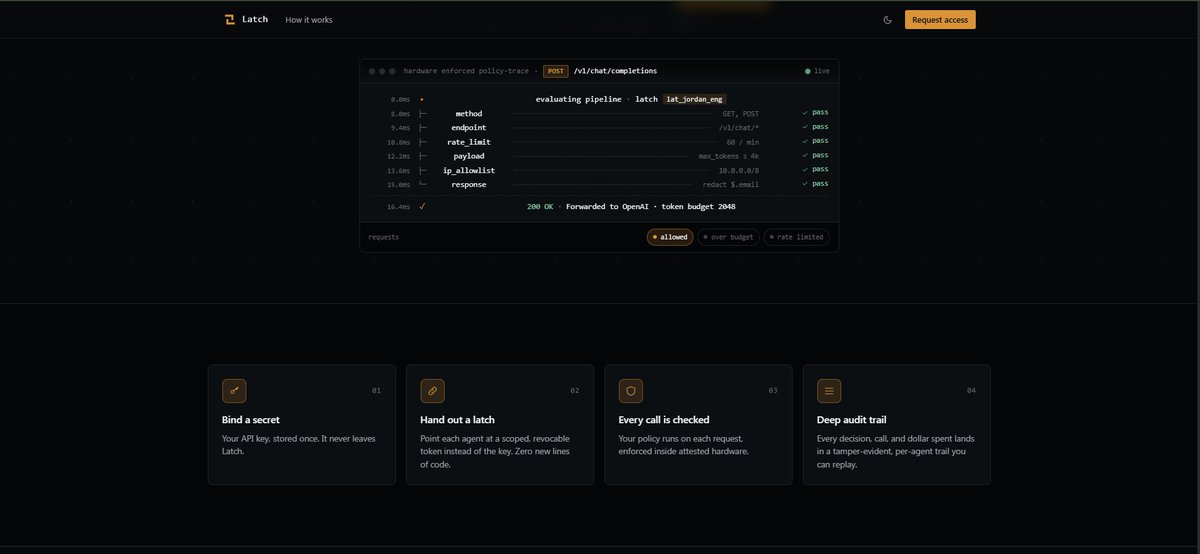
this is the problem @RialoHQ is solving with OnLatch.
onlatch is building a secure delegation layer for AI agents. Instead of giving an AI agent full access to your keys and permissions your secrets remain locked inside a secure environment and never leave it.
you then issue the agent a latch a limited, revocable permission token that only allows specific actions.
for example, an agent can be permitted to spend only a certain amount, access only certain APIs, or perform tasks within predefined rules.
every action the agent takes is checked against these policies in real time inside hardware enforced secure environments.
If the action violates your rules, it is blocked immediately. Every request is also recorded in tamper evident audit logs, so you always know what the agent did and why.
In simple terms, OnLatch is building the trust and security infrastructure that allows AI agents to interact with the real world safely.
They're solving one of the biggest problems in the AI agent economy:
how to give AI systems enough authority to be useful without giving them enough access to become dangerous.
been off for a little over 2 weeks and wow.!, @risechain hasn't been slowing down.
one thing is becoming clear: RISE isn't launching as just another chain. It's building an entire trading ecosystem from day one.
-> @heliosdottrade has already crossed $1B in trading volume on the RISE testnet.
helios combines full range and concentrated liquidity with RISE's ultra-fast execution, delivering low latency spot trading. Demand is already showing before mainnet even goes live.
-> @stage0_ is evolving into much more than a launch platform.
it introduced 2 new hot features:
• Senna – an AI assistant for intent-based onchain actions
• RISE Names – human readable identities like sam.rise and satoshi.rise.
the vision is simple:
tell the network what you want to do and the infrastructure handles the complexity.
-> @spineprotocol is launching on RISE with two major products:
• Pool based lending powered by Morpho Lite
• An orderbook based fixed-rate borrowing product
with Yearn as the initial curator, RISE is building serious lending markets from day one.
-> @Icarus_Fi is becoming foundational infrastructure on RISE.
as the native ve(3,3) DEX, it will power:
• Liquidity incentives
• Liquidations for Spine Finance
• Portfolio margin on RISEx
• Fully onchain basis trade vaults
This goes far beyond a standard DEX.
-> @KyberNetwork one of DeFi's largest DEX aggregators with $150B+ in trading volume, is also going live on RISE.
It will route across AMMs and orderbooks on RISE to execute the best price in a single transaction.
put it all together and the picture becomes clear:
-> Trading
-> Liquidity
-> Lending
-> Identity
_> AI-powered interactions
-> Aggregation
RISE is positioning itself to launch with the infrastructure stack that traders, builders and applications actually need.
$1B in testnet volume isn't just a milestone, it's proof of demand.
Helios is showing what happens when traders, LPs, builders and community align around a shared vision.
And with Ascension still underway, this is only the beginning. ☀️
$1B in testnet volume isn't just a milestone, it's proof of demand.
Helios is showing what happens when traders, LPs, builders and community align around a shared vision.
And with Ascension still underway, this is only the beginning. ☀️
Helios Testnet has officially crossed $1B in trading volume!
To every trader, LP, builder, and community member who joined us, thank you.
And we're not done yet.
Less than 13 hours remain in Helios Ascension and the numbers keep climbing ☀️
Spine Finance is live on RISE from day one.
Spine will be operating two products:
• Pool based lending (@Morpho Lite deployment)
• Orderbook based fixed rate borrowing product (built by Spine).
Spine will be kicking off initial markets with @yearnfi as main curator.@spineprotocol. Live from day one.
We've gotten very good at putting assets onchain.
The harder challenge is making them respond to the real world.
A tokenized building, loan or piece of real estate is still just a digital representation if it can't react to what's happening around it.
A thread 🧵
The question isn't whether RWAs will grow.
The question is:
What happens when they start responding to the world around them?
That's the future I'm most interested in watching.
What are your thoughts?
@RialoHQ
We've gotten very good at putting assets onchain.
The harder challenge is making them respond to the real world.
A tokenized building, loan or piece of real estate is still just a digital representation if it can't react to what's happening around it.
A thread 🧵
As the RWA market continues to grow, the biggest unlock may not be tokenization itself.
It may be automation.
Because an asset that can react to reality is fundamentally more useful than one that simply exists onchain.