We’re about to launch our first product
And I believe this marks as a turning point for the market making industry.
If you’re an early-stage Web3 team looking for a self-serve way to manage professional liquidity with full control, we’d like to involve you early.
Join the waitlist: https://t.co/5di2Pa0lIo
Enflux now supports Robinhood Chain.
Active liquidity management for projects building on the chain. Positions deployed, ranges managed, reporting you can check.
DMs are open.
Most trading edges expire. Here is how to see it coming from someone who built a 9 figure fund in the past👇
Alpha is a property of a strategy inside a market condition. The edge you found last year may still look fine in your backtest while the live P&L is flat. This is alpha decay, and it kills more strategies than bad ideas do.
Why does it happen?
When you find an edge, you are finding a pattern in how other participants behave. That pattern exists for a reason: structural mechanics, behavioral inefficiency, or information asymmetry. All three of those can change, and they do.
Structural edges are the most durable. Funding rates in perpetual swaps mean-revert because arbitrageurs force them to. That pressure does not go away unless the market structure changes. But even these thin over time as more capital chases the same spread and the premium compresses toward transaction costs.
Behavioral edges are fragile. The retail momentum pattern you found in 2022 was probably real. But the retail cohort trading in 2024 is different, the platforms are different, and the speed at which information moves is different. Same signal, different world.
The sneaky one is crowding. Your strategy can lose edge not because the signal stops working, but because ten other desks found the same signal. Now you are all in the same position. Your collective entry pressure has already compressed the return, and your correlated exits are going to make the drawdown much worse than your backtest ever showed.
How do you catch this before the P&L turns?
The most useful metric I have tracked is a rolling information coefficient. The IC is the correlation between your signal and the subsequent return it is supposed to predict:
IC_t = corr(signal_t, return_{t+h})
Run this in 30-day rolling windows over live trading data, not backtested. A downward trend over 90 days is a warning. Not "kill the strategy immediately", reduce size, and start building the replacement.
This is more informative than watching a drawdown because it shows the edge itself is fading, not just that you hit a rough patch. A drawdown in a regime where IC is flat is bad luck. A drawdown in a regime where IC has been falling for three months is a structural problem.
The second thing worth tracking is fill quality over time. If you are taking liquidity and your average slippage is drifting up, the market may have learned your timing pattern. You are becoming predictable to the people you need to surprise.
I had a basis strategy that ran well for 18 months on both IC and P&L. Then IC flattened over about six weeks. We watched it too long. The flat IC window was not zero-edge, it just meant the edge was declining faster than we thought. By the time the P&L went negative, the signal was already dead. We gave back a quarter of what we had made.
The rule I use now: every live strategy needs a written exit condition before it goes live. Not "when P&L is bad." P&L is a lagging indicator. The exit condition should reference something earlier in the causal chain - IC trend, fill quality, the explanatory variable your edge is built on. If the mechanism behind the edge has changed, you want to know that before the tape tells you.
The goal is not to hold strategies forever. The goal is to hold them for exactly as long as the edge is real, and cut before it costs you the principal.
In addition to our Poker Night, Enflux is hosting a private Cigar Night during @EthCC🥃
Join a curated room of founders, investors, traders, and operators for an intimate evening built around meaningful conversations and strong connections.
Invite-only. Secret location shared upon approval.
Event link: https://t.co/aU02dQCnCF
Everyone optimizes for Sharpe.
If you're trying to break into quant trading, that's the first thing to unlearn.
When I was building out a nine-figure crypto fund a few years ago, we structured our strategy evaluation around two questions that Sharpe doesn't answer. Most people coming from academic finance or early-career quant roles don't think this way yet, bc Sharpe is what gets taught, and it's what gets capital allocated.
However, it's not what determines whether a strategy is actually worth building.
The first question is capacity-adjusted return. Sharpe is completely scale-agnostic. A strategy with a Sharpe of 4 and $150k capacity before edge degradation is more like a curiosity. We required total extractable value calculations before any strategy passed initial review.
That meant modeling realistic capacity against infrastructure costs, execution costs, and the degradation curve as size increases. Most high-frequency and stat-arb proposals that looked compelling on a risk-adjusted return basis became uninteresting immediately when capacity was modeled honestly.
That filter saved more time than any other part of our process.
The second question is drawdown architecture. For mid-frequency strategies, Sharpe and maximum drawdown are evaluated as a pair, never independently.
A Sharpe of 1.8 with a 40% maximum drawdown doesn't survive a rational risk process regardless of how annualized returns look. A Sharpe of 1.1 with a controlled 8% maximum drawdown gets allocated and compounds.
We stress-tested drawdown profiles against regime conditions absent from the historical data, specifically the regimes where the strategy's core assumption breaks. If it couldn't survive that test theoretically, it didn't get to test it with real capital.
Keep this in mind if you want to execute this seriously:
High-frequency: capacity and total extractable value first, before any model refinement. Optimization is worthless if the strategy can't scale to relevance.
Mid-frequency: Sharpe and drawdown modeled jointly under adversarial conditions. Historical performance is the starting point. Stress testing is the filter.
Sharpe is a useful component of the picture. It's not the evaluation. Most quant teams, especially earlier-stage ones, inherit an evaluation framework that was designed to raise capital, not to build strategies that survive contact with real market conditions.
If you're building a trading operation from scratch, design the evaluation framework before you design the strategies.
Everything else follows from that.
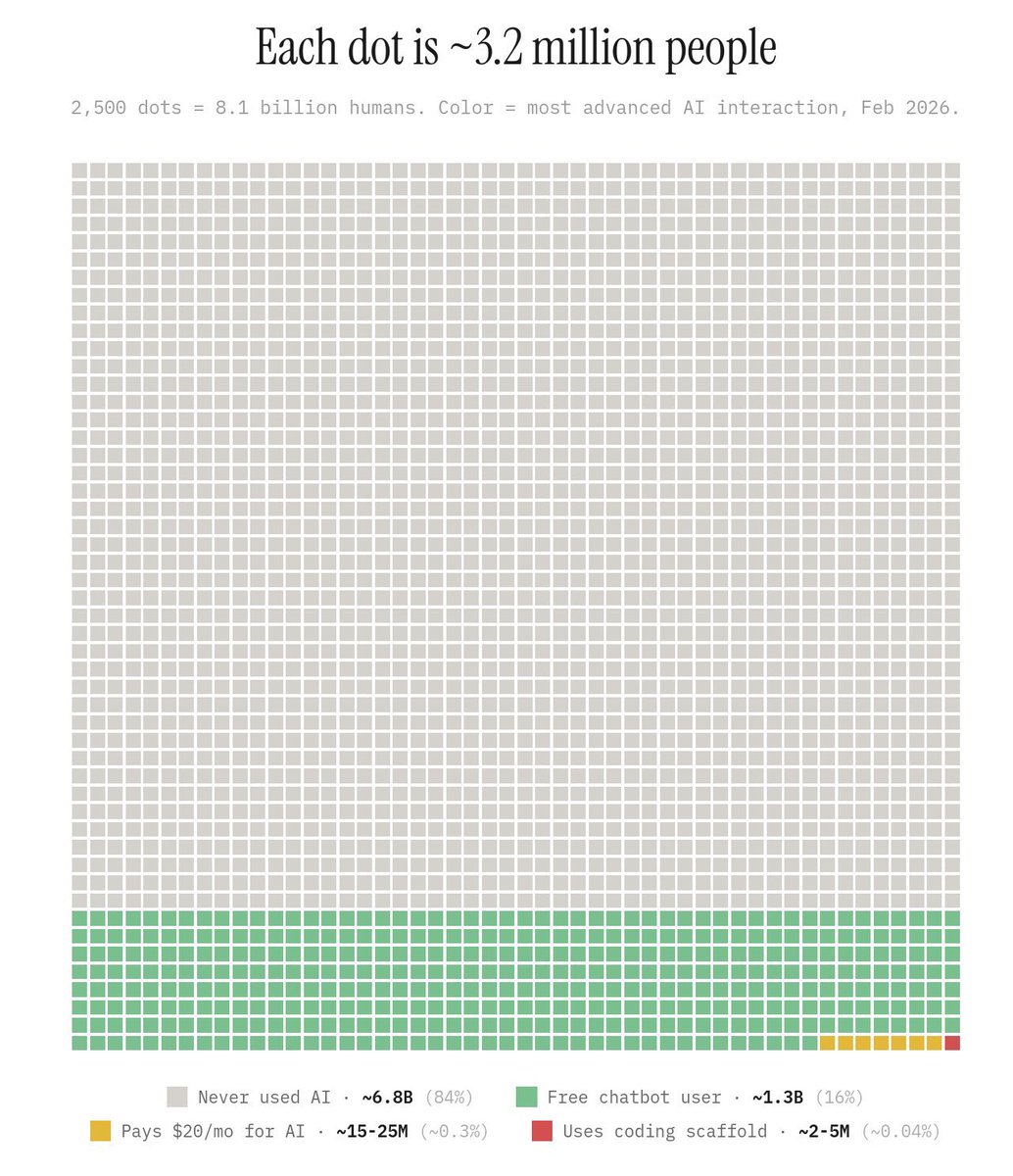
Ever thought you felt behind when it comes to AI?
Each dot represents 3.2 million people. 2,500 dots = 8.1 billion humans.
Grey: 6.8 billion people who have never used AI.
Green: 1.3 billion free chatbot users.
Yellow: 15-35 million who pay for it.
Red: that tiny sliver is us.
The AI space feels crowded because you're in an echo chamber of the 0.06%.
It seems the rest of the world hasn't even started yet.
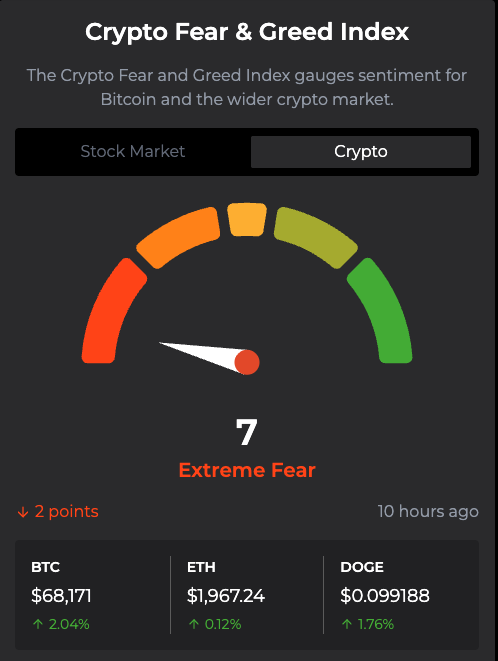
Based on risk asset analysis every major market is just about ready to correct.
In this event, crypto market falls as well.
Commodities will have another run, and treasury’s will spike as their technicals are looking rather Fed-inflationary I believe.
With March - April looking like a party for the blood hunters.
Or perhaps a large industrial sized blanket for the hopers.
Good luck everyone, may patience and resilience be in your side.
Consensus this year felt more intentional.
The conversations were sharper, more thoughtful, and stronger, with builders pushing forward despite the current markets.
Grateful to everyone who took the time to show up, share perspective, and spend the evening with us.
And especially big thank you to the @enflux_io team for making this happen
See you all at the next one 🙌🏼
Our event starts in an hour.
If you’re joining us in Central tonight, looking forward to seeing you there.
If you’re still deciding, a few seats just opened up: https://t.co/nYbdXvoifF
See you on the rooftop
Tomorrow night we're creating a space to talk through this current market cycle.
If you’re still in Hong Kong post-Consensus, come join us and bring your perspective
Spots are limited: https://t.co/nYbdXvnKq7
@jussy_world liquidity is in crypto and equities, everything else is just portfolio ballast. pre-IPOs already priced most of the upside in private rounds imo