You rarely get a mic at the UNHRC, so when you do, you don't waste it on generic speeches. You make every second count.
@asuvathaman did just that by taking two vital issues to the global stage: forced religious conversions and the erosion of ancient civilizations.
He reminded the world that Hinduism is a nature-centric civilization, not just a religion. Every time an indigenous culture is converted and erased, humanity loses centuries of ecological wisdom that no modern climate policy can replace. It’s high time the world views cultural survival as environmental protection.
Two thoughts: The current Indian government is more democratic and image-conscious / aware than its detractors claim. And it has been less successful in resolving many of India’s structural issues as compared to what its supporters claim. (1/2)
2007 : Rajdeep Sardesai airs a program on CNN IBN claiming Sohrabuddin encounter was fake
2008 : Rajdeep is awarded Padmashree by Sonia Gandhi
2010 : Amit Shah arrested in Sohrabuddin case and spends 3 months in jail. He is acquitted in 2014 as it's a fake case.
2018 : Courts declare Sohrabuddin case false. Everyone is acquitted. Many had careers ruined and spent years in jail.
2020 : Rajdeep and 10 other "journalists" apologise in court for fake reporting in 2007.
2026 : Rajdeep is glorifying CJP Ashutosh Ranka without mentioning his role as AAP spokesperson. Calls others Godi media.
Your short memory is the only reason they exist.
Share it.
Indian men are among the toughest people on Earth.
They spend years studying relentlessly without breaks. Once their education is complete, they transition immediately into the workforce—there are no gap years or rest periods.
For an eldest son, the pressure is immense. He carries the heavy burden of providing for the family, taking full responsibility for bringing in an income, funding his siblings' education, and covering their marriage expenses.
Once he marries, his responsibilities only multiply. Society places immense pressure on him to buy a house, a car, and jewelry for his wife.
Between providing for his parents, supporting his wife, and guiding his siblings, he rarely has time for himself or his own hobbies. He transitions seamlessly from an overworked student into a 24/7 machine.
Nine out of ten Indian men find themselves trapped in this exact cycle. While a man’s hard work and dedication are often overlooked, this is the quiet reality for millions of Indian men.
If you walk into the Secretariat of Public Education in Mexico City & look up at the massive, world-famous frescoes painted by Diego Rivera, you will see something that should make every Indian’s jaw drop.
Among the painted Mexican revolutionaries, farmers & national heroes sits an Indian man with intense eyes, sitting at a long wooden table, breaking bread with poor peasants.
He is not a diplomat. He is not a movie star. He was a wanted fugitive from Maharashtra whom the British Empire spent decades trying to hunt down & the man who quietly revolutionized global agriculture before the world even knew what the "Green Revolution" was.
His name was Pandurang Sadashiv Khankhoje.
Born in 1884 in Wardha, Maharashtra, Khankhoje grew up on stories of the 1857 uprising. While other kids played games, young Pandurang spent his teens founding secret societies & training in martial arts. Inspired by Lokmanya Tilak, he reached a radical conclusion early in life: To defeat an empire, you need military training & global allies.
In 1906, penniless & under British surveillance, he fled India on a ship. He worked his way through Japan & San Francisco, eventually enrolling at the Mount Tamalpais Military Academy in California while earning a degree in agriculture at Oregon State University.
In Oregon, he co-founded the Ghadar Party, the legendary international movement aimed at overthrowing British rule in India through armed revolt.
During World War I, Khankhoje traveled across Europe & the Middle East, attempting to recruit Indian soldiers in the British Indian Army to turn their guns against their colonizers. But the revolt failed. British intelligence put a massive price on his head. He could not go back to India. He could not stay in the West. He was a man w/o a country.
Exiled & on the run, Khankhoje slipped across the border into Mexico in the 1920s. Mexico was rebuilding after its own bloody revolution & its rural population was dying of starvation & drought.
Khankhoje realized something profound: An empire does not just conquer with guns; it conquers through hunger. If you want a nation to be truly free, you have to feed its people.
Appointed as a prof at the National School of Agriculture in Texcoco, he threw himself into plant genetics. Working under harsh conditions with limited funding, he did something extraordinary:
- Taming the Wild Corn: He crossbred wild grass (teosinte) with domestic maize, creating high-yielding, drought-resistant hybrid corn that produced multiple ears per plant instead of just 1.
- Frost-Proof Wheat: He developed new strains of high-yield wheat capable of surviving extreme Mexican weather & blights.
- Schools for the Poor: He did not lock his research in academic journals. He founded the Escuelas Libres de Agricultura (Free Agricultural Schools), teaching impoverished Mexican farmers hands-on genetics, soil conservation & yield optimization.
His high-yield crops transformed Mexican farming. Decades later, when American scientist Norman Borlaug came to Mexico & developed the high-yield dwarf wheat that kicked off the global Green Revolution, he built directly upon the foundation of plant genetics laid by Pandurang Khankhoje.
In 1947, India finally won its independence. The British were gone.
Now an elderly scientist globally celebrated across Latin America, Pandurang Khankhoje packed his bags & came home to Nagpur, eager to offer his life's work to build the agricultural backbone of a newborn India.
The bureaucracy of newly independent India did not know what to do with him. His radical revolutionary past frightened bureaucrats; his foreign academic achievements were ignored. He was given no major agricultural policy role, no national honors & no platform :((
When he passed away in Nagpur in 1967, his passing barely made a ripple in the local newspapers. His neighbors knew him simply as a quiet, retired old man who used to live abroad.
Today, if you ask an Indian agricultural student who fathered modern crop hybridization, they will quote Western scientists. Almost no 1 in Maharashtra/Delhi knows the name Pandurang Khankhoje.
But 1000s of KMs away in Mexico City, inside the halls of govt, his face remains painted on the wall, immortalized by Diego Rivera as a symbol of unity, knowledge, and freedom.
He was erased from the history books of the country he fought to liberate, but the soil of Mexico still remembers the Indian ghost who taught them how to feed a nation.
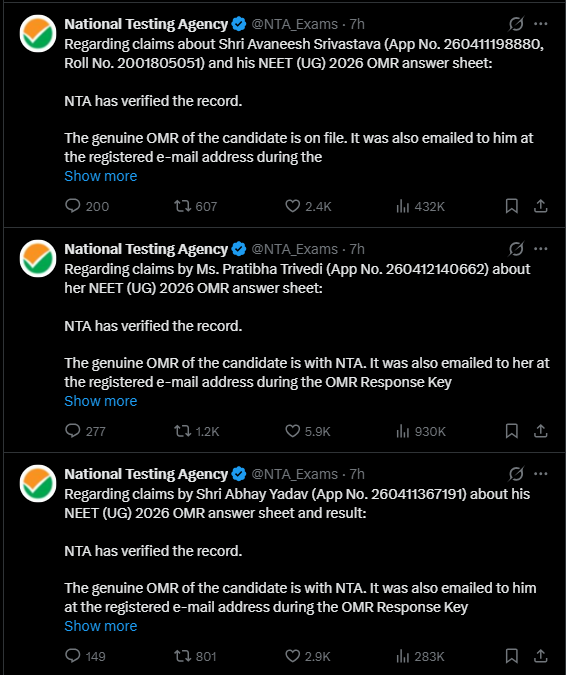
Today, NTA exposed 5 students who digitally altered their OMR sheets to claim a discrepancy in their final NEET marks.
Some of them scored as low as 38 marks out of 720.
It is one thing to get low marks and another thing to come on national media and lie with impunity.
Some of these students are just 18 years old.
These kids are manipulating their OMR sheets using AI and playing the 'victim card.'
Vulture journalists are then using their fake sob stories to peddle political propaganda.
But this made me think about the mindset of these students and, particularly, their parents.
The NTA needs to file FIRs against them. This will act as a deterrent for those willing to create mass hysteria and panic.
A shocking and highly volatile video has surfaced from the heart of New Delhi, capturing the exact moment aggressive CJP protesters forcefully broke through heavy police barricades as their high-stakes 'Chalo Sansad' march heads directly toward the Parliament building!
It feels like someone has reopened the 2020 Delhi Riots playbook. Police cars being attacked and vandalised, even police men and women being pelted with stones and almost lynched.
Start with a street-corner protest. Add students. Add “democracy is dying.” Add foreign media. Add NGO outrage. Add opposition amplification. Add street confrontation. Then wait for one spark, one viral video, one death, one police action, one headline abroad.
That is how a so called 'protest' is converted into a destabilisation project.
And this reeks of the deep state playbook.
The old establishment understands one thing very clearly: if it cannot defeat Prime Minster Narendra Modi through elections, it must make India appear ungovernable between elections.
The moment a protest over exams becomes a march on Parliament, the moment the slogans move from reform to regime-change vocabulary, the moment familiar activists, Left networks, foreign media ecosystems and opposition parties begin speaking from the same script, India has every reason to ask:
Who is coordinating this escalation?
Why does every protest in Delhi follow the same choreography?
Why is the elected government always framed not as accountable, but illegitimate?
Why does every local grievance suddenly become an international campaign against Indian democracy?
We saw this during the CAA riots. We saw this during the farm agitation. We saw toolkits, foreign amplification, coordinated narratives, selective outrage and attempts to turn India’s capital into a permanent theatre of instability.
Now the same template appears to be back.
Because Delhi Riots of 2020 was not an accident, the court's recent ruling last week made it clear.
And someone clearly wants a sequel.
Two men were sitting next to each other at Murphy’s Pub in London...
After a while, one bloke looks at the other and says, ‘I can’t help but think, from listening to you, that you’re from Ireland’
The other bloke responds proudly, ‘Yes, that I am!’
The first one says, ‘So am I! And where about from Ireland might you be?’
The other bloke answers, ‘I’m from Dublin, I am.’
The first one responds, ‘So am I!’
‘Mother Mary and begora. And what street did you live on in Dublin ?’
The other bloke says, ‘A lovely little area it was. I lived on McCleary Street in the old central part of town.’
The first one says, ‘Faith and it’s a small world. So did I! So did I! And to what school would you have been going?’
The other bloke answers, ‘Well now, I went to St. Mary’s, of course.’
The first one gets really excited and says, ‘And so did I. Tell me, what year did you graduate?’
The other bloke answers, ‘Well, now, let’s see. I graduated in 1964.’
The first one exclaims, ‘The Good Lord must be smiling down upon us! I can hardly believe our good luck at winding up in the same place tonight. Can you believe it, I graduated from St. Mary’s in 1964, my own self!’
About this time, Vicky walks up to the bar, sits down and orders a drink.
Brian, the barman, walks over to Vicky, shaking his head and muttering, ‘It’s going to be a long night tonight.’
Vicky asks, ‘Why do you say that, Brian?’
‘The Murphy twins are drunk again.’
Another racially motivated assault against an Indian in the UK.
An Indian origin doctor says her brother was attacked near Romford Station, London, after a man abused him, smashed his belongings, and assaulted him before fleeing.
Police are investigating. Anti-Indian stereotypes and online hate don't exist in a vacuum they can contribute to prejudice in the real world.
Let me explain what this whole fight is about, because it is very different from what the tweet by the Japanese official makes it sound like.
Back in 2015, India and Japan signed the Mumbai to Ahmedabad bullet train deal. 508 km.
India would use Japan's Shinkansen trains and Shinkansen technology. Japan put up a massive soft loan, covering most of the cost, at almost no interest, 0.1 percent, to be repaid over 50 years.
On paper it sounded amazing. Cheap money, world class trains.
But every such loan has a catch. Cheap Japanese money came tied to buying Japanese things.
Their trains. Their coaches. Their signal system. Their price, largely on their terms. That is normal. No country lends billions out of pure love. They lend to sell their own industry.
Then two things went wrong, and this is where his anger comes from.
One, the price.
The Japanese Shinkansen trainsets turned out to be extremely expensive. India felt it was being overcharged for the rolling stock. So, talks hit a wall.
Two, the timeline.
The newest Japanese trains, the E10 series, would reportedly only be ready for India around 2032. India did not want to sit on a finished 1.08 lakh crore track with no trains to run on it.
So India made a call. And this is the part I am proud of.
Instead of waiting and overpaying, India decided to run its own trains first. BEML in Bengaluru got an order to build indigenous high speed trainsets at about 866 crore each, designed to run at 280 kmph.
India will open the line with Indian made trains on the Surat to Vapi stretch around 2027, and bring in the Japanese Shinkansen later.
And the signal system, the thing he is bitter about, India switched from Japan's DS-ATC to the European ETCS Level 2 system.
The same family already used on the Delhi Meerut rapid rail. That is what he means by Japan being excluded from the signal system. India looked at the Japanese option, found it too costly and too slow, and picked a different one.
Now let me be fair, because I cannot be blind just because I am pro India.
He is not lying about everything.
India is genuinely a tough, frustrating negotiator. We change our mind. We push for our own interest till the last minute. We renegotiate things others thought were settled.
To a Japanese official raised on politeness and fixed agreements, this feels like betrayal.
But flip it around and look at it from our seat.
Our job is not to protect Japanese honour. Our job is to get India a bullet train at a fair price, that runs soon, and that builds Indian factories in the process.
On all three, changing course was the right call. Waiting till 2032 and overpaying for imported trains would have been the polite choice. It would also have been the stupid choice.
There is a bigger thing hiding under his frustration, and I think it is the real reason for the anger.
For decades, the deal was simple. Rich countries gave loans and technology, and poorer countries said thank you and bought whatever came bundled with it.
You took the money, you took their trains, you did not argue.
India argued. India took the loan, then insisted on its own trains, its own signal system, its own factories getting the work. We used their money to build our capability instead of just renting theirs.
That is what stings them. Not that we were reckless. That we refused to stay the junior partner in our own project.
I will give the Japanese side genuine credit.
Their engineering is world class. In 60 years, the Shinkansen has never had a passenger death from a derailment or collision.
That safety record is worth respecting. Their frustration with our chaos is also probably fair on a human level. Working with India can be maddening. Anyone who has managed an Indian project knows this.
For me, the real issue is what’s in it for our country.
India has the track. India is building its own trains for it. India picked its own signal system.
India got a 50 year loan at almost zero interest. And India will still get the Shinkansen later, on better terms than the original bundle.
If that is what Indian recklessness produces, I will take it every single time.
Be tough. Be a nightmare to negotiate with. Just make sure the country wins at the end of it. :)
Kanikoot Massacre is the story of my family. My grandfather was the son of Zana Bhat.. only he survived. 11 members of our family died that day. A servant took care of him. It’s also available as my essay in the book Literature in Exile available on Amazon
Mount Everest is named after
a British surveyor.
A man who never even saw the peak.
But in 1852…
An Indian mathematician measured
the mountain…
Radhanath Sikdar.
Using spherical trigonometry
from 150 miles away he calculated
the exact altitude 29,000 feet.
The world still remembers a British surveyor.
The mountain remembers an Indian mind.
Narrative building