A statement from Future of Life Institute Religious Outreach Lead, @willjmjones, on @Pontifex’s AI encyclical:
"His Holiness Pope Leo XIV’s much-anticipated encyclical on AI exemplifies the moral leadership so needed in an age when a handful of technology corporations race to replace humans in work, relationships and decision-making. While significant work remains to be done, the encyclical represents enormous progress in bringing the faithful into the conversation about how this technology will impact our world, our communities, and our families. It is a great gift, not only to Catholics, but to everyone grappling with the challenges of AI and discerning how to steer it away from harm and towards benefiting humanity. Notably, the encyclical mirrors and champions many of the core principles found in the Pro-Human AI Declaration, calling for humanity always to come first.
The Encyclical is clear in its exhortation to reject human replacement: 'Humanity — in all its grandeur and woundedness — must never be replaced or surpassed. We can embrace the technological progress that alleviates suffering and unlocks new possibilities, provided that we do not abandon the very essence of our humanity, namely the capacity for relationship and love.' This is a direct rebuke of the leading AI companies' stated goal of creating smarter-than-human superintelligence. It is also an acknowledgement that AI tools, not autonomous general purpose systems, are the key to a flourishing human future.
Magnifica Humanitas can serve as a rallying cry for the world to reassert unashamedly the primacy of humanity, in all its flawed glory, over our tools."
Humanity, created by God in all its grandeur, is today facing a pivotal choice: either to construct a new Tower of Babel or to build the city in which God and humanity dwell together. In Jesus Christ, this humanity in its grandeur becomes the Way, the Truth and the Life, opening the path for each of us to grow toward fullness. #MagnificaHumanitas
https://t.co/6i9MWs6LJl
It was great to speak with @ashleyrgold at the AIxGlobal Risk Summit, where I was honored to accept the AI Impact Award for my work to create one federal rulebook for AI.
Thank you, @scientistsorg and @FLI_org. Let’s get the TRUMP AMERICA AI Act to the President’s desk.
"[The Church] was one of many institutions to decide early on that human cloning was beyond the pale... Twenty years later, the resulting taboo has largely restrained governments, entrepreneurs, and scientists. Something similar could, and should, be achieved with superintelligence."
New in @compactmag from FLI's @willjmjones:
We don't have to accept the way AI is going.
The biggest companies building AI aren't building it for us. They're building it to replace us.
We’ve made a roadmap for how we can build pro-human AI: https://t.co/70Zb7KauWg
Let me take you through it…
"A.I. is less regulated in America than sandwiches. You can’t open a sandwich shop without having your kitchen inspected. But you can release an A.I. girlfriend for 11-year-olds and that’s fine."
@tegmark in @nytimes:
It’s time for Congress to choose: Big Tech or kids and families.
This week, the largest gathering of survivor families came to Capitol Hill to share the unthinkable, how unregulated AI and a lack of protections contributed to the loss of their children.
These are not statistics. These are real families, real stories, and preventable tragedies.
Congress can act, or they can continue to look the other way.
Follow and share to make sure their voices are heard and their stories lead to action.
Thank you to the senators and the families who had the courage to come to Capitol Hill this week and share their stories.
@MarshaBlackburn@SenBlumenthal
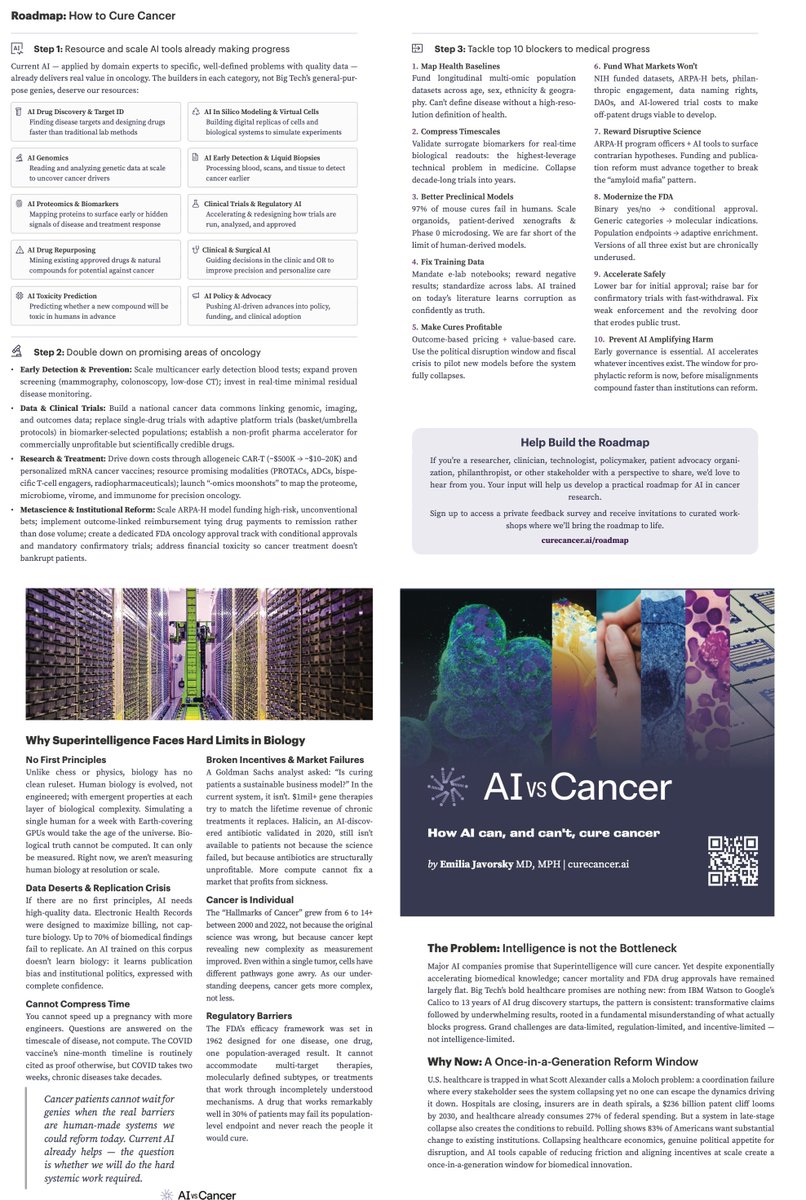
Where are our AI cancer cures? Summoning a superintelligent genie to cure cancer sounds compelling. It also conveniently avoids confronting the real barriers: no first principles to work from, data gaps, broken incentives, and a regulatory system frozen in the mid-20th century.
The good news: AI tools are already delivering across labs and clinics. There are many promising breakthroughs in cancer research underway. And the builders actively fixing the broken system are already at work.
We just need to back the right things. Diagnosis and roadmap: https://t.co/qOsY88LmPY
It's clear: across the Right and the Left, the American public overwhelmingly prefer a pro-human future, and reject the AI race-to-replace us.
The vast majority of American voters:
👉 Back human oversight of AI systems;
👉 Want AI companies held accountable for harms;
👉 Reject fast-and-loose AI development;
👉 Support protecting our children & families from AI systems.
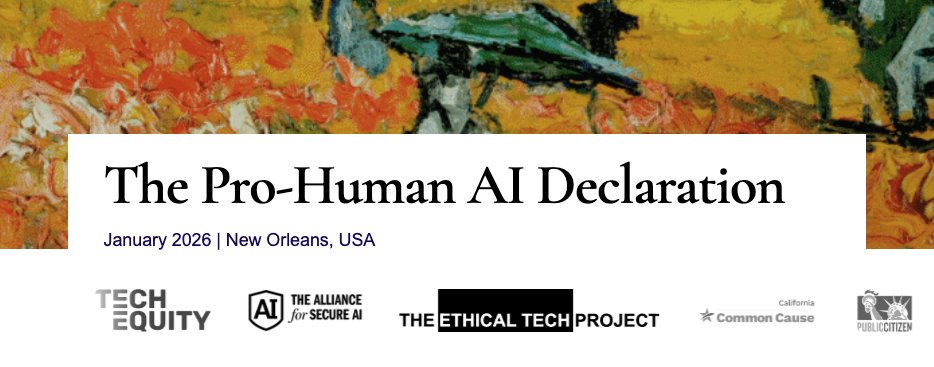
Today, a broad coalition issued the Pro-Human AI Declaration, defining the goals of the growing Pro-Human Movement in response to Silicon Valley's destructive race to replace humans.
Leaders from both the Left and Right; parents; faith groups; labor unions; civil society organizations; and others came together to agree on 33 AI principles, across 5 key themes:
1. Keeping Humans in Charge
2. Avoiding Concentration of Power
3. Protecting the Human Experience
4. Human Agency and Liberty
5. Responsibility and Accountability for AI Companies
🔗 Read the full Declaration & add your name now at the link in the replies:
𝘕𝘦𝘹𝘵 𝘞𝘦𝘦𝘬 𝘰𝘯 𝘋𝘰𝘰𝘮 𝘋𝘦𝘣𝘢𝘵𝘦𝘴:
SHOULD WE BAN ARTIFICIAL SUPERINTELLIGENCE?
Featuring:
👤 Max Tegmark (@tegmark)
👤 Dean Ball (@deanwball)
This is the debate the world needs right now, between two of the clearest voices on both sides.
Topics covered:
◻️ Should the US race toward ASI, or slam the brakes?
◻️ Is banning ASI compatible with democracy?
◻️ What would actually change either side’s mind?
Max Tegmark is an MIT professor whose research has focused on artificial intelligence for the past 8 years. He is also the cofounder of the Future of Life Institute, a leading organization dedicated to addressing existential risks from AI and other transformative technologies.
Dean Ball is a Senior Fellow at the Foundation for American Innovation. Earlier this year, as Senior Policy Advisor at the White House Office of Science and Technology under President Trump, he helped craft America's AI Action Plan, the central document for US federal AI strategy.
We're taping next week. What should I ask them?
I've heard a number of reasons for not signing or supporting the Statement on Superintelligence at https://t.co/82IrETU5vx. Some are valid, others...less so. Here are some such reasons and my personal commentary on them.
Thanks @sirramk for engaging with our letter calling for a prohibition of superintelligence.
As an org, FLI is pro AI tools (responsibly managed). Our foremost worry is loss of control to superintelligence. The public is worried too, with only 5% favoring the current race, and 73% for "heavy regulation" of advanced AI development.
We currently have no idea how to build superintelligence that would be under meaningful human control, and it may not even be possible. Losing control of (or to) superintelligence isn’t in the interest of any major nation, and there should therefore be a narrow path to agreeing on some capabilities that are out of bounds for all. Examples may include the ability of AI systems to engage in recursive self-improvement and self-replication.
To me, this would be an excellent part of any potential deal between President Trump and President Xi, and it can built on President’s Trump’s efforts to strengthen the biological weapons convention to limit the spread of man-made pathogens.
Yes, it is not going to be easy, but nothing worth having ever is.
AI companies are racing to build superintelligent AI, despite its many risks.
Let's take our future back.
📝 Sign the Superintelligence Statement and join the growing call to ban the reckless development of superintelligence, until it can be made safely.
#KeepTheFutureHuman
I stand with a majority of GOP governors against stripping states of the right to protect our people from the worst abuses of AI. The U.S. must win the fight against China – on AI and everything else. But we won't if we sacrifice the health, safety, and prosperity of our people.




![FLI_org's tweet photo. "[The Church] was one of many institutions to decide early on that human cloning was beyond the pale... Twenty years later, the resulting taboo has largely restrained governments, entrepreneurs, and scientists. Something similar could, and should, be achieved with superintelligence."
New in @compactmag from FLI's @willjmjones:](https://pbs.twimg.com/media/HIncZM4WsAA-r3T.jpg)