🧬 If life is built on language, then there must be a language of protein dynamics.
My brilliant PhD student Kaiwen Shi, sought to uncover the building blocks of such a language.
In our latest preprint, we introduce ENSEMBITS (Ensemble bits): an alphabet for local protein dynamics, the first tokenizer for ensembles of protein conformations.
We designed a residual VQ-VAE model to compress large datasets of MD simulations and AF2-based predictions of protein ensembles.
Key findings:
* The ENSEMBITS alphabet excels at encoding protein flexibility, and tokens explain various range of motions.
* ENSEMBITS match or outperform existing structural tokenizers on function prediction tasks.
* Through a distillation approach, we are able to generate highly informative dynamic tokens from single structures alone.
ENSEMBITS opens the door to the next generation of protien language modeling and design.
Paper and code: https://t.co/Vm4MdYhzm5
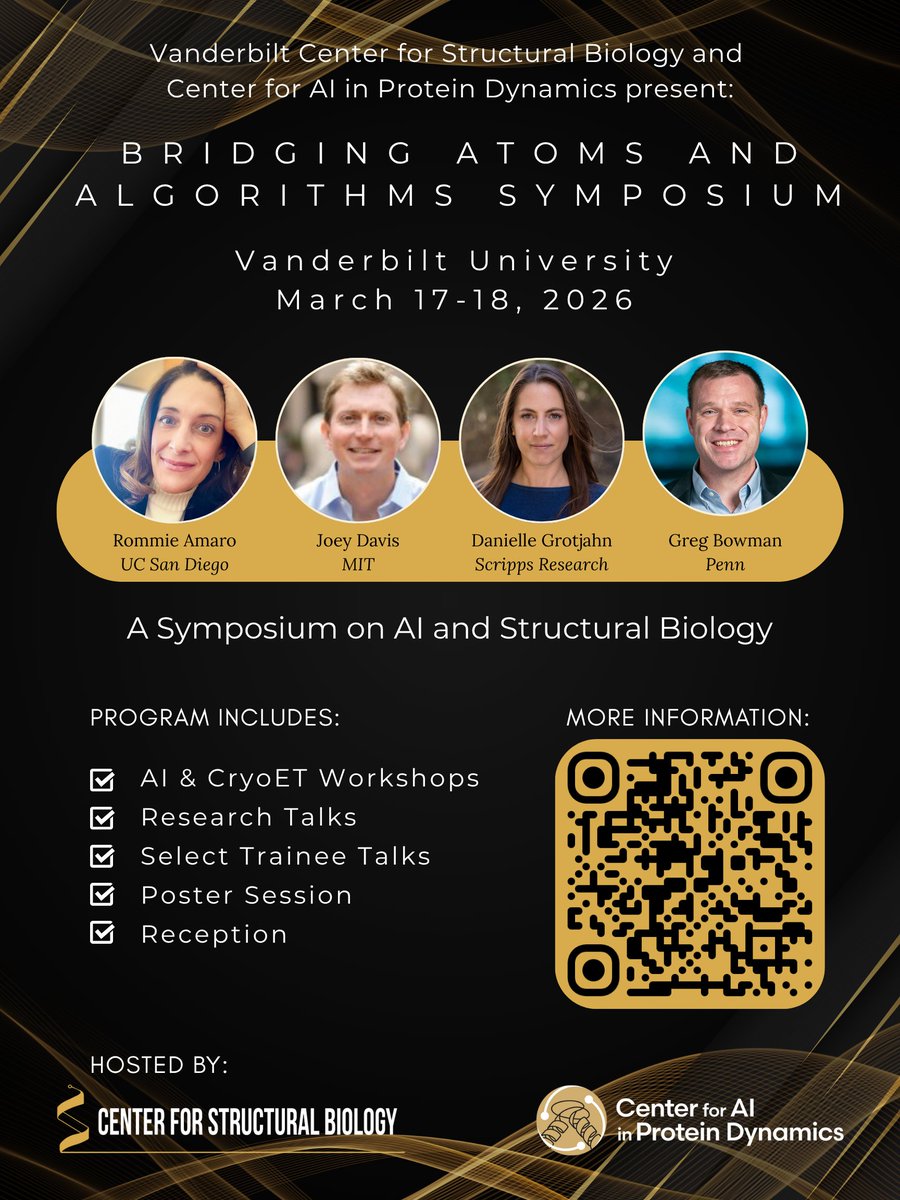
Registration is open for Bridging Atoms and Algorithms: A Symposium on AI and Structural Biology!
📅 March 17-18, 2026
🏫 Vanderbilt University in Nashville, TN
ℹ️ https://t.co/dxn2GKUywH
@RommieAmaro@jhdavislab@nani_grotjahn@drGregBowman
It was an honor to contribute a small part to this expansive and highly insightful look at the current state of ML-assisted RNA drug design led by @MalletVincent and Wissam Karroucha.
Most exciting is a new benchmark on virtual screening specificity (including Boltz2).
https://t.co/jH2MjpoKvr
My first manuscript as an independent PI, and my first single-author research article, is now published in @PNASNews. It's an attempt to contribute to the dialogue on generalizability in structure-based protein-small molecule affinity prediction with neural networks.
Vanderbilt Symposium on AI, Spatial & Systems Biology 2025. Thank you all for coming out on the weekend! @VUBasicSciences. Key note: Dr. Jonathan Liu from Stanford on hybrid open top light sheet microscopy!
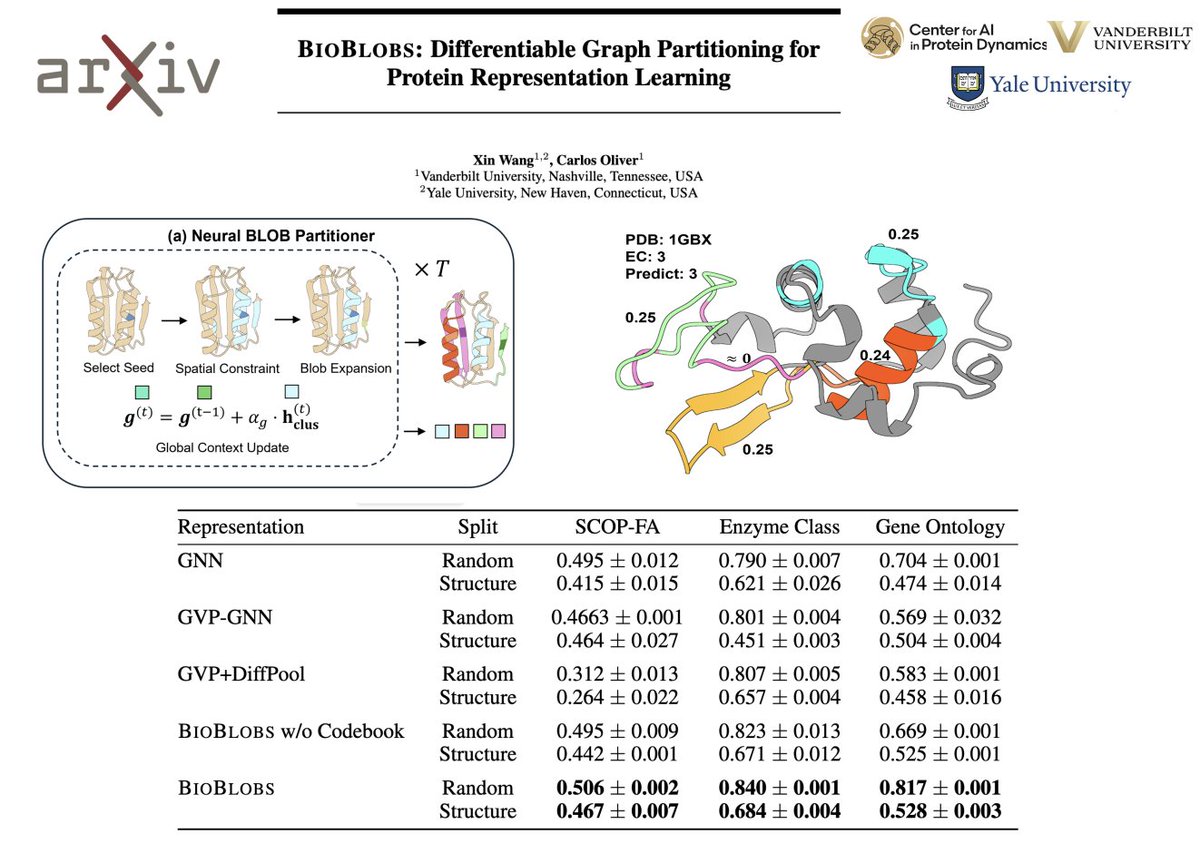
Our new deep protein structure representation layer, BioBlobs is out on arXiv.
Protein function operates by coordinating cohesive substructure modules shaped by evolution. Current protein representation methods break proteins down into rigidly shaped and sized blocks. Would you model a bicycle by breaking it into uniform blocks?
We built a differentiable graph partitioning model which learns to identify these cohesive 3D modules (blobs) and use them to build protein embeddings.
Our embeddings showed significant improvement when placed on top of GVP-GNNs on 3 protein function prediction tasks.
Blobs are assigned importance scores which can help us better understand the mechanisms of protein function.
Thank you to Allen (Xin) Wang for his outstanding effort in leading this project and making the first paper of my lab a reality.
Preprint: https://t.co/GKXhT1WGM0
Code: https://t.co/pGZiGjNU14
Vanderbilt Biochemistry is recruiting for two tenure-track Assistant Professors.
🔬 Chemical biology at the interface of chemistry, biology & medicine
🔬 Molecular approaches to key biomedical questions
📅 Review of applications begins Oct 15, 2025
https://t.co/pvWgE1PjoU
.@stephanie_mul of CAIPD will be hosting Dr. Polly Fordyce (@fordycelab) on October 27, 2025.
Talk Title: Microfluidics for Quantitatice, High-throughput Biochemistry and Biophysics.
You are cordially invited to the next installment of the CAPID journal club.
Our speaker will be
Shawyon Shirazi
presenting
CF-random: An MSA-subsampling Approach for Predicting Alternate Conformations
NOTE: we have a slightly different time, 12:30-1:30 PM.
Monday October 6
The external speakers are set and ready to navigate the intersection of #AI & #StructBio for the Bridging Atoms and Algorithms: A Symposium on AI and Structural Biology.
🗓️Tuesday & Wednesday, March 17–18, 2026
🏫Campus of Vanderbilt University
https://t.co/8VNudlMxbb
With a new collaboration called diffUSE, the @stephanie_mul lab is helping to advance our understanding of protein motion, leading to a new paradigm in dynamic structural biology.
@VUBasicSciences@VanderbiltMPB@VanderbiltAIPD
https://t.co/5xkl802f3N
Excellent turnout for today's journal club. Today's paper from @mvendruscolo14 was about guiding coarse-grained molecular dynamics of disordered proteins using AF2 distograms. Thank you to Te-Yu Kao for presenting.
Paper: https://t.co/NJKVPhQr96