My personal truths as a clinical psychologist, for today (July 18, 2026):
People often grieve the childhood they never had.
We don’t only grieve people we’ve lost. Sometimes we grieve things we never had in the first place.
A father who showed up. A mother who could comfort us. A home that felt safe. Parents who were interested in who we were. The chance to just be a kid and not have to worry so much.
And sometimes we don’t even know we’re grieving this until something brings it home. We watch another family together. We see a dad delight in his child. We have children of our own and find ourselves thinking, Why couldn’t I have had that?
You can be 40, 60, even 80 and still feel the ache of something you needed at 8.
We can’t change the childhood we had. But it matters to understand what we missed. Otherwise, we can spend a lifetime still trying to get it without even knowing that’s what we’re doing.
My personal truths as a clinical psychologist, for today (July 13, 2026):
Fear distorts reality.
Fear is one of the most powerful forces in the human mind. It doesn’t just change how you feel. It changes what you think is true.
A spouse comes home quiet and you’re sure something is wrong. Your teenager doesn’t answer a text, and you imagine a tragedy. A headache becomes a brain tumor after twenty minutes online. Your boss says, “Can we talk?” and you’re convinced you’re about to lose your job.
Fear also whispers that you’ll never find love again. That one mistake ruined your future. That people are judging you when they’re barely thinking about you. That trying something new will end in humiliation.
The more afraid we become, the more certain we become. We stop asking, “What else could explain this?” and start treating our worst-case scenario as reality.
Fear isn’t a liar because it invents everything. It’s a liar because it takes one possibility and makes it feel like the only possibility.
The antidote isn’t pretending fear doesn’t exist. It’s slowing down, checking the evidence, and staying curious long enough for reality to catch up.
@SahilBloom Life is already hard. Having people in your life who are predictable, resilient, can regulate themselves and have strong, moral character are the best type of people to have in your life.
“Imagine if Taylor Swift would have been put on an SSRI as a teenager.”
“The reason her music is so good is because you feel her intense lows and her super high highs.”
“We would not have Taylor Swift if she would’ve been medicalized.”
Alex Clark raises a question that cuts to the heart of medicalization.
How many gifted, creative, deeply feeling young people have we taught to see their emotional intensity as a disorder rather than part of what makes them who they are?
When we medicalize pain, sadness, grief, and struggle, we risk losing something beautiful about the human experience itself.
@realalexclark
Jimmy Carr nailed something a lot of us feel but can’t explain.
We’re living better than 99.9% of humans who ever walked the earth, hot showers, modern medicine, endless entertainment, kids that actually survive infancy, yet so many of us feel miserable.
He calls it “life dysmorphia.” We get used to how good we have it (the hedonic treadmill), then compare ourselves to everyone else and tank our own happiness.
As he puts it: happiness = quality of life minus envy.
Marcus Aurelius put it perfectly: “Very little is needed to make a happy life; it is all within yourself in your way of thinking.”
When was the last time you caught yourself feeling unhappy despite objectively having it pretty damn good?
My personal truths as a clinical psychologist:
#297 Polarized thinking reduces anxiety at the cost of nuance.
*Life is complicated. Most people don’t enjoy uncertainty. We want clear answers, clear villains, and clear heroes.
That’s one reason polarized thinking is so attractive.
If your ex was entirely terrible, you don’t have to wrestle with what was good. If your boss is completely incompetent, you don’t have to consider the pressures they’re under. If your political party is always right and the other side is always wrong, you never have to tolerate the discomfort of mixed truths.
But reality is usually messier than that.
Most relationships contain both love and disappointment. Most people have strengths and flaws. Most social problems have more than one cause. Even political leaders we admire make mistakes, and those we oppose occasionally get something right.
Polarized thinking feels good because it reduces uncertainty. It gives us a sense of certainty and control.
The problem is that certainty often comes at the cost of understanding.
Psychological maturity is not seeing everything as good or bad. It’s developing the capacity to hold two truths at the same time.
That’s harder.
But it’s usually closer to reality.
IF I GET DEMENTIA…..
I’d like my family to hang this wish list up on the wall where I live. I want them to remember these things.
1a. Every time you enter the room announce yourself. “Hi Dad - it’s Amanda.”
NEVER ask- Do you know who I am??? That causes anxiety.
• If I get dementia, I want my friends and family to embrace my reality.
• If I think my spouse is still alive, or if I think we’re visiting my parents for dinner, let me believe those things. I’ll be much happier for it.
• If I get dementia, don’t argue with me about what is true for me versus what is true for you.
• If I get dementia, and I am not sure who you are, do not take it personally. My timeline is confusing to me.
• If I get dementia, and can no longer use utensils, do not start feeding me. Instead, switch me to a finger-food diet, and see if I can still feed myself.
• If I get dementia, and I am sad or anxious, hold my hand and listen. Do not tell me that my feelings are unfounded.
• If I get dementia, I don’t want to be treated like a child. Talk to me like the adult that I am.
• If I get dementia, I still want to enjoy the things that I’ve always enjoyed. Help me find a way to exercise, read, and visit with friends.
• If I get dementia, ask me to tell you a story from my past.
• If I get dementia, and I become agitated, take the time to figure out what is bothering me.
• If I get dementia, treat me the way that you would want to be treated.
• If I get dementia, make sure that there are plenty of snacks for me in the house. Even now if I don’t eat I get angry, and if I have dementia, I may have trouble explaining what I need.
• If I get dementia, don’t talk about me as if I’m not in the room.
• If I get dementia, don’t feel guilty if you cannot care for me 24 hours a day, 7 days a week. It’s not your fault, and you’ve done your best. Find someone who can help you, or choose a great new place for me to live. With a bus and activities!!
• If I get dementia, and I live in a dementia care community, please visit me often.
• If I get dementia, don’t act frustrated if I mix up names, events, or places.
Take a deep breath. It’s not my fault.
• If I get dementia, make sure I always have my favorite music playing within earshot.
• If I get dementia, and I like to pick up items and carry them around, help me return those items to their original place.
• If I get dementia, don’t exclude me from parties and family gatherings.
• If I get dementia, know that I still like receiving hugs or handshakes.
• If I get dementia, remember that I am still the person you know and love.”
ᴄᴏᴘʏ ᴀɴᴅ ᴘᴀsᴛᴇ in Honor of someone you know or knew who has dementia. In Honor of all those I know and love and lost who are fighting Dementia/Alzheimer’s.
My personal truths as a clinical psychologist:
#286 Hope survives best when shared.
*A struggling student finds it in a teacher who says, “You can do this.” A patient finds it in a doctor who says, “We have options.” A grieving person finds it in a friend who simply stays close. A child finds it in a parent who believes in them.
Hope spreads from person to person. It grows when someone lends us their confidence, their encouragement, or their faith in a better tomorrow.
Most of us have carried hope for someone else at one time or another. Chances are, someone has carried it for us too.
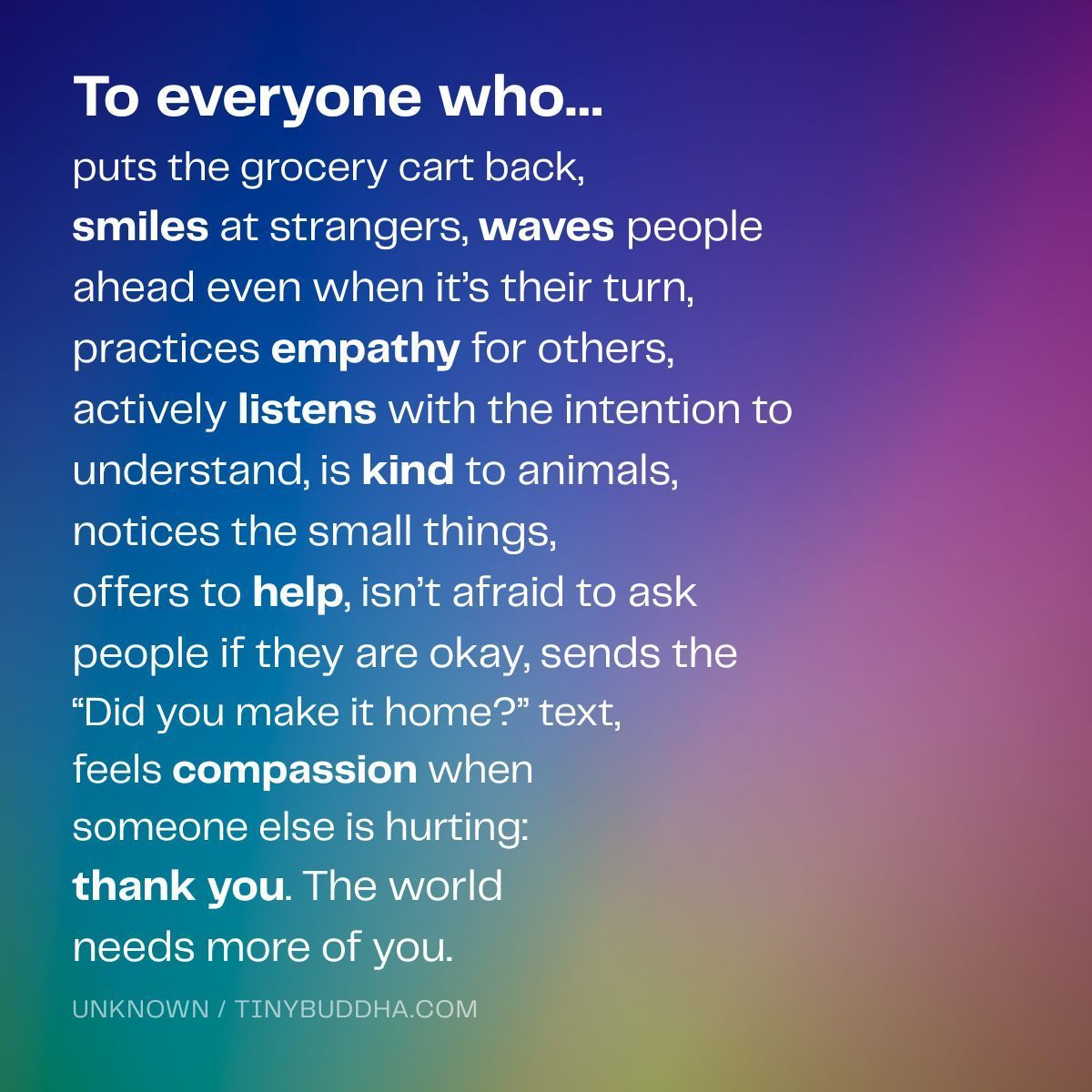
“To everyone who puts the grocery cart back, smiles at strangers, waves people ahead even when it’s their turn, practices empathy for others, actively listens with the intention to understand, is kind to animals, notices the small things, offers to help, isn’t afraid to ask people if they are okay, sends the ‘Did you make it home?’ text, feels compassion when someone else is hurting: thank you. The world needs more of you.” ~Unknown
@IT_Guru74@JDaviesPhD I had no idea tardive can develop months after the last dose. Thanks for sharing. Such valid points as we become honest about the risks involved with tapering.