@shelbynewsad Idk.. I think inference will do a lot of the heavy lifting once encoders across modalities get good enough. I find it more likely that H&E (soon unstained tissue) will take over NGS/st/sp for majority of cases
most "AI for biology" startups aren't AI companies
they're data companies wearing an AI costume
the Protein Data Bank cost roughly $20B to build and OpenFold matched AlphaFold's performance on 1% of it
that tells you the model was never the scarce resource
the moat is whoever owns the weird, expensive, impossible-to-copy dataset nobody else can generate
if you're investing in this space, 2 things:
1) stop asking founders about their model architecture, start asking what data nobody else has
2) DM me
@claudiosgbjj ie the Venetian glassmakers who made clear glass for the first time. They inadvertently spurred centuries of optics innovation, catalyzing advances in biology, chemistry, astronomy, medicine, art, and even AI (via optical lithography for GPU fabrication)
The gut-brain axis is a bidirectional communication network between the gastrointestinal tract and the central nervous system. This dynamic system integrates neural, endocrine, immune, and metabolic signals, many of which are modulated by the gut microbiota.
🧠 1. Neural Pathway
The vagus nerve and enteric nervous system (ENS) transmit afferent signals from the gut to the brain. Microbial metabolites and host-derived neurotransmitters (e.g., serotonin, dopamine, GABA) influence mood, cognition, and stress responses. Enteroendocrine and enterochromaffin cells release neuroactive compounds in response to microbial cues.
🧬 2. Endocrine Pathway
The gut microbiota modulates HPA axis activity through changes in gut barrier integrity, circulating metabolites, and stress hormones. Cortisol, released from the adrenal cortex, affects both systemic inflammation and brain function. Microbiota-regulated hormones such as GLP-1, CCK, and ghrelin further influence appetite, mood, and behavior.
🦠 3. Immune Pathway
Microbial antigens (PAMPs) and metabolites interact with intestinal immune cells (e.g., Th1, Th17, dendritic cells), influencing systemic and neuroinflammatory tone. Elevated cytokines like TNF-α, IL-1, and IL-6 have been linked to blood-brain barrier disruption, depression, and cognitive impairment.
🔁 4. Metabolic Pathway
The gut microbiota ferments dietary components (e.g., fiber, protein, bile acids) into signaling molecules including:
-SCFAs (butyrate, propionate)
-Secondary bile acids
-Branched-chain amino acids (BCAAs)
These metabolites affect energy regulation, neurotransmission, and epigenetic signaling within the CNS and peripheral tissues.
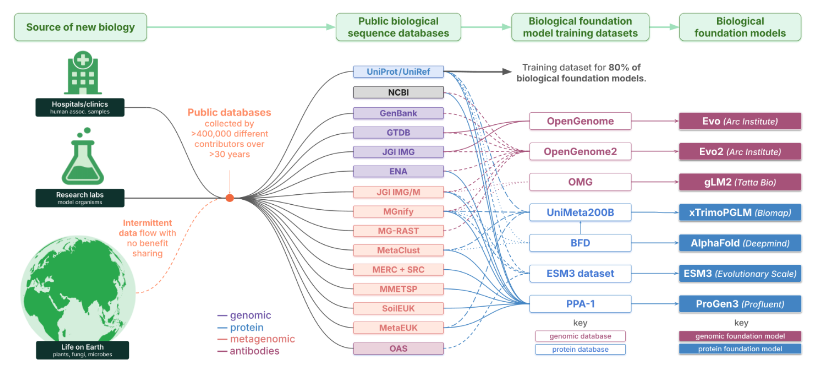
BioAI hit a data wall 🧱BaseData tries to shatter it 💥
9.8 B 🧬 protein sequences + >1 M 🦠 unseen species, gathered with enforceable benefit-sharing 🤝, expand known diversity >10× 🌍
Next-gen bio-FMs just got rocket fuel 🚀
BioAI hit a data wall 🧱BaseData tries to shatter it 💥
9.8 B 🧬 protein sequences + >1 M 🦠 unseen species, gathered with enforceable benefit-sharing 🤝, expand known diversity >10× 🌍
Next-gen bio-FMs just got rocket fuel 🚀
@wolfejosh@Osmo_Labs Reminds me of a Robin Williams film where he would "edit" a highlight reel from people's lifelong recordings to play it at their funeral
What if you had a world-class doctor in your pocket, 24/7, at no cost? That’s the promise of AI in healthcare, but mistakes can be catastrophic.
That's why OpenAI launched HealthBench, a new benchmark to test how well AI models handle real, complex medical conversations.
Here's what you need to know 👇