Inventor & builder in AI, medicine, minerals, finance, and energy. Vet, Ex–cyber warfare architect. Stewarding Capital via my family office. @mxtktoken founder
If godly people do not step forward to influence the trajectory of the nation, godless people WILL (and are).
Why Christians *should* vote in the midterm elections this week 👇
@Andrew_Moser Imagine 57!! You’d think that would be enough to end the socialist movement once and for all (at least for the next 75 years, until it pops up again)...
Voting Day!!
Muslims have a plan to make America a Muslim nation.
Marxists have a plan to make America a Marxist nation.
Secular Progressives have a plan to make America a Secular Progressive nation.
… but Christians seem to always have a plan to keep Christianity from further influencing our nation by discipling people into either:
1) Political apathy (“God is sovereign, back off”, “we don’t get political, just do evangelism”)
2) Political ambiguity (“Jesus isn’t a Republican or Democrat, neither Right nor Left” = primary application of gospel to culture)
If continued, this will have very predictable (and disastrous) results in coming years, and a few conversations with pastors in deep blue cities / states trying to build churches, pastor people, and raise Christian families will help you realize it.
I put in some trades. I agree; I don’t believe these prediction. Smart on @TheDemocrats for using it as free advertising. (But I’m going to take the free money 🤓)
I’ve been saying this for months. @WayneAllynRoot Wayne and I have been in the sports betting markets for a combined 80 years so we get this latest fake DEM scam. A $200k bet at 2:00 am shifts the market for Taralico +30 points. That’s like 2 days of tv ads in Dallas. If you bet $2MM on the Jets Sunday it won’t move the line a dime. This is a fraud to depress GOP votes like fake polls.
I’ve been saying this for months. @WayneAllynRoot Wayne and I have been in the sports betting markets for a combined 80 years so we get this latest fake DEM scam. A $200k bet at 2:00 am shifts the market for Taralico +30 points. That’s like 2 days of tv ads in Dallas. If you bet $2MM on the Jets Sunday it won’t move the line a dime. This is a fraud to depress GOP votes like fake polls.
So, basically, 500 million Europeans expect 300 million Americans to protect them from 120 million Russians who can’t even defeat 40 million Ukrainians while those 500 million Europeans don’t even realize they are being conquered by 2 billion Muslims who claim they are being persecuted by 8 million Israelis. Is that about right?
1
You know what I ❤️ about #crypto? When an issue happens, everyone circles the wagons. We help each other. When a bank gets hacked or has a run on it, it asks for public funds!! Plus, everyone seems happy when a bank crashes too. 🤷♂️ #CryptoCommunity#Web3#DeFi#Binance
AI just made every hidden vulnerability discoverable. Trust in closed, centralized systems will keep falling.
Open code plus cryptographic verification is the only model that gets stronger under that pressure.
Crypto wins!!
#AI#Crypto#Bitcoin#Web3#CyberSecurity#OpenSource
There is an absolute barrage of inference providers popping up that get to $1M/mo extremely quickly.
This is the rough economics of inference providers:
Even if you rent on-demand B300s at $8/GPU-hr, many open source models (GLM 5.3, Kimi K3, DeepSeek 4.1 Flash / Pro) can get you >$10-20/GPU-hr at reasonable throughputs (100tok/s). DeepInfer from DeepSeek directly shows they can get $38/GPU-hr on off-peak hours. Every chip / model has a different throughput / interactivity curve, but there is a lot of arbitrage between even high rental spot prices and token prices. New chips (Vera Rubins) also change this meaningfully. Your ability to be making gross margin relies on your utilization and how good your stack is.
Gateways like OpenRouter, Vercel and more help solve that problem by aggregating demand to you. May inference providers discount their tokens to get longer term commits too. I've even heard stories of selling back Chinese model tokens to Chinese labs!
One thorn in the economics of these players is that many Chinese open source model labs are now asking for rev share if you're at a certain scale, espp for pre-release access to their models for day 1 support. That further pushes the threshold to be in the money.
The barrier to entry seems low and falling. There are even stories of smaller ones who can "vibe code" a way to stand up OSS models on a cluster they rent. And as a result, we're seeing 10s of such companies pop up almost every week and immediately skyrocketing revenue at low-ish gross margin and raising rounds on the back of that.
Unsurprisingly, because the actual service provided seems commodity, this eventually drives up compute prices and drives down token prices. In theory, it would seem like neoclouds who have the lowest cost of compute and themselves have started inference businesses would win the race to the bottom (Crusoe Coreweave Nebius and GMI all have inference businesses), with larger players (Modal Fireworks Baseten) being second because they are well capitalized to make bigger compute commits cheaply and have demand (high utilization), but the reality is the pie is growing so quickly that even upstarts are absolutely crushing it and growing aggressively (inference dot net, DeepInfra, Wafer, Relace, Morph).
Strategies vary across the board: neoclouds want to serve inference, inference players want to be neoclouds and do higher margin reserved instances / post training, and some want to go heterogeneous hardware or creatively flexible compute constructs.
The risks are: do open source models continue to be competitive? Will their creators rent seek more? Will their shape change compute needs? How do different chips change economics? Who gets compute in a supply crunch?
Below is a aggressive sketch of how gross margin scales with utilization for various models / chip sets.
For now, there are many inference providers and they’re all ripping!
THREAD:
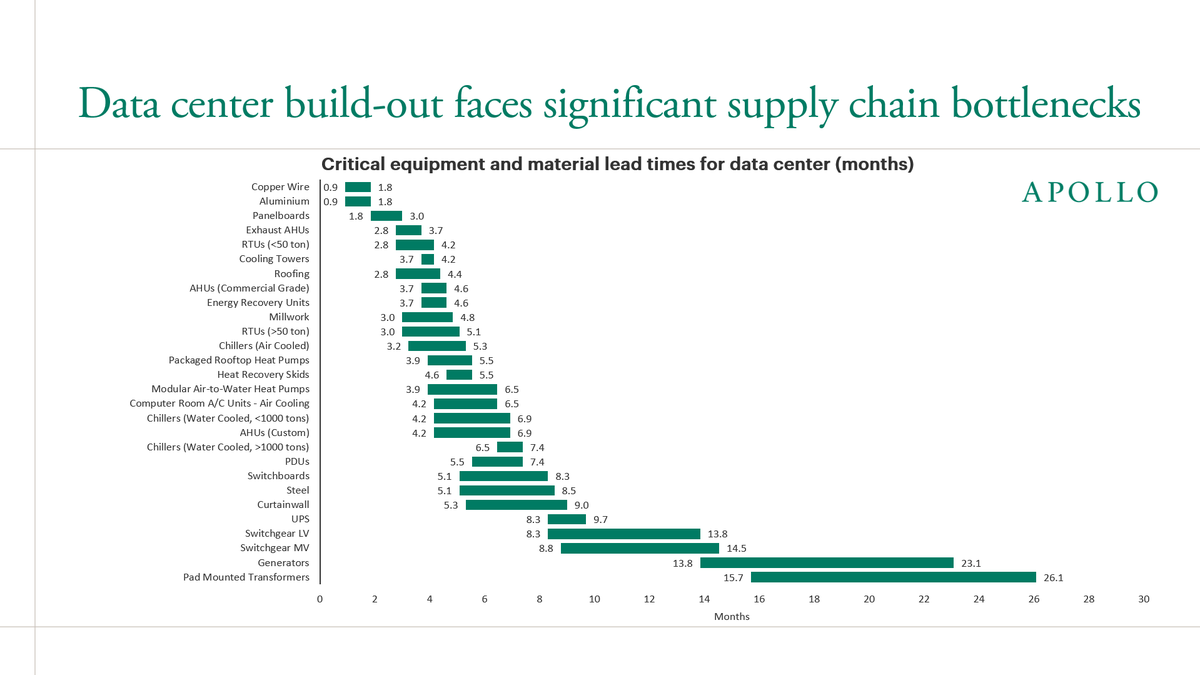
Apollo laid out the winners and losers if the data center buildout is delayed:
Winners:
1. Owners of operating data centers.
2. Hyperscalers with capacity already secured.
3. Holders of powered land and grid access.
4. Suppliers of long-lead equipment.
5. Power producers and on-site generation.
Losers
1. Hyperscalers’ growth and earnings.
2. AI labs, startups and enterprise buyers. They will face rationing, higher prices and slower model training, with smaller players crowded out first.
3. Developers and construction-stage investors. Cash flows start later while interest and carrying costs continue, lowering returns. Leveraged or pre-lease-dependent developers face covenant and refinancing stress.
4. Equity investors in the AI trade. Valuations that assume on-time delivery are exposed to earnings revisions and multiple compression.
5. The broader economy. Near-term GDP growth, which leans on AI investment, is lower, and the productivity gains from AI arrive later. Households and businesses on the same grid may also see higher electricity costs.
@prankash@immad@mercury level-funded makes sense as a bridge. The captive interest is specifically about retaining the float so we can invest it and let it compound to offset risk, rather than premiums disappearing forever into a carrier (plus more control on claims).