Two air forces started the Pacific war.
One trained its pilots, then kept them fighting until they died. The other trained its pilots, then often pulled many of its experienced combat pilots out to teach everyone else.
This is one of the reasons America won the Pacific air war, let's dive in..
Japan's Elite Aviators
At the start of the war, Japan had some of the finest fighter pilots in the world.
The aviators who attacked Pearl Harbor were elite. Many had hundreds of hours in the cockpit and real combat experience from the fighting in China. Flying the nimble A6M Zero, they cut through Allied opposition in the early months of the war and earned a fearsome reputation.
But Japan made a fateful choice about these men. It kept them in combat, more or less indefinitely. Japanese pilots flew mission after mission with no real system to rotate them home. They fought until they were shot down, crippled, or killed.
It seemed ruthless and efficient. In reality, it was a slow-motion disaster.
The Difference in Philosophy
Because every time Japan lost one of those veterans, everything he knew died with him.
America did the opposite. It regularly rotated many of its experienced combat pilots back home once they had done their share of fighting. There, they became instructors, pouring everything they had learned in real air combat directly into the next generation of pilots.
So the two systems pulled in opposite directions. Japan's pool of skill drained away with every ace it buried. America's pool of skill grew, as each returning veteran multiplied his knowledge across hundreds of students.
One nation was teaching. The other was simply dying.
The Training Gap
The gap became a chasm, and it was made worse by sheer scale.
By 1944, the United States was training around 8,000 new aviators every month, each of them getting well over a year of instruction and hundreds of hours in the air before they ever saw combat.
Japan could not come close. As its veterans vanished, its training program collapsed, and it was crippled by something else, too. Fuel. Japan was running so short of it that many trainees could barely fly enough hours to learn their trade. By the later part of the war, Japanese pilots were being rushed into battle with barely 100 hours of flying time, and sometimes far less. They were teenagers with almost no training, being sent up against American veterans who had been taught by the best combat pilots in the fleet.
The outcome was no longer a contest. It was a slaughter.
The Great Marianas Turkey Shoot
Nowhere was that clearer than in the skies over the Mariana Islands in June 1944.
When the Japanese launched hundreds of aircraft against the American fleet, they flew into a wall of Hellcat fighters, guided by radar and expert fighter direction that positioned the Americans at the perfect height and moment to strike. The green Japanese pilots in their now outdated Zeros never had a chance.
In and around that battle, Japan lost nearly 480 aircraft, while the Americans lost only a few dozen. It was so one-sided that the American aviators nicknamed it the Great Marianas Turkey Shoot.
Japan's naval air power, once the terror of the Pacific, was broken in a matter of days.
Better Aircraft, Better Technology
It was not only the pilots. It was the machines too.
America kept producing better and better aircraft, like the tough, heavily armed F6F Hellcat, designed after studying a captured Zero and built to beat it. It could take punishment, out-dive and out-gun its opponent, and it was forgiving enough that even a less experienced pilot could survive his first fights and become a veteran. Over the war, Hellcat pilots claimed more than 5,000 enemy aircraft for a tiny fraction of that in losses.
Japan, meanwhile, kept sending men up in the aging Zero, a plane that had been revolutionary in 1941 but was now underpowered, fragile, and outclassed. It was fast and agile, but a single burst of American fire could tear it apart, because it had traded armor and protection for maneuverability.
Better pilots, in better planes, backed by better technology. The advantages stacked on top of one another.
The Spiral Ends
By the end, Japan had reached the final, desperate stage of the spiral.
With almost no trained pilots left, and no way to make more in time, it turned to the kamikaze. A pilot did not need 500 hours of training to crash his aircraft into a ship. He only needed to take off, aim, and die. It was the last resort of an air force that had run out of the one thing it could never mass produce. Experienced men.
America won the Pacific air war for many reasons. Its factories out-built the enemy. Its radar and intelligence gave it eyes the Japanese lacked. Its aircraft grew deadlier every year.
But underneath all of it was something simpler. America treated its best pilots as a resource to be protected and passed on. Japan treated them as fuel to be burned. One of those choices built an air force that kept getting stronger. The other burned brightly, and then burned out.
This was why America won the Pacific air war.
I post a story like this every single day. Most people never see them. Follow so you don't miss the next one.
@Eurosport_ES@HBOMaxES@JavieRubioF1@SaldanaTomas Otro año más pagando para poder disfrutar la carrera sin anuncios y la aplicación un año más fallando y poniendo anuncios, pasan los años y siguen fallando las mismas cosas. Enhorabuena a @Eurosport_ES y especialmente al dueño de la aplicación @HBOMaxES.
Llegan las 24 horas de Le Mans.
Vamos con un HILO con fotos aéreas y stélite del circuito de Le Mans y algunos de sus cambios.
Y empecemos en 1923, año del estreno, con la horquilla de Pointleue en rojo, y en amarillo las rectas por donde se llegaba y salía.
Vamos con un HILO con la evolución del circuito de Mónaco con fotos aéreas y satélite.
Empecemos en 1920.
Vemos la plataforma de tiro al pichón, bajo la que pasará el túnel, pero no hay carreteras ni antes ni después. Es costa pura.
El circuito está a nueve años de crearse.
Liftoff of Starship V3, from the dunes right outside the pad.
This is the most insane shockwave action I have ever seen on video. Absolutely mad.
📽️ Me for @WeAreSpaceScout
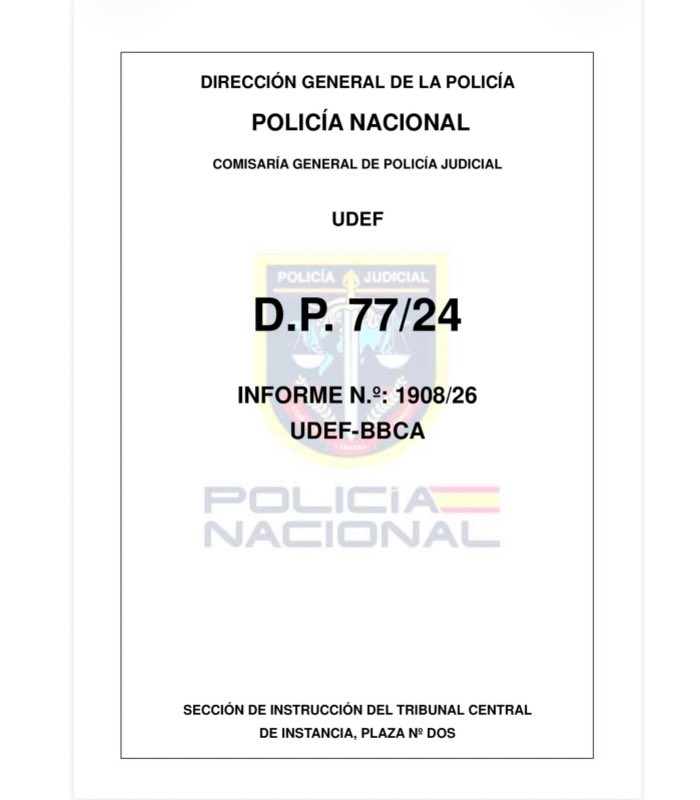
Ayer recibí los dos informes de la UDEF sobre Zapatero, como me imagino le ha pasado a media España.
He hecho como Rufián el otro día y apenas he dormido leyendo todo por aclararme.
Como los medios sacan noticia por noticia para ganar clicks… he decidido ordenar las ideas y hacer un hilo completo sobre el caso.
El informe 1907 (186 páginas) reconstruye la estructura: quién es quién en la red, qué sociedades controlan, por dónde se mueve el dinero, dónde acaba y qué papel juega cada implicado. Es la radiografía societaria y financiera.
El informe 1908 (158 páginas) reconstruye la cronología: ordena por fecha los mensajes de WhatsApp, correos electrónicos, llamadas y reuniones recuperados del móvil de Rodolfo Reyes y de los demás dispositivos intervenidos. Es el guion temporal del caso.
Uno te explica el cómo y el cuánto, el otro te explica el cuándo y el con quién.
Por eso, a lo largo del hilo, las capturas alternan entre los dos: cuando se cita un mensaje concreto (una frase, una hora, un día), la fuente es casi siempre el 1908; cuando se cita una conclusión policial, una titularidad societaria o un flujo de dinero, la fuente es el 1907.
Abrochaos los cinturones… que empezamos.🧵