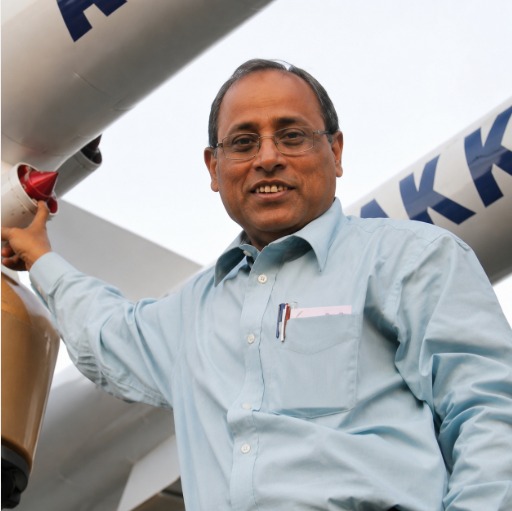
On May 8, 2025, as Pakistani drones and missiles were intercepted over Indian airspace during Operation Sindoor, a retired scientist watched the reports come in on television. "This is the happiest day of my life," said Dr. Prahlada Ramarao. He had spent 15 years building the weapon that was doing the intercepting.
The story begins in 1983 at DRDO's laboratory in Hyderabad, where Prahlada was a junior scientist working alongside Dr. APJ Abdul Kalam. India had just approved the Integrated Guided Missile Development Programme, charged with building five missile systems from scratch. Kalam chose Prahlada, still in his thirties, to lead Akash, the most complex of the five.
"I was young and scared about handling such a massive responsibility," Prahlada would later say. Kalam's instruction was simple: get it done.
The challenge was daunting. India needed a surface-to-air missile capable of engaging multiple fast-moving aircrafts simultaneously, each equipped with electronic warfare designed to defeat the radar tracking it. The Rajendra Radar, a Passive Electronically Scanned Array system, was Akash's eye and ear for every engagement. Prahlada coordinated 1,000 scientists across 12 laboratories, solving signal processing failures and electronic jamming in a phased array comprising roughly 4,000 discrete elements. Development took fifteen years from first principles to battlefield readiness.
The Rajendra can track up to 64 aerial targets and engage 12 of them concurrently. Akash's total development cost came in 8 to 10 times lower than comparable foreign systems. Countries including Armenia have since placed export orders. Prahlada received the Padma Shri in 2015, virtually unknown to the public he spent a career protecting.
More than four decades after Kalam handed him the project, his missile system went to war for India.
That is what indigenous defence technology looks like when it is given the time, the trust, and the people it deserves.
India's PCB Exports to China a Rare Success Story — Exports Surged Over 40-Fold to $1.5 bn in FY26
The Rare Reversal
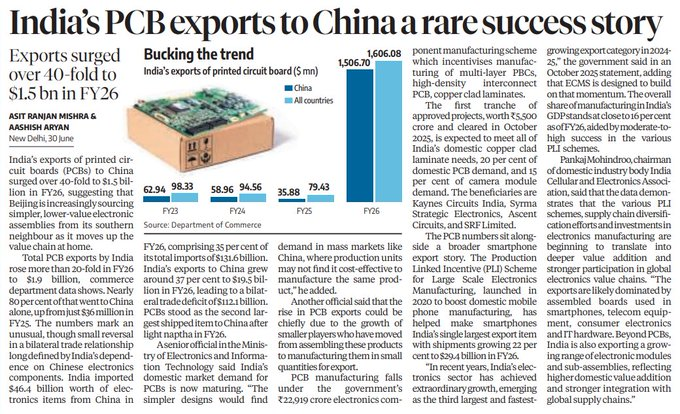
India's exports of printed circuit boards (PCBs) to China surged over 40-fold to $1.5 billion in FY26, suggesting Beijing is increasingly sourcing simpler, lower-value electronic assemblies from its southern neighbour as it moves up the value chain at home
Total PCB exports by India rose more than 20-fold in FY26 to $1.9 billion, per commerce department data
Nearly 80% of that went to China alone, up from just $36 million in FY25
The numbers mark an unusual, though small, reversal in a bilateral trade relationship long defined by India's dependence on Chinese electronics components
Bucking the Trend — PCB Export Numbers
FY23: Exports to China stood at $62.94 million, while exports to all countries totaled $98.33 million
FY24: Exports to China declined to $58.96 million, with total exports at $94.56 million
FY25: Exports to China fell further to $35.88 million, while total exports dropped to $79.43 million
FY26: Exports surged to $1,506.70 million to China, while total PCB exports jumped to $1,606.08 million
India-China Trade Context
India's exports to China grew around 37% in FY26, leading to a bilateral trade deficit of $112.1 billion
PCBs stood as the second largest shipped item to China after light naphtha in FY26
India imported $46.4 billion worth of electronics items from China in FY26, comprising 35% of its total imports of $131.6 billion
Why China is Buying India's PCBs
A senior official in the Ministry of Electronics and Information Technology: India's domestic market demand for PCBs is now maturing
"The simpler designs would find demand in mass markets like China, where production units may not find it cost-effective to manufacture the same product"
Another official said the rise in PCB exports could be chiefly due to the growth of smaller players who have moved from assembling these products to manufacturing them in small quantities for export
Government Schemes Driving the Push
PCB manufacturing falls under the government's ₹22,919 crore Electronics Component Manufacturing Scheme (ECMS), which incentivises manufacturing of:
Multi-layer PCBs
High-density interconnect PCBs
Copper clad laminates
First tranche of approved projects, worth ₹5,500 crore and cleared in October 2025, is expected to meet:
All of India's domestic copper clad laminate needs
20% of domestic PCB demand
15% of camera module demand
Beneficiaries: Kaynes Circuits India, Syrma Strategic Electronics, Ascent Circuits, and SRF Limited
Broader Electronics Story
PCB numbers sit alongside a broader smartphone export story
PLI Scheme for Large Scale Electronics Manufacturing (launched 2020) has helped make smartphones India's single largest export item, with shipments growing 22% to $29.4 billion in FY26
"In recent years, India's electronics sector has achieved extraordinary growth, emerging as the third largest and fastest-growing export category in 2024-25", the government said in an October 2025 statement
Overall share of manufacturing in India's GDP stands at close to 16% as of FY26, aided by moderate-to-high success in various PLI schemes
Industry View
Pankaj Mohindroo, Chairman, India Cellular and Electronics Association: data demonstrates that PLI schemes, supply chain diversification efforts, and investments in electronics manufacturing are beginning to translate into deeper value addition and stronger participation in global electronics value chains
"The exports are likely dominated by assembled boards used in smartphones, telecom equipment, consumer electronics and IT hardware. Beyond PCBs, India is also exporting a growing range of electronic modules and sub-assemblies, reflecting higher domestic value addition and stronger integration with global supply chains"
Core Theme:
India's 40-fold surge in PCB exports to China represents a remarkable, if nascent, reversal in the India-China electronics trade dynamic — as China moves up the value chain at home, India's lower-cost PCB manufacturing (enabled by PLI schemes, ECMS, and a growing ecosystem of smaller manufacturers) is finding a receptive market in Beijing; while this remains a small reversal in a $112 billion bilateral deficit, alongside India's $29.4 billion smartphone export story, it signals that India's electronics sector is beginning to participate meaningfully in global value chains beyond mere assembly — a structural shift that could deepen significantly as ECMS projects ramp up and domestic PCB manufacturing capacity scales.
AI is moving from "being built" to "being used." 2026 is the turning point where running AI (inference) overtakes building AI (training). Translation: the technology is now generating real economic activity.
@LearningEleven I dont understand why this report is painting a lower bottomline cagr compared to its 45% revenue guidance. The Hobel acquisition is a debt free , high ebitda ~50% business running at lower utilization levels currently and it will be PAT accretive when utilization picksup
The West poured $50 billion into fast breeder nuclear reactors and abandoned every single one. India poured $900 million and just achieved criticality on the first commercially viable one outside Russia.
The US spent $15 billion. Gave up. Japan spent $12 billion. Their Monju prototype had one sodium fire in 1995 and never recovered. The UK spent $8 billion. Germany spent $6 billion. France, Italy, all walked away. Six of the richest nations on Earth concluded this technology was too hard and too expensive to pursue.
India started building in 2004 with an initial budget of $420 million. Twenty-two years, a dozen missed deadlines, and a cost doubling later, the Prototype Fast Breeder Reactor at Kalpakkam just sustained a controlled fission chain reaction. The reactor is now alive.
The reason India never quit is a constraint most people have never thought about. India has only 1-2% of the world's uranium reserves. For a country of 1.4 billion people trying to build energy independence, that's a death sentence if you're running conventional nuclear.
But India has 25% of the world's thorium. The single largest national reserve on Earth.
The problem: you can't just burn thorium the way you burn uranium. A physicist named Homi Bhabha designed a three-stage nuclear program in the 1950s specifically to solve this. Stage 1: burn natural uranium in heavy water reactors, collect plutonium as a byproduct. Stage 2: feed that plutonium into fast breeder reactors, where it breeds MORE plutonium AND converts thorium into fissile uranium-233. Stage 3: burn thorium directly at scale.
India just entered Stage 2. Seventy years after Bhabha drew it up on paper.
The math on the thorium endgame is wild. At current energy consumption rates, India's thorium reserves could power the country for over 700 years. Most nuclear nations are playing a uranium game with maybe 80-100 years of runway. India is playing a completely different game with a 7x longer fuel supply.
The West quit because uranium stayed cheap and sodium coolant is terrifying. It catches fire on contact with air. It explodes on contact with water. Russia's BN-600 had 27 sodium leaks and 14 sodium fires between 1980 and 1997. And Russia kept going anyway because Russia doesn't quit nuclear projects. India watched all of that and kept going too.
When you have 1% of the uranium but 25% of the thorium, the engineering difficulty stops being a reason to quit. It becomes the price of admission to a 700-year energy supply that nobody else can access.
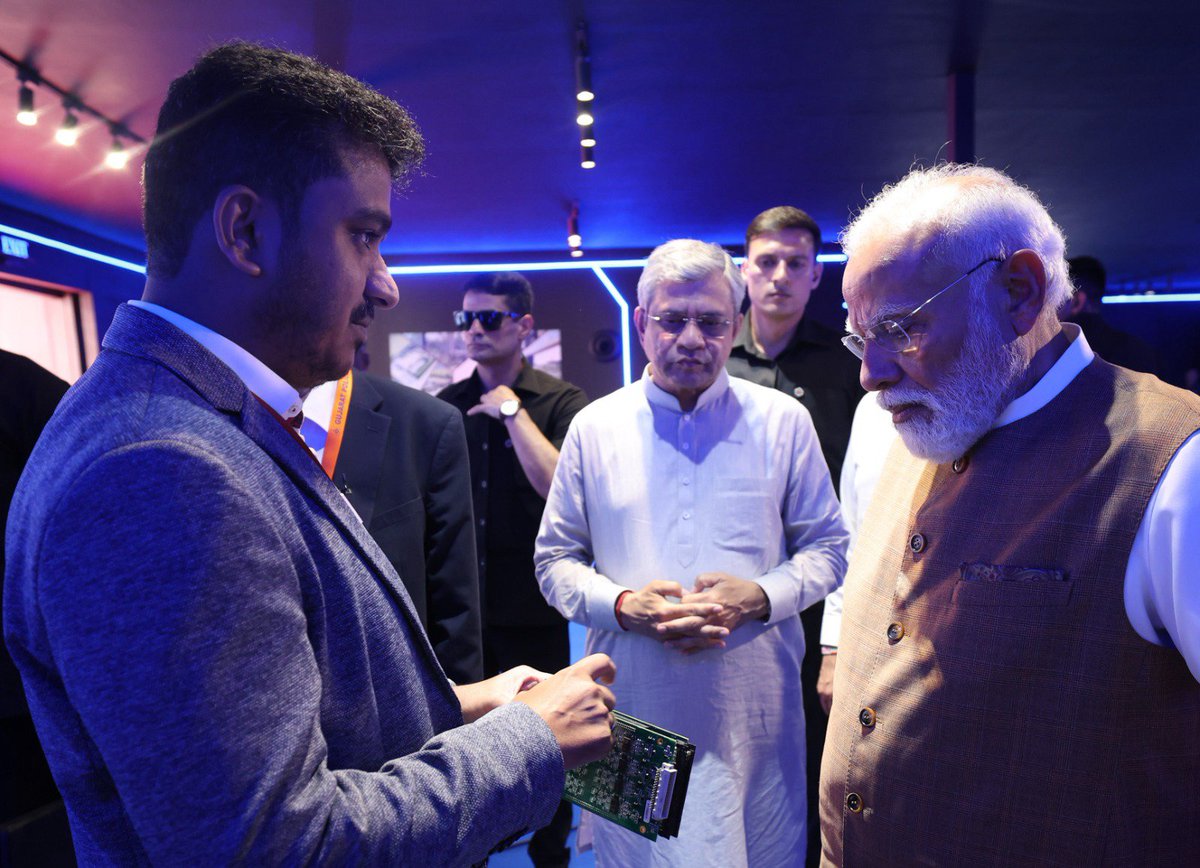
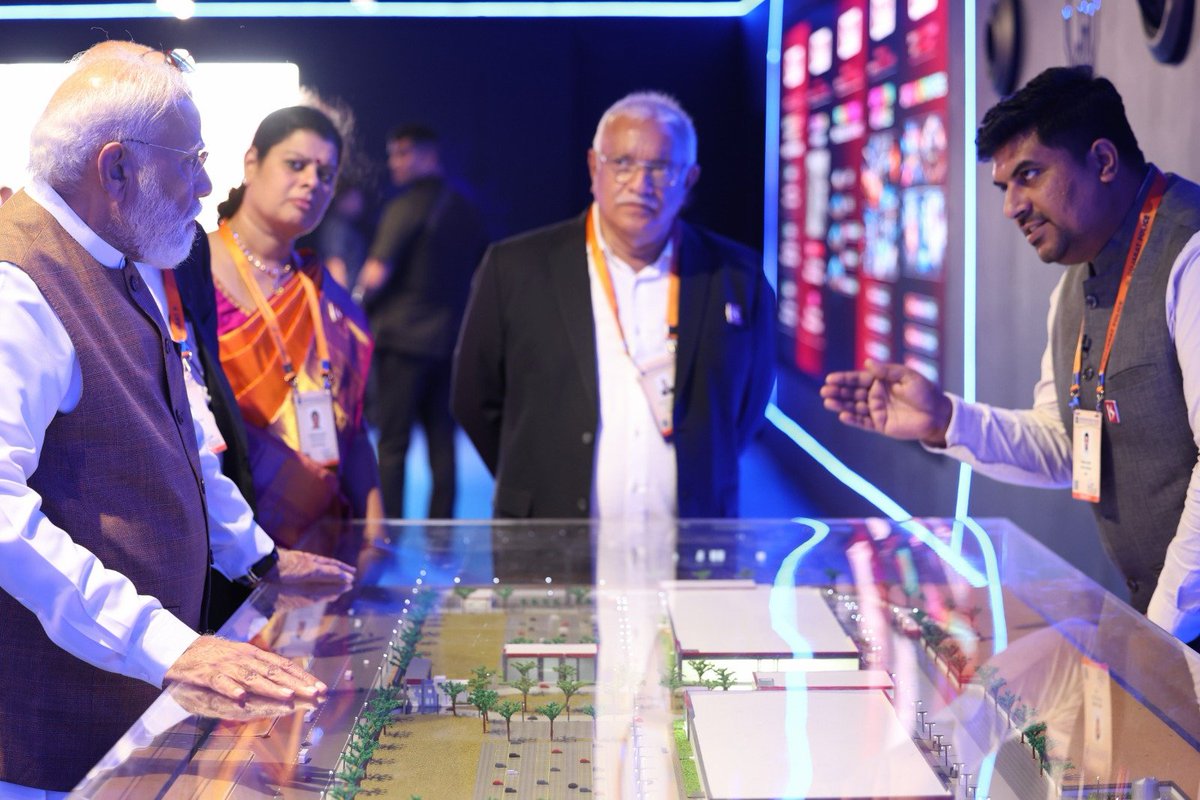
It is indeed a proud moment for India’s Semiconductor ecosystem that the Kaynes Semicon OSAT facility has been inaugurated in Sanand, Gujarat. This will boost India’s efforts of emerging as a leader in futuristic technologies and innovation.
@Ajaya_buddy Good now that family offices start investing back into their businesses. Instead of PE rerating due to excess liquidity now we can see funds getting deployed to increase earnings
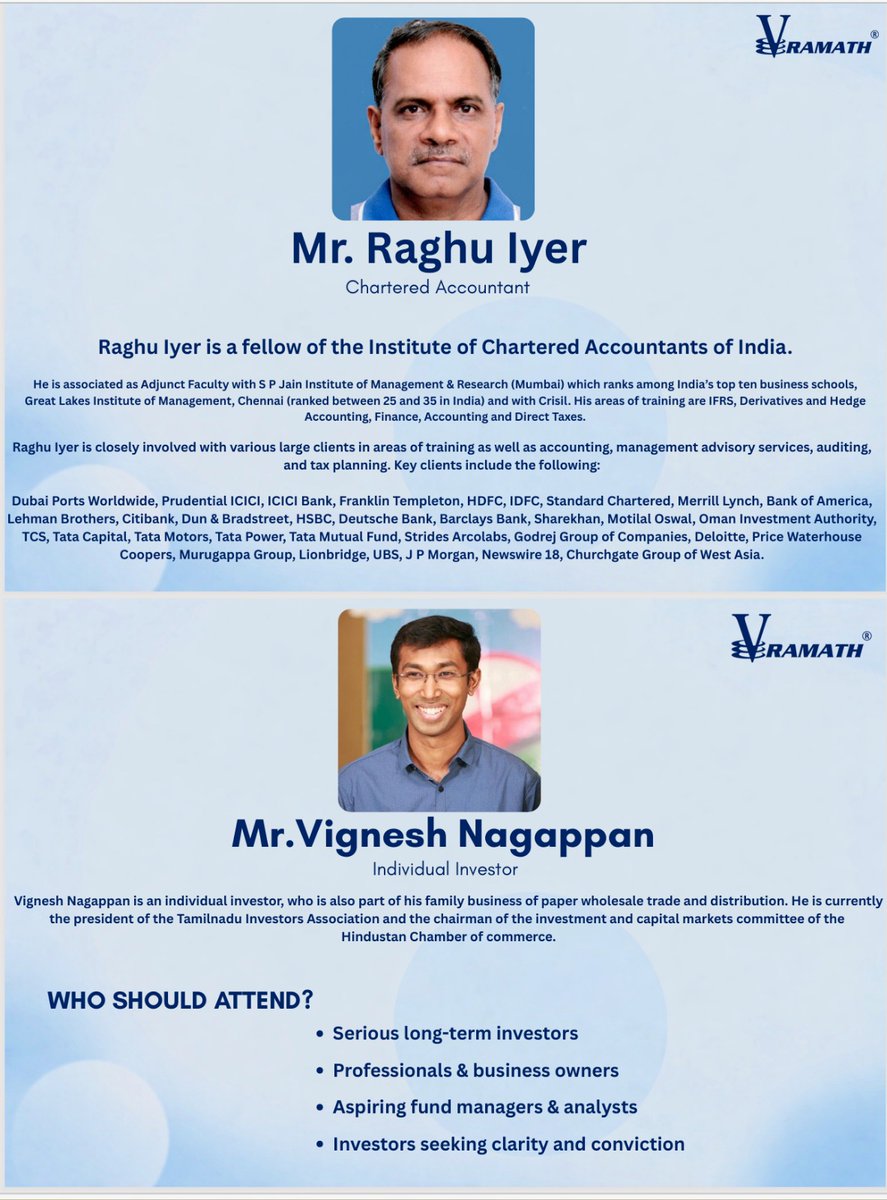
Full day Equity Investing workshop based on Fundamentals happening at Coimbatore, organized by @VRAMATH
Pls do check it out and share with interested participants
I was thinking that we were missing Rakesh Jhunjhunwala to come on media and give a broader and experienced view on markets during difficult phases and thankfully landed upon this interview @chokhani_manish@jakesprime filling big shoes !!
https://t.co/WNFxERwR09