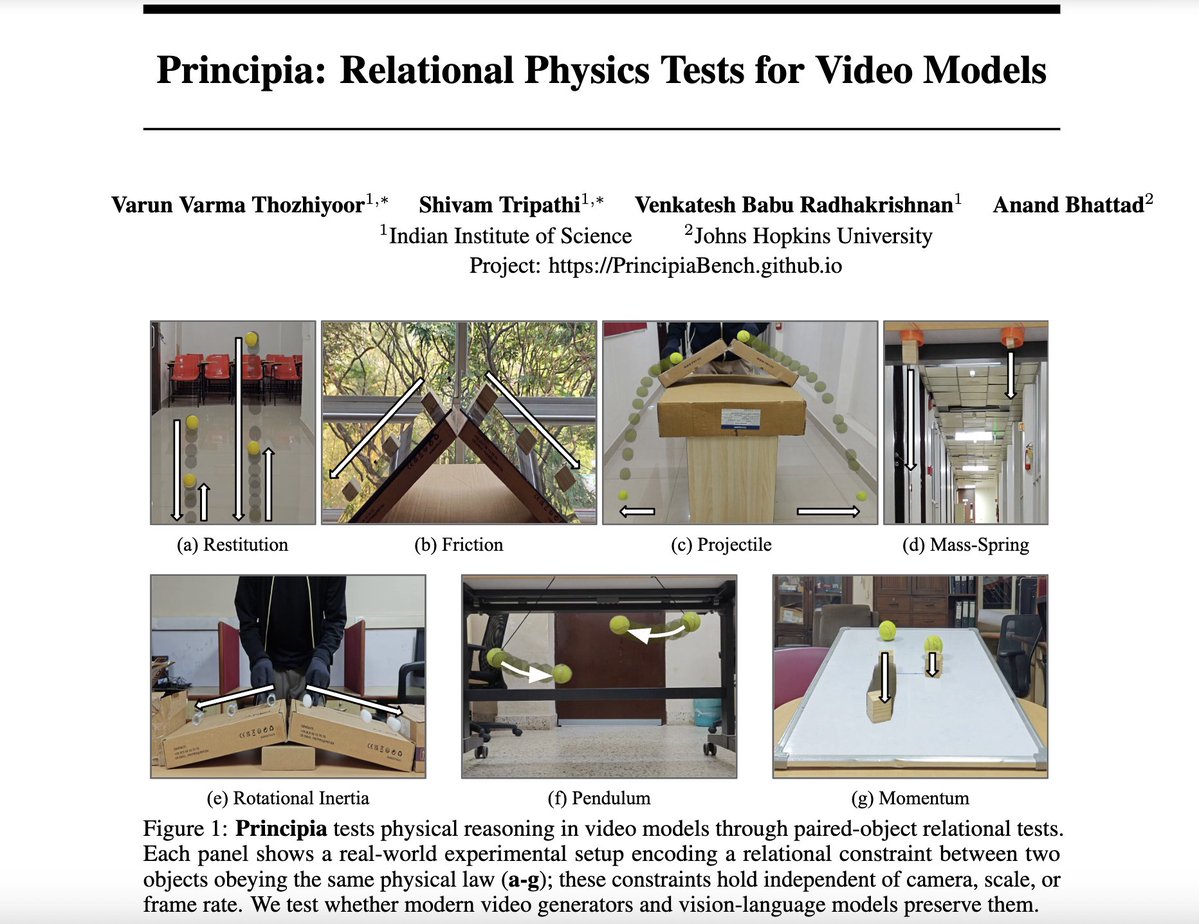
[1/5] For a video model to truly understand physics, it must capture the dependencies between physical quantities that govern the real world.
For example, does a model understand how a pendulum’s time period depends on its length?
We introduce Principia to test this.
Principia will appear at #NeurIPS2026 with three 5s, though it wasn’t selected for a Spotlight or Oral. Reminds me of “Shadows Don’t Lie and Lines Can’t Bend” at #CVPR2024, which had similar faith; still one of my favorite papers.
I would have loved to see the students get that recognition. Still very proud of this work and the effort that went into it.
Huge congrats to @varunvarmat and @shivam_tr! Collecting this dataset required a great deal of patience: setting up calibrated experiments, checking physical properties, and even machining components to ensure they are comparable. It’s hard to convey how much work goes into getting these details right.
With Principia, we are asking a simple question: if a video generator has better physics, can we show it in simple, controlled settings? Relative evaluation with objective metrics gives us a way to test those claims. I’d love to see future models evaluated this way.
@arena, would you be interested in helping us set this up for future video generators?
1/ What do video models know about high school physics? Less than you'd think.
Led by @varunvarmat and @shivam_tr with @rvbabuiisc, we built Principia: relational physics tests for video models. Eight laws, 500+ real scenes, one simple idea.
https://t.co/oWmEQ06fYx
paper: https://t.co/ewIZmH8wtO
Principia: Relational Physics Tests for Video Models
TL;DR: A benchmark for testing whether video models obey physics via relational invariants between objects. Despite strong visual scores (~0.8 VBench), leading generators score ≤0.42 on physical consistency.
https://t.co/c8TddKcqi2
[1/5] For a video model to truly understand physics, it must capture the dependencies between physical quantities that govern the real world.
For example, does a model understand how a pendulum’s time period depends on its length?
We introduce Principia to test this.
[4/5] We also test VLMs on their ability to detect "relational" physics errors, using videos with correct and incorrect physical behavior - and find they struggle to reliably distinguish the two.
📣Thrilled that "Rethinking Dataset Distillation: Hard Truths about Soft Labels" is a Best Paper Finalist @CVPR (Top 15 out of 16,000+ submissions)! 🏆
Congrats to the authors! 🥳🙌🏻
Join us today:
🎙️ Oral: 10:15 @ Mile High Ballroom 1A-2A
📍Poster 18 @ ExHall A
“Objects in Generated Videos Are Slower Than They Appear: Models Suffer Sub-Earth Gravity and Don’t Know Galileo’s Principle...For Now” by @anand_bhattad, @varunvarmat, @shivam_tr, & more investigates video generators’ representation of gravity: https://t.co/tE7Fi4LQbS (3/7)
An unsolicited guide to being a researcher: super instructive slides by @EugeneVinitsky https://t.co/sclj1rY930
- different goals of a PhD student
- how to be a good collaborator
- how to keep up with literature
- tracking your ideas & experiments
- stress & productivity
Excited to share that 5 papers (4 main & 1 findings) from the @val_iisc@iiscbangalore have been accepted at @CVPR 2026! 🎉 Our team continues to push boundaries in GenAI, 3D vision, and efficient learning. Check out our accepted works below! 👇🧵 #CVPR2026#GenAI#IISc
[1/3] Two balls, a basketball and a tennis ball, are dropped from the same height, side by side. Assuming no air resistance, which hits the ground first?
The answer is neither: they strike the ground simultaneously. Galileo demonstrated this principle over 400 years ago, and it remains one of the most fundamental predictions of Newtonian mechanics.
Continuing our theme of what generative models know (and don't) about the physical world -- and building on our #CVPR2024 work exposing failures in projective geometry -- we now revisit Galileo’s equivalence principle.
Super excited to share our latest work!