NotebookLM es una de las herramientas de IA más potentes (y subestimadas) para lo que buscan aprender, para docentes e investigadores
Transforma PDFs, apuntes, artículos o transcripciones en conocimiento accionable en cuestión de minutos
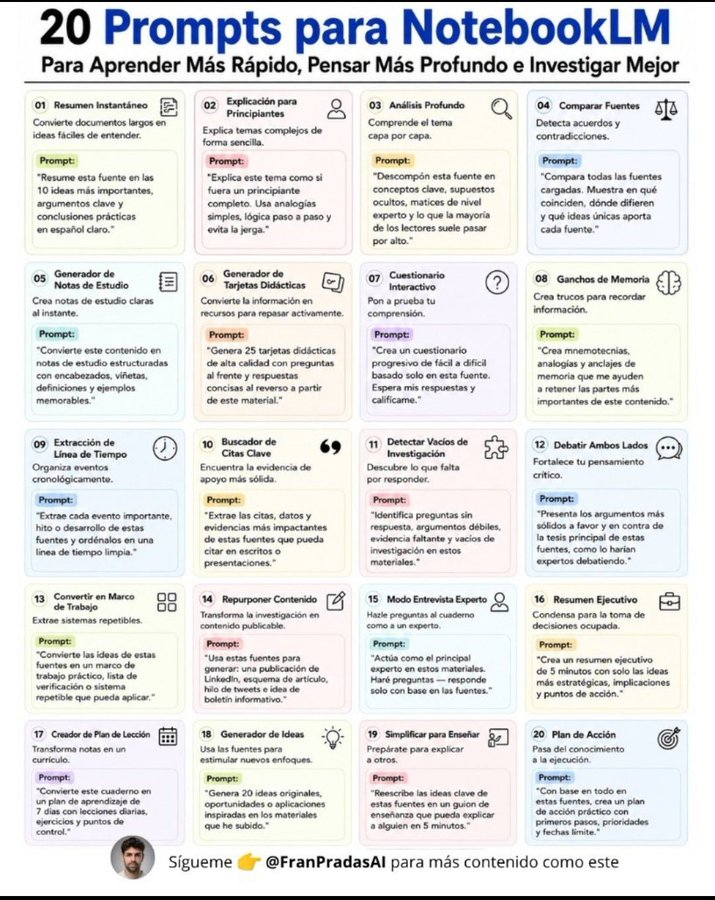
“Loop engineering” is a hot buzzphrase after mentions of it by Boris Cherny (Claude Code’s creator) and Peter Steinberger (OpenClaw's creator) went viral on social media. Loops are now a key part of how we get AI agents to iterate at length to build software. In this letter, I’d like to share my 3 key loops, shown in the image below, for building 0-to-1 products. These loops guide not just how I build software, but also how I decide what software to build.
Agentic coding loop: Given a product specification and optionally a set of evals (that is, a dataset against which to measure performance), we can have an AI agent write code, test its work, and keep iterating until the code is bug-free and meets its specification. This idea of closing the loop took off around the end of last year, and it has been a game changer in enabling coding agents to work longer productively without human intervention. For example, over the weekend, I was building an app for my daughter to practice typing, and my coding agent could easily work for around an hour, using a web browser to check what it had built multiple times before getting back to me, without needing my intervention.
The engineering loop executes quickly. Every few minutes, the coding agent might build and test a new version of the software. I hear frequently from developers who are finding new ways to engineer more effective engineering loops. This is an active area of invention!
Developer feedback loop: In this loop, a developer examines the current product and steers the coding agent to improve it. Last year, a lot of developers (including me) were acting as the QA (quality assurance) function for our coding agents, manually finding bugs and then asking the agent to fix them. But with coding agents much more able to test their own code, the amount of time we need to spend on this function has decreased significantly. This allows us to make higher-level product decisions, such as what key features to offer, where the UI needs improvement, and so on.
The developer-feedback loop operates over time intervals between tens of minutes and hours — that's how frequently a developer might review a product and give feedback. In the case of the typing app, I changed my mind a few times about the visual design, what cat costumes she can unlock as she learns (she loves cats), and the user flow for a grown-up to log in and steer the child's learning experience.
When a developer has a clear vision for what to build, it is still a lot of work to translate that vision into a specification for a coding agent to implement. Further, after the developer has seen an implementation, they might update (or perhaps clarify) the spec to steer it toward what they want. If you find that the system repeatedly runs into certain problems, building a set of evals for the agent becomes useful.
AI-native teams are increasingly using AI to help shape product direction, for example, automating the gathering and analysis of usage data, summarizing written and verbal customer feedback, or carrying out competitive analysis. However, for pretty much all the products I’m involved in, I see humans as having a significant context advantage over current AI systems — we know a lot more than the AI system about the users and the context the product has to operate in — and thus humans play a critical role. Many people describe this human contribution as “taste,” but I prefer to think of it as humans having a context advantage, since that gives us a clearer path to helping AI systems get better. This also speaks to why this step can’t be automated: So long as the human knows something the AI does not, human-in-the-loop is needed to to inject that knowledge into the system.
External feedback loop: This includes a wide range of tactics like asking a few friends for feedback, launching to alpha testers, or putting the code into production with A/B testing. These tactics are usually slow, rarely taking less than hours and sometimes taking days or even weeks. This data informs the developer vision, which in turn continues to drive the detailed product spec, which in turn drives the coding agent.
With coding agents speeding up software development, more engineers are starting to play a partial product management role. For many engineers who are growing into this role, the hardest part is shaping the product vision and striking a balance between building (bridging the gap between vision and spec) and getting user feedback to evolve the vision. It is important to do both!
I will write more about how to do this in future posts, but for now, I find it encouraging that engineers are playing an expanded role (just as product managers and designers now do more engineering).
[Original text: The Batch]
The fastest way to change your life is to rip yourself out of your (physical and digital) environment. Change everything overnight. The places you go, the accounts you follow, the info you consume, etc. It's difficult but it absolutely works.
Anthropic acaba de publicar 24 conferencias gratuitas sobre Claude Code.
11 horas y 32 minutos de formación gratuita (enlaces abajo):
01 · Keynote de apertura → https://t.co/HtFIjMhNB8
02 · Más allá de lo básico → https://t.co/KWXlC6Fwaq
03 · Ingeniería nativa de IA → https://t.co/qXPNzcpRqK
04 · Más novedades de la plataforma → https://t.co/I97YMkefKP
05 · Guía práctica de prompting → https://t.co/YpOlDVjfje
06 · Curva de capacidades → https://t.co/Z94APNS9EH
07 · Del prompt a producción → https://t.co/LCeOr9P5c6
08 · Construcción en Google Cloud → https://t.co/6PaT2bDFB1
09 · Caso de estudio de Man Group → https://t.co/fAfv9Sn0hQ
10 · Cómo elegir el modelo adecuado → https://t.co/rztRNAsniN
11 · Memoria para agentes → https://t.co/7HdH4RNAOC
12 · Agentes legales → https://t.co/tjIXz61oHx
13 · Llegar a producción más rápido → https://t.co/1nPSkqotld
14 · Agente listo para producción → https://t.co/8PiJQZotGi
15 · La palanca del razonamiento → https://t.co/LWBZXYj8Uu
16 · Lovable a gran escala → https://t.co/OMABpiwaI7
17 · Tres unicornios → https://t.co/zUS1duJWuN
18 · Escalando Base44 → https://t.co/iFZNzWcBtM
19 · Agentes proactivos → https://t.co/DLi3zdw8Sj
20 · Claude en Foundry → https://t.co/LTgW8sunFK
21 · Caso de estudio de Spotify → https://t.co/uW0u56KUcx
22 · Claude en AWS → https://t.co/o5xHjmphg4
23 · Deja de supervisar agentes constantemente → https://t.co/yvrHSRJe6t
24 · Novedades → https://t.co/4vgMK1BEBU
As a result of a US government directive, we are suspending access to Claude Fable 5 for all users. You can continue to use all other Claude models.
Here’s what this means for you:
Across Claude products, new sessions will run on your selected default model or Opus 4.8, and existing Fable 5 sessions will end with an error.
On the Claude Platform, requests to Fable 5 will also return an error. Please update your integrations to other Claude models.
We know this is a disruption to your workflows; we appreciate your patience and support.
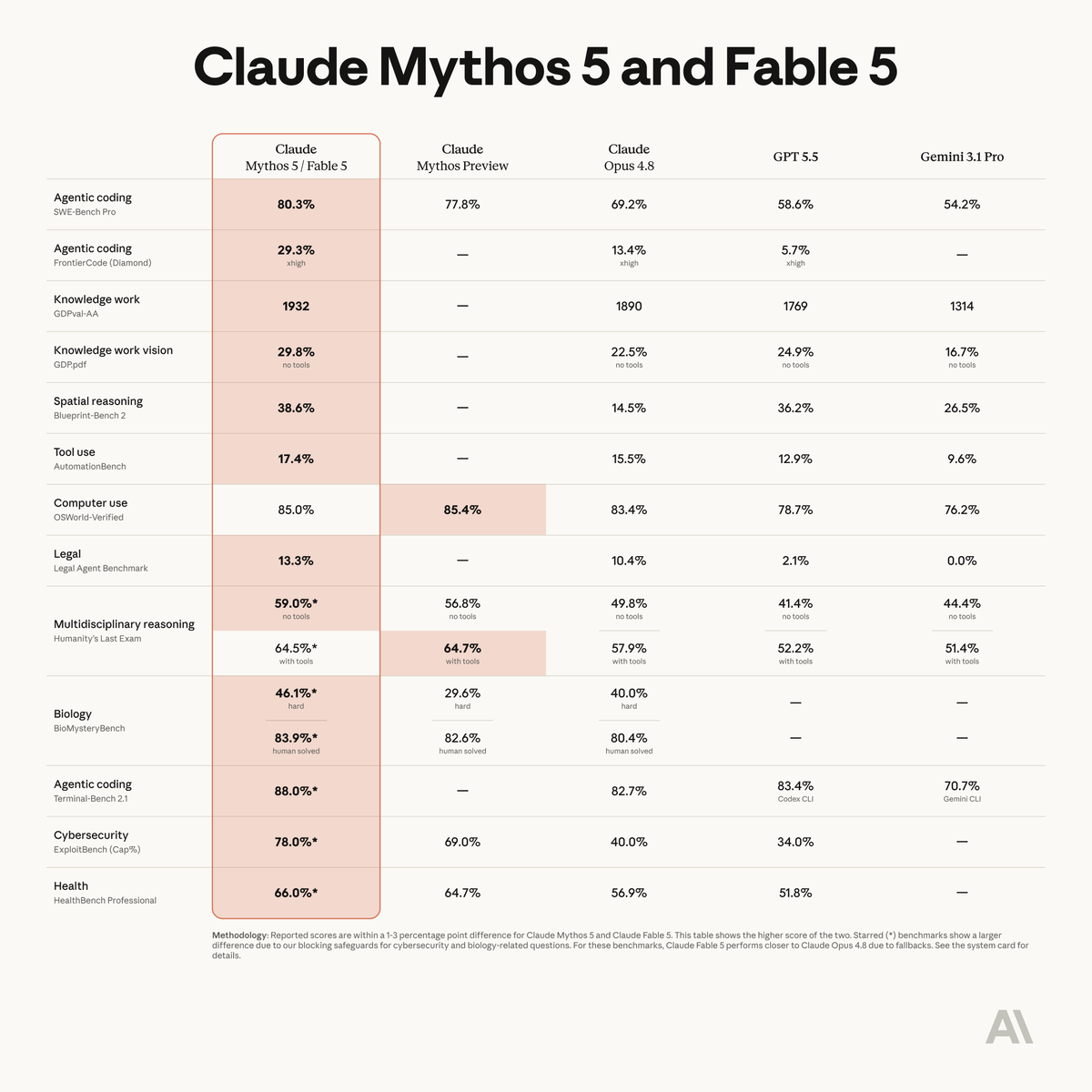
Fable 5 is state-of-the-art on nearly all tested benchmarks, with exceptional performance in software engineering, knowledge work, scientific research, and vision.
The longer and more complex the task, the larger Fable 5’s lead over our other models.
Ingeniero de anthropic:
“No se trata de que tú le hagas prompt a Claude, se trata de que construyas un sistema que se haga prompt a sí mismo.”
Este es, sin duda, uno de los workflows más potentes que he visto en mucho tiempo.
En el video desmonta exactamente cómo la mayoría está usando Claude mal:
- El 14% que pierdes en CLAUDE.md antes de escribir una sola palabra
- Los plugins que el 95% de la gente ni siquiera ha instalado
- El setup de caching que mantiene un 95% de hit rate y lo hace casi gratis
- Por qué empezar cada chat desde cero es la forma más lenta de usar Claude
Si llevas más de un mes usando Claude y nunca has salido de la ventana de chat, estás usando un solo proyecto cuando podrías estar dirigiendo un equipo entero de ellos.
En vez de ver otro capítulo de una serie, mira esto.
Guárdalo ya, antes de que se pierda en el feed.
Code with Claude, our developer conference, returns next week.
Whether you're just getting started with Claude Code or you've been building for a while, there's a session for you.
Register for the livestream: https://t.co/GJwOPMDLEC
el ingeniero que construyó Claude Code acaba de publicar un video de 28 minutos sobre cómo escribir prompts que realmente funcionan
he visto cursos de 300$ que no cubren lo que él muestra en los primeros 10 minutos
archivos CLAUDE.md, atajos de memoria, sesiones paralelas, patrones de prompting
todo en un video y completamente gratis
funciona seas desarrollador, principiante o alguien que lleva meses usando Claude
''NVDIA'':
Porque sacó la LapTop de todos los tiempos: Un solo chip de RTX 5070 + 128 GB de memoria unificada + 1 petaflop de potencia. Lo realmente enfermo es que tu IA personal ahora vive adentro de la máquina. Cero nube, cero internet, 100% local 24/7
¿La conoces?
Se llama Tina Huang y es creadora de contenido tecnológico y ex científica de datos de Meta.
Este vídeo de 22 minutos (lo he subtitulado al español) es uno de los MEJORES TUTORIALES de Claude Cowork que puedes ver actualmente.
Explica paso a paso cómo dominar el agente de escritorio de Anthropic para automatizar tareas directamente en tu ordenador.
Estructura y contenido del vídeo:
- Configuración de Cowork: Cómo descargar la aplicación de escritorio (Windows/Mac), vincular tu cuenta y seleccionar una carpeta local compartida para darle contexto al agente.
- Nivel Principiante: Automatizaciones iniciales básicas, como pedirle que organice tu caótica carpeta de descargas, renombre archivos o mueva documentos automáticamente.
- Nivel Intermedio: Uso en profundidad de habilidades (skills), conectores y la ejecución de tareas complejas en paralelo.
- Tareas programadas: Cómo dejar flujos de trabajo programados para que se ejecuten de forma autónoma en tu dispositivo.
- Nivel Avanzado: Creación de proyectos específicos acotados con archivos context md o memory md para mantener un contexto continuo en flujos largos.
- Flujo de trabajo superavanzado: Demostración de un ecosistema digital conectado de extremo a extremo.
This works really well btw, at the end of your query ask your LLM to "structure your response as HTML", then view the generated file in your browser. I've also had some success asking the LLM to present its output as slideshows, etc.
More generally, imo audio is the human-preferred input to AIs but vision (images/animations/video) is the preferred output from them. Around a ~third of our brains are a massively parallel processor dedicated to vision, it is the 10-lane superhighway of information into brain. As AI improves, I think we'll see a progression that takes advantage:
1) raw text (hard/effortful to read)
2) markdown (bold, italic, headings, tables, a bit easier on the eyes) <-- current default
3) HTML (still procedural with underlying code, but a lot more flexibility on the graphics, layout, even interactivity) <-- early but forming new good default
...4,5,6,...
n) interactive neural videos/simulations
Imo the extrapolation (though the technology doesn't exist just yet) ends in some kind of interactive videos generated directly by a diffusion neural net. Many open questions as to how exact/procedural "Software 1.0" artifacts (e.g. interactive simulations) may be woven together with neural artifacts (diffusion grids), but generally something in the direction of the recently viral https://t.co/z21CP5iQfu
There are also improvements necessary and pending at the input. Audio nor text nor video alone are not enough, e.g. I feel a need to point/gesture to things on the screen, similar to all the things you would do with a person physically next to you and your computer screen.
TLDR The input/output mind meld between humans and AIs is ongoing and there is a lot of work to do and significant progress to be made, way before jumping all the way into neuralink-esque BCIs and all that. For what's worth exploring at the current stage, hot tip try ask for HTML.
Ya está disponible la certificación Claude Certified Architect de @AnthropicAI!
Si trabajas con IA y quieres validar tu expertise construyendo con Claude, ahora puedes registrarte, aprender y obtener tu certificación.
Regístrate aquí 👉 https://t.co/RY8EHuP0i8
#Claude#AI #CertifiedArchitect #Anthropic
Claude puede viajar 6 meses al futuro y explicarte exactamente por qué tu próximo proyecto va a fracasar.
Existe una técnica llamada "premortem" que obliga a la IA a dejar de ser optimista y empezar a detectar riesgos, errores y puntos débiles.
El resultado es muy útil para tomar mejores decisiones antes de perder semanas o meses de trabajo.
Te dejo la skill en comentarios 👇


![AndrewYNg's tweet photo. “Loop engineering” is a hot buzzphrase after mentions of it by Boris Cherny (Claude Code’s creator) and Peter Steinberger (OpenClaw's creator) went viral on social media. Loops are now a key part of how we get AI agents to iterate at length to build software. In this letter, I’d like to share my 3 key loops, shown in the image below, for building 0-to-1 products. These loops guide not just how I build software, but also how I decide what software to build.
Agentic coding loop: Given a product specification and optionally a set of evals (that is, a dataset against which to measure performance), we can have an AI agent write code, test its work, and keep iterating until the code is bug-free and meets its specification. This idea of closing the loop took off around the end of last year, and it has been a game changer in enabling coding agents to work longer productively without human intervention. For example, over the weekend, I was building an app for my daughter to practice typing, and my coding agent could easily work for around an hour, using a web browser to check what it had built multiple times before getting back to me, without needing my intervention.
The engineering loop executes quickly. Every few minutes, the coding agent might build and test a new version of the software. I hear frequently from developers who are finding new ways to engineer more effective engineering loops. This is an active area of invention!
Developer feedback loop: In this loop, a developer examines the current product and steers the coding agent to improve it. Last year, a lot of developers (including me) were acting as the QA (quality assurance) function for our coding agents, manually finding bugs and then asking the agent to fix them. But with coding agents much more able to test their own code, the amount of time we need to spend on this function has decreased significantly. This allows us to make higher-level product decisions, such as what key features to offer, where the UI needs improvement, and so on.
The developer-feedback loop operates over time intervals between tens of minutes and hours — that's how frequently a developer might review a product and give feedback. In the case of the typing app, I changed my mind a few times about the visual design, what cat costumes she can unlock as she learns (she loves cats), and the user flow for a grown-up to log in and steer the child's learning experience.
When a developer has a clear vision for what to build, it is still a lot of work to translate that vision into a specification for a coding agent to implement. Further, after the developer has seen an implementation, they might update (or perhaps clarify) the spec to steer it toward what they want. If you find that the system repeatedly runs into certain problems, building a set of evals for the agent becomes useful.
AI-native teams are increasingly using AI to help shape product direction, for example, automating the gathering and analysis of usage data, summarizing written and verbal customer feedback, or carrying out competitive analysis. However, for pretty much all the products I’m involved in, I see humans as having a significant context advantage over current AI systems — we know a lot more than the AI system about the users and the context the product has to operate in — and thus humans play a critical role. Many people describe this human contribution as “taste,” but I prefer to think of it as humans having a context advantage, since that gives us a clearer path to helping AI systems get better. This also speaks to why this step can’t be automated: So long as the human knows something the AI does not, human-in-the-loop is needed to to inject that knowledge into the system.
External feedback loop: This includes a wide range of tactics like asking a few friends for feedback, launching to alpha testers, or putting the code into production with A/B testing. These tactics are usually slow, rarely taking less than hours and sometimes taking days or even weeks. This data informs the developer vision, which in turn continues to drive the detailed product spec, which in turn drives the coding agent.
With coding agents speeding up software development, more engineers are starting to play a partial product management role. For many engineers who are growing into this role, the hardest part is shaping the product vision and striking a balance between building (bridging the gap between vision and spec) and getting user feedback to evolve the vision. It is important to do both!
I will write more about how to do this in future posts, but for now, I find it encouraging that engineers are playing an expanded role (just as product managers and designers now do more engineering).
[Original text: The Batch]](https://pbs.twimg.com/media/HMEtxp3bsAARJdi.jpg)