🦔UC Berkeley's computer science department just posted its worst failure rates in years. 35.3% of CS 10 students got F's in spring 2026, up from under 10% in prior semesters. Professor Dan Garcia says the primary driver is a "vast increase in academic dishonesty" through LLMs. Students use AI to complete assignments, never learn the material, then fail exams. His office hours, once full, are now empty.
My Take
Companies are firing experienced engineers while the pipeline that produces new ones is being gutted by the same technology. Students use AI to bypass the hard part of learning, show up to exams without the understanding, and fail. One professor discovered a student's linear algebra class had an "open AI" policy for homework and exams. That student then couldn't do basic linear algebra in the next course.
Both ends of the workforce are eroding at the same time. Senior engineers are getting cut to fund AI spending. Junior engineers are graduating without the skills because AI did their coursework. And the companies spending trillions on these tools haven't connected those two facts yet.
Hedgie🤗
Cheers, chills, and a standing ovation when RASolute 302 showed unprecedented survival on daraxonrasib for patients with progressive pancreatic cancer
Seldom do you sense you’re witnessing a historic moment in cancer care but this feels like ras targeting has arrived
#ASCO26
@ASCO LUNG ABSTRACTS MEGA-THREAD
⭐️I've said it before; #ASCO26 is like a giant music festival - the @coachella of oncology
🎵You have the headliners [plenaries], acts on the main stages [halls B & D], & indie gems on the side [posters]
🎗️My PERSONAL list of the MOST interesting abstracts and WHY I think they are great! 🧵
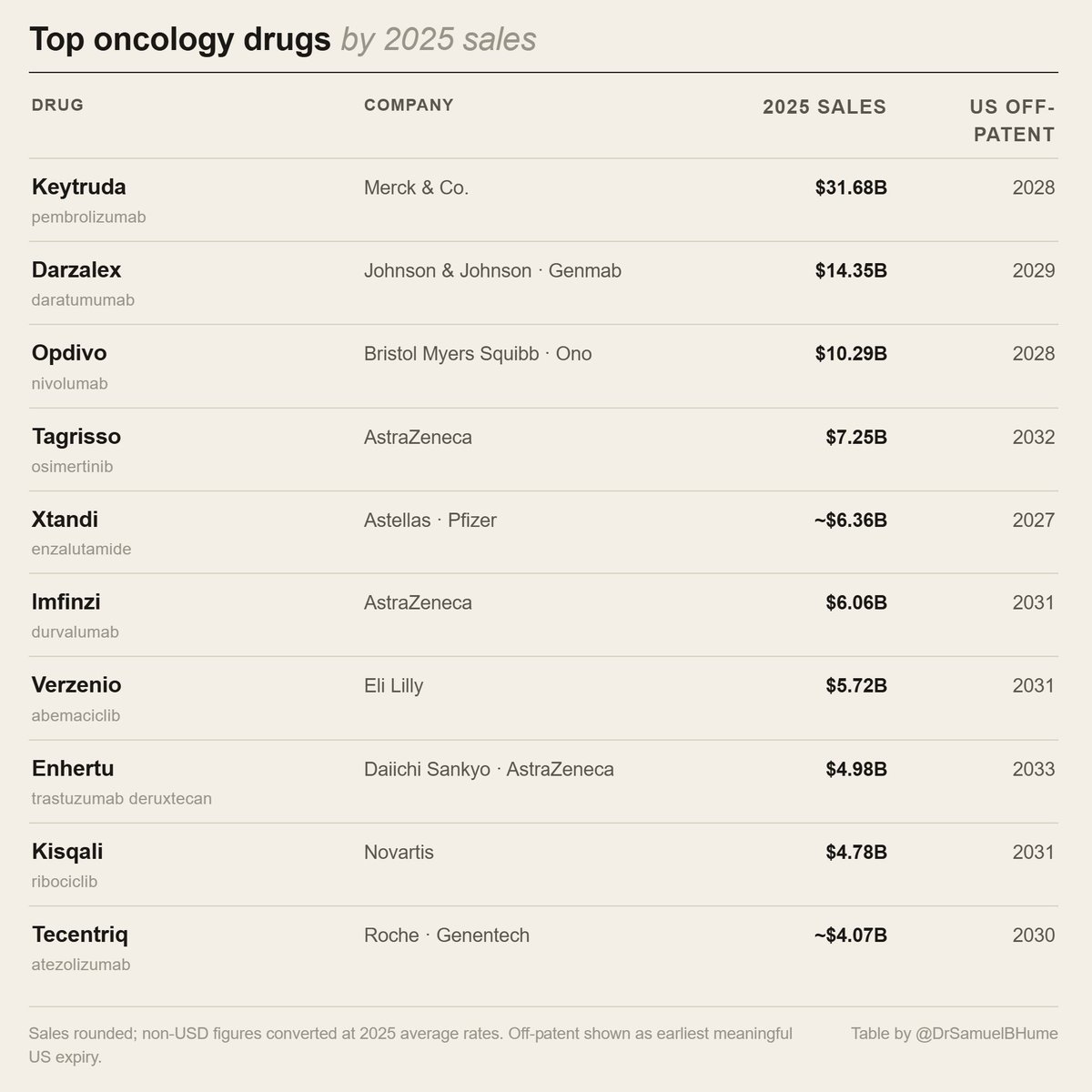
Keytruda transformed cancer care and made Merck more money than any drug in history. It was also discovered by accident, and nearly out-licensed in 2010 for pocket change.
New Approved + exclusive interviews with the inventors and the Merck CMO who ran development:
Cancer survival in the U.S. just crossed 70%.
It was 63% in the 1990s.
That gap = 4.8M people alive today.
This one chart captures survival gains across 29 cancer types.
The wins are real.
So is the unfinished work.
▪️CML: 31% → 72%
▪️Multiple myeloma: 32% → 62%
▫️Kidney: 59% → 82%
▫️Metastatic melanoma: 16% → 35%
▫️Childhood ALL: 80% → 92%
But some cancers barely moved.
Cervical cancer outcomes actually worsened.
None of this is abstract progress, though.
These are birthdays, grandkids, and years of life returned.
This is what funded science does.
Next time someone asks if cancer research works, show them this (full) chart.
- - - - -
Source: ACS Cancer Statistics 2026 · SEER · 𝘷𝘪𝘢 @Jori_health
- - - - -
This memory felt too special to lose, so I’m sharing it here.
Never imagined I’d use a Harry Potter analogy to comfort my child at bedtime, but it worked beautifully.
Thank you @jk_rowling for creating such a powerful world. @harrypotter@HPotterUniverse
Tonight my little one went to bed sad, he saw a bird dying in our backyard and felt really bad for it.
Instead of just saying “it’ll be okay,” I told him about Dementors from Harry Potter: how they feed on happy memories and create despair… but can’t touch joyful thoughts.
Harry Potter isn’t just magic for kids sometimes it really is emotional armor.
So proud of my boy for choosing joy on a sad night.
Grateful for stories that help us fight the Dementors in real life. ✨
A kid drew himself sleeping in bed between mom and dad and labeled it 'safe.'
In Japan, this exact sleeping arrangement has a name. They call it 'the river.' Mother is one bank. Father is the other. The child between them is the water. Roughly 70% of Japanese mothers sleep this way with their kids, sometimes through the teenage years. The Western model of putting a kid alone in their own bedroom is barely 200 years old. For most of human history, in most cultures still alive today, kids slept beside their parents.
James McKenna runs the Mother-Baby Behavioral Sleep Lab at Notre Dame. He spent decades watching what happens when parents and kids share a bed. The bodies sync up. Heart rates align with the parent's, breathing falls into the same rhythm, and by morning even sleep stages have started matching. The parent's body, in McKenna's words, acts as a kind of biological jumper cable for the child's.
In 2013, researchers in the Netherlands tracked 193 babies through the first year of life. They measured cortisol, the brain's main stress hormone. Babies who had spent more weeks co-sleeping in the first six months produced less cortisol under stress at 12 months. Sleeping near a parent had rewired the kid's stress system to be calmer under pressure.
Inside the kid's brain at night, the amygdala, the fear alarm, gets more sensitive as the body gets tired. Darkness makes it worse. A 2021 paper in PLoS One from Australian researchers showed that light directly suppresses amygdala activity. Lights off, alarm louder. The whole brain is wired to read 'alone in a dark room' as a threat.
Now add a parent's body to that bed. The kid's nervous system reads warm body, breathing nearby, familiar smell. The threat alarm dials down. Two parents on either side dial it down twice. The drawing is the kid's brain calculating maximum safety: I am surrounded by the people who keep me alive, and nothing can reach me without going through them first.
The arrangement in this drawing is what most of human history called 'sleeping.' Sleeping the kid alone in another room is a 200-year-old Western invention that we forgot was an invention. Every kid who has ever padded into your room at 3am and crawled into the middle of the bed is just trying to redraw the picture.
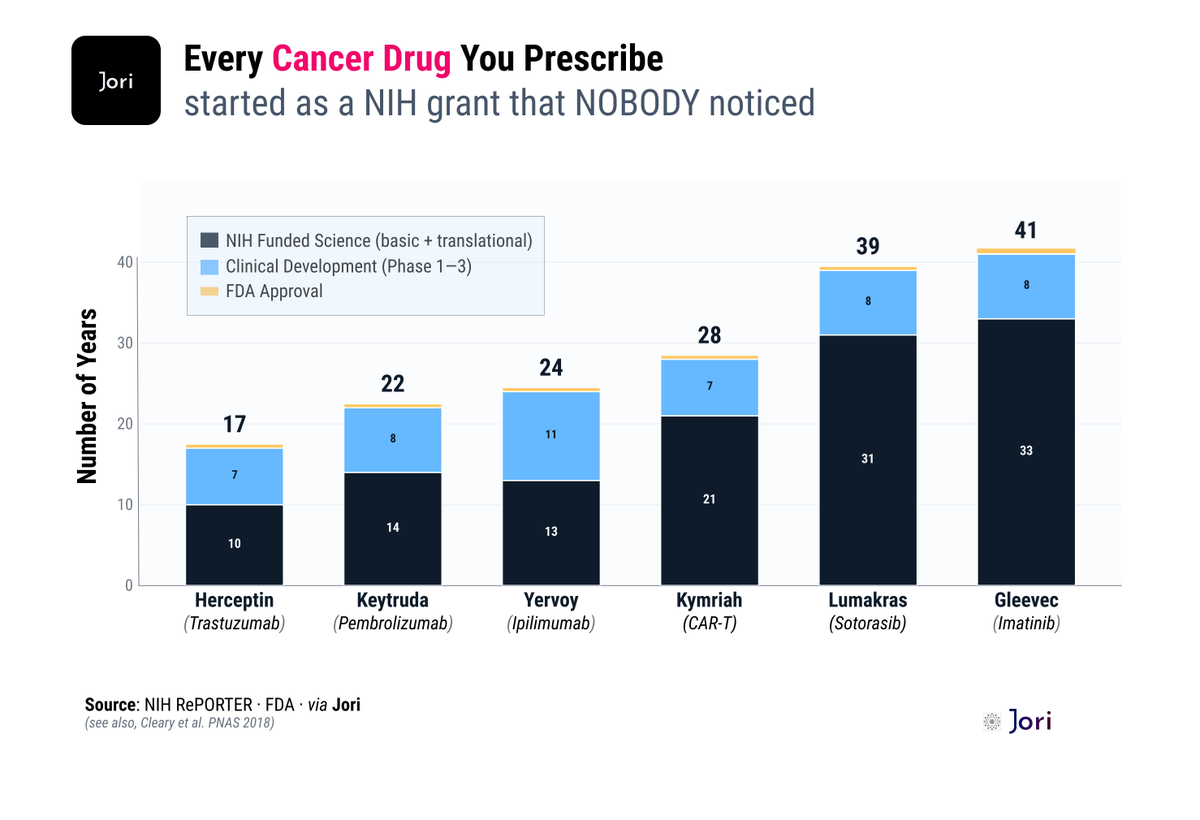
Every cancer drug you prescribe today
was once an NIH grant nobody noticed.
Pharma celebrates launches.
Few notice the 20–40 year runway behind that.
Gleevec took 41 years from NIH-funded discovery of the Philadelphia chromosome → FDA approval.
Behind every “breakthrough” sits a graveyard of failed attempts that made it possible.
Cut that lineage today,
the next Gleevec doesn’t arrive in 2067.
Funded science matters.
If someone says NIH funded science is inefficient,
show them this.
- - - - -
Source: NIH RePORTER · FDA · via @Jori_health
- - - - -
People who are averse to having kids and live a DINK life. It’s perfectly fine. But they are missing on one key thing in life:
The purest form of love in the world is what a parent has for their kid. Their own blood. It may not be vice versa. Relationships, marriages often devolve into transactional setups. Love between a couple diminishes with time & becomes a most optimal peaceful settlement. But the affection for your kid is pure.
If you are okay with not experiencing it, it’s totally fine. :)
Confessions and realities
42M, 55LPA
I am a 42-year-old man with a senior job in IT. I have a house in Chennai, a supportive wife, and two children. On paper, everything about my life looks perfect. I have achieved all the things society says a man should achieve.
In my twenties, life felt different. I had friends to spend time with. We would hang out at Marina Beach and Besant Nagar beach, watch movies at Rohini, Udayam, and Kasi theatres, and ride around Mount Road on my RX100.
In my thirties, I had colleagues to talk with over tea breaks. We would discuss apartments, onsite trips, and share random stories about life and work.
But now, in my forties, life has turned into a quiet routine. My phone rarely rings for anything personal. Most calls are about office work, bank alerts, or someone from home asking me to pick up milk on the way back.
The loneliness of a man in his forties is unusual. I am not physically alone, but I often feel like a machine.
When I enter my home, I am simply “Appa.” I am the person who pays school fees, fixes the Wi-Fi, and handles repairs. My wife is busy with her work and the kids. My children are teenagers now, living in their own worlds and their own rooms. They love me, but they mostly see me as the person who provides comfort and stability. They no longer see me as an individual.
At the office, I am the senior person. I am expected to have all the answers. I cannot tell my team that I feel tired. I cannot tell my boss that I sometimes struggle to keep up with new technologies. I must appear confident and strong, even when I quietly worry about the future.
Sometimes I drive home slowly from work just to spend a few extra minutes in the car. I listen to songs from my college days.
For those fifteen minutes, I am not a manager or a father. I am simply myself again.
I realize that I have not had a real conversation about my feelings with anyone in years.
My old friends now exist mostly as names on WhatsApp. We send “Happy Birthday” or “Congratulations” messages, but rarely talk. When we meet at weddings, our conversations revolve around our children’s grades or the cars we drive. We never talk about what we actually feel.
The hardest part is that I cannot even complain. If I tell my family that I feel lonely, they look confused and say, “But we are all here with you.”
They do not understand that a person can be surrounded by people and still feel like they are on a desert island.
Society teaches men that if they provide money and security, they have succeeded in life.
But no one teaches us how to deal with the silence that comes with it.
I have built a beautiful life for everyone around me, but sometimes it feels like there is no space left for me inside it.
And maybe… this is what life in your forties feels like.
Cancer survival just crossed 70% in the U.S.
It was 63% in the 90s.
That gap = 4.8M people alive today.
Myeloma: 32% → 62%
Melanoma (metastatic): 16% → 35%
Lung (metastatic): 2% → 10%
That is not abstract progress.
These are birthdays, grandkids,
& years of memories restored.
Sure, we have ways to go.
But this is what funded science does.
Next time someone asks if cancer research works,
show them this chart.
- - - - -
Source: ACS Cancer Stats. 2026 + SEER (via @Jori_health)
- - - - -
Getting recognized by the hospital staff at @UCSF like I’m a #FrequentFlyer 😂
At this point we’re basically on a first-name basis and swapping stories between visits.
Silver lining: great conversations come with the check-ins!
#CancerCare





![TejasPatilMD's tweet photo. @ASCO LUNG ABSTRACTS MEGA-THREAD
⭐️I've said it before; #ASCO26 is like a giant music festival - the @coachella of oncology
🎵You have the headliners [plenaries], acts on the main stages [halls B & D], & indie gems on the side [posters]
🎗️My PERSONAL list of the MOST interesting abstracts and WHY I think they are great! 🧵](https://pbs.twimg.com/media/HJNoASNbsAAysw0.jpg)