A toothpaste company has quietly killed the entire market research industry and nobody is talking about it.
Colgate published a paper showing you can predict real purchase intent at 90% accuracy by simply asking LLMs to roleplay customers.
And this is beyond insane.
If you ask an AI, "Rate this product from 1 to 5," it gives safe, middle-of-the-road garbage.
So researchers invented a method called Semantic Similarity Rating (SSR).
Instead of asking the AI for a number, they asked it to roleplay.
They gave the LLM a demographic profile. They showed it a product concept. And they asked it to write down its raw, unfiltered thoughts.
Then, they used a semantic model to translate those written thoughts into a numerical score.
The results are staggering.
Tested against 57 real corporate surveys and 9,300 actual human responses, the synthetic AI consumers matched real human buying behavior with 90% reliability.
They perfectly mirrored how different age brackets and income levels react to price changes.
And they provided detailed, qualitative feedback that was deeper and more critical than what actual humans wrote.
This destroys the economics of traditional market research.
You don't need to wait a month to see if a product will sell.
You can simulate 1,000 hyper-targeted customer interviews overnight.
You can A/B test pricing across every demographic instantly.
AI will disproportionately benefit ADHD minds because it externalizes the boring, parts of cognition like planning, sequencing, drafting, remembering, prioritizing and amplifies the parts ADHD minds often cook at: rapid association, novelty-seeking, pattern recognition, emotional intensity, and divergent synthesis
THIS IS WHERE ABHINAY SIR EXPOSED THE WHOLE NARRATIVE 🔥
SHALINI: Is India really becoming powerful?
ABHINAY SIR: Biggest hypocrisy of our times. We say we brought Lord Ram, but can’t even bring oil from Russia without Trump’s permission.
SHALINI: Government says earlier PMs also faced pressure on what India could buy.
ABHINAY SIR: My father can’t deny me new clothes just because his father never got them.
SHALINI: But Manmohan Singh was called the silent PM.
ABHINAY SIR: The man did 170 press conferences. Our PM hasn’t done even one. Why are people not even outraged?
📍JKG Palm Court, Gaur City 2, Greater Noida West
Some residents are attempting to ki!! old, sterilized & vaccinated community dogs living peacefully inside the society for years. They have ZERO history of aggression.
Taking the law into own hands is a crime. Need urgent intervention before it’s too late! @noidapolice@Uppolice@dgpup #StopDogCruelty
Is INDIA now a barbaric nation then?? SHAME ON YOU … DIRTY ROTTEN SCOUNDRELS … You are only going to polarise society .. DO NOT UNDERESTIMATE the anger of the pro animal groups. FAILED to stop the corruption in ABC ? So kill the innocent souls then. Karma will not spare you … AND NEITHER WILL THE ELECTORATE
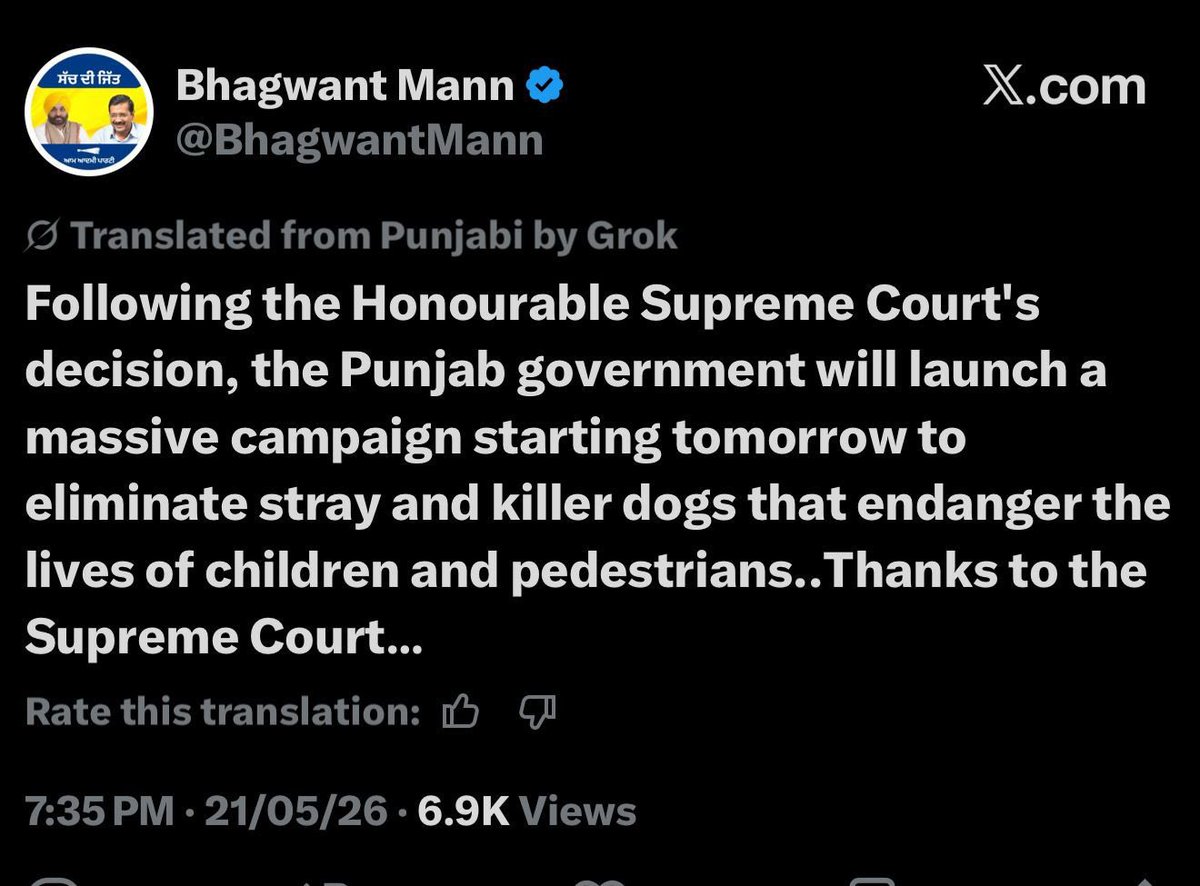
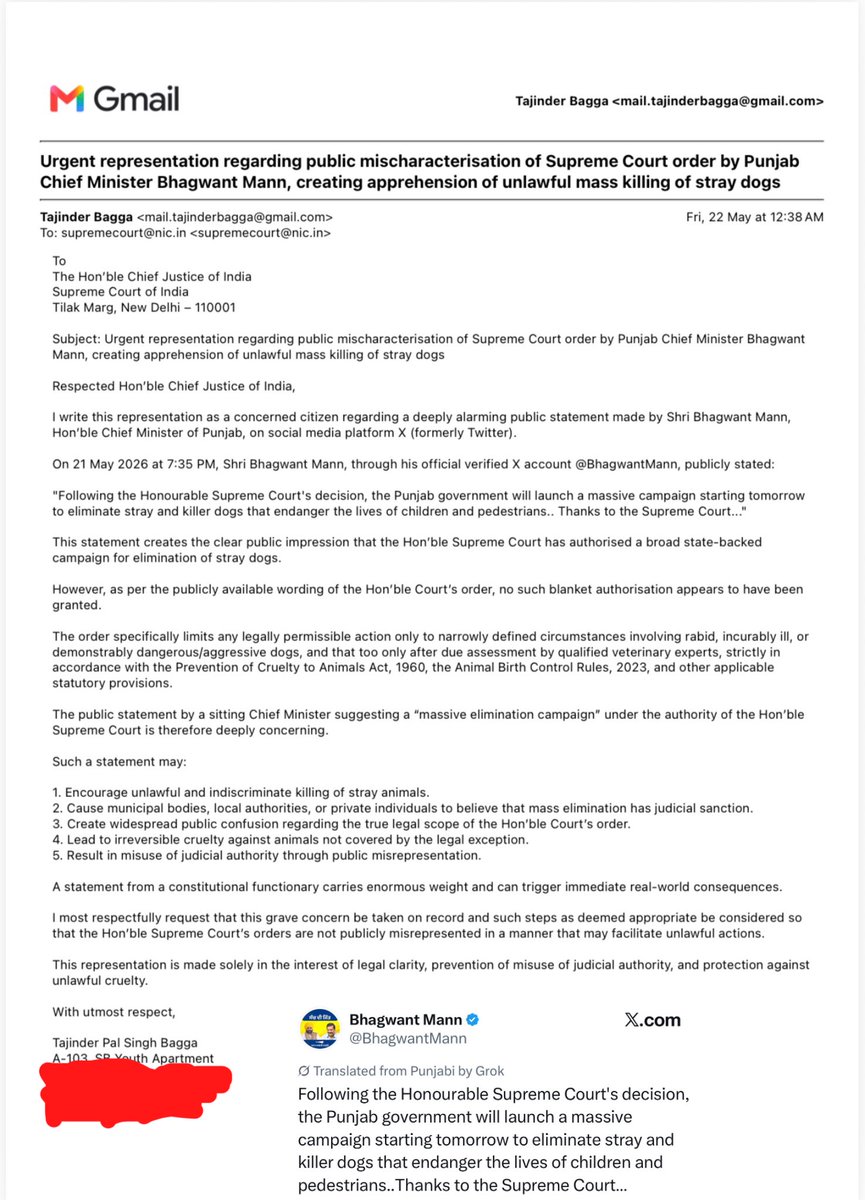
I have formally written to the Hon’ble Chief Justice of India regarding Punjab CM Bhagwant Mann public mischaracterisation of the Supreme Court’s order on stray dogs.
The SC order permits action only in specific legally defined cases involving rabid, incurably ill, or demonstrably dangerous dogs after veterinary assessment and under law.
It does NOT authorize a blanket mass elimination campaign.
The last time a Chinese lab open-sourced something this big, Nvidia lost $600 billion in a single day.
It's happening again.
DeepSeek panicked Silicon Valley in January. Crashed Nvidia's stock $600B in one day. Made Sam Altman rewrite his entire business plan.
Now there's a second one.
Kimi just made AI notably cheaper to run. Open-sourced it. Put it out for free. Meanwhile OpenAI is asking people to pay $200 a month to use a model that already feels behind the curve.
Two Chinese labs. Both open source. Both doing more with less. Both giving away for free what American companies charge billions for.
The AI race isn't US vs China anymore... It's closed vs open. And closed is losing.
And the wildest part? Nobody in Silicon Valley will quote tweet this.. Because admitting a Chinese lab just moved the field forward for free destroys the entire "we need $10B to build AGI" fundraising pitch.
The number of people on Twitter fighting hard to prove that Sarvam is a bad idea and has 'nothing novel' is just insane.
They are doing fantastic work and unlike many AI companies they are genuinely exploring and expanding on a possible moat with their focus on Indian languages.
How this thing did not have legions of fans is beyond me! India needs more local built brands and companies!
Fantastic work @pratykumar and the @SarvamAI team!
These two are now the guiding lights of Indian AI Prowess.
Both @sarvamAI and @emergentlabs have fired a billion Indian dreams.
I see 100 Indian AI unicorns, 10 decacorns and 2-3 $100B AI companies in the next 5 years.
You ain’t seen anything yet. Game has just started.
Chinese company ByteDance released its latest AI model, “Seedance 2.0,” just 48 hours ago.
Someone tested the new version by giving it a prompt to generate a fight scene between Brad Pitt and Tom Cruise, with their dialogue during the fight revolving around the Epstein files.
With this release, it has become almost impossible to distinguish between reality and fiction. To the extent that Lu Huang, an AI consultant and digital film director, said:
“I studied digital filmmaking for seven years, and I’d say that 90% of the skills I learned have now become useless after the release of Seedance 2.0.”
Drop 7/14: Introducing Sarvam Arya - our multi-agent orchestration platform, built from the ground up with robust systems engineering principles and frontier AI-assisted developer experience.
We illustrate the Arya advantage on a common ETL task of extracting structured data from unstructured documents. Arya system with GPT 4.1 mini achieved ~5x higher accuracy at ~10x lower cost compared to Claude Code with agent swarm.
Read more about Arya in this thread and our blog: https://t.co/UVodZcgMLd
Last one on this topic, and I have been holding this in myself for a while.
For centuries, class divides kept the labor of the poor invisible to the rich. Factory workers toiled behind walls, farmers in distant fields, domestic help in backrooms. The wealthy consumed the fruits of that labor without ever seeing the faces or the fatigue behind it. No direct encounter, no personal guilt.
The gig economy shattered that invisibility, at unprecedented scale.
Suddenly, the poor aren't hidden away. They're at your doorstep: the delivery partner handing over your ₹1000+ biryani, late-night groceries, or quick-commerce essentials. You see them in the rain, heat, traffic, often on borrowed bikes, working 8–10 hours for earnings that give them sustenance. You see their exhaustion, their polite smile masking frustration with life in general.
This is the first time in history at this scale that the working class and consuming class interact face-to-face, transaction after transaction. And that discomfort with our own selves is why we are uncomfortable about the gig economy. We want these people to look our part, so that the guilt we feel while taking orders from them feels less.
We aren't just debating economics. We are confronting guilt. That ₹800 order might equal their entire day's earnings after fuel, bike rent, and app cuts. We tip awkwardly, or avoid eye contact, because the inequality is no longer abstract. It's personal.
Pre-gig era, the rich could enjoy luxury without moral discomfort. Labor was out of sight. Now, every doorbell ring is a reminder of systemic inequality. That's why debates explode. It's not just policy. It's emotional reckoning. Some defend the system (“they choose it”), others demand change (“this isn't progress, its exploitation”).
And here’s the uncomfortable twist: the unsaid ask of clumsy ‘solutions’ isn’t dignity. It is about returning to invisibility.
Ban gig work and you don’t solve inequality. You remove livelihoods. These jobs don’t magically reappear as formal, protected employment the next day. They disappear, or they get pushed back into the informal economy where there are even fewer protections and even less accountability. Over-regulate it until the model breaks, and you achieve the same outcome through paperwork instead of slogans: the work evaporates, prices rise, demand collapses, and the people we claim to protect are the first to lose income.
And then what happens?
The rich get their old comfort back. Convenience returns without faces. Guilt dissolves. We go back to clean abstractions and moral posturing from a distance. The poor don’t become safer, they become invisible again: back in cash economies, back in backrooms, back in shadows where regulation rarely reaches and dignity isn’t even debated.
The gig economy just exposed the reality of inequality to the people who previously had the luxury of not seeing it. The doorbell is not the problem. The question is what we do after opening the door.
Visibility is the price of progress. We can either use this discomfort to build something better (which we keep doing continuously as delivery partners are our backbone), or we can ban and over-regulate our way back into ignorance. One of those choices improves lives. The other simply helps the consuming class feel virtuous in the dark.