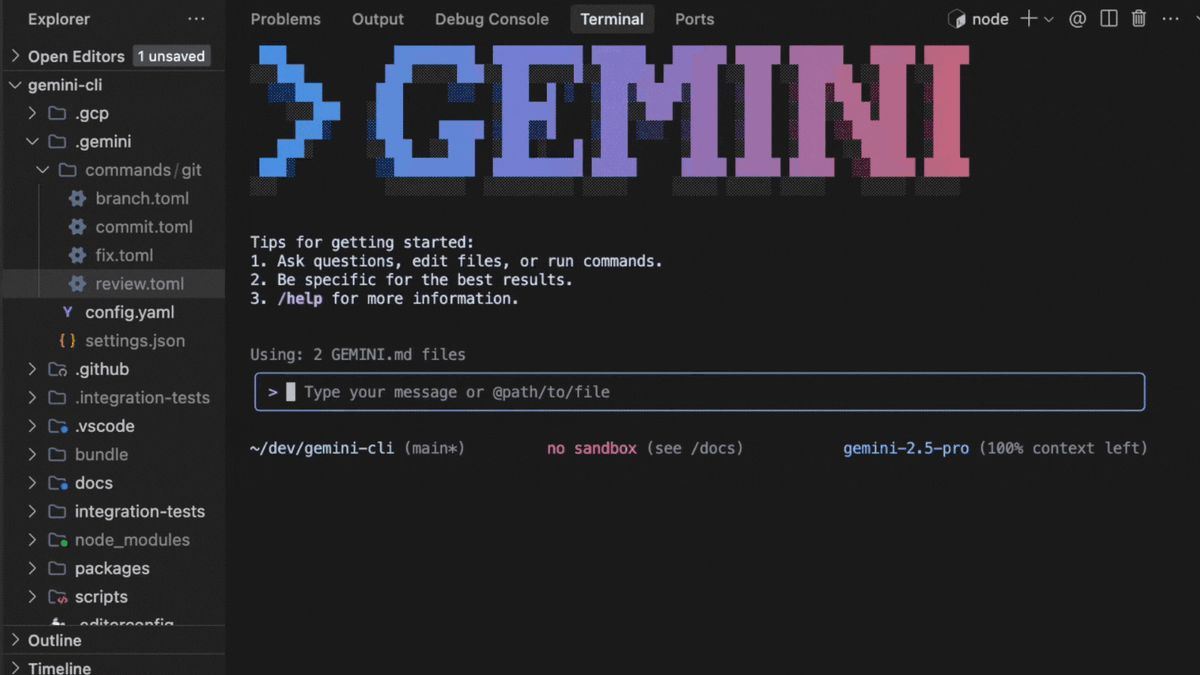
We’re thrilled to announce the Antigravity CLI, a lightweight way to spin up the same Antigravity agents right from the terminal. 💻
It gives you the exact same harness and same models, with a product experience tailored for the command line. It adapts entirely to you: your keybindings, your themes, your workflows.
Full Antigravity CLI Walkthrough:
@hwchase17 /replay
definition: Neural replay - It is the process where your brain literally "re-runs" the neural firing patterns of your day’s experiences while you are asleep.
Everyone gets 2x Daily Credits until Jan 12th! ⚡️
To celebrate the New Year and the massive growth of the Vibe Design community, we are doubling your capacity.
We want you to be part of the Vibe Design movement from Day 1. Start your year by shipping.
I just registered for NeurIPS 2025! https://t.co/9wbMPHtDhY Google is always looking for some great people to join our mission.Please do come say hello!
Welcome to the party @huggingface 🤗
Access the Hugging Face Hub directly from Gemini CLI with this new Gemini CLI extension.
🔍 - Search models, datasets and papers
📈 - Find trending models or datasets
🤗 - Learn how to fine-tune models and more!
Big thanks to @evalstate and @reach_vb for making this happen!
This is insane! The new Gemini Flash model released yesterday has the same accuracy as o3, but it is 2x faster and 4x cheaper for browser agent tasks.
I ran evaluations the whole day and could not believe this. The previous gemini-2.5-flash had only 71% on this benchmark.
Ever wished your shell could do more with AI? The new Gemini CLI lets you define custom slash commands using simple YAML. Automate complex prompts, right from your terminal. Pretty neat for boosting productivity!
#GeminiCLI#DevTools#googlegemini
The real-time conversational fluency of GPT-4o is striking. The ability to understand and respond with such speed and nuance via audio marks a significant leap. Imagine the possibilities for accessibility and intuitive interfaces. #AIInnovation#ConversationalAI
DeepMind's new Genie model is fascinating! It can turn text, images, or even sketches into playable, interactive environments. Imagine sketching a world and instantly stepping into it. A glimpse into the future of content creation! #AI#Genie
https://t.co/XcOmWtA3B9
Introducing Genie 3, the most advanced world simulator ever created, enabled by numerous research breakthroughs. 🤯
Featuring high fidelity visuals, 20-24 fps, prompting on the go, world memory, and more.
Gemini Deep Research has gotten very good since it was upgraded to 2.5 Pro.
Claude and ChatGPT tend to go a good job acting like analysts and building an argument, but Gemini is probably the best right now at synthesizing a coherent overview of a complex topic.
We're all in on context engineering!
A related topic that imo is table stakes for every AI engineer/user: workflow engineering 🛠️
A lot of agent use cases revolve around automating work that otherwise a human would have to perform - customer support, legal research, report generation, unit testing, etc.
It obviously needs to be context-aware, but it also needs to be a repeatable multi-step process; there's usually a sequence of steps that you can describe that require multiple LLM calls to achieve a given outcome.
In most cases you can't fully trust a simple ReAct agent with tools - it is too unconstrained and doesn't necessarily fulfill the task at hand.
Both AI engineers and non-technical users need to get really good at describing these workflows, because that's how you get AI to meaningfully complete work for you instead of giving you back chat responses from the raw LLM API.
(If you go back to the model layer, you could even use RL/tuning to optimize/overfit to the workflow at hand, to ensure 100% accuracy vs. 80%)
I'm super bullish on workflow engineering; at the end of the day every AI builder is building specialized AI workflows in one way or the other. We're building document workflows at @llama_index, other companies are building customer support workflows, coding workflows, and more.
I really like the term “context engineering” over prompt engineering.
It describes the core skill better: the art of providing all the context for the task to be plausibly solvable by the LLM.