@RespOficial_Arg They are doing this to implement tolls, so the tax payer will be paying for those roads and letting profits be captured by the private sector.
@LefterisJP We need to stop calling these "DeFi exploits" - they are key management attack happening to onchain finance protocols at best (CeDeFi) - all the protocols affected have ~ god like multisigs and thus CANNOT BEGIN TO QUALIFY AS "DEFI" - they violate its first principle
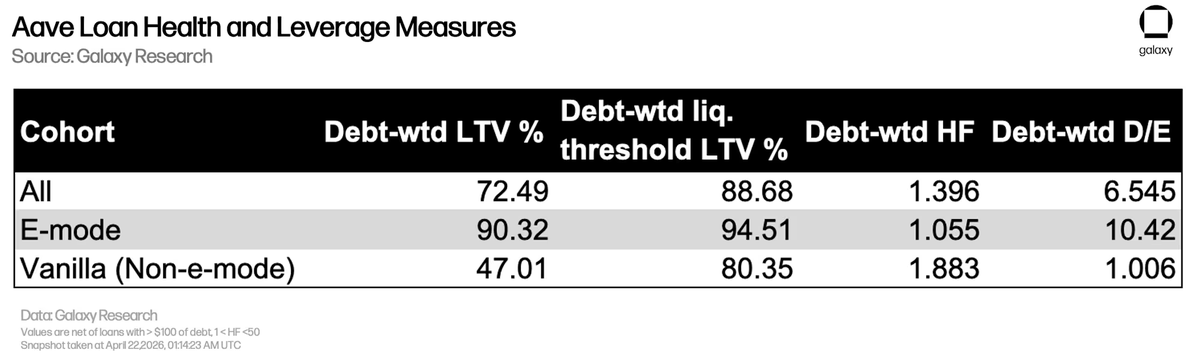
A full view of Aave is hard to come by. Onchain data makes loans transparent, but aggregating the data into a coherent view has been underexplored.
Finally we have a picture of what the Aave book looks like.
The take: looped loans hold ~60% of borrows and are highly levered.
🚨 There’s a large-scale supply chain attack in progress: the NPM account of a reputable developer has been compromised. The affected packages have already been downloaded over 1 billion times, meaning the entire JavaScript ecosystem may be at risk.
The malicious payload works by silently swapping crypto addresses on the fly to steal funds.
If you use a hardware wallet, pay attention to every transaction before signing and you're safe.
If you don’t use a hardware wallet, refrain from making any on-chain transactions for now.
It’s still unclear whether the attacker is also stealing seeds from software wallets directly at this stage.
Excellent report here: https://t.co/5CtiZJHYsN
@L_Jeannal@Capetlevrai Certains y vont pour cashout et éviter l'impôt puis reviennent pour bénéficier des acquis sociaux et le contexte culturel financé grâce aux impôts.
Je sais pas si c'est le cas ici mais Dubaï n'a pas grand chose à offrir à part une fiscalité faible et un ghetto pour riches.
The amazing @OpenZeppelin team add to their already immense contributions to the EVM ecosystem by open sourcing part of their Defender tool.
Security for all by the OZ legends 👏
https://t.co/BtWc8XfqwD
I'm still baffled that the Ethereum Core Dev community does not prioritize fixing the 2 most cited problem of EVM developers per the Solidity Lang survey despite our repeated efforts:
1. Stack too Deep: yes this is a Solidity skill issue a little bit but just add a SWAP/DUP17-32 opcode range and call it a day. You will burn some opcodes. It's fine, they are meant to be used. You're gonna have another PUSH0-style mismatch, this is also fine, it's not perfect but it's fine.
2. Lift the 24KB limit. I don't really care what you do, make it 32KB, 48KB, 128KB, 256KB, 512KB, do it all at once, incrementally, price it or not but do something! Now, not next year!
If you are scaling the L1, ensuring people can write contracts without stupid errors is P0.
If the system cannot handle an extra 8KB per bytecode which is a param that was set 10yrs ago literally then there's no chance you will be able to actually scale the L1.
Fix stack too deep and bytecode size limit! For the devs!
@nono2357 L'idée de lutter contre le blanchiment est compatible avec la protection de l'anonymat.
Pour quelles raisons une entreprise ou un individu cache-il l'origine de ses fonds au fisc ?
Du coup, le fisc doit il s'en tenir à la seule parole des individus pour l'origine de fonds ?