Btw I'm bearish on startups launching text based AI agents as the primary interface for apps moving forward. Most people don't have the time or patience to message an agent and go through an entire convo loop just to reach an outcome. They want pictures, buttons, or in the future voice.
What I could see working is a reactive messaging loop where the AI understands your preferences, takes action in the background, and only reaches out when there's something worth knowing or approving.
My guess is that many successful AI agents end up as extensions of existing products rather than standalone apps. It's much easier to layer AI onto an existing habit or app than create a new one from scratch.
it might feel like a lowest-friction playground when it’s quite accessible, outcomes are binary-ish, and the “research” looks legible enough
“Low context cost = easy alpha” fallacy
It's always been really strange to me that the AI agent trading gang has chosen PMs as their first port of call.
I literally cannot think of a worse place to try out agentic trading. Just like everything, models work best when they are 'verticalized' with industry information, not with a generic prompt.
In the PM space, anything with volume is pretty 'verticalized' already:
>Pre-game sports markets (well studied, sport specific)
>In-game sports markets (pure latency game)
>Elections (very well studied)
Not to mention:
>Extremely high execution costs (spreads and/or fees)
>News parsing is ~very~ latency sensitive; Jump are already beating you at this game.
Like I said in a previous post - the near-term successes with trading agents will come from the ability to generate fast, on-the-fly code to quickly generate, validate and backtest trading ideas.
If you want to give it a try on a liquid, 24/7 exchange with the widest equity offering of any perps platform right now, we have you covered:
https://t.co/Urkn1dg3Vn
PS shout out to @emilyjnicolle for the great article:
https://t.co/lm13cqLxq3
Probably the best justification for why to build prediction markets on-chain.
With this roadmap anyone who seeks a predictive answer can effectively “outsource” the forecasting task to a market rather than hiring an individual or team to produce a forecast. With sufficient liquidity, the resulting prediction is arguable accurate since the market mechanism implicitly recruits a broader set of rational participants.
Two further questions are:
(i) what level of cost is required for a novel market’s prediction to become sufficiently accurate or demonstrably more accurate than alternative approaches(traditional sources etc?)
(ii) once the prediction is public, what implications does this public availability have for the party seeking the forecast, including how it may affect incentives?
In any case, mad bullish.
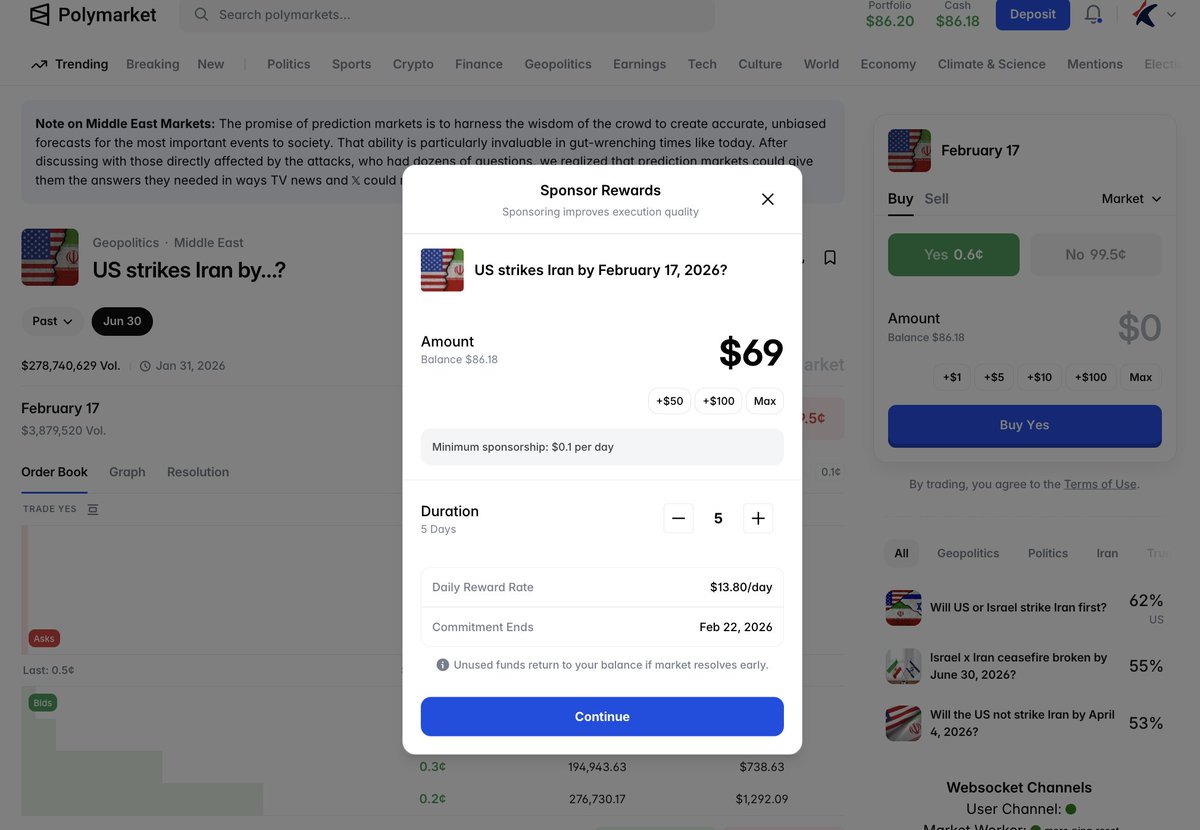
sponsoring market rewards is now open to all users 😛
add rewards to any market to get the liquidity for the size you want to trade.
permissionless market deployment and creator fees next...
Liquidity could be brutally expensive for any potential PM startup with only a couple million in funding), but the market listing pipeline is also worth mentioning. Think they both maintain a quite mature, semi-automated market selection -> launch -> monitoring -> resolution lifecycle. Part of their secret sauce imo.
The closest thing Polymarket and Kalshi have to a moat is VC money. They subsidize liquidity on resting orders, which effectively turns prediction markets into a capital intensive business where liquidity is not real (makers get paid to post, not to get filled)
biggest trend in ai next year will be world models.
LLMs are running out of data to train on, only way to solve this at scale is putting them in simulated worlds, running millions of real-world simulations and generating synthetic data.
google leads here (surprise surprise) with genie 3
tesla's a dark horse, most people don't realize full self driving runs on a world model simulating every possible car accident so that its avoids it.
world models will also be used to train agents and robots. one of the biggest drawbacks for robots today is theres no data for what a human sees and does.
real world, physics-based simulations ftw.
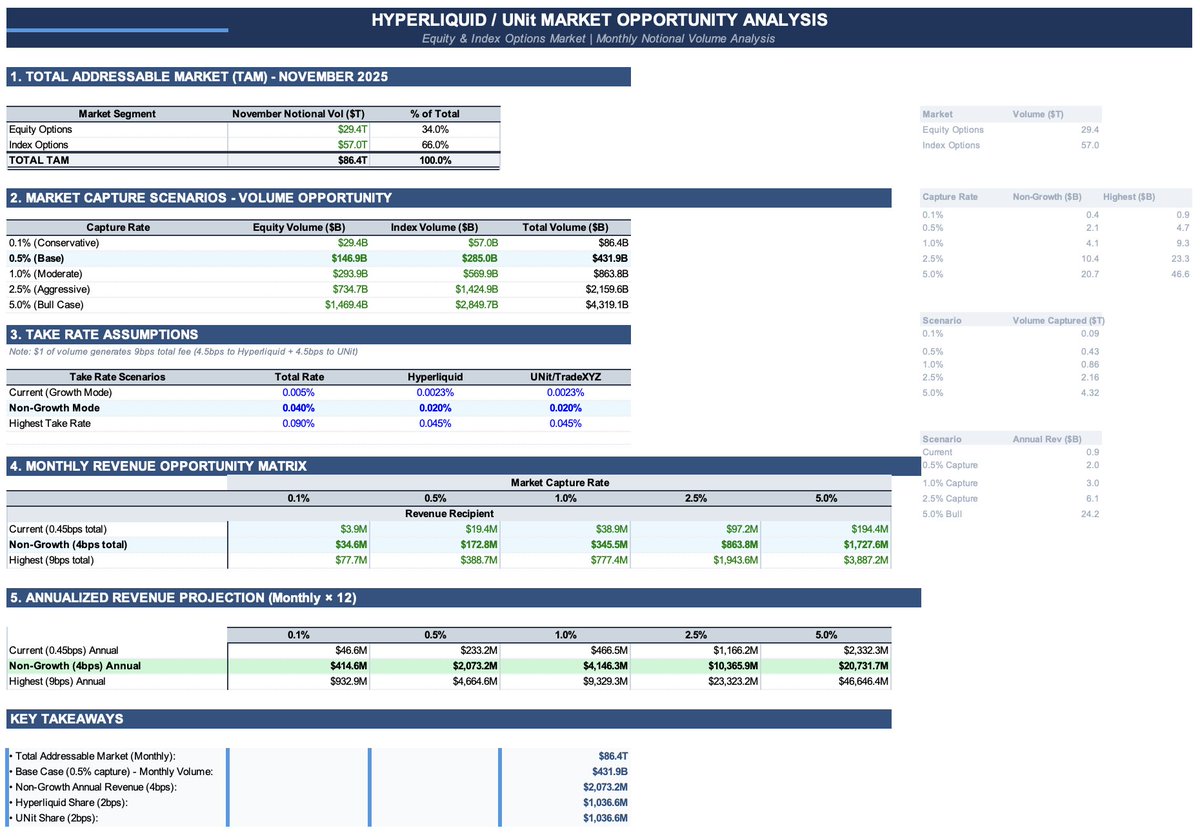
1/ With $86T in monthly options volume, equities represent the single largest untapped market for DeFi exchanges.
Breaking down the economic opportunity of equity perps and a path to 2-40x @HyperliquidX revenues:
5 months later…
0 talk of airdrop
0 progress killing Facebook, TikTok, and Twitch
0 actually funny memes launched
0 streams worth watching
0 reason to buy the token
Am I wrong?
Together with leading financial institutions, @DigitalAsset has completed a second round of pioneering transactions on the @CantonNetwork, building on U.S. Treasury financing, proving how these workflows can operate onchain.
This latest phase shows clear progression toward scalable, always-on capital markets infrastructure
Future phases will further advance these capabilities, including expansion toward cross-border transactions.
what's crazy is crypto spent 10 years building an entirely new financial system that's 10x better than the old one
but we couldn't roll it out because they made it illegal so we had to build in the grey and get political (meanwhile they blamed us for having no use cases while making all our use cases illegal)
but then in 2025 crypto become legal so now we have 10 years of awesome stuff we can roll out
so we're starting to roll it out
banks and wall street have no idea what's about to hit them because they've been shielded from competition in a cute little regulatory box
but now we can deploy the defi we spent 10 years building and actually do things
in a fair fight crypto wins
Spoke to a DAT this morning that’s launching its stock on the Nasdaq BEFORE the token even starts trading on the secondary market. It’s both a sign of speculative hype, but also innovation:
1) Exchanges like Binance now have competition from TradFi for initial liquid token price discovery,
2) The cost of Nasdaq listing can be lower than giving up 5% of the token supply to Binance, and
3) Investors get better, more transparent disclosures and stronger governance rights
A major inefficiency in tech and research is the issue of people & problem fit--are you working on the problem that maximizes your probability and/or scale of success.
You always bear the opportunity cost of not working on the "best" problem for you.
However, you never know which problem is "best" for you unless you attempt and understand all of them.
There is also the added complication of not knowing what you don't know, which could skews decision making to choosing a problem rather than exploring the unknown possibilities.
* "Best" in quotes here because different individuals are motivated by different factors: some more by the scale and impact of the outcome while some more by the pursuit of the challenge itself.
It is no secret Ethena has faced significant challenges with VC unlocks. I know many of you have been through the pain with us. I personally made countless mistakes with fund raising and think about these mistakes daily. Crypto has a severe capital misallocation problem with private VC capital far outweighing liquid capital to sustain token valuations post TGE. This is the diametric opposite to Web2 where private VC capital is a fraction of equity capital markets. We have been searching for a solution. There is no need to reinvent the wheel - the solution has been sitting there for decades. You wanted a solution to the overhang of VC unlocks?
Well this is it.
✍️Sharing a project I’m watching closely: What is Canton, and why does it deserve our attention?
@CantonNetwork is a privacy-first chain built for institutional finance. It combines the privacy and control required by regulated markets with the composability of DeFi.
Recently backed by a fresh $135M raise from Tradeweb, DRW, Circle, Paxos, Citadel Securities, Goldman Sachs, IMC, and others.