“In order to create art, you must be very alive. Alive with grief or love or anything else, it doesn't matter. Art is an imprint of aliveness. Artists think that process is what you do when you sit down at the table, but it's actually everything you do before that.” @briannawiest
Van Gogh once wrote one of the most beautiful sentences I have ever read:
"Just as we take the train to go to Tarascon or Rouen, we take death to reach a star."
You have seen the painting below hundreds of times, but you probably do not know the story behind it, and it is as unbearably beautiful as the words you just read...
Van Gogh had painted the night before. Yet, he had never painted it like this, because he had never been this far down, or reached this far up.
After a breakdown, Vincent had committed himself, of his own will, to an asylum at Saint-Rémy, a former monastery for the mentally ill. He was thirty-six years old. From the window of his room, behind iron bars, he could see a wheatfield and a strip of sky. He described it to his brother Theo like a man who had found something to hold onto:
"Through the iron-barred window I can make out a square of wheat in an enclosure, above which in the morning I see the sun rise in its glory."
Out of that view, that narrow slot of world seen from inside a mental institution, he made one of the most famous paintings that has ever existed. The night sky rolls and swirls like a living sea, eleven stars and a blazing crescent moon burn and turn in currents of blue, the whole heavens surging with a force that feels almost too large for the canvas to hold...
Vincent had trained as a preacher once, and though he had long since broken with the church, he never stopped reaching for something larger than himself. He had once written Theo a line that explains this whole painting:
"I have a tremendous need for, shall I say the word, religion. So I go outside at night to paint the stars."
That is what he was doing here: reaching for the divine the only way he had left, with a brush and a sky full of light. He made it locked away, ill, and more alone than he had ever been, and instead of despair he gave us what may be the most beautiful thing anyone has ever painted.
The lower he sank, the higher his work climbed, until he turned the view from a barred asylum window into the closest thing we have to heaven.
And if he was right, if death really is only the train we take to reach a star, then somewhere out past the swirling blue he painted from that cell, Vincent finally made the journey he was always looking up toward...
I appreciate that Dolly Parton played no part in "dress respectability" and, by her own account, modeled her aesthetic after a town "tramp," who she thought was beautiful. She separated aesthetics from character and understood "classiness" to be about how you treat people.
Do you know what impasto is?
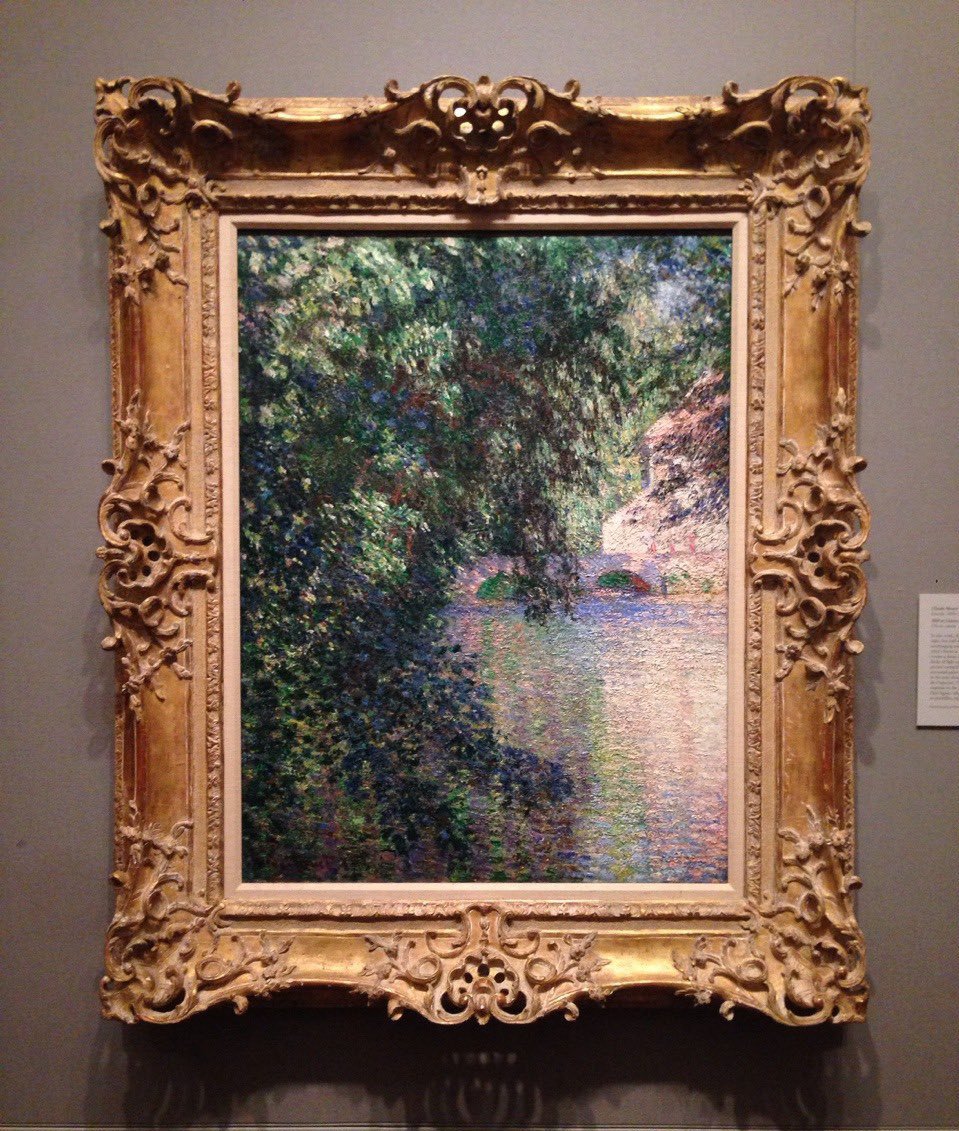
Look closely at a Monet.
Not from across the room. Not on your phone.
Get close.
The painting stops making sense. The trees become patches of colour.
Impasto: the technique of applying paint so thickly that it stands off the canvas.
Up close, you don't just see paint, you see 3D texture and material.
Step back.
Suddenly, the whole scene comes together.
His structural impasto and broken brushstrokes let your eye do the work.
And that’s the trick.
Impressionism
Cleopatra spoke nine languages, studied astronomy, medicine, and philosophy at the Library of Alexandria, and ruled Egypt for two decades through war, famine, and Roman invasion. Rome reduced all of it to one word: seductress.