🚨 New paper: “Asymptotically Optimal Regret for Reinforcement Learning without Horizon Dependence.”
We give the first polynomial-time algorithm for time-homogeneous tabular MDPs whose regret term is both:
• completely independent of the horizon H, and
• asymptotically optimal in S, A, and K.
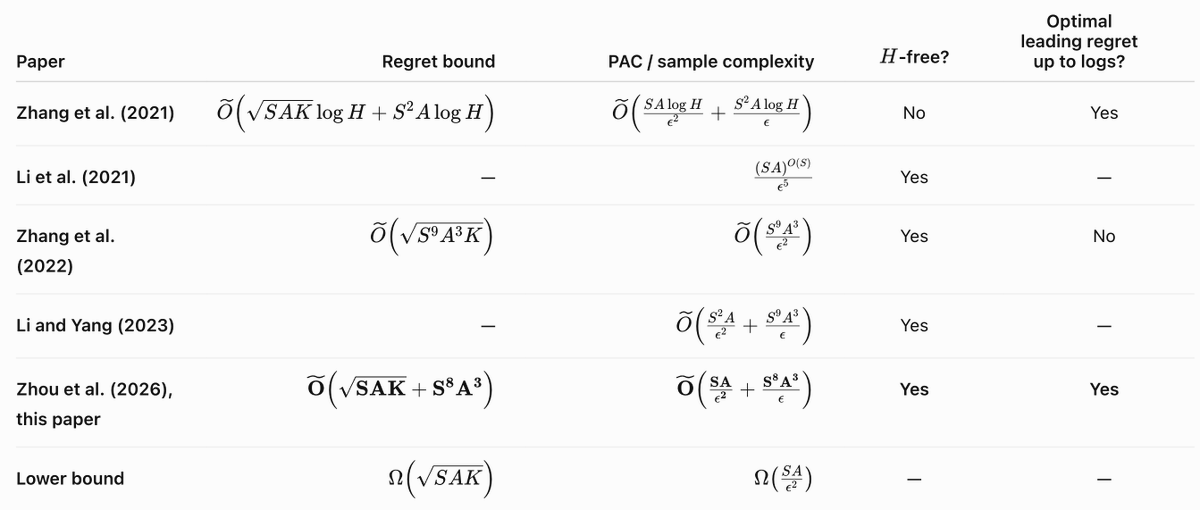
Our regret bound is
Õ(√SAK + S⁸A³)
matching the contextual-bandit lower bound Ω(√SAK) in the leading term.
Technically, we introduce:
• an S-dimensional discretization of the monotone optimal value sequence;
• a new cutting bonus for horizon-free optimism;
• a total-deviation bound controlling clipped variance independently of H; and
• a horizon-truncation framework enabling reward-aware exploration.
📄 https://t.co/mogFTNGbFK
Greatly thankful to collaborators Zihan Zhang, Maryam Fazel, @SimonShaoleiDu
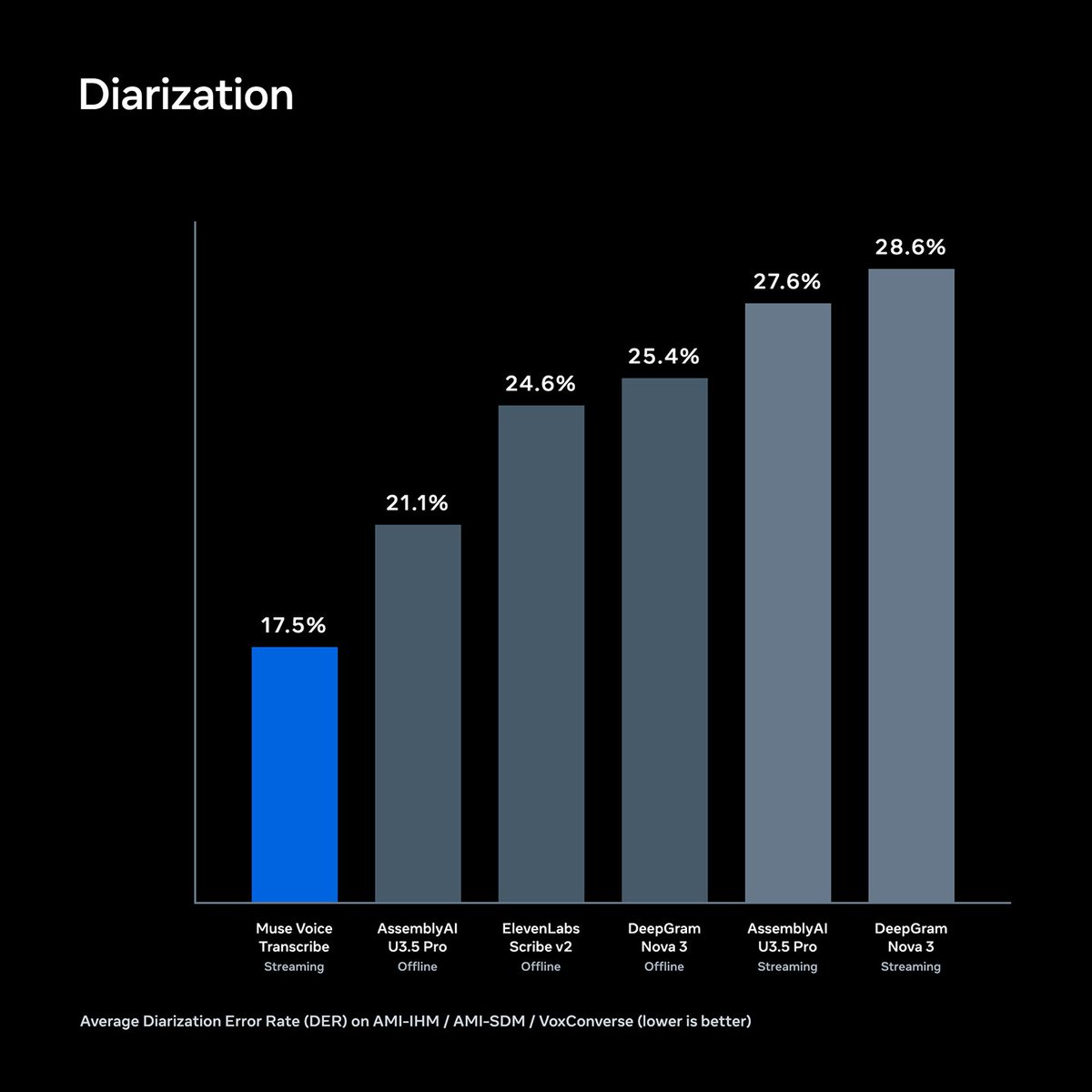
1/ today we're rolling out muse voice transcribe, our first real-time audio perception model - SOTA in streaming speech-to-text. also handles speaker diarization and endpointing natively in a single model.
Since announcing Jalapeño, our first custom inference chip, we’ve been testing it and the system around it.
The results show a major advance: more intelligence from every watt and faster responses, delivering both higher throughput and lower latency in one architecture without sacrificing efficiency.
Apodex 1.1 is out. Weights and harness are fully open:
▸ Apodex 1.1 Mini — 35B FrontierLevel model for Professional Work, Finance, and Scientific Research tasks.
▸ FrontierAgent — Native TUI, ReAct and Agent Team modes.
🐙 https://t.co/Ma7sTYMlJn
🤗 https://t.co/fHlFFkJCUD
I've decided it's time to resign from FAIR. 🫡
I'm especially grateful for the compute that made much of my research possible: 400 H100/200 GPUs allocated to me by FAIR; over a thousand H100s borrowed from FAIR Europe's CodeGen team led by Gabriel (@syhw ); thousands more borrowed from a legacy cluster in early 2025; and access to thousands of idle and low-prio GPUs across FAIR.
For clarity, since joining FAIR four years ago, I've been on FAIR-level pay throughout. I mention this simply to avoid any confusion in any media coverage.
Many thanks to @ylecun for founding FAIR, and to Joelle (@jpineau1 ) for steering FAIR through the later years of its golden age.
��ゃあね — so long, FAIR.
Introducing GEN-1.5, a one-shot learner.
It can learn new tasks in a few seconds. Show it what to do, and it generalizes.
This capability emerged from pretraining on physical data at scale, as a step towards our mission of building general intelligence for the physical world.
Releasing Muse Code in beta today. It's a terminal coding agent that takes on complete software engineering tasks across large repos: planning changes, writing code, validating the results. Powered by Muse Spark 1.2, a coding-focused model update.
yes, nonsofic groups exist: this statement is one of many new beautiful results proved by Astra, our next major model.
We're releasing 10 such Astra proofs, complete with lean certificates and CoT walkthroughs for each of them. The results are wide-ranging, from von Neumann algebras (disproof of Connes' Rigidity Conjecture) to better bounds for high dimensional sphere packing, for circuit complexity, for monochromatic triangles in multicolored graphs, and more.
More thoughts here: https://t.co/8SjXONeh38
Releasing the model weights and technical report of Kimi K3.
Kimi K3 is our most capable model: a 2.8T MoE model with native visual understanding and a 1M-token context window.
New model architecture: 2.5x the intelligence per unit of compute, not just more params.
Alongside Kimi K3, we're opening up more of the stack behind it — high-performance attention kernels, MoE communication library, and infrastructure for running agent environments at scale.
Model weights: https://t.co/7m7eEg6Y0B
Tech report: https://t.co/yeu6cjpMCT
Tech blog: https://t.co/YTfiMSNM1f
[7/7] Conceptually, our result implies that in asympotitc sense, long-horizon RL is no more difficult than a contextual bandit problem.
The main open question is whether the S⁸A³ burn-in term can be substantially reduced to SA.
A positive answer would suggest that time-homogeneous tabular RL is no harder than contextual bandits even at the finite-sample level.
A lower bound on the burn-in, on the other hand, would reveal a genuine separation between learning actions and learning state-transition dynamics.
[1/7] Why is removing H difficult?
Even when the transition kernel is time-homogeneous, the optimal value functions {V₁⋆, V₂⋆, …, Vₕ⋆} are time-inhomogeneous.
For each state-action pair, the learner must estimate one transition distribution accurately against a potentially enormous sequence of value functions. Previous concentration methods introduce a min{log H, S} factor.
The main challenge is therefore not merely estimating the transition model. It is controlling its error uniformly over a long, structured, time-varying sequence of value functions.
[6/7] How does this compare with prior work?
Zhang et al. (2021) obtained:
Õ(√SAK log H + S²A log H),
which has an optimal leading dependence on S, A, and K, but still depends logarithmically on H.
Li et al. (2021) showed that completely horizon-free learning is information-theoretically possible, but with exponential dependence on S.
Zhang et al. (2022) gave the first polynomial-time horizon-free algorithm, with regret:
Õ(√(S⁹A³K)).
Our result is both completely horizon-free and tight in leading term.
🚨 New paper: “Asymptotically Optimal Regret for Reinforcement Learning without Horizon Dependence.”
We give the first polynomial-time algorithm for time-homogeneous tabular MDPs whose regret term is both:
• completely independent of the horizon H, and
• asymptotically optimal in S, A, and K.
Our regret bound is
Õ(√SAK + S⁸A³)
matching the contextual-bandit lower bound Ω(√SAK) in the leading term.
Technically, we introduce:
• an S-dimensional discretization of the monotone optimal value sequence;
• a new cutting bonus for horizon-free optimism;
• a total-deviation bound controlling clipped variance independently of H; and
• a horizon-truncation framework enabling reward-aware exploration.
📄 https://t.co/mogFTNGbFK
Greatly thankful to collaborators Zihan Zhang, Maryam Fazel, @SimonShaoleiDu
hello there the jacobian conjecture is false thanx to my close friend akhil for asking about it and my other close friend fable for working during the world cup final
((1+xy)^3 z + y^2 (1+xy) (4+3xy), y + 3 x (1+xy)^2 z + 3 x y^2 (4+3xy), 2 x - 3 x^2 y - x^3 z): \C^3\to \C^3, has jacobian determinant -2, and sends (0, 0, -1/4), (1, -3/2, 13/2), and (-1, 3/2, 13/2) to (-1/4, 0, 0)
We’re excited to introduce Muse Spark 1.1, a significant upgrade from the first Muse Spark model we released earlier this year.
Along with this release, we are launching a public preview of the new Meta Model API where developers can access Muse Spark 1.1.
The model is also available now in "Thinking" mode in the Meta AI app and on https://t.co/wHkMPH82ZH.
Learn more: https://t.co/zGcA3XaWpN
Alongside the release of Muse Image, we’re sharing an early preview of Muse Video. It offers competitive performance in prompt adherence, visual fidelity, and temporal consistency.
We’re investing in areas with current performance gaps, such as audio-video synchronization and physically accurate fast motion.