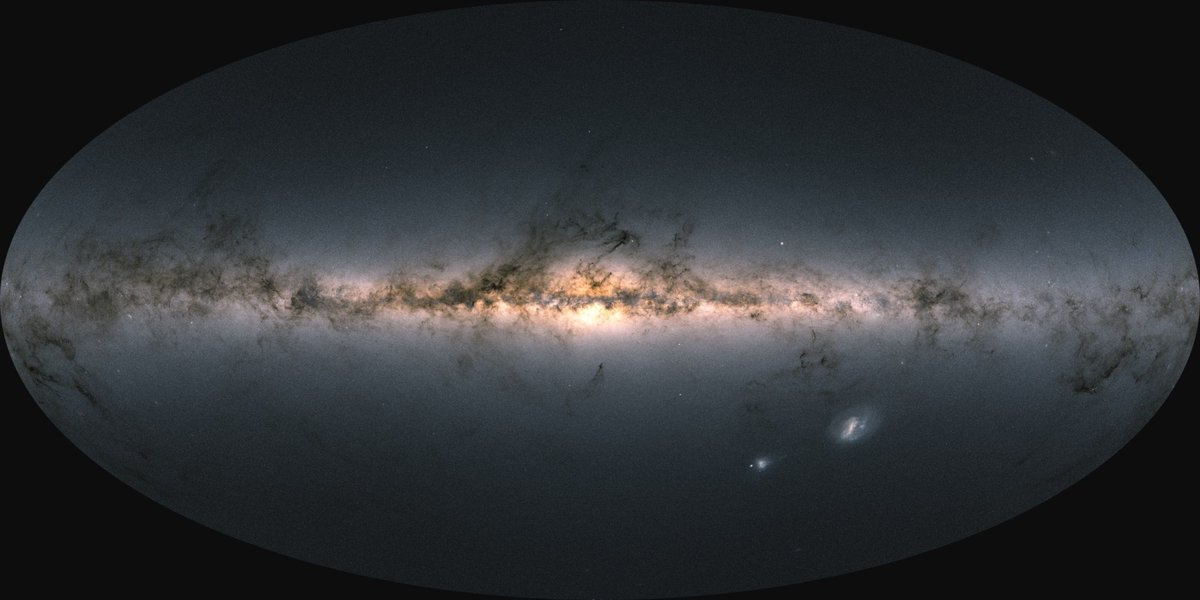
Paper day! A central result from our survey of the Milky Way's outskirts:
"All-Sky Kinematics of the Distant Halo: The Reflex Response to the LMC"
https://t.co/tr3bmmeWHM
One particularly interesting result from Wheeler et al is that surface brightness detection limits can affect dynamical mass estimates pretty significantly - has implications for the use of UDF’s for testing, dark matter models.
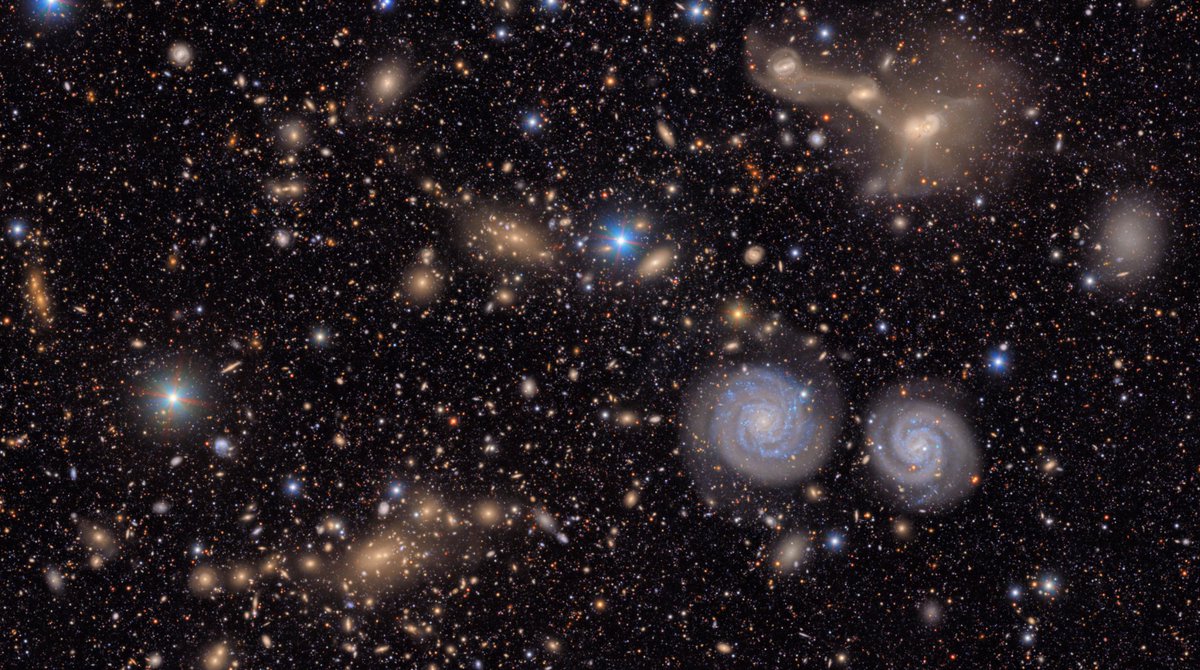
Introducing...your sneak peek at the cosmos captured by @NSF–@doescience Vera C. Rubin Observatory!
Can you guess what regions of sky they are?
This is just a peek...join us at 11am US EDT for your full First Look at how Rubin will #CaptureTheCosmos!
https://t.co/1a74X2edp8
Paper day! We report a compelling candidate for a Pop 3 galaxy! Pop 3 here refers to the very first generation of stars formed out of primordial material left over after the Big Bang. https://t.co/GjzSNPDHib
Northwestern has joined the Giant Magellan Telescope's international consortium 🔭
Launching in the 2030s, @giantmagellan will be the world’s most powerful optical telescope—exploring the distant universe, including the search for Earth-like planets. https://t.co/VG3CCKlQLZ
Exciting news! With support from @KavliFoundation, @RisaWechsler and @suzIQUV are leading the Via Project from KIPAC’s end to develop and deploy new observing equipment for an in-depth study of the Milky Way, from detecting dark matter halos to mapping the cold gas in our galaxy!
The Milky Way contains an extremely long-lived stellar disk component that formed, according to Xiang et al., more than 13 billion years ago. Such longevity is due to the exceptionally quiescent dynamical history of the Galaxy. https://t.co/CUvSPCRFAq
Today on the arXiv: All the Little Things in the Abell 2744 field: ~1600 redshifts measured with our Cycle 2 NIRCam grism program, and much, much more, showcasing the discovery space of this instrument
Among these 1600:
1) An analog of the Milky Way + local group 12.7 Gyr ago
I'm back with another new Milky Way satellite galaxy from the DELVE survey! Introducing Aquarius III: https://t.co/3EYRpW9SMq. We argue it's interesting because of its cold velocity dispersion + orbit which keeps it far from the disk plane --> formed in a very-low-mass DM halo?
The outer halo is made up of many substructures, one of my favourites being the Pisces Plume, part of which could be tentatively associated to the Magellanic stellar stream. PS these are all very metal-poor, [Fe/H]<-2.5. Stay tuned for more updates from our Gemini/GHOST follow-up
Paper summary!!! On Monday, @astrobystrom and I put out this cool work: https://t.co/YP2ZAi40Pi selecting red giants stars out to 100 kpc using the Pristine survey's data release 1 and Gaia XP catalogues. Here is a short summary of this long (sorry!) paper 🥳
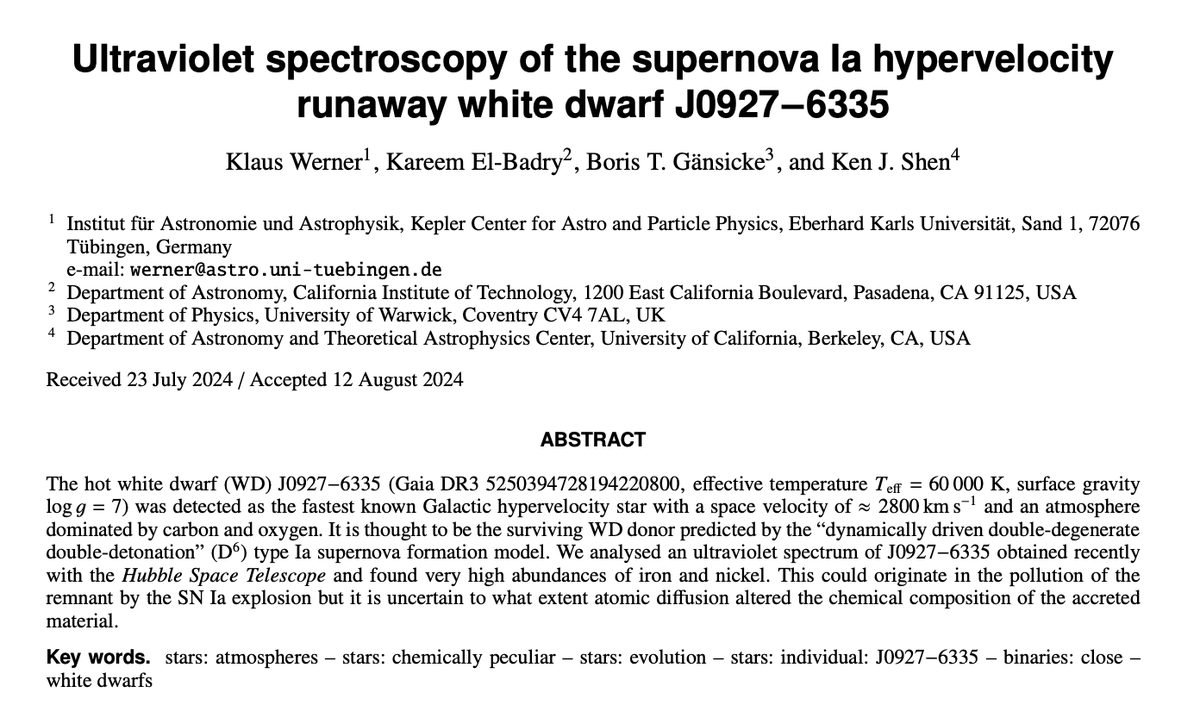
New paper, led by Klaus Werner: we show that the fastest star in the Galaxy, a white dwarf ejected from a type Ia supernova, is strongly enriched in iron and nickel! https://t.co/pZu5L0SRzN 1/n
Ivana Barisic & T. Jones et al. @ucdavis introduce MSA-3D JWST program to produce IFS data cubes for 43 star-forming galaxies at z~1. Aim is to study emergence of thin-disk galaxies. Shown example: a cold, V/sig=8, nearly face-on spiral disk at z=1.
https://t.co/UZTTVTtgta
My new paper is on arxiv! We surveyed ~110K stars and found a metallicity "cliff" in super-Earth formation. This one has been in the works for a while. Check it out here: https://t.co/9tAx5n0W6d
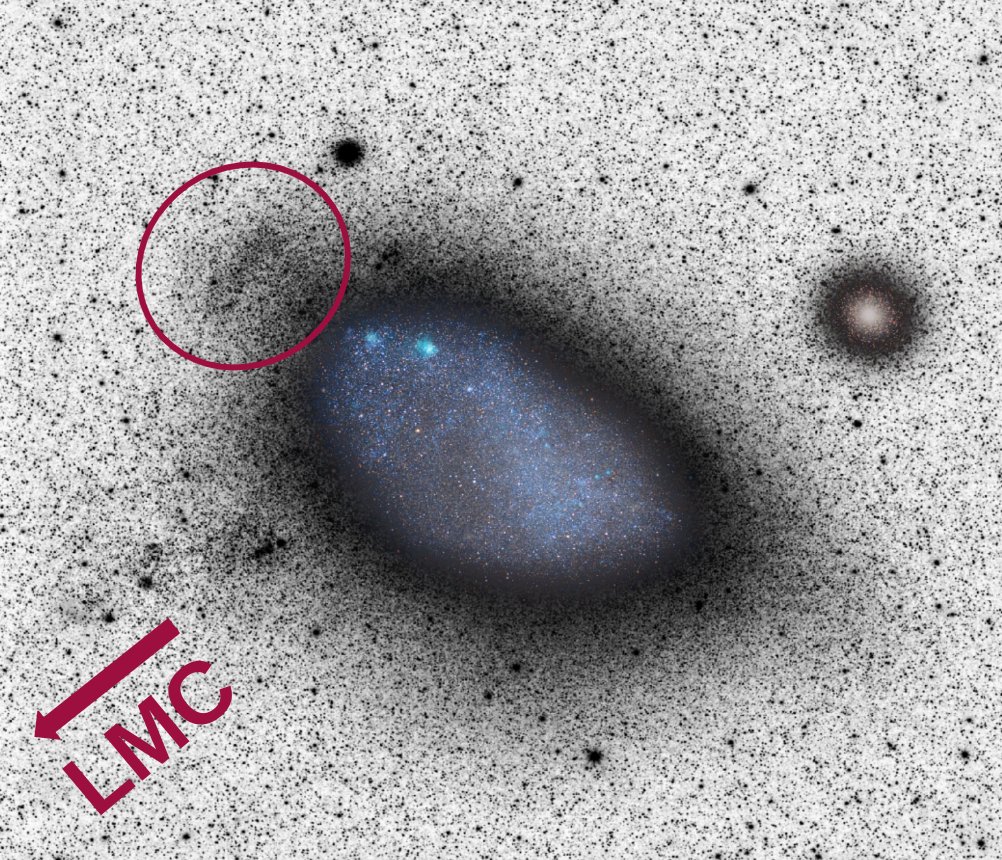
Paper day! https://t.co/VYU1ISine5 We find that the "shell" of young stars in the northeastern SMC formed due to ram pressure stripping as the SMC travelled through 1. the LMC's bowshock and 2. the Milky Way's circumgalactic medium (edited image from @astro_delgad 2019) (1/7)
I'm heading to the outer Milky Way for an #arXivoftheweek: Chandra et al measuring the Milky Way's response to the pull of the Large Magellanic Cloud (https://t.co/BEukV6z9UM) [1/6]
A new paper on the initial mass function (IMF), with Charlie Conroy. Fiddling with the IMF is an attractive way to explain "universe breaking" high z massive galaxies that JWST has found. We try to simultaneously explain observations at low z and high z. https://t.co/jcB8UYoP9R
Beginning in the fall of 2024, Johns Hopkins University will provide tuition-free Medical School for most medical students and expand aid for future nurses and public health pioneers. Learn more: https://t.co/QuBluT7CWo
1/ New paper thread (well, new last week)! We find that most white dwarfs are born ready to explode. They just need something to hit them hard enough, which should happen when they merge with other white dwarfs. Read on for details!
https://t.co/rVAAXNMqRL
Really exciting paper led by @vedantchandra!
The entire Milky Way is traveling towards the Magellanic Clouds! The two tiny blobs on the bottom-right have just arrived, are not so tiny after all, and our whole Galaxy is rising to greet them.


![astroakshara's tweet photo. The outer halo is made up of many substructures, one of my favourites being the Pisces Plume, part of which could be tentatively associated to the Magellanic stellar stream. PS these are all very metal-poor, [Fe/H]<-2.5. Stay tuned for more updates from our Gemini/GHOST follow-up https://t.co/7WfKUXMMCz](https://pbs.twimg.com/media/GWts3H2WEAE2Avk.jpg)












![astroakshara's tweet photo. The outer halo is made up of many substructures, one of my favourites being the Pisces Plume, part of which could be tentatively associated to the Magellanic stellar stream. PS these are all very metal-poor, [Fe/H]<-2.5. Stay tuned for more updates from our Gemini/GHOST follow-up https://t.co/7WfKUXMMCz](https://pbs.twimg.com/media/GWts3H4XMAAzDby.jpg)

![McMillan_Astro's tweet photo. I'm heading to the outer Milky Way for an #arXivoftheweek: Chandra et al measuring the Milky Way's response to the pull of the Large Magellanic Cloud (https://t.co/BEukV6z9UM) [1/6] https://t.co/obv3EOZTKD](https://pbs.twimg.com/media/GSS6kzuWQAAO2TP.jpg)